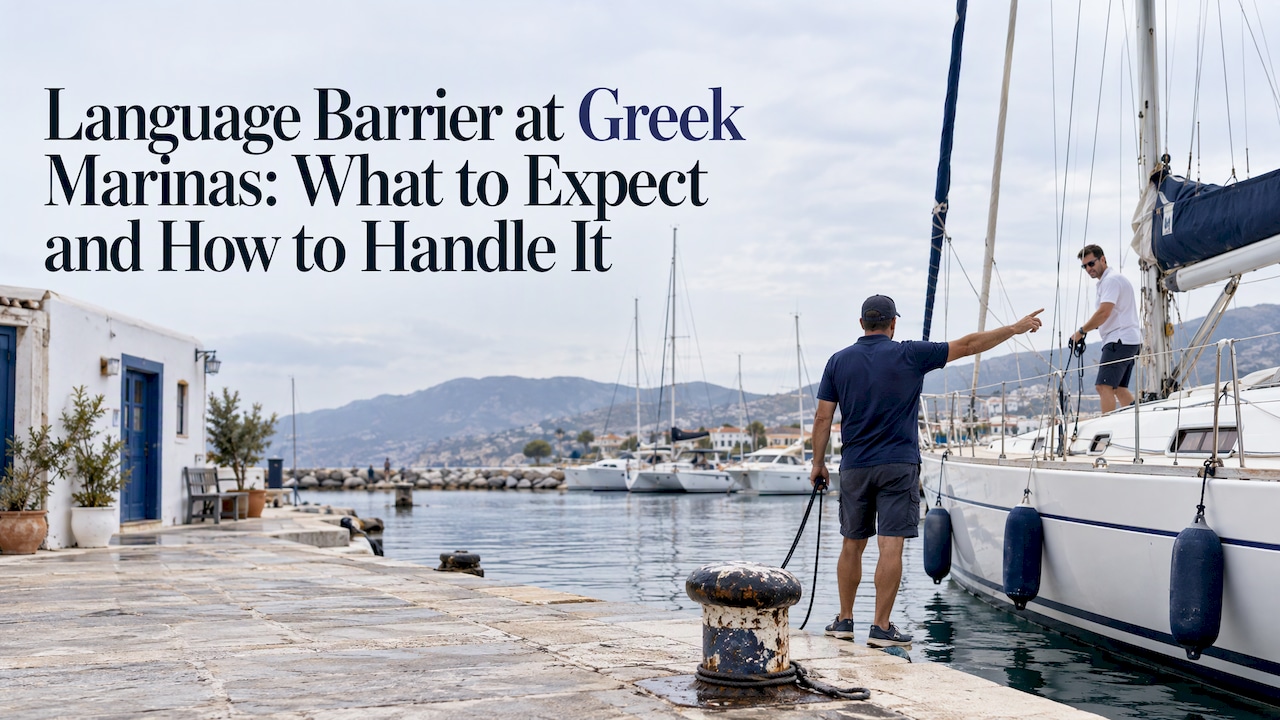
The language barrier at Greek marinas is smaller than most first-time charter guests fear. English is widely spoken along the coast and on the islands. The real friction is elsewhere: Greek-only signs, a crackly VHF call, a quay hand shouting instructions over engine noise, and a pile of forms. Handle those four and you can forget about the language. Sailing with people who do this every week takes most of the worry off your plate too.
This guide is for groups of friends, families and first-time charterers heading to Greece. It covers what you will actually hear at the dock, the few Greek words worth learning, and how to avoid the misunderstandings that cause stress at arrival time.
TL;DR
- English is widely used in Greek tourism, marinas and island harbors. A handful of Greek words is a courtesy, not a survival requirement.
- The trouble spots are Greek-only signage, VHF calls, mooring instructions shouted from the quay and paperwork. Prepare for those, not for conversation.
- Repeat back every berth number and approach instruction, and never nod along when you have not understood.
- Learn the Greek alphabet basics and keep one offline note with your boat details and marina contacts.
- A skippered holiday with a curated route means you are never working it all out alone.
Tabla de Contenidos
- How much English will you actually hear?
- Where misunderstandings really happen
- What the marina rules say about communication
- Arriving at a marina: a simple five-step routine
- Using the VHF when you do not understand
- Greek words worth learning (and the yes/no trap)
- Small harbors and town quays
- One offline note for the whole crew
- Our view: the language barrier is a planning problem
- Sail Greece with people who know the harbors
- Preguntas frecuentes
- Fuentes
How much English will you actually hear?
More than you expect. A UK government travel leaflet for Greece states that English is widely spoken, and that matches what charter guests report on the big sailing routes: Athens and the Saronic Gulf, the Ionian, the Cyclades and the Dodecanese.
Marinas that serve visiting yachts make a point of it. The Greek Marinas Association directory, for example, lists Leros Marina’s facilities as including experienced staff speaking English and French, along with 220 floating berths and 24-hour security. Staff at organized marinas deal with foreign crews every day, so you will usually get a clear answer to a plain question in English.
A few places are different. Small town quays, remote mainland villages and a harbor on a quiet day in shoulder season may put you in front of someone whose English is limited. That is where a smile and five Greek words do real work.
Where misunderstandings really happen
When charter guests tell stories about a bad arrival, the cause is rarely a lack of conversation. It is almost always one of these.
Greek signage
Most signs in Greek ports are in Greek. A cruising guide from the Cruising Club of America makes this point directly: because most signage is in Greek, knowing the Greek alphabet helps you translate place names, such as a taverna someone recommended, back and forth between English and Greek. You do not need to speak Greek. Learning to sound out the letters on a harbor sign or a menu is a one-evening job, and it makes every town feel less foreign.
A useful first word: limani (λιμάνι) means port or harbor, and you will see it everywhere.
Instructions from the quay
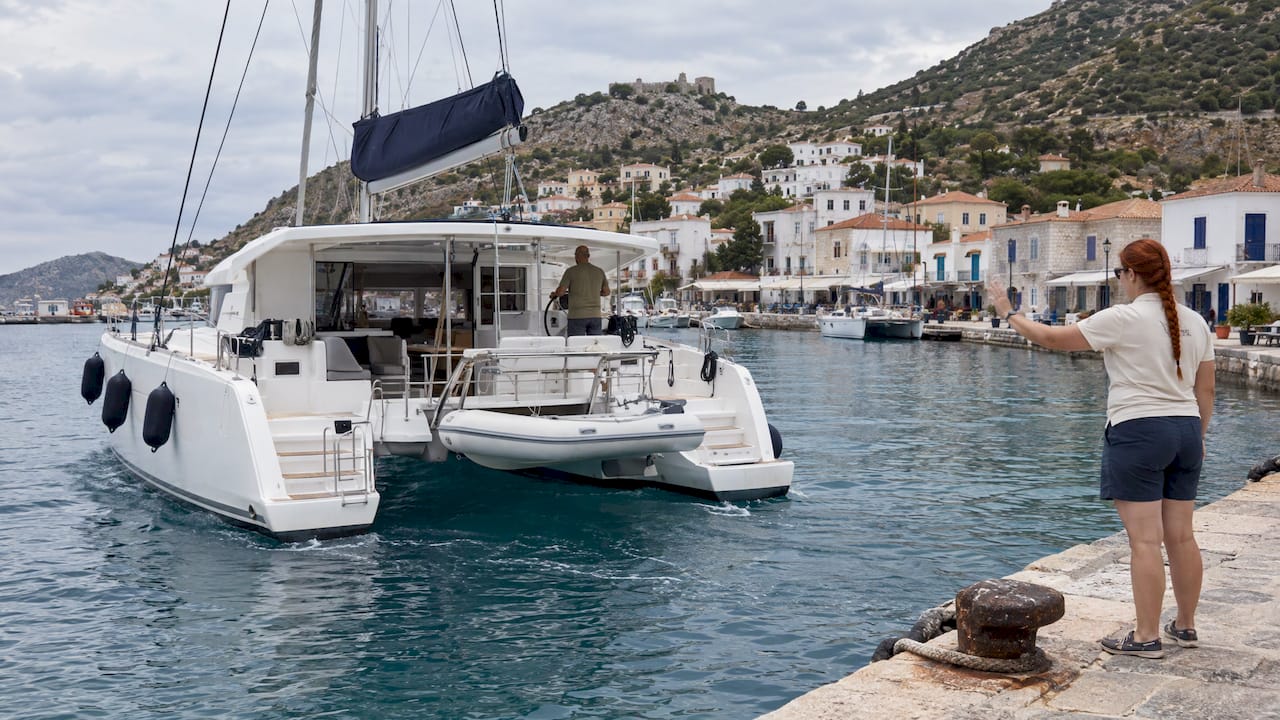
You are approaching a stern-to berth, the wind is picking up, and someone on the quay is gesturing and calling out in half-English. This is the most common stressful moment of a Greek week, and it is about mooring more than language. Our guide to anchoring and docking etiquette in Greece covers the unwritten rules, and the sailing terms every beginner should know will help you follow what your crew shouts back and forth.
The radio
VHF is the channel where accents, engine noise and rushed speech stack up. We come back to it in its own section below.
Paperwork
Arrival in Greece comes with forms, and officials expect original documents. That is a procedure issue, not a vocabulary one, but it feels like a language problem when a form is in Greek. More on that in a moment.
What the marina rules say about communication
The General Rules of Greek Marinas, the regulation that organized tourist marinas follow, are published in English by Alimos Marina. Three points matter for visitors.
- Contact before you enter. A vessel entering a marina’s sea area must give its details to the managing body by any appropriate means, wait for permission to enter, and follow staff instructions for mooring. “Any appropriate means” means VHF, phone, or a call from the entrance.
- Paperwork is on the captain. The owner-captain fills in the forms the marina provides and presents the original vessel documents, such as the seaworthiness and safety certificates.
- Berthing remains the captain’s responsibility. Even when staff or a launch assist, the same rules put the berthing at the designated berth on the captain.
The same rules also require emergency instructions to be posted in Greek and at least one other official EU language, so safety information at a marina is not Greek-only.
For the check-in side of a charter, including the transit log and the TEPAI cruising fee, see our step-by-step guide to Greek yacht check-in in 90 minutes. Greek rules for skippers, from port fines to documents, are in practical Greece sailing regulations.
Arriving at a marina: a simple five-step routine
Whether you are on a catamaran with six friends or a family monohull, this routine takes most of the confusion out of the dock.
- Call ahead. Contact the marina on the VHF channel in your guide or by phone, give your boat name, length, beam and arrival time in plain English, and ask for a berth. Speak slowly. Greek marina staff hear this call every day.
- Ask three questions. Which berth are we on, where do we wait if it is not ready, and who do we call after hours? Asking if the allocated berth might change before you arrive saves a lot of circling.
- Brief the crew. Decide in advance who talks to the marina and who handles lines. One voice on the radio and one on the quay beats five people shouting.
- Repeat the instruction. When the marina gives you a berth, read it back: berth number, approach direction, which side your lines go to, and any depth or width limit. If it is not right, they will correct you before you turn into the wrong fairway.
- Present the paperwork. Have original documents, crew list and insurance details together in a folder and an offline note on your phone, so a weak mobile signal does not leave you stuck.
Bookings matter too. Greek marinas fill up in summer, and arriving without a confirmed berth is the quickest way to turn a language issue into an argument. Our guide to three confirmations that secure Greek marina reservations for family groups explains what to have in writing, and if your week starts near Athens, the Athens marina guide shows which marinas to book for June to August.
Using the VHF when you do not understand
The VHF is a marine radio, and in Greece it is how marinas, harbormasters and the Coast Guard talk to boats. Standard English is used on it, but accents and static can make it hard. Bluewater Bound’s guide to calling a harbormaster suggests a few habits that work anywhere, and they work well in Greece:
- Ask for long instructions one section at a time and write them down.
- Read back the critical items: berth number, approach direction, side-to, depth limits.
- Use the phonetic alphabet for numbers and letters, for example ‘Charlie One Four’.
- Never pretend to understand.
The same author explains why read-backs matter: a rushed operator, an unfamiliar accent, engine noise and an unknown place name make it easy to hear what you expected rather than what was said.
Weather is a good example of Greek and English sharing the airwaves. According to the CCA’s Ionian cruise guide, VHF weather announcements in Greek waters are made in Greek and English on Channel 16 at 0600, 1000, 1600 and 2200 UTC, with the Greek broadcast first and the English second. They direct listeners to working channels, Channel 02 in the northern Ionian and Channel 27 further south. The same guide notes that Olympia Radio, based in Piraeus, coordinates search and rescue on Channels 03 and 16, and the Coast Guard on Channel 12. The guide dates from 2015, so confirm the schedule in a current pilot book or with the harbormaster for your area.
In an emergency, use the standard distress procedure on Channel 16 in English. Do not waste time searching for Greek words.
Greek words worth learning (and the yes/no trap)
You do not need a phrasebook’s worth. Five phrases cover almost everything, and Greeks notice and appreciate the effort. Here is a short list drawn from a Greek island tourism page and a language guide.
| English | Greek | How it sounds |
|---|---|---|
| Hello | Γειά σου | YAH-soo |
| Thank you | Ευχαριστώ | ef-kha-ree-STO |
| Please / you’re welcome | Παρακαλώ | para-ka-LO |
| Do you speak English? | Μιλάτε αγγλικά; | mi-LA-te an-gli-KA |
| I don’t understand | Δεν καταλαβαίνω | then ka-ta-la-VE-no |
| The bill, please | Τον λογαριασμό, παρακαλώ | ton lo-ga-ree-a-SMO, para-ka-LO |
| How do I get to the port? | Πώς πάω στο λιμάνι; | pos PA-o sto lee-MA-nee |
The pronunciations come from Discover Cyclades’ phrase page. Add three emergency words from the UK government leaflet: ambulance is asthenoforo, doctor is yiatros, and firemen are pyrosvestes.
There is one trap. The Greek word for yes, ναι, is pronounced ‘ne’, which sounds like the English ‘no’. Preply’s guide to Greek travel phrases flags this mix-up and suggests speaking slowly and smiling when you switch to English, since attitude matters more than perfect pronunciation. On a dock, this means: when a staff member says what sounds like ‘no’ while nodding, check the point again before you act. A repeated question, ‘So I take berth twelve, yes?’, settles it.
One more habit comes from general travel advice. Packzup’s 2026 country guide rates Greece as widely spoken for English and suggests that if someone does not follow you, speak slower rather than louder and use numbers and pointing. A dock is a good place for that: point at the berth number and say it.
Small harbors and town quays
Greece has far more town quays than organized marinas, and this is where sailing life gets charming and a little less predictable. Quay-side staff may be a harbor official, a taverna owner or a fisherman. Your Greek will rarely be tested, but three habits help:
- Ask, then show. Gesture at the spot you hope to take and ask if it is free before you commit.
- Respect what is already there. Fishing boats and ferries have priority and often leave early. A quick word with a neighbor about timing avoids a 6 a.m. surprise.
- Be easy to read. Fenders and lines ready on the right side, and a friendly wave, signal competence in any language.
If you own a boat and keep it in Greece, you will also talk with yard staff about haul-outs and maintenance, and reading up on saltwater protection for your boat gives you the vocabulary for those conversations.
Once the boat is tied up, the best of Greece begins. Our list of Greek tavernas you can reach by boat is a good excuse to use your new phrases. Ordering food is the friendliest way to practice.
One offline note for the whole crew
The most useful tool is boring: a single note on every phone. A marina arrival checklist from an Australian marina directory suggests keeping the booking confirmation, proposed berth, office contact and opening hours, and instructions together with your vessel dimensions and insurance details. Add the VHF channels, the harbormaster’s number for each port on your route, and the Greek spelling of each harbor name, copied from a chart or a guide. That last item makes it easy to ask a taxi driver or show a sign to a local.
If you travel as a group of friends, share it before departure so that more than one person can answer if the marina calls.
Our view: the language barrier is a planning problem
We spend our time with sailors, so we hear this worry often: will we cope in Greece if we do not speak Greek? Our honest answer is yes, and it is not close.
What makes a week smooth is the route and the preparation, not the vocabulary. Our routes are curated by experienced, professionally trained skippers from CAPETAN.club, who know which harbors suit a group, where the quays are friendly and where you want to book ahead. That is why we put the route first and the boat second.
We also think you should never feel alone with the logistics. You get personalized support from actual sailors at every step, from choosing a yacht or catamaran to understanding what happens at check-in. If you want the freedom of a private charter with a helping hand, or the company of a group week, the language of the dock becomes something you pick up on the way, along with a tan.
Learn the alphabet, say ‘efharisto’, smile, and repeat your berth number. The rest is sunshine.
Sail
Sail Greece with people who know the harbors
If you want to see the islands without being the one who has to work out every arrival alone, our private Greece week is built for families and groups of friends. You choose the yacht or catamaran and the departure date, and the route is curated by experienced skippers. Greece, Go Private starts from €560 per week per person.
Prefer company? Our Vacaciones en grupo con navegación let you join a week with other travelers, and you can read more about Vacaciones en vela en Grecia before you decide.
Preguntas frecuentes
Do I need to speak Greek to use a marina in Greece?
No. English is widely spoken in Greek tourism, and organized marinas are used to foreign crews. Some island marinas, such as Leros, list English-speaking staff among their services. Learning five phrases is a courtesy that helps most on small town quays.
What language is used on the VHF in Greece?
Calls to marinas and the Coast Guard can be made in English, and weather announcements on Channel 16 are given in Greek first and then in English. If you do not catch an instruction, ask for it in short sections, write it down and read it back.
Are signs and documents in Greek only?
Many signs are in Greek, so basic knowledge of the Greek alphabet helps you read place names. Marina rules require emergency instructions in Greek and at least one other official EU language. The forms you fill in at arrival are explained by staff, and you present original vessel documents.
What should I do if I cannot understand a marina instruction?
Say so, in plain English: ‘Please repeat, I don’t understand.’ Ask for the berth number and approach direction, write them down, and read them back. Never guess, and avoid manoeuvring until the instruction is confirmed.
Is yes or no confusing in Greek?
Yes, a little. The Greek word for yes, ne, sounds like the English no. If a reply is unclear, restate your question in full and confirm the answer with the berth number or a gesture.
Fuentes
- Holidaying in Greece, UK government leaflet
- Greek Marinas Association directory
- General Rules of Greek Marinas
- CCA Ionian Islands Cruise guide
- How to call a harbormaster or marina by VHF
- Greek phrases for the Cyclades
- Greek travel phrases
- Do They Speak English? Traveler’s Guide by Country