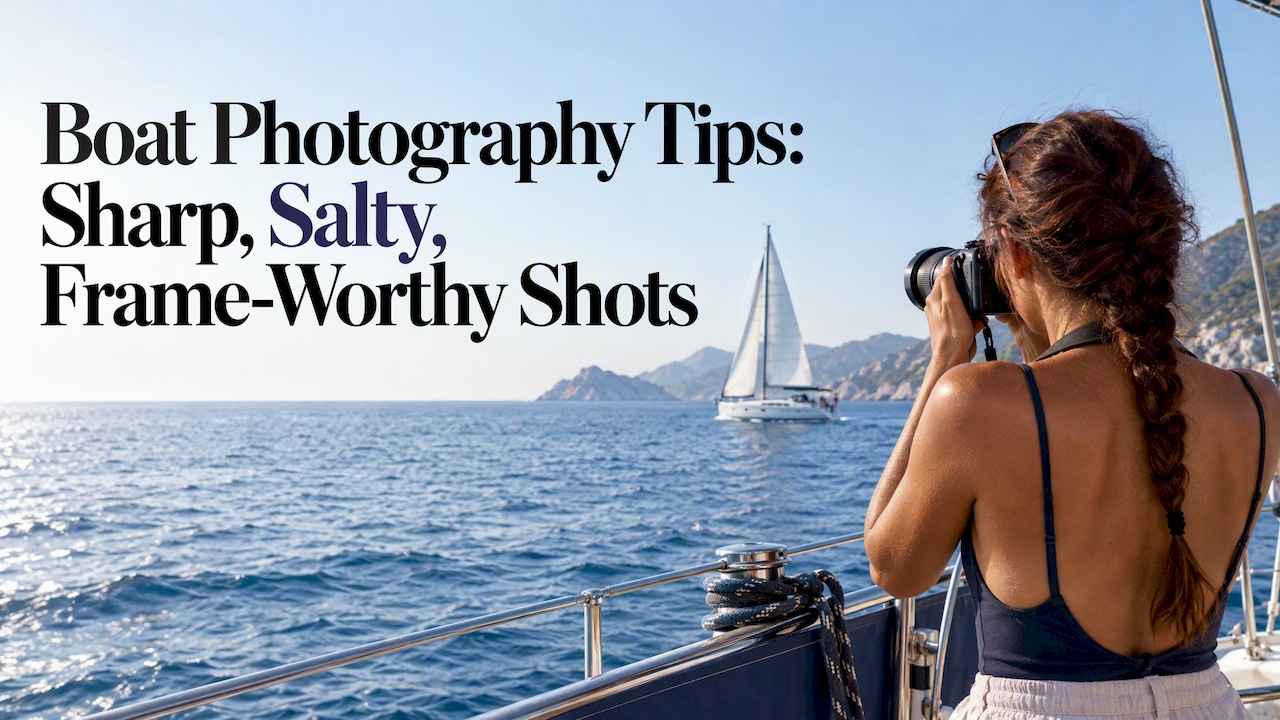
The short version: on a boat, everything moves, so you win by keeping your shutter speed fast, shooting in bursts, protecting your gear from water, and using the golden hours for light. Do those four things and your holiday photos go from “nice, I guess” to the ones your friends ask you to send right away.
We spend our summers on catamarans and sailing yachts in Greece and around the Mediterranean, so we have seen every way a camera can fail at sea: blurred sunsets, a phone sliding across a salty cockpit, a hundred near-identical shots with the horizon tilted. This guide gathers what works, backed by experienced photographers, and adapts it for a sailing week with friends or family.
TL;DR
- Keep your shutter speed high (around 1/1000s for sharp handheld shots) and accept a higher ISO to get it.
- Shoot in burst mode and take the same composition several times. The sea never holds still.
- Keep gear in a dry bag between shots and always wear a strap. Salt and one surprise wake are your two biggest enemies.
- Don’t brace against railings or the hull. Engine vibration travels right into your camera.
- Shoot the soft light early and late, and photograph people actually sailing, not only posed shots.
Tabla de Contenidos
- Why photographing from a boat is different
- Protect your gear first
- The settings that matter at sea
- How to hold the camera on a moving boat
- Composition: make the boat look like a boat
- Light, time of day and where to be
- Phone or camera?
- Shoot for the story of the week
- Our perspective: the best photographer on board is the one who is relaxed
- Where to go for the best photos
- A quick pre-trip photo checklist
- Preguntas frecuentes
- Fuentes
Why photographing from a boat is different
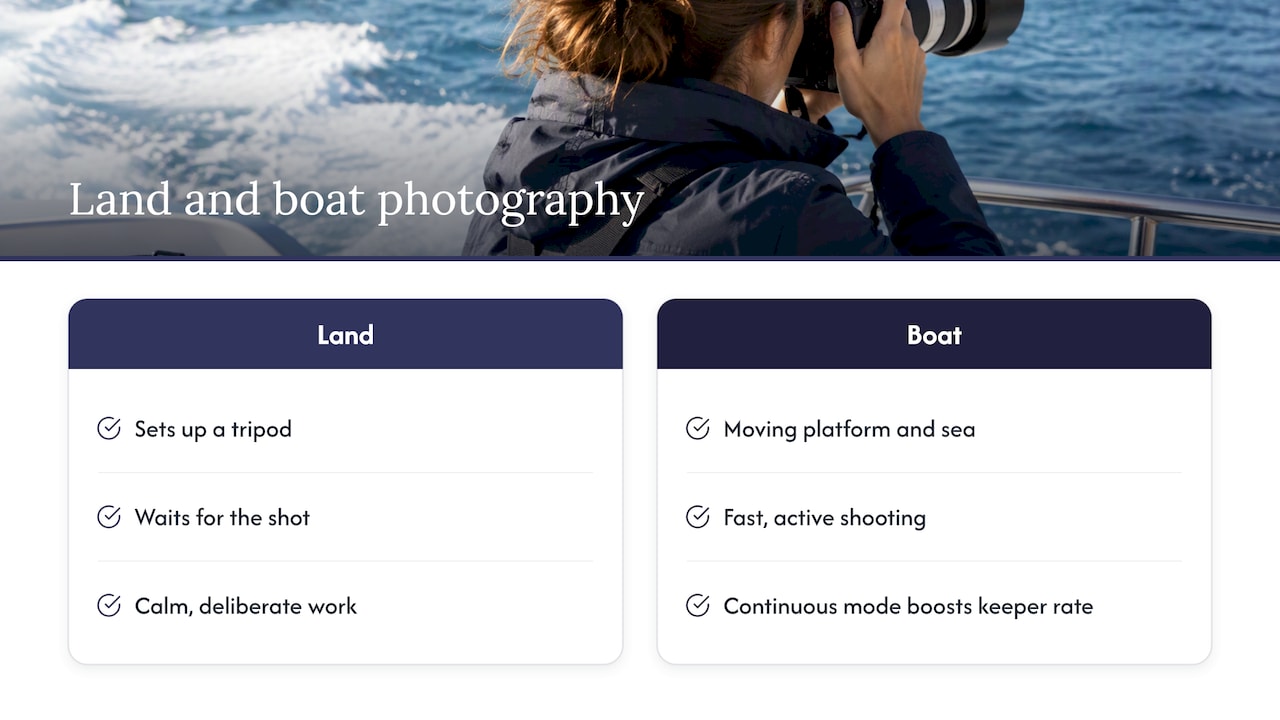
On land, a landscape photographer sets up a tripod and waits. On a boat, you are standing on a moving platform, on top of a moving sea, often pointing a lens at another moving object. Professional photographer Jeroen Van Nieuwenhove, in his guide to photographing from a boat or ship, describes the shift in mindset: you move from calm, deliberate landscape work to fast, active shooting where continuous mode increases your “keeper rate”.
That is good news for a holiday. You do not need a pro kit. You need a few habits, and you need to build them before the best light of the day arrives. Practice on the first afternoon, when you are still tied up in the marina or motoring out, and you will be ready when the dolphins or the sunset show up.
Protect your gear first
Before any setting matters, your camera has to survive the trip. Salt spray, splashes and sand are tough on electronics, and boats have a way of throwing surprises at you.
El Discover Boating guide calls this the “dry first” rule: keep cameras in a waterproof dry bag whenever you are not actively shooting, ideally stowed below deck or under a console between shots. It also recommends a wrist or neck strap at all times, because even a small, unexpected wake can knock gear out of your hands.
On a sailing holiday, that translates into a simple routine:
- Keep one small dry bag in the cockpit for camera, phone and a microfiber cloth.
- Put the strap on your wrist or around your neck before you lift the camera out of the bag, not after.
- Wipe the front of the lens with a clean cloth every so often. A dried salt film makes photos look hazy and you will blame the camera.
- Never change lenses in the open cockpit with spray in the air. Do it inside the saloon, or in the shelter of the cabin.
- Bring a rain cover if the forecast is even slightly unsettled. Photographer Tom Bol also suggests one in his notes on photographing from boats.
For phones, a slim waterproof case with a lanyard is cheap insurance. Check your packing list as well: our sailing trip checklist covers what else to bring so you are not improvising at the dock.
The settings that matter at sea
You do not need to master the whole exposure triangle to get good boat photos, but it helps to know what you are trading. Exposure is the balance of shutter speed, aperture and ISO, and, as Classic Boat magazine explains, understanding it is what moves you to the next level. Here is how that plays out on the water.
Shutter speed comes first
The boat rocks, the engine hums, and your hands move. The JVN guide recommends a shutter speed of at least 1/1000s for sharp, frozen handheld shots, even in bright light. If you want artistic motion blur, you can go as slow as 1/60s, but only on very calm water.
In practice: put your camera in shutter priority, or manual with auto ISO, set 1/1000s, and only slow down when you have a deliberate reason.
Let your ISO climb
Most people fear high ISO and end up with blurry photos instead. The same photographer says not to be afraid of it: modern noise reduction makes images shot at ISO 12,800 perfectly usable. A slightly grainy sharp photo beats a clean blurry one every time.
Burst mode and repetition
Turn on continuous shooting and photograph the same composition several times. A wave lifts the bow, a sail flutters, a friend blinks. Out of ten frames, two are great. The rest are the price of admission, and storage is cheap.
Turn on stabilization
If your lens or camera body has image stabilization, switch it on. Keep an eye on the horizon too: a tilted horizon is the most common giveaway of a boat photo taken in a hurry. Most cameras and phones can show a grid or a level indicator. Use it.
| Situación | Suggested approach |
|---|---|
| Sharp action shot, moving boat | Shutter 1/1000s or faster, burst mode, ISO as high as needed |
| Calm anchorage, artistic blur | 1/60s or slower, only on very calm water, both feet planted |
| Cabin interior or dim saloon | Higher ISO, steady your elbows on a table, take several frames |
| Sunset | Burst mode, check horizon grid, expose for the sky |
How to hold the camera on a moving boat
This one surprises people. Your instinct is to lean against a railing or the hull to steady yourself. Don’t. According to the JVN guide, engine vibrations travel through the boat’s structure and into your body, often blurring shots more than the boat’s movement does. Instead, keep your arms tucked close to your torso and let your body act as a shock absorber.
A few more habits that help:
- Bend your knees slightly and move with the boat, like surfing a small wave.
- Breathe out as you press the shutter.
- Brace yourself with your feet, not your elbows against hard surfaces.
- Stay safe first. A photograph is never worth a fall, so keep one hand for the boat when you move around, and never stand at the edge to get a shot.
That last point matters for composition too. The Discover Boating guide suggests going low, at deck level or below, never at the edge, to make the water and wake feel larger and more alive. Sitting in the cockpit with your lens just above the waterline of the stern often gives you a more dramatic frame than standing.
Composition: make the boat look like a boat
The rule of thirds is still a solid starting point. Place the horizon on the upper or lower third line instead of dead center, and put your subject, a sail, a person, a rocky islet, on one of the intersections. The U.S. National Park Service photography guide uses the rule of thirds as a basic composition tool for any camera. Then break it when something feels more dynamic.
Use lines and wide angles
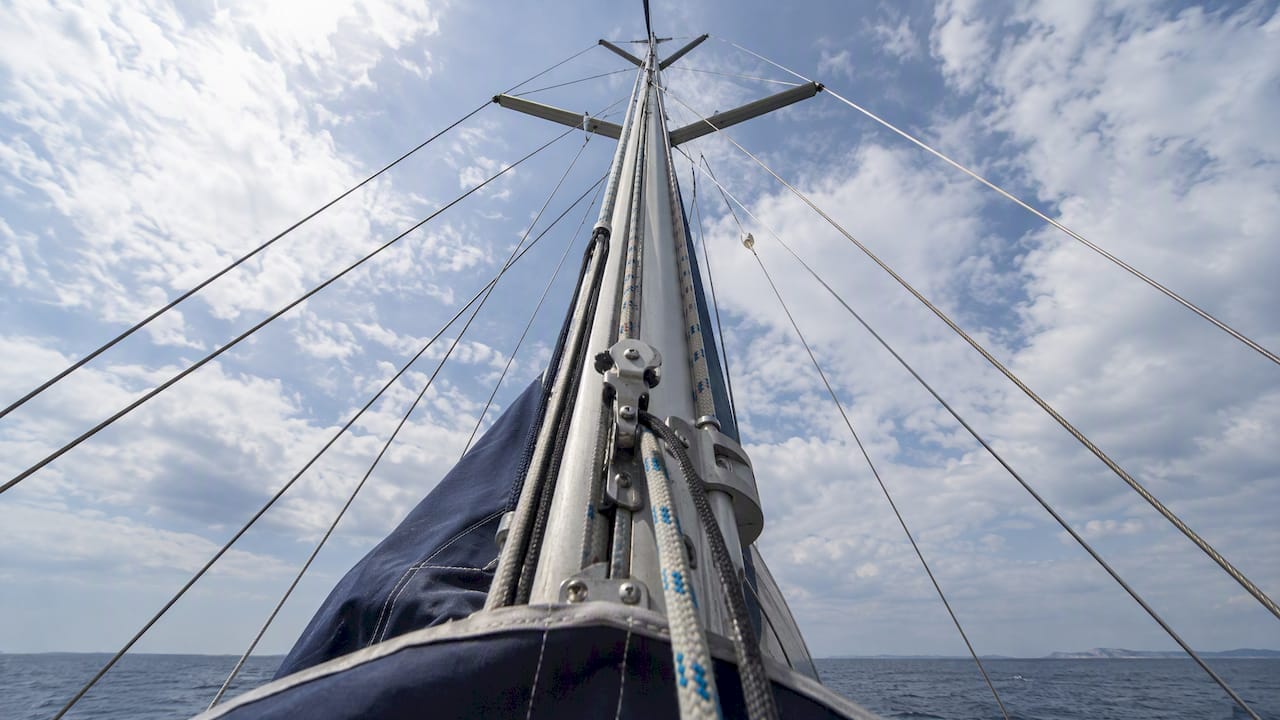
For seascapes, a wide-angle lens is perfect for capturing the vastness of the scene. The Sailing Photo Awards guide to Greek seascapes also recommends using lines in the scene, such as waves, masts and rigging, to lead the viewer’s eye to your subject. Rigging is a gift for this: stand at the foot of the mast and look up, and you have instant leading lines against the sky.
Shoot other boats from the side
If a friend’s boat or another sailing yacht sails past and you have a telephoto lens, stay abeam, meaning off to the side. Yachting Monthly notes that telephoto compression can make a boat look dumpy when shot from directly ahead or behind, while the beam view shows the elegant lines of a sailboat or catamaran.
Photograph people, not just scenery
The same magazine points out that people actively sailing make great pictures, not just posed shots looking into the camera. Catch the helmsperson squinting at the sail trim, someone coiling a rope, a kid on the trampoline of the catamaran with wet hair and a huge grin. Those are the shots that bring a week back in ten years.
Details tell the story
A prime lens with a wide aperture is handy for close-ups of details: a rope loop, a sun-bleached fender, a cup of coffee on the cockpit table at sunrise. You will not take dozens of these, but they pull a photo album together.
Light, time of day and where to be
Mid-day light in the Mediterranean is hard and bright, with deep shadows and glare off the water. A polarizing filter helps, reducing reflections on the water and paintwork, as photography guides for seaside boating often suggest. Even without one, you can work around it: shoot with the sun behind you for saturated blues, or lean into silhouettes.
The best light comes early and late. On a sailing holiday, you are positioned perfectly for that, because your hotel is the boat. Wake up before the others, step into the cockpit with a coffee, and the anchorage is usually glassy and quiet. In the evening, the sun drops behind the nearest island while you are already sitting at anchor with a drink, no sprint to a viewpoint required.
Some tips for planning your frames:
- Sunrise in the anchorage: Calm water makes reflections and the best moment for slow shutter creativity, if you can brace the camera on a solid surface.
- Under sail, mid-morning: Wind and spray, so settle your settings in advance, then shoot sails against the sky.
- Arriving in a harbor: Whitewashed houses, colorful fishing boats and narrow lanes. Snap them while you tie up, since the light moves quickly.
- Swim stop: Keep your camera dry and take photos from the swim platform, low and close to the water.
Phone or camera?
For most people on a sailing week, the phone is the camera you will actually carry. It is small, it fits in a pocket, and today’s models handle bright light and burst shooting well. The same principles apply: use burst, keep the horizon level, wipe the lens, and lock exposure by tapping on the sky if the screen is washed out.
If you have a dedicated camera, a mid-range zoom covers 90% of your needs. Add a longer lens (80 to 200 mm is a common range) if you want to catch details on faraway boats. Bring one prime lens for close-up details if you like. Do not take your whole bag. On a boat with six or eight people sharing cabins and lockers, a compact kit wins.
Shoot for the story of the week
A good set of photos from a sailing holiday is less about technique and more about coverage. Think of the week like a short film and capture the beats:
- Arrival and boarding: the boat, the marina, bags piled on the pier.
- Briefing and first sail: nervous grins, skipper pointing at the chart.
- Daily life: breakfast in the cockpit, swimming, snorkeling, cooking together.
- Landscapes: the islands you visited, from the water and from the shore.
- Evenings: tavernas, sunsets, the whole crew around one table.
- Last morning: the tidy boat, empty glasses, the one group photo you forgot to take earlier.
Want to see what a typical day looks like before you plan your frames? Our post about a regular day on a sailing holiday walks through it.
Our perspective: the best photographer on board is the one who is relaxed
We talk to a lot of guests after their week, and the pattern is always the same. The photos people love most are not the most technical. They are the ones taken when everyone had stopped checking their watch: someone laughing at the helm, a child asleep on a sail bag, the anchorage lit pink at 7 p.m.
That is why we design our routes with slow mornings and short sailing legs. Our skippers, trained professionals from CAPETAN.club, know the anchorages where the light is best and the water is calmest, and they will happily tell you when to be on deck. Ask them. They also know when to hold the helm so you can take that one shot of the whole crew under sail.
Our honest advice is to give yourself a rule: the first hour of sailing each day is for photos, and the rest of the day is for living. Put the camera in the dry bag, clip it down, and join the swim.
— Sail
Where to go for the best photos
The Aegean is a photographer’s dream, with white Cycladic villages, turquoise coves and strong afternoon light. If you are planning a private trip with friends or family, our Greece private sailing week starts from 560 € per week per person, and you choose the boat and the route with your skipper’s guidance. Prefer to travel with others? Browse our Vacaciones en grupo con navegación for set routes and departure dates, whether you are traveling solo or with a small party.
Not sure which style suits you? Our guide to private or group sailing holidays breaks it down, and our step-by-step holiday guide for families and friends helps with the planning.
A quick pre-trip photo checklist
Before you leave, run through this list:
- Charge batteries and bring a power bank or a charger for the boat’s sockets.
- Clear space on your memory cards and phone.
- Pack a dry bag, a lens cloth, a wrist strap and a rain cover.
- Check that your camera’s grid or level display is on.
- Test your burst mode and shutter priority on land for ten minutes.
- Agree with your crew when you want a group photo, ideally before the first drink.
Preguntas frecuentes
How do I take good pictures on a boat?
Use a fast shutter speed, around 1/1000s for sharp handheld images, and let ISO rise as needed. Shoot in burst mode, keep the horizon level, and avoid leaning on railings, because engine vibrations will blur your photo. Protect your gear with a dry bag and a strap.
What is the best time of day to photograph from a sailing boat?
Early morning and the last hours before sunset give soft, warm light and often calmer water at anchor. Mid-day is harsher, so use it for action shots, swimming photos and details, and consider a polarizing filter to cut glare.
What lens should I bring on a sailing holiday?
A wide-angle or standard zoom covers most needs, from the cockpit to the landscapes. If you want to photograph other boats from a distance, add a longer lens such as an 80 to 200 mm, and shoot from the side rather than head-on.
Is it safe to take photos while the boat is moving?
Yes, as long as you stay low, keep one hand for the boat when moving around and never stand at the edge to get a shot. Wear your camera strap, and listen to your skipper about where to stand when the boat is heeling.
Fuentes
- Getting The Best Results When Photographing From A Boat Or Ship, Jeroen Van Nieuwenhove
- How to Take a Great Photo on a Boat, Discover Boating
- Boat photos: how to take an amazing shot of your yacht, Yachting Monthly
- How to Capture Stunning Photos of Seascapes and Yachts from Greece, Sailing Photo Awards
- How to take photos at sea, Classic Boat Magazine
- Beginner’s Photography Guide, U.S. National Park Service