
The best group sailing games are the ones that fit a moving boat: few loose pieces, no running on deck, and a skipper who has said yes. Think a pencil-and-paper quiz at anchor, a “name that knot” contest, a swim-ashore treasure hunt, or a friendly tacking challenge with the whole crew on the lines. Below you will find games sorted by moment (sailing, anchored, evening, rainy day), tips for mixed groups of ages and personalities, and the safety ground rules that keep the fun from turning into a story nobody wants to tell.
TL;DR
- Pick games by moment: wind-and-sail games while underway, low-gear games at anchor, cards and quizzes for the evening.
- Anything that moves the boat or crowds the deck needs the skipper’s approval first. In Greece, the skipper and local conditions decide, not a list online.
- The best games make people handle the boat, talk to each other and notice the wind, rather than just burn energy.
- Pack waterproof cards and compact games with few pieces. Skip water balloons, squirt guns and standing on deck while moving.
- Mixed groups bond fastest with team games where everyone has a role, and a short debrief afterward.
Tabla de Contenidos
- Why games work so well on a sailing week
- 1. Ground rules before anyone plays
- 2. Games while you are sailing
- 3. Games at anchor
- 4. Evening and rainy-day games
- 5. Mixed groups: ages, personalities and the quiet ones
- 6. What about kids and teens?
- 7. Games to leave on land
- 8. Our perspective
- 9. Ready to try it with your crew?
- Preguntas frecuentes
- Fuentes
Why games work so well on a sailing week
A week on a boat gives you something rare: nobody has anywhere to be. No commute, no dinner reservations, just sea views 24/7 and a group of people sharing a very pleasant, very small floating living room. That is wonderful, and it is also exactly when a little structure helps. Games break the ice between friends of friends, give teenagers a reason to look up from their phones, and turn the long, lazy hours between one cove and the next into shared memories.
There is a second reason, and it comes from sailing instruction. Yachting New Zealand’s Sailing Games Book collects 40 games meant to make learn-to-sail sessions more fun while building skills and knowledge. The lesson for a holiday crew: the games people remember are the ones that get everyone steering, communicating and reading the wind, not the ones that just create the most noise.
1. Ground rules before anyone plays
Let’s get the unglamorous part out of the way, because it is what makes everything else possible.
- Ask the skipper first. Every boat, wind and anchorage is different. Greek water-sports safety guidance supports a cautious approach: games should not interfere with navigation, swimming zones or visibility. The skipper decides what is appropriate that day.
- One skill at a time. Instructors start with a briefing, mark a clear area and pick games that practice a single skill, such as steering, tacking or teamwork. You can borrow that approach on holiday.
- No contact, no crowding. Training guidance for soft-ball tag repeatedly stresses that boats must not touch. On a charter, skip water balloons, squirt guns, standing crew and racing between anchored yachts unless your skipper has approved the setup.
- Lifejackets and swimmers. Anyone in the water means the engine is off, the deck is calm and somebody is watching.
- Debrief. After a game, spend two minutes asking what worked. In training, instructors use this moment to talk through which decisions prevented incidents. On holiday it doubles as a good excuse for a cold drink.
Thinking about safety for a whole group is a habit that starts well before you board, from safe group transport planning to the final briefing at the dock.
2. Games while you are sailing
These are the ones that make you part of the crew. All of them happen with the skipper’s blessing and in conditions he or she is happy with.
Tack and gybe challenge
Borrowed from dinghy training, where an obstacle course can include five tacks on the beat, a circle around a buoy on a reach and five gybes on the run. On a cruising boat, you do not need a course. Ask your skipper to run a few tacks and let teams compete on smooth coordination: who calls the maneuver clearly, who trims the sheet without a tangle, who gets the loudest cheer. Score style, not speed.
Guess the wind
Everyone writes down an estimate of the wind speed and direction, then checks it against the instruments. Over a week, keep a leaderboard. You will be amazed how fast people start noticing the flag, the water texture and the feel on their cheek. It is cheap, silent, and practices exactly the skill that makes sailing click.
Helm swap contest
Each person steers a compass course for five minutes with the skipper beside them. Whoever holds the straightest line wins the title of “Captain of the Day”, which comes with the very serious privilege of choosing the evening playlist.
Sail-trim detective
The skipper changes the trim slightly and the crew has to figure out what changed from the boat’s behavior: speed, heel, the sound of the water. It is a fun way to learn what the lines actually do.
Spot the landmark
Give each team a chart or a paper map and a list of islands, lighthouses and churches to identify before the skipper confirms. A wonderful one for kids, and for adults who secretly think they are great at navigation.
If some of these terms are new, our guide to sailing terms every beginner needs to know will help the whole crew speak the same language.
3. Games at anchor
Anchored in a quiet cove, with the engine off and the water crystal clear, is where the real playtime happens. Always check with the skipper that swimming areas are clear of traffic and that the boat’s position is safe.
Floating treasure hunt
Training groups use hunts where clues are hidden on buoys or teach rules like “windward boat gives way”, as described in a UK sailing club’s children’s games guide. On a holiday, flip it into a swim-and-find game: hide small items on the dinghy, the stern platform or along a shoreline you have scouted, and give teams a riddle for each. Make the clues about the places you have visited that week.
Port versus starboard collection
The same guide describes a game where red and green markers, which can be bottle tops, foam floats or ball-pool balls, are tossed in the water and port and starboard teams collect them. Do it from a swim platform with lifejackets on, and use only items you will pick up again so nothing is left in the sea. Count every piece out and every piece back.
Snorkel scavenger list
Write a list of things to spot underwater: a starfish, a sea urchin, a striped fish, a shell. First team to tick everything wins. Look, do not touch, and nothing leaves the sea.
Stern-platform diving contest
Categories: best entry, most dramatic belly flop, best synchronized pair. Judges hold up scorecards. Nobody dives without the skipper confirming depth and clear water.
Dinghy relay
If your boat has a dinghy, you can set up a gentle relay between two points in the cove, but only at a pace and distance the skipper has approved. Be aware that in Greece, children under 16 typically are not allowed to operate motorized tenders alone, so adults take the helm and kids are the navigators.
4. Evening and rainy-day games
Most sailing days end the same way: a sunset, a table in the cockpit, and a group that is pleasantly tired. This is when low-tech games shine.
The practical rule comes from boating guides: pack games that survive movement and humidity. Discover Boating’s list of onboard games includes classics like Battleship and Yahtzee, and compact options such as Spot It!, Go Fish, Bananagrams and UNO Splash are far more practical aboard than a big board game with dozens of small pieces.
Here is a mini kit that fits in a duffel bag:
| Game | Players | Why it works on a boat |
|---|---|---|
| Waterproof playing cards | 2 to 8 | Tolerate spray and humidity, endless variations |
| Spot It! | 2 to 8 | Tiny, fast, kids and adults on equal footing |
| Bananagrams | 2 to 8 | Tiles in a pouch, no board to slide off the table |
| Pencil-and-paper quiz | Any | Zero gear, wind-proof if you use a clipboard |
| Compact trivia | 3+ | Great for teams, easy to tailor |
Make your own: the logbook quiz
Each evening, one person writes five questions about the day: which island did we pass, what time did we raise the sails, what was the wind in the afternoon, what did we eat for lunch. Read them aloud after dinner. By the end of the week the logbook is a memory book, and your crew has accidentally learned the route.
Two truths and a sea story
Everyone shares three stories about themselves, two true and one invented. The group votes. It is the fastest cure for “we barely know each other” on a friends-of-friends charter.
Knot-tying relay
Teams race to tie a bowline, a cleat hitch or a figure-eight. The skipper is judge and referee. A rainy morning at the dock suddenly becomes a competition nobody wants to lose.
5. Mixed groups: ages, personalities and the quiet ones
A sailing week often brings together people with very different energy: a teenager who wants action, a grandparent who wants a book, a friend who never takes part in anything with a scoreboard. Mixed groups do best when games follow a few simple principles.
- Teams, not individuals. Mix ages and experience in each team so nobody is left to win or lose alone.
- Roles for everybody. The timekeeper, the scorekeeper, the judge, the photographer. Not everyone wants to dive, and that is fine.
- Opt-in always. Let people watch first. Half the quiet ones join the second round.
- Short rounds. Ten to fifteen minutes. Leave people wanting one more.
- Rotate who chooses. Each day a different person picks the evening game, so every personality gets a turn.
For group planning more broadly, our guide on how a yacht group booking works explains cabins, costs and how to organize a crew before departure. If you want ideas for tailoring the trip itself, see ways to personalize yacht holidays for groups and families.
6. What about kids and teens?
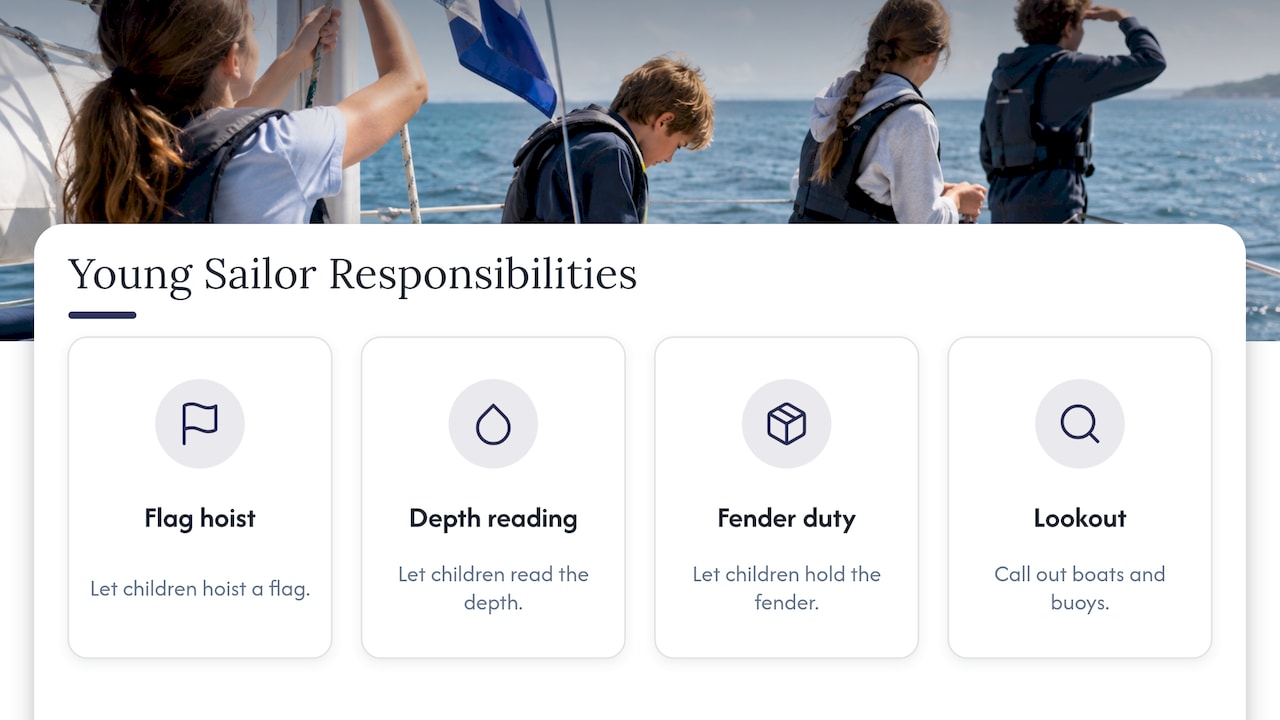
Children are the best game partners on a boat, as long as the games give them real responsibilities. Let them hoist a flag, read the depth, hold the fender or be the “lookout” who calls out boats and buoys. Training guides for young sailors lean heavily on games like treasure hunts and relays because fun and skill-building overlap so naturally.
For families, a flotilla can make this easier: other children on nearby boats mean built-in playmates at every anchorage. We run a Kid Sailing Flotilla, priced from €1,247 per week per cabin, and you can see current details on our group sailing holidays page. We do not publish a single age range that fits every trip, so check the specific departure before you book and ask our team about your kids’ ages.
If you are planning a family holiday in Greece, our skippered family sailing holidays are a good place to start.
7. Games to leave on land
Some ideas look great on a party-boat list and do not belong on a charter yacht. The pdracer collection of sailing games includes formats like capture-the-flag, which needs two teams and marked buoys and explicitly requires that participants know right-of-way rules and avoid contact between boats. That is a controlled-fleet exercise with a safety boat, not something to improvise between anchored yachts.
Leave these at home:
- Water balloons and squirt guns, which cause slips and are easy to lose overboard.
- Anything that has people standing on deck while the boat is moving.
- Games that involve throwing objects at other boats or swimmers.
- Races between yachts in a crowded anchorage or harbor.
- Loud music contests that make it impossible to hear the skipper’s instructions.
If you want to understand the other side of safe sailing in Greece, our guide to practical Greek sailing regulations covers what skippers need to know about ports and fines.
8. Our perspective
We have seen how a group changes over a sailing week. Day one is polite. Day three is when somebody falls in love with the helm, somebody else becomes the unofficial chef and a game of cards turns into a tradition. Games are not the main attraction, the sea is, but they are the glue.
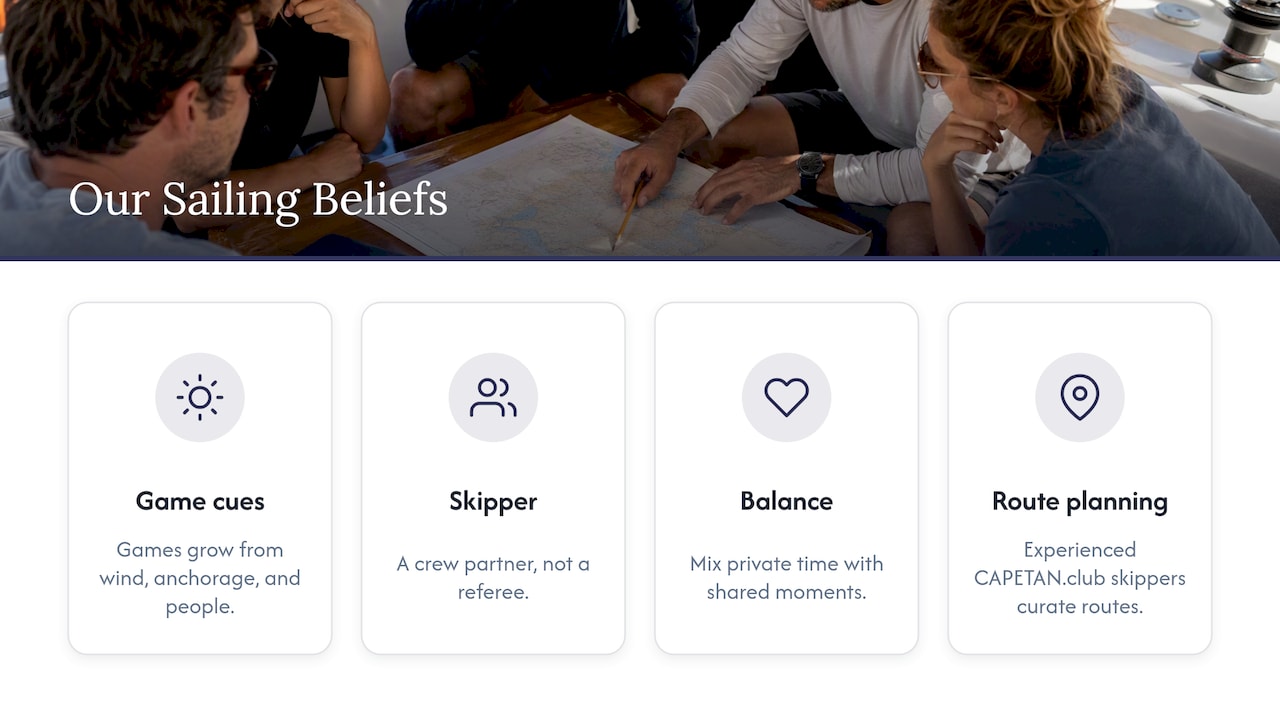
As a team of sailors, we keep a few beliefs. The best games grow out of what is happening: the wind, the anchorage, the people on board. The skipper is part of the crew and a partner in the fun, not a referee. And a good week balances private time with shared moments, which is exactly why we offer both private and group formats. If you are not sure which suits your crew, our page on choosing between a private or group sailing holiday walks through the trade-offs.
Our routes are curated by experienced skippers from CAPETAN.club, so the people planning your week are people who actually sail. Ask them for game ideas, and they will happily share their favorites for the cove you are about to enter.
— Sail
9. Ready to try it with your crew?
If you are dreaming of a week where games, swims and sunsets fill the days, we can help you build it. You can sail privately with your own group or join a social flotilla and meet new people on the water. Our private Go Private weeks start from €560 per week per person in Greece, from €560 in Croatia, from €530 in Turkey and from €870 in Italy. See the Greece Go Private week or browse all our Vacaciones en grupo con navegación to pick your dates.
Preguntas frecuentes
What are fun games to play on a boat with a group?
Good picks are compact card games, Spot It!, a pencil-and-paper quiz, a logbook trivia round and a snorkel scavenger list. At anchor you can add a treasure hunt or a diving contest, with the skipper’s approval. Choose games with few loose pieces, since wind and humidity are hard on boards and paper.
Is it safe to play active games on a sailing yacht?
Calm games are fine anywhere. Active games depend on conditions, and the skipper should decide, since onboard play must not interfere with navigation, swimming zones or visibility. Avoid water balloons, squirt guns and standing on deck while sailing.
What age range suits a sailing flotilla?
It depends on the specific trip. Some departures are built for families with children, such as our Kid Sailing Flotilla, while others are designed for adults. Tell us the ages of everyone in your group and we will point you to the right departure.
How do you keep a mixed group of friends and strangers connected on board?
Use team games with defined roles, keep rounds short and let people opt in. Rotating who picks the evening activity gives every personality a turn. A group flotilla also helps, since shared routes and shared dinners create natural moments to connect.
Fuentes
- Sailing Games Book, Yachting New Zealand
- On the water games with wind, UK sailing club guide
- Misc Sailboat Games and Races, PDRacer
- 15 Fun Boating Games to Play On-Board, Discover Boating
- Safe Water Sports
- Family sailing vacations in Greece, Responsible Vacation