Charter prices for bareboat catamarans vary widely depending on size, and crewed catamarans for the 45 to 60 foot range can also have substantial variation in weekly rates. The base fee is only the starting point. Advance Provisioning Allowance, crew gratuity, fuel, and marina fees frequently add a significant portion on top of the base fee, so advertised rates often represent only part of the true cost. The worked budgets below turn those ranges into real trip math.
En bref :
- The true cost of a catamaran charter often exceeds the base fee due to additional charges like provisioning allowance, gratuity, fuel, marina fees, and insurance, which can add significantly to the advertised rate.
- Prices vary greatly by boat size, with 35-40 foot bareboats costing $2,500 to $5,500 weekly and larger crewed yachts exceeding $15,000, often influenced by seasonality and regional location.
- Early bookings, shoulder season trips, or shorter charters can reduce overall expenses, especially if booked several months in advance or during off-peak months.
- Be sure to request itemized estimates for extra costs such as provisioning, marina fees, and APA to avoid surprises and compare total trip expenses accurately.
- Security deposits, generally between $2,000 and $15,000, are refundable after inspection confirms no damage, with most returns processed within two weeks.
Table des matières
- How Much Does a Catamaran Charter Cost by Size and Type?
- What Extra Costs Come on Top of the Base Charter Fee?
- Does the Time of Year Really Change the Price That Much?
- What Do Real 3-Day and 7-Day Catamaran Budgets Look Like?
- How SailArmada Helps You Budget Before You Book
- What Security Deposit Should You Expect, and When Do You Get It Back?
- Why Does the Same Catamaran Cost Different Amounts in Different Regions?
- Why the Base Fee Number Everyone Quotes Is the Wrong One to Trust
- Book Your Catamaran with Confidence Through a Specialized Charter Platform
- Sources
- FAQ
How Much Does a Catamaran Charter Cost by Size and Type?
Size drives price more than almost anything else, but the charter type (bareboat versus skippered versus fully crewed) shifts the math too. Bareboat means you or a certified sailor in your group handles the boat yourself, which cuts crew costs entirely. Skippered adds one professional to steer and navigate. Crewed adds a full team, often including a chef, and comes with the “plus expenses” pricing model common across Mediterranean crewed catamaran charters.
Here’s how the ranges typically break down:
- 35–40 ft catamarans (3-4 cabins): $2,500 to $5,500 per week bareboat, $4,500 to $8,000 skippered. Best for groups of 6 to 8 who want a manageable boat without sacrificing comfort. Lagoon and Bali models in this range are among the most listed on Greek charter platforms.
- 45–50 ft catamarans (4-5 cabins): $5,000 to $9,000 bareboat or skippered, $9,000 to $16,000 crewed. This size fits families or friend groups of 8 to 10 who want private cabins and real living space, and it’s where Fountaine Pajot and larger Bali models sit.
- 50+ ft luxury catamarans, including models like the Saona 47: crewed weekly rates commonly run $15,000 to $30,000 or more, depending on crew size and season. Groups here often run 8 to 12 guests split across multiple ensuite cabins.
Per person, that translates to roughly $40 to $90 a day for a bareboat 40-footer split six ways, climbing to $150 to $300-plus per day for a crewed luxury catamaran once APA and gratuity are folded in. A catamaran suits groups precisely because cabin count, not just boat length, determines how far your budget stretches per traveler.
What Extra Costs Come on Top of the Base Charter Fee?
The quoted weekly rate covers the boat itself. Everything that makes the trip actually happen gets billed separately, and this is where first-time charterers consistently underestimate their real spend.
- Advance Provisioning Allowance (APA). This is a deposit, typically 20% to 40% of the base fee, that the crew or marina uses to buy fuel, food, drinks, and pay port fees as you go. Unspent APA gets refunded at the end of the trip; overspent APA gets billed. Our guide to budgeting for APA breaks down how to estimate it before you sail.
- Crew salaries and gratuity. Crew pay is baked into crewed-charter base fees, but gratuity is separate and customary at 10% to 15% of the base charter fee, paid directly to the crew at trip’s end.
- Fuel, generator, and watermaker use. Motoring hours, air conditioning, and fresh water production all draw fuel. Budget $200 to $600 for a week of moderate use on a mid-size catamaran.
- Marina and port fees. Catamarans pay more than monohulls of similar length because berth pricing is often calculated by beam, not just length. A 45-foot catamaran can cost noticeably more to dock than a 45-foot monohull, a detail explained in ownership cost breakdowns for Mediterranean catamarans.
- Insurance, VAT, and cleaning. Hull insurance typically runs about 1% to 1.5% of the boat’s value annually, a cost folded into the charter rate, while VAT (usually applied at the local rate) and a final cleaning fee of $150 to $400 are often itemized separately, per liveaboard cost breakdowns.
Conseil de pro : Ask your charter company for an itemized APA estimate before booking, not after.
Does the Time of Year Really Change the Price That Much?
Yes, and the swing is bigger than most first-time charterers expect. Peak season (July and August) commands the highest rates across Greece, driven by school holidays and the best, most reliable wind. Shoulder months (May, June, and September) offer a meaningfully lower price point while still delivering warm water and steady breeze. Low season (April, October, and into November in some regions) drops further still, though fewer operators run full fleets.
Charter companies typically publish rate sheets broken into weekly periods rather than a single flat price, so the same 45-foot catamaran might carry three or four different weekly rates across a single summer.
A few practical moves lower your total:
- Shift your dates into June or September instead of late July, where you’ll find the best balance of price and weather.
- Book a shorter charter, like 4 or 5 days instead of a full week, if your group’s schedule allows it.
- Watch for early-booking discounts (often released in winter) and last-minute openings within a few weeks of departure.
What Do Real 3-Day and 7-Day Catamaran Budgets Look Like?
Numbers on a page are one thing. Seeing them add up for an actual trip is another. Here’s how a typical 7-day bareboat charter on a 40 to 45 foot catamaran might shape up for a group of 8:
- Base fee: $5,500
- APA typically ranges and can be approximately a quarter of the base fee.
- Marina fees (beyond what’s covered): $300
- Provisioning extras (drinks, water toys): $250
- Estimated total: around $7,425, or roughly $928 per person for the week
A 7-day crewed charter on a 50 to 60 foot catamaran for 10 guests tells a different story:
- Base fee: $18,000
- APA (30%): $5,400
- Crew gratuity is commonly around 10% to 15% of the base charter fee.
- Extras (transfers, specialty provisioning): $800
- Estimated total: around $26,360, or roughly $2,636 per person
How SailArmada Helps You Budget Before You Book
A quoted weekly rate rarely tells the whole story, which is why the checklist matters as much as the number. Before you commit to any catamaran charter, confirm these basics:
- Deposit timing: most charters require 30% to 50% down at booking, balance due 30 to 60 days before departure.
- Required documents: passports, sailing certifications if bareboat, and crew list details for port authorities.
- APA planning: ask for a written APA estimate tied to your specific itinerary, not a generic percentage.
- Transfers: airport-to-marina transport is almost never included in the base fee, so price it separately.
Curated fleet listings often pair each boat with realistic cabin-allocation guidance to help groups avoid overpaying for too-large yachts or squeezing into boats too small for comfort. That single decision, matching cabin count to actual guest count, is one of the most common places charterers waste money.
Conseil de pro : If your group has an odd number or a mix of couples and singles, check cabin configuration before comparing prices. A single-cabin layout can change your per-person math significantly.
What Security Deposit Should You Expect, and When Do You Get It Back?
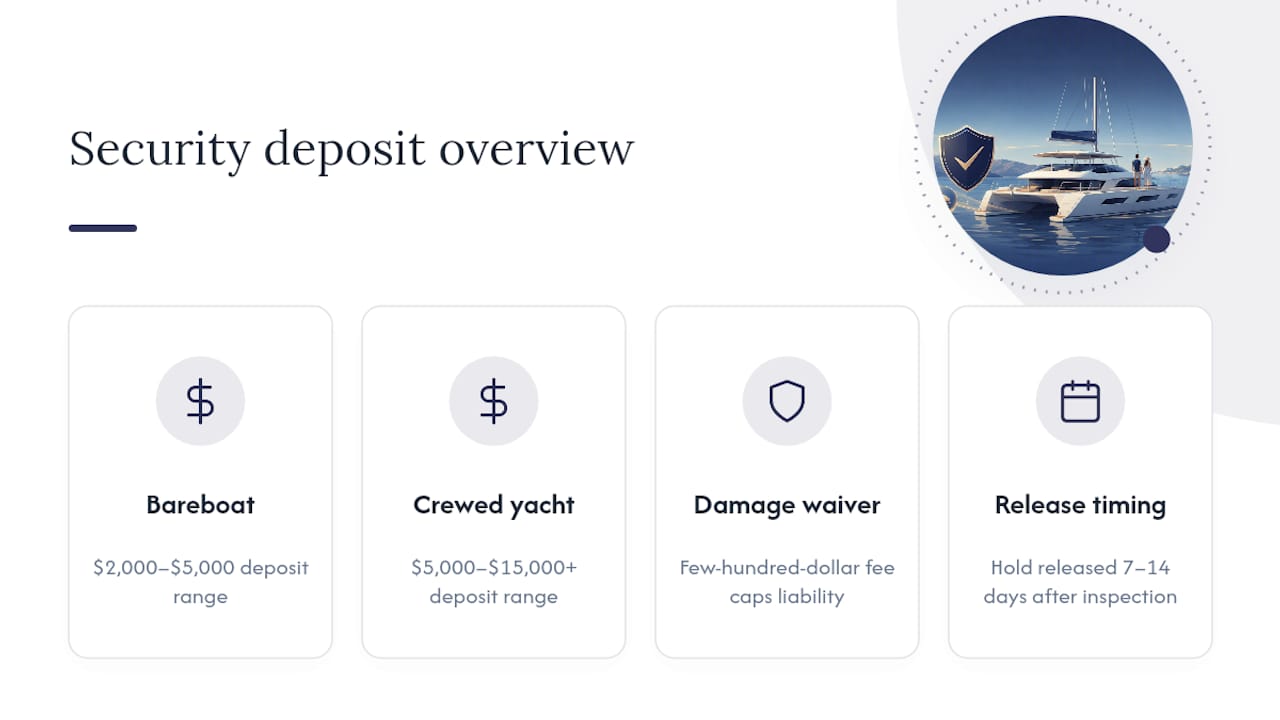
Security deposits for catamaran charters typically range from $2,000 to $5,000 for bareboat charters, and can run $5,000 to $15,000 or more on larger crewed yachts, depending on the boat’s value and the operator’s policy. This is separate from your APA and is meant to cover damage, not day-to-day expenses.
Most operators hold the deposit as a pre-authorization on a credit card rather than an actual charge, releasing the hold within 7 to 14 days after the boat is returned and inspected. Some Mediterranean operators offer a damage waiver, essentially a fixed fee (often a few hundred dollars) that caps your liability instead of requiring the full deposit hold, which can be worth considering if you’d rather not tie up several thousand dollars on a card during your trip.
Refund conditions hinge almost entirely on the condition of the boat at check-in versus check-out. A documented handover inspection, ideally with photos, protects you if a dispute arises over existing scratches or gear wear. Ask specifically whether the deposit covers bottom damage from grounding, since that’s the single most expensive category of damage claim on a catamaran and some policies exclude it from the standard waiver.
Why Does the Same Catamaran Cost Different Amounts in Different Regions?
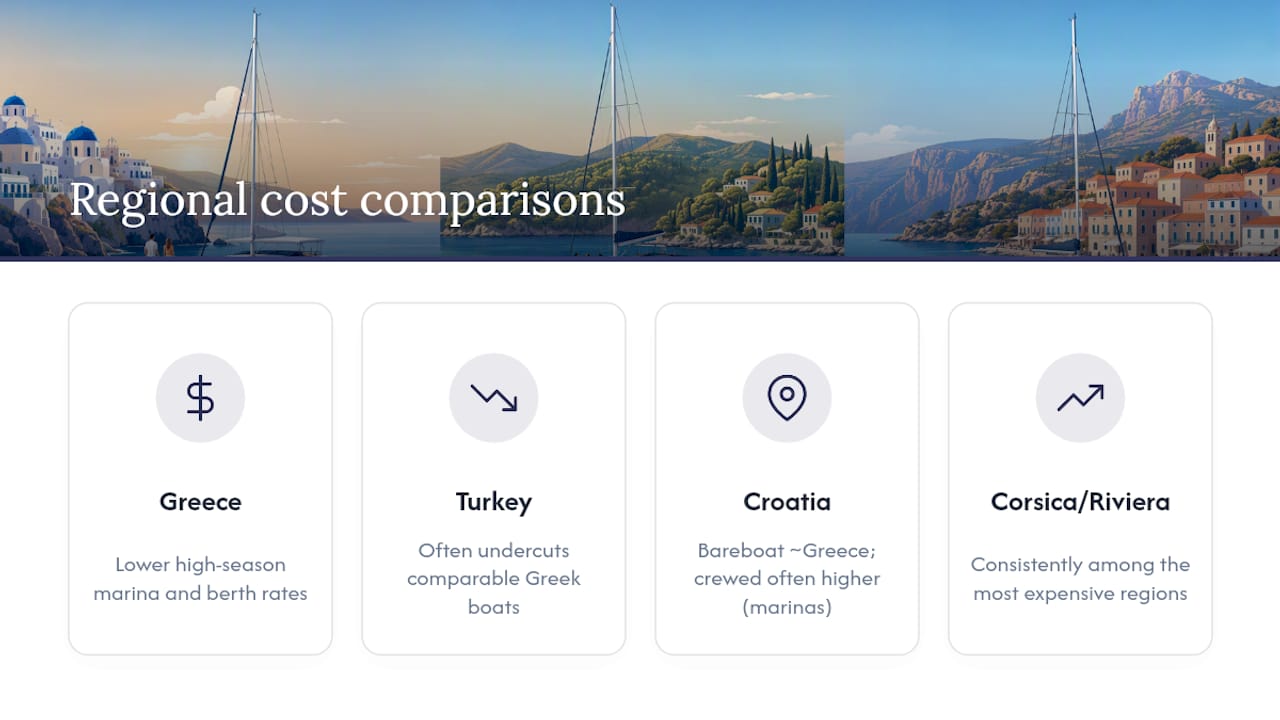
Geography matters almost as much as boat size when it comes to catamaran charter cost. Greece generally offers lower high-season marina and berth rates than Spain or Italy, a gap documented in liveaboard cost comparisons across Mediterranean regions, which makes it one of the more budget-friendly Mediterranean bases for the same size and class of boat.
Within Greece itself, prices shift by departure point. The Ionian islands and Sporades tend to run slightly below Cycladic hubs like Athens or Paros during peak weeks, partly because Cycladic marinas see heavier July and August demand. Turkey’s charter market often undercuts Greek pricing on comparable boats, though currency fluctuations and taxes complicate direct comparisons year to year.
Croatia sits in a similar price band to Greece for bareboat charters but tends to run higher for crewed luxury catamarans due to marina infrastructure costs. Corsica and the French Riviera consistently rank among the most expensive Mediterranean charter regions, driven by premium marina fees and, as regional charter cost comparisons show, high demand from a wealthier clientele.
Why the Base Fee Number Everyone Quotes Is the Wrong One to Trust
The conventional advice, “compare weekly base fees across a few operators,” is not wrong, exactly. It’s just incomplete in a way that costs people real money. Chasing the lowest headline number without asking what it excludes is the single most common budgeting mistake we see.
What actually matters is asking every operator the same three questions: what percentage APA do you charge, is gratuity expected on top of that, and are marina fees for this specific itinerary included or additional? Get those three answers in writing and you can compare apples to apples, something a bare price list never lets you do.
If there’s one place to spend your planning energy, it’s matching boat size to guest count before you even start comparing prices. A 50-foot catamaran split eight ways beats a 40-footer split six ways almost every time, even at a higher sticker price, because the per-person math and comfort both improve.
- Voile
Book Your Catamaran with Confidence Through a Specialized Charter Platform
Some specialized sailing holiday platforms provide curated fleet listings with transparent APA guidance from the start, sample budgets matching typical cost ranges, and booking support that highlights marina surcharges and crew gratuity expectations before finalizing reservations.
Every itinerary we curate accounts for cabin allocation, group size, and season, so the price you’re quoted is close to what you’ll actually pay, not a stripped-down base fee designed to look good on a comparison chart. If you’re weighing a 40-footer against a crewed 50-foot Fountaine Pajot for your group, SailArmada’s pricing guide walks through exactly what’s included in each package. Ready to see real numbers for your dates? Check availability and get a quote through SailArmada’s private sailing page and start locking in your preferred week before peak-season dates disappear.
Sources
The ranges and worked budgets in this guide draw on current Mediterranean charter market data rather than estimates:
FAQ
How Much Does a 40 ft Catamaran Cost to Charter?
A 40-footer typically runs $2,500 to $5,500 per week bareboat or $4,500 to $8,000 skippered, fitting comfortably for groups of 6 to 8 guests across 3 to 4 cabins.
How Much Does a 60 ft Catamaran Cost to Charter?
A 60-foot catamaran, usually chartered crewed, commonly costs $15,000 to $30,000 or more per week before APA and gratuity, reflecting larger crew requirements and higher-end amenities for groups of 8 to 12.
Is the Security Deposit Refundable on a Catamaran Charter?
Yes, security deposits (typically $2,000 to $15,000 depending on boat size) are refunded within 7 to 14 days after a clean handover inspection confirms no damage beyond normal wear.