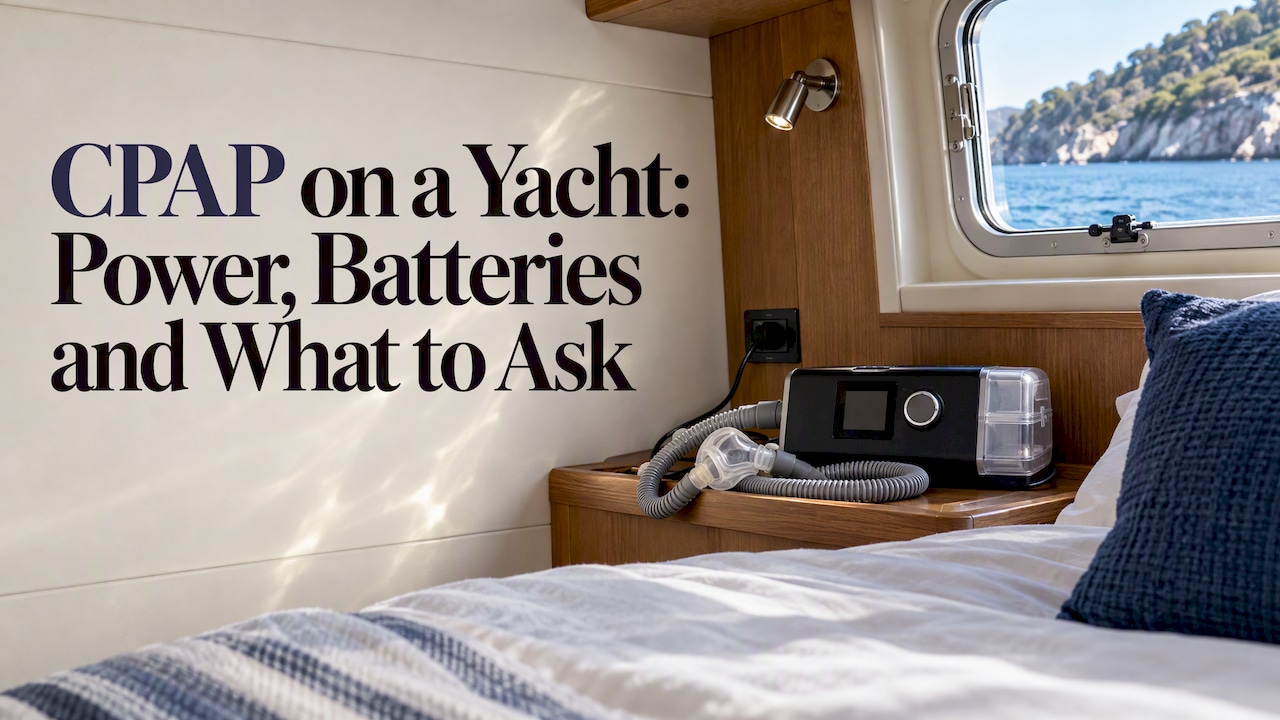
Yes, you can sleep with your CPAP on a sailing yacht or catamaran, including in Greece. It just needs a little planning. Your machine needs real power (not a USB port), the boat needs enough battery capacity for the whole night, and your skipper needs to know before you step aboard. Sort those three things out and a week of anchoring in a quiet bay can be some of the best sleep you’ve had.
TL;DR
- A CPAP runs on 12V DC (with the right adapter) or 110/220V AC (via an inverter or shore power). USB sockets cannot run it.
- Humidifier and heated tubing are the big power drains. Turning them down or off stretches your battery a lot.
- At a marina dock you plug into shore power. At anchor you depend on the house batteries, so ask about battery capacity and the inverter before you book.
- Tell your charter company or skipper about your machine in advance, and bring the right cable, a spare power lead and your own distilled water.
- Talk to your sleep doctor about a backup plan for the one night when something fails.
Table des matières
- Why a CPAP on a boat is easier than it sounds
- What power you actually have on board
- How much power does a CPAP really use?
- Three ways to power your CPAP aboard
- What to ask your charter team or skipper
- Charging phones and other devices without draining the bank
- What to pack for your CPAP
- Preparing for the night when something goes wrong
- Our perspective: plan the power, then relax
- Choose a boat that suits your power needs
- Ready to plan your week?
- FAQ
- Sources
Why a CPAP on a boat is easier than it sounds
A charter yacht is basically a small floating house with its own power system. The boat has 12V DC house batteries, and 110/220V AC is available from shore power, a generator or an inverter, according to NauticEd’s charter guide. Your CPAP is a small, modest appliance by comparison with a fridge or an electric kettle, so most modern boats can handle it.
The real question is not “is there an outlet?” but “how long will the power last when we’re swinging at anchor, and where will I plug in?” That’s what the rest of this guide answers.
What power you actually have on board
Think of a yacht’s electricity as three separate sources, each behaving differently overnight.
Shore power at the marina
When you’re tied up in a marina, the boat connects to a dock pedestal. In Europe, pedestals provide 220V AC through IEC 309 plugs, as NauticEd explains. In Greece, port infrastructure is mixed: modern private marinas use standard blue CEE plugs (16A or 32A), while many municipal island docks may need a CEE-to-Schuko adapter, according to Lyvio Marine’s country guide. Your skipper handles the cable and connection. You just need to know that a night in a marina is the easiest night for your CPAP, because the machine can run off the boat’s AC sockets without touching the batteries much.
One rule worth knowing: marinas take electricity seriously. Alimos Marina near Athens, for example, asks customers to check the maximum permitted supply on connection and strictly forbids tapping power from other vessels. Leave the plugging in to the crew.
Batteries and the inverter at anchor
Away from the dock, the boat lives on its house battery bank. AC power is only available if the yacht has a generator or an inverter, which turns 12V battery power into household-style current. Not every boat has one, and the quality varies. For yachts, pure sine wave inverters are the suitable type, and some builders fit good ones as standard while others do not. That’s one more reason to ask your charter team what’s on your specific boat.
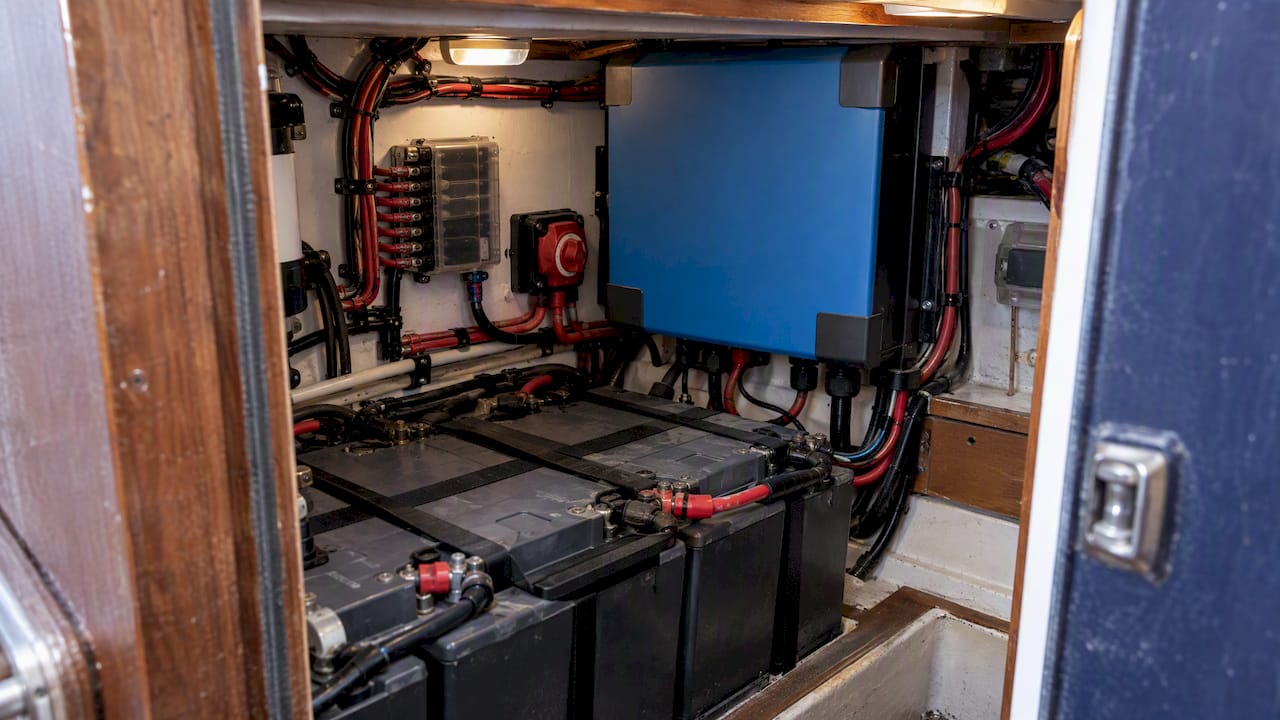
There’s also a hidden cost: leaving an inverter switched on, even with nothing plugged in, can use up to 25% of a single house battery’s capacity. So don’t leave it running all day just in case. Turn it on at bedtime, off in the morning.
USB and 12V sockets
Most boats have USB outlets and cigarette-style 12V sockets. USB (5V) is fine for phones, but it can’t power a CPAP. A CPAP needs either a 12V DC car-style adapter or 110V/220V AC power through an inverter. The 12V route is often the most efficient, because you skip the conversion loss of the inverter.
How much power does a CPAP really use?
The numbers are modest, but they add up over eight hours.
As one example, the ResMed AirCurve 10 VAuto has typical power consumption of 57VA and a maximum above 108VA. Its 90W power supply accepts 100 to 240V at 50 to 60Hz, which means it works on Greek 230V mains as well as on 12V through the right converter. Your own machine will differ, so look at the label on the power supply or the manual.
Here’s a rough back-of-the-envelope estimate (our own arithmetic, not a manufacturer figure). Say your machine averages 60 watts through the night, which is a plausible figure given the numbers above:
| Objet | Estimate |
|---|---|
| Average draw | 60 W |
| Hours of sleep | 8 |
| Energy per night | about 480 Wh |
| At 12V, that is roughly | 40 Ah |
With the heated humidifier on, the figure goes up significantly. Humidification and heated tubing significantly increase consumption, and Philips notes for its DreamStation 2 that an attached battery does not support humidification, while an 80W power supply is required to run it. In practice, that means two things:
- Your machine’s own travel battery is a backup, not the main plan, if you use a humidifier.
- The biggest saving you can make is on the humidifier and heated hose. Ask your sleep clinic what settings are acceptable for you. A sea breeze at night is often humid anyway, but that’s a conversation for your doctor, not a guess.
Your machine may also have a sleep-quality camera, Bluetooth or a built-in modem. These draw very little compared with the blower and heater.
Three ways to power your CPAP aboard
Option 1: 12V DC cable (our usual recommendation)
Most major brands sell a DC converter or cable that plugs into a standard 12V socket. Running straight from 12V means no inverter and fewer losses. Sailors on forums often report that a CPAP without humidifier is a manageable load for a typical boat battery bank, but how much your yacht can spare depends on its bank size and condition, so confirm that with the charter company rather than relying on anecdotes.
Bring the genuine cable for your machine model. Generic cigarette-lighter cables can deliver the wrong voltage or fail under continuous load.
Option 2: The yacht’s inverter (230V AC sockets)
If the boat has a good inverter, you can plug your normal power brick into a standard socket in the cabin. It’s convenient, and you don’t need a special cable. Remember to switch the inverter on only when you need it, as above.
Check the socket location. Some yachts have AC sockets only in the saloon or the nav station, not in the cabins. A good extension lead (short, marine-friendly, with a plug that fits European sockets) solves that. A plug adapter is useful if your machine’s plug is a UK or US style.
Option 3: Your own battery pack
Portable lithium power stations and CPAP-specific batteries are popular with campers, and they work for a night or two. Two cautions. First, many CPAP-specific batteries do not support humidification, as noted above. Second, airlines have rules about lithium battery sizes, so check your carrier’s policy before you fly to Greece. A power bank you can’t carry on board isn’t much use.
Think of your own battery as insurance: a full charge before the flight and a second charge on a marina night keeps you covered if the boat’s bank runs lower than expected.
What to ask your charter team or skipper
A short message before you book saves a lot of worry. Here’s what we’d ask, in order:
- Is there an inverter, and is it pure sine wave? Are there AC sockets in the cabin where I’ll sleep?
- Is there a 12V socket near the bed? Can the skipper check it delivers a steady output?
- How big is the house battery bank, and how is it recharged? Engine alternator, solar panels, a generator, or only shore power?
- Is there a generator? Some larger yachts and catamarans run one, which makes overnight power much simpler.
- How many nights will we spend at anchor versus in a marina? Mix them up in your itinerary if power is a concern.
- Can I run a test? Plug in your machine for a few minutes at the dock and watch the battery monitor.
It also helps to tell your skipper that someone aboard uses a CPAP. That way they’ll plan marina nights, run the engine for an hour in the evening if needed, and keep an eye on the battery level without making a fuss about it.
If you’re travelling with a group, put the question in the group chat early. Other people will want to charge phones, cameras and speakers, and everyone shares the same battery bank. For ideas on connecting devices and staying online, see our guide to Wi-Fi on a yacht charter.
Charging phones and other devices without draining the bank
Your CPAP should get first call on the battery. For everything else:
- Charge phones and small devices through USB outlets or a USB adapter in a 12V socket.
- Top up your devices during the day while the engine runs or while you’re in a marina, not at 2 a.m.
- Switch off the inverter when you’re not using it.
- Skip hair dryers, kettles and other heating appliances unless you’re plugged into shore power.
- If your group is large, agree on a charging rota or bring a power bank for each cabin.
For a longer packing list, our liste de contrôle pour une sortie en voilier covers adapters, dry bags and the small items people forget.
What to pack for your CPAP
- Your machine, mask, hose and the original power supply.
- A 12V DC cable or converter made for your machine.
- A plug adapter and a short extension lead.
- Distilled water for the humidifier if you use one. Don’t count on finding it on a small island.
- A waterproof bag or case. Salt air and spray are hard on electronics.
- Spare filters.
- A copy of your prescription or a doctor’s letter, just in case.
- Your own battery pack, fully charged, as a backup.
Keep the machine off the floor of the cabin and away from hatches that might leak in a rain squall. A shelf near the head of the bunk, with the cable secured, is ideal. In a bunk with a lee cloth or a berth with a high side, the hose stays out of your way when the boat moves.
Preparing for the night when something goes wrong
A boat is a small place, and help is not on the next corner. A medical memorandum written for offshore sailing makes the point bluntly: there is no “911” on a small boat, so the vessel and crew should be ready for likely medical emergencies. Your CPAP isn’t an emergency, but it’s a good reason to think ahead.
Speak to your sleep doctor before you go, and ask:
- How should I manage a night without therapy, for example if the battery runs out?
- Are there positions, or things I should avoid (such as alcohol before bed), that help on a night without the machine?
- Do I need any extra supplies for a week away from a pharmacy?
Sailing in Greece is gentler than it sounds on this front. Many islands have ports with shops, pharmacies and marinas with shore power within a short hop. If your itinerary leans on those, a failure is more of an inconvenience than a crisis. Our Idées pour une croisière sur les îles de la Méditerranée show how short the legs between harbors can be.
Our perspective: plan the power, then relax
We’ve seen it often: someone who uses a CPAP assumes a sailing holiday isn’t for them, and then discovers it’s one of the easiest trips to plan around. A boat is a place where you control the schedule. That’s a real advantage.
Our private sailing holidays let you choose your yacht or catamaran, your route and your departure date, so you can pick a boat with a proper inverter and a healthy battery bank, and shape your week around marina nights when you want guaranteed shore power. Our routes are curated by experienced, professionally trained skippers from CAPETAN.club, and our team are actual sailors who can talk through your set-up before you commit.
On a group holiday, the same applies: tell us about your machine when you enquire and we’ll help make sure the skipper knows, so there are no surprises at the dock.
If you want to compare the two formats, our guide to Vacances en mer privées ou en groupe explains who each suits.
Voile
Choose a boat that suits your power needs
A few features make life easier for CPAP users:
- A catamaran usually offers a larger living area and often more battery capacity than a monohull of the same length, though it varies from boat to boat, so ask.
- A generator or solar panels reduce the worry about overnight power.
- A cabin with its own AC socket saves you running an extension lead through the saloon.
- An air-conditioned cabin is a plus in summer, but it draws a lot of power as well. Our guide to air conditioning on yachts explains how the hours work and what to ask.
If you’re traveling with kids, a family-friendly layout matters as much as the power, and our family-friendly yacht features guide walks through what to look for.
Ready to plan your week?
Tell us about your CPAP when you enquire and we’ll match you with a boat and an itinerary that suits. Our private Greece holidays start from €560 per person per week, and you can see the Greece Go Private option here. Prefer company? Explore our vacances en groupe à la voile and mention your machine in your message.
You can also start at Sailarmada and browse destinations in Greece, Italy, Croatia and Turkey.
FAQ
Can I use a CPAP machine overnight on a sailing yacht in Greece?
Yes, as long as the boat can supply the right kind of power. In a marina, shore power is straightforward. At anchor, you rely on a 12V adapter or an inverter running from the house batteries. Ask your charter team about the battery bank and inverter before you book.
Can I charge my CPAP from a USB port?
No. USB outlets give 5V, which is fine for phones but can’t run a CPAP. You need a 12V DC adapter made for your machine or 110/220V AC power through an inverter or shore power.
Does the humidifier matter for battery life?
Yes, a lot. Humidification and heated tubing significantly increase energy use, and some machine batteries don’t support the humidifier at all. Ask your sleep specialist whether you can lower the humidifier setting or switch it off for the trip.
Do I need to tell the skipper I use a CPAP?
Yes, ideally before you book. The skipper can plan marina stops, manage the battery bank and make sure the inverter is on when you need it. It takes one message and saves a lot of stress.
What if the battery runs out during the night?
Your first step is to ask your sleep doctor how to handle a night without therapy, before you leave. Then, on board, start the engine or move to a marina the next day to recharge. Bringing your own charged battery pack gives you a second layer of backup.
Sources
- Electricity and Charging Your Devices on a Charter (NauticEd)
- Guide to Adapters and Chargers needed for Devices on Yacht Charter (NauticEd)
- Shore power plugs for boats: guide by country and ports (Lyvio Marine)
- Rules and Regulations (Alimos Marina)
- Domestic Systems (YachtBuyer)
- ResMed AirCurve 10 VAuto fact sheet
- Philips DreamStation 2 instructions for use
- Fleet Surgeon’s Memorandum for Offshore Passages (Cruising Club)