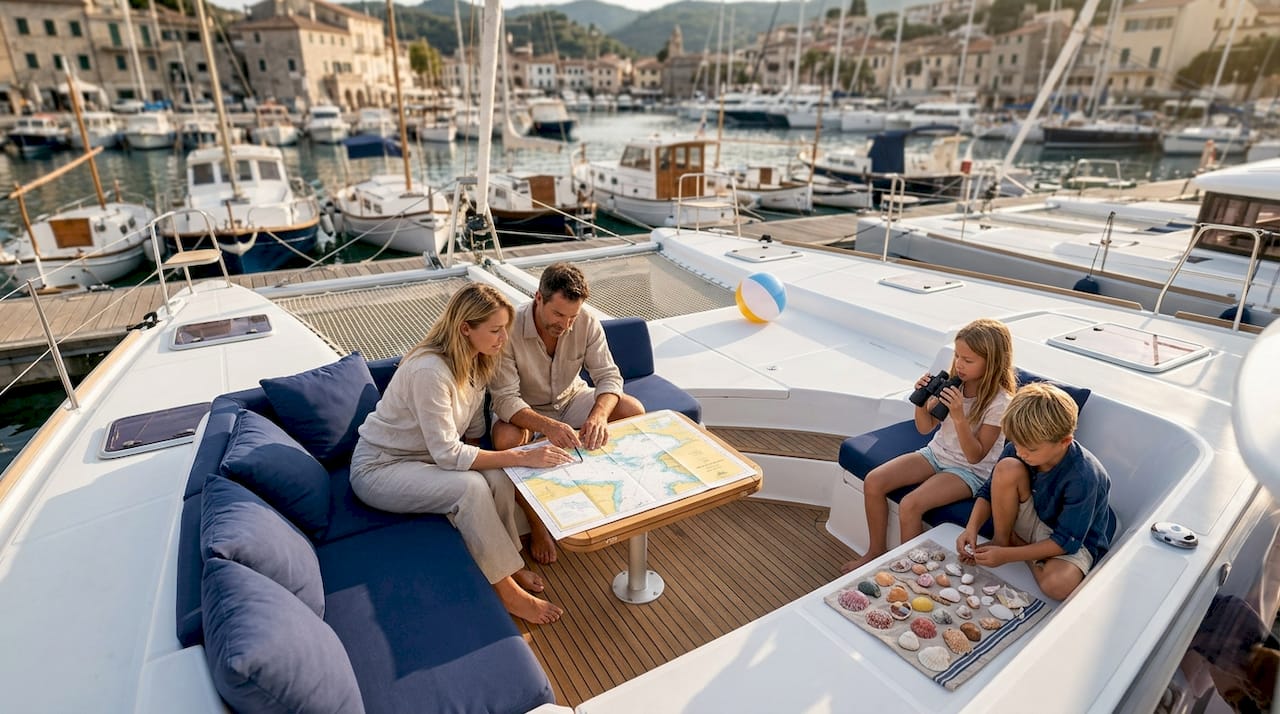
Il y a un détail que la plupart des nouveaux affréteurs ne prennent jamais en compte : un catamaran en Europe peut ressembler à des vacances complètement différentes selon le mois où vous montez à bord. Naviguez en Grèce en juillet et vous éviterez les marinas bondées, les rafales de Meltemi dans la mer Égée et les files d'attente à chaque taverne au bord de l'eau. Naviguez dans les mêmes eaux en mai et vous aurez des criques cristallines pour vous tout seul, de douces brises et des couchers de soleil qui semblent avoir été arrangés spécialement pour votre groupe. La saison de navigation en Méditerranée est plus longue, plus variée et plus gratifiante que la plupart des gens ne le pensent, et savoir la lire change tout.
Table des matières
- Comprendre la saison de navigation des catamarans en Méditerranée
- Top destinations méditerranéennes en catamaran par saison
- Choisir le bon catamaran pour une croisière en famille ou en groupe
- Planification de l'itinéraire du catamaran et stratégie de réservation
- Pourquoi un choix judicieux du moment et du navire peut transformer l'expérience de navigation de votre groupe
- Avec Sail Armada, la navigation en catamaran de groupe en Méditerranée est un jeu d'enfant.
- Questions fréquemment posées
Principaux enseignements
| Point | Détails |
|---|---|
| L'importance de la variété saisonnière | La saison des catamarans en Méditerranée s'étend d'avril à octobre, avec des régions idéales et des niveaux de fréquentation différents selon les saisons. |
| Choisissez judicieusement votre destination | Le printemps favorise la Corse et les Cyclades, l'été les Baléares et la Croatie, et l'automne la Sicile et Malte pour la navigation en famille. |
| Des catamarans modernes pour plus de confort | Les catamarans à vocation familiale sont dotés d'espaces de vie fluides et de systèmes d'énergie solaire pour des croisières agréables et sans heurts. |
| Prévoir les heures de pointe | Les mois de juillet et d'août nécessitent des réservations anticipées en raison de la forte demande, tandis que les saisons intermédiaires offrent plus de flexibilité. |
| La synchronisation intelligente enrichit l'expérience | Naviguer en dehors des heures de pointe permet de réduire le stress lié à la foule et d'améliorer la détente générale et les liens entre les membres du groupe à bord. |
Comprendre la saison de navigation des catamarans en Méditerranée
Le Saison de navigation des catamarans en Méditerranée s'étend en gros d'avril à octobre, avec des mois différents selon les régions et les styles de voyage. Cela représente près de sept mois d'eau libre, d'air chaud et de côtes parmi les plus belles de la planète. Mais tous les mois ne sont pas égaux.
Voici un aperçu de l'évolution des conditions au cours de la saison :
| Saison | Mois | Température de l'air (moyenne) | Température de la mer (moyenne) | Niveau de la foule | Meilleures régions |
|---|---|---|---|---|---|
| Printemps | Avril à juin | 18 à 25°C | 18 à 22°C | Faible à modéré | Corse, Sardaigne, Cyclades |
| L'été | Juillet et août | 28 à 35°C | 24 à 27°C | Haut | Baléares, Croatie, Iles Ioniennes |
| Automne | Septembre et octobre | 22 à 28°C | 23 à 26°C | Faible à modéré | Sicile, Malte, Dodécanèse |
Ces chiffres font ressortir plusieurs éléments. Tout d'abord, les températures de la mer en automne sont en fait plus chaudes qu'au printemps, car l'eau a passé tout l'été à absorber la chaleur. Cela signifie que les mois de septembre et d'octobre sont sans doute les meilleurs pour la baignade, même si la plupart des familles n'envisagent jamais de naviguer à ce moment-là. Deuxièmement, les températures de l'air en Méditerranée orientale peuvent dépasser les 35°C sur le pont, ce qui semble attrayant jusqu'à ce qu'un enfant en bas âge fonde ou qu'un grand-parent ait besoin d'ombre.
Les points clés de la saison en un coup d'œil :
- Les vents de printemps dans l'ouest de la Méditerranée (Corse, Sardaigne) sont doux et fiables, parfaits pour les marins moins expérimentés.
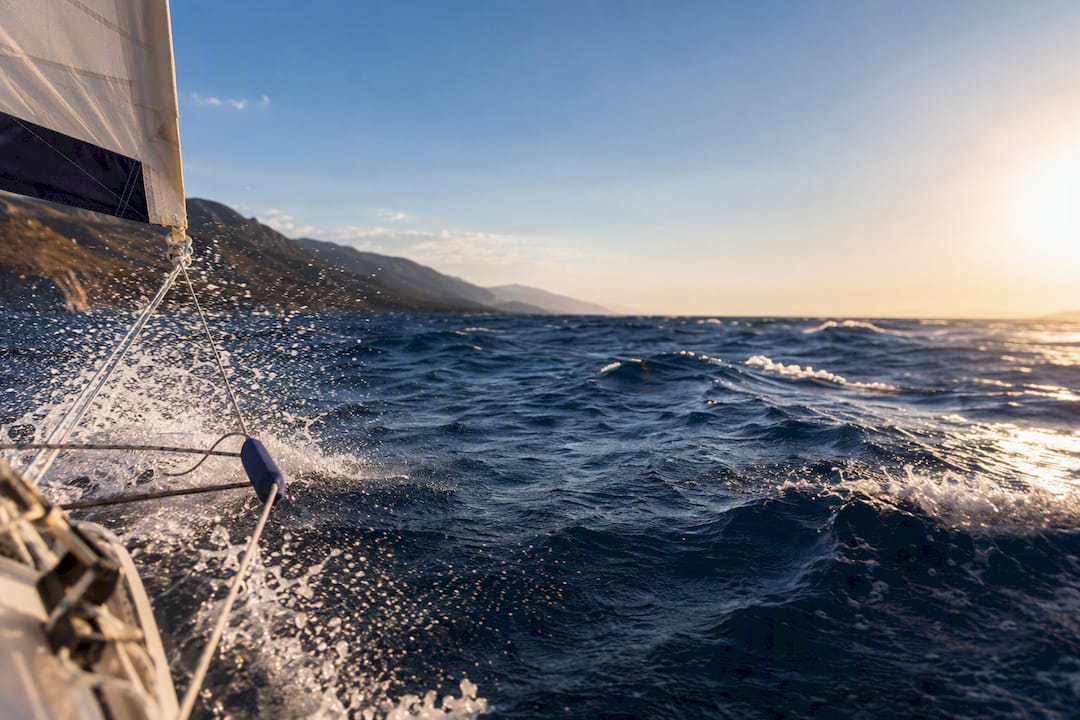
- Le Meltemi, un fort vent du nord dans la mer Égée, atteint son apogée en juillet et en août et peut rendre les passages agités.
- Les ports croates se remplissent rapidement en plein été, certaines marinas exigeant des réservations plusieurs mois à l'avance.
- Les mois de l'épaule offrent plus de flexibilité dans Destinations de voile en Méditerranée pour les groupes, tant pour les postes d'amarrage que pour les mouillages
Alors que la saison de navigation en Méditerranée se profile à l'horizon, explorons les conditions météorologiques et les eaux spécifiques des régions les plus populaires.
Top destinations méditerranéennes en catamaran par saison
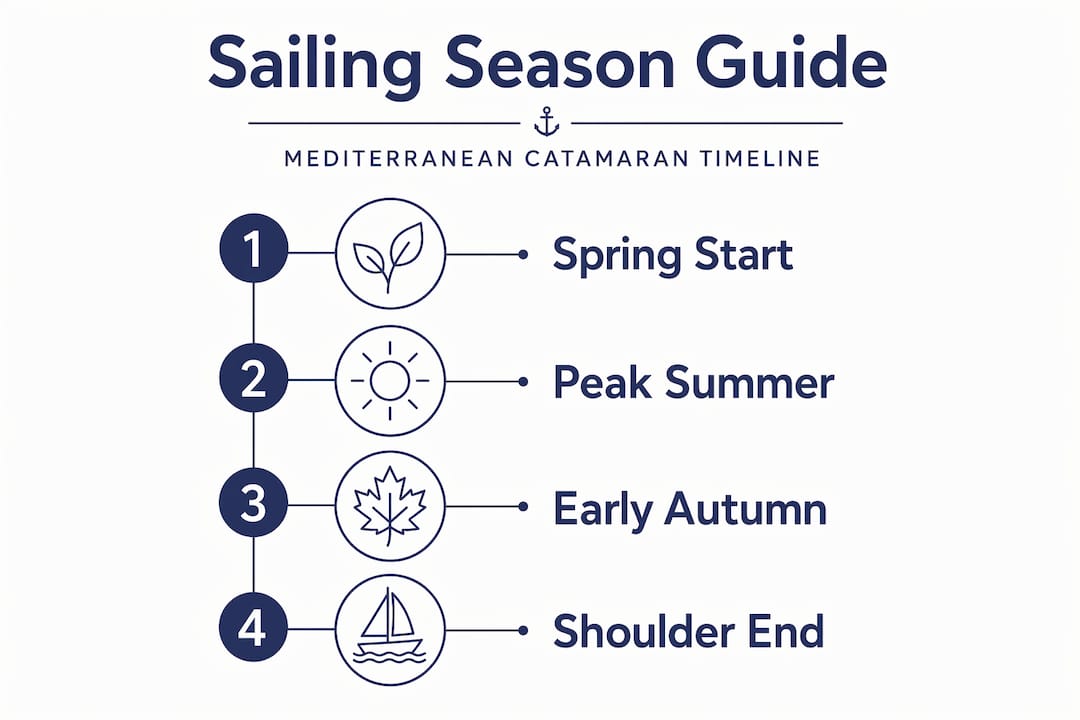
Le choix de l'endroit où naviguer est tout aussi important que le choix du moment. La bonne nouvelle, c'est que les meilleurs itinéraires de catamaran en Europe se déplacent en fonction des saisons, de sorte qu'il y a presque toujours une destination magnifique à son apogée lorsque vous êtes prêt à partir.
Printemps : Corse, Sardaigne et Cyclades
Le printemps est idéal pour la Corse, la Sardaigne et les Cyclades, avec des mouillages paisibles et beaucoup moins de touristes que l'été. Ces régions récompensent les navigateurs de début de saison en leur offrant des paysages spectaculaires et des ports qui restent des secrets locaux. En Corse, vous pouvez jeter l'ancre dans le golfe de Porto, une baie classée par l'UNESCO et entourée de falaises volcaniques rouges, sans avoir à vous battre pour obtenir de l'espace. Dans les Cyclades, les sites emblématiques de Santorin et de Milos sont époustouflants sans les foules de bateaux de croisière qui s'y pressent à partir du mois de juin.
Été : les Baléares, la Croatie et les îles Ioniennes
Les mois de juillet et d'août sont les plus populaires aux Baléares, en Croatie et dans les îles Ioniennes grâce à un temps stable, des vents fiables et une facilité de navigation exceptionnelle. Ces destinations sont intéressantes pour les familles, car les navigations entre les îles sont courtes, rarement plus de deux à quatre heures, ce qui permet aux enfants de s'amuser et de se sentir à l'aise. Ibiza et Formentera forment ensemble l'une des plus belles boucles de navigation de la Méditerranée occidentale, avec des eaux turquoise suffisamment peu profondes pour observer les poissons depuis le pont. La côte dalmate de la Croatie est un véritable chef-d'œuvre en matière d'excursions sur les îles, avec des dizaines de villes historiques situées à quelques encablures les unes des autres.
Si vous prévoyez activités familiales à Barcelone Avant ou après votre séjour aux Baléares, la ville se marie parfaitement avec une semaine sur l'eau.
Automne : Sicile, Malte et Dodécanèse
L'automne offre d'excellentes conditions de navigation en Sicile et à Malte, avec des mers chaudes et des mouillages beaucoup moins fréquentés. Ces destinations offrent également une grande richesse culturelle qui va au-delà de la plage. En Sicile, vous pouvez naviguer jusqu'aux îles Éoliennes, un archipel volcanique d'un autre monde où le Stromboli brille la nuit, et avoir les mouillages en grande partie pour vous. La Valette, capitale fortifiée de Malte, est l'un des plus beaux ports de la Méditerranée, et y accoster en octobre est vraiment spécial.
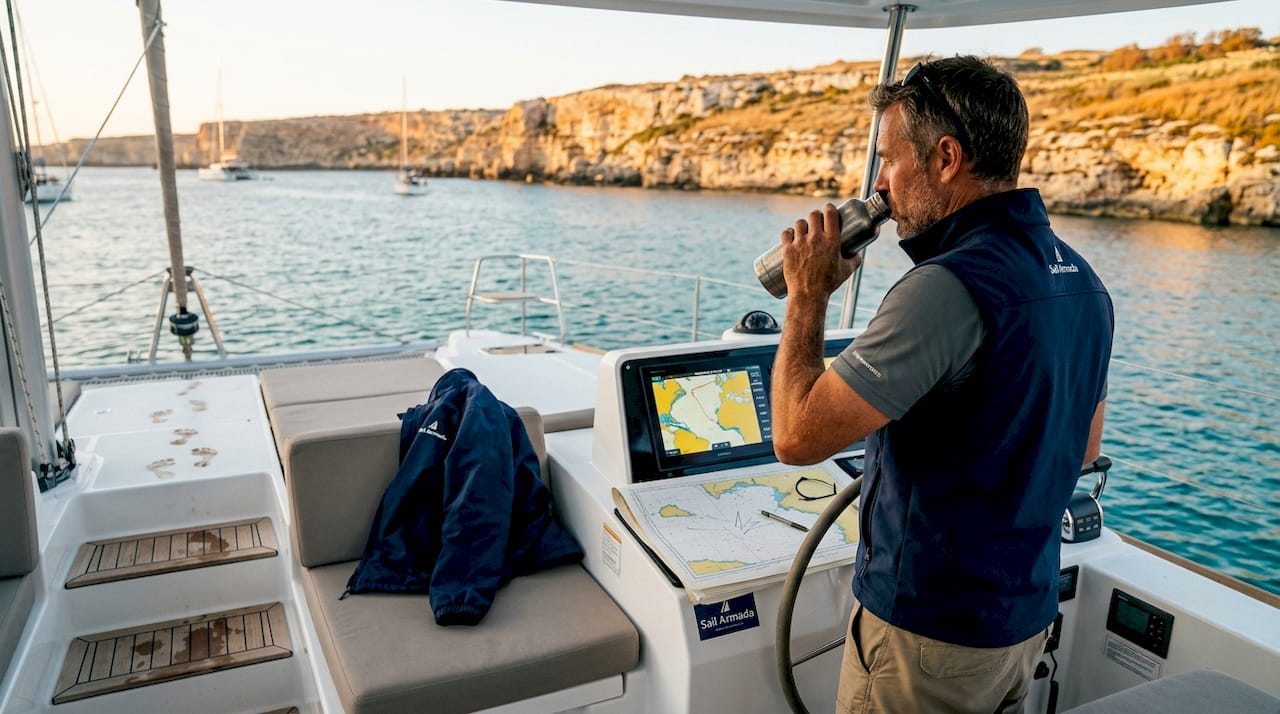
Voici une comparaison côte à côte pour vous aider à évaluer vos options :
| Destination | Meilleure saison | Facilité de navigation | Familial | Niveau de la foule | Caractéristique particulière |
|---|---|---|---|---|---|
| Corse | Printemps | Modéré | Haut | Faible | Baies de l'UNESCO, mouillages vierges |
| Sardaigne | Printemps | Facile | Haut | Faible | Côte d'émeraude, eau claire |
| Îles Ioniennes | L'été | Facile | Très élevé | Modéré | Des sauts courts, des mers calmes |
| Croatie | L'été | Facile | Très élevé | Haut | Villes insulaires, cuisine locale |
| Baléares | L'été | Facile | Haut | Haut | Bas-fonds turquoise, vie nocturne |
| Sicile | Automne | Modéré | Haut | Faible | Îles Éoliennes, histoire |
| Malte | Automne | Facile | Haut | Faible | Port de La Valette, culture |
Vous pouvez explorer toutes ces régions et bien plus encore, avec des destinations de choix pour les groupes et les familles, ainsi qu'une gamme complète d'activités de loisirs. idées de vacances en famille à la voile pour inspirer votre planification.
Choisir le bon catamaran pour une croisière en famille ou en groupe
Une fois que vous connaissez votre saison et votre destination, le navire lui-même devient le véritable facteur décisif pour que votre groupe apprécie le voyage. En Europe, les catamarans à voile sont disponibles dans de nombreuses tailles et configurations, et un choix judicieux fait une énorme différence dans la vie quotidienne à bord.
Quelles sont les priorités dans le choix d'un catamaran de croisière familial ?
- Espace de vie connecté. Les meilleurs catamarans familiaux se caractérisent par un flux continu entre le cockpit, le salon et le pont. Lorsque tout le monde peut se déplacer librement, les enfants restent en vue et les adultes restent en contact.
- Aménagements de cabines modulaires. La configuration flexible des cabines vous permet de séparer les quartiers des enfants de ceux des adultes, ce qui, tous les parents vous le diront, vaut son pesant d'or après la première nuit tardive.
- L'énergie embarquée et l'autosuffisance. Les catamarans modernes comme le Fountaine Pajot FP51 sont conçus pour la croisière familiale avec un aménagement continu cockpit-saloon et jusqu'à 2 000 W de panneaux solaires pour l'autonomie énergétique à bord. Cela signifie que les ventilateurs, la réfrigération, le chargement des appareils et l'éclairage ne nécessitent pas de faire tourner le moteur au mouillage.
- Interfaces de contrôle de l'énergie. Les tableaux de bord énergétiques intelligents vous permettent de suivre votre consommation en temps réel, ce qui est vraiment utile lorsque vous êtes ancré dans un endroit isolé pour deux nuits.
- Plate-forme large et stable. Les catamarans reposent sur deux coques au lieu d'une, ce qui réduit considérablement les mouvements de roulis. Pour les enfants et les personnes sujettes au mal de mer, cela change la donne.
Conseil de pro : Lorsque vous comparez les locations de catamarans en Europe, posez des questions précises sur la capacité solaire et les systèmes de gestion de l'énergie. Un bateau qui peut rester confortablement à l'ancre pendant 48 heures sans alimentation à quai donne à votre groupe beaucoup plus de liberté pour rester dans des baies isolées plutôt que de rentrer précipitamment à la marina tous les soirs.
L'exploration de l'Europe en catamaran est tellement plus riche lorsque vous n'êtes pas ancré à une prise de courant. Regardez à travers itinéraires de navigation conçus pour les groupes pour trouver des itinéraires conçus autour de ce type de mouillages favorables à l'autonomie.
Planification de l'itinéraire du catamaran et stratégie de réservation
Choisir le bon bateau ne représente que la moitié de la bataille. L'autre moitié est une planification intelligente, en particulier pour les groupes où huit ou dix personnes doivent se mettre d'accord sur tout, des dates de départ aux restrictions alimentaires.
Voici une approche étape par étape qui fonctionne bien pour les familles et les groupes qui affrètent un catamaran en Europe :
- Choisissez d'abord votre saison, puis votre destination. Ne tombez pas dans le piège de choisir un endroit et de vous rendre compte ensuite que les prix et les foules de l'été le rendent moins agréable. C'est la saison qui détermine l'expérience.
- Réservez les places dans les ports de plaisance bien à l'avance pour les mois de juillet et d'août. Le plein été est synonyme de congestion portuaire, et les marinas les plus prisées de Croatie et des Baléares affichent complet des mois à l'avance.
- Mélangez les jours de navigation et les jours de mouillage. Un bon itinéraire de groupe ne prévoit pas de naviguer tous les jours. Alternez les navigations actives avec des journées de détente au mouillage dans une baie magnifique où le seul programme est la baignade et le déjeuner.
- Les distances quotidiennes doivent être raisonnables. Pour les groupes familiaux, visez des passages de 20 à 40 milles nautiques par jour. Cela représente environ deux à quatre heures de navigation, ce qui permet de garder le moral et de réduire la fatigue.
- Tenir compte de la configuration régionale des vents. Le Meltemi en mer Égée souffle le plus fort de la mi-juillet au mois d'août. Si vous naviguez en catamaran en Grèce pendant cette période, prévoyez de naviguer tôt dans la journée ou choisissez des itinéraires qui vous permettent de naviguer sous le vent.
- Déléguer la logistique à quelqu'un qui connaît le terrain. La planification d'un affrètement de groupe comporte de nombreux éléments mobiles, qu'il s'agisse des arrêts de ravitaillement en carburant ou des formalités douanières dans certains pays.
Conseil de pro : Examiner conseils pour planifier un voyage sans stress avant de finaliser votre itinéraire. Pour une logistique de groupe complexe, le recours à un service d'affrètement spécialisé vous décharge entièrement de la coordination. Vérifier conseils pour la réservation de bateaux de plaisance pour les groupes et l'ensemble des planification d'un voyage privé en voilier pour une description complète de ce qu'il faut préparer.
Pourquoi un choix judicieux du moment et du navire peut transformer l'expérience de navigation de votre groupe
Voici une opinion que vous ne lirez pas dans tous les guides de navigation : Le pic de l'été est surestimé pour les familles.
Tout le monde pense que les mois de juillet et d'août sont le choix le plus évident, car c'est la période où l'école est finie et où le soleil est le plus fort. Mais en choisissant les mois d'avril à juin ou de septembre à octobre, vous éviterez les foules tout en bénéficiant d'excellentes conditions météorologiques et maritimes pour les familles. Vous bénéficiez de la même magie méditerranéenne avec une fraction du stress.
Réfléchissez à ce à quoi ressemble la haute saison dans la pratique. Vous êtes en concurrence pour les postes d'amarrage. Les meilleurs mouillages sont occupés par trois ou quatre autres bateaux à midi. Les excursions à terre sont prises d'assaut. La spontanéité qui fait la spécificité de la navigation est réduite à néant par la pression de la foule.
La navigation pendant la saison intermédiaire, en revanche, ressemble à ce qu'était la Méditerranée avant l'arrivée du tourisme de masse. Vous mouillez dans une baie où il n'y a pas d'autres bateaux. Vous explorez un village perché sans être bousculé par les photographes. Vous avez une taverne pour vous tout seul au déjeuner. C'est l'expérience dont les familles se souviennent.
“Le vrai luxe d'une location de catamaran en Méditerranée n'est pas le bateau lui-même. C'est d'avoir suffisamment d'espace maritime pour respirer”.”
Le navire joue également un rôle important. Les catamarans conçus pour les familles mettent l'accent sur les espaces partagés et les fonctions d'autonomie qui rendent les vacances plus relaxantes et plus conviviales. Un catamaran doté d'un cockpit bien agencé fait de chaque repas un événement partagé. Les systèmes solaires vous permettent de rester ancré dans la beauté plutôt que de courir jusqu'à la marina la plus proche pour obtenir de l'électricité. Ces détails s'additionnent tout au long d'une semaine et changent complètement le sentiment du voyage.
La leçon à retenir : investissez dans le bon moment et le bon bateau, et des vacances en catamaran pour un groupe en Europe deviendront l'un de ces voyages dont les gens parlent pendant des dizaines d'années. Pour en savoir plus, consultez le site aperçu de la location de yachts privés pour voir comment cette approche est mise en pratique.
Avec Sail Armada, la navigation en catamaran de groupe en Méditerranée est un jeu d'enfant.
Vous disposez maintenant d'une carte claire pour planifier une location de catamaran vraiment géniale en Europe, depuis le choix de la bonne saison jusqu'à la recherche du navire idéal et l'élaboration d'un itinéraire qui convienne à tout le monde. L'étape suivante consiste à transformer ces plans en une véritable réservation auprès d'une équipe qui connaît parfaitement ces eaux.
Sail Armada se spécialise dans ce type de vacances à la voile en groupe ou en famille dans toute la Méditerranée, avec une flotte qui comprend des catamarans modernes et adaptés aux familles et des itinéraires conçus en fonction des conditions de navigation réelles et du confort. Que vous souhaitiez un charter entièrement privé ou une semaine de navigation en groupe, l'équipe s'occupe de la sélection des bateaux, de la planification des itinéraires et de toute la logistique qui, autrement, prendrait tout votre temps. Découvrez pourquoi les locations de bateaux privés sont un choix plus judicieux pour les groupes, obtenez une description complète du fonctionnement des réservations de groupe ou parcourez les itinéraires méditerranéens sélectionnés pour commencer à imaginer votre voyage. Ne tardez pas à nous contacter, car les meilleurs bateaux et les meilleures dates partent rapidement.
Questions fréquemment posées
Quelle est la meilleure période pour louer un catamaran en Méditerranée ?
Les saisons intermédiaires sont idéales. D'avril à juin et de septembre à octobre, le temps est excellent et les foules moins nombreuses, ce qui donne aux familles plus de liberté et de souplesse sur l'eau.
Pourquoi un catamaran est-il préférable pour les voyages en groupe ou en famille ?
Les catamarans offrent beaucoup plus d'espace de vie, une plate-forme stable et des aménagements de cabine flexibles que les monocoques. Le design continu cockpit-saloon et les cabines modulaires du FP51 sont un excellent exemple de la façon dont les catamarans familiaux modernes sont construits pour que tout le monde soit à l'aise et en contact.
Comment les groupes peuvent-ils éviter les marinas bondées pendant les mois de pointe de la navigation en Méditerranée ?
Réservez les places dans les ports de plaisance des mois à l'avance si vous naviguez en juillet ou en août, et prévoyez des nuits de mouillage supplémentaires pour éviter la dépendance à l'égard des ports de plaisance pendant la haute saison.
Quelles sont les caractéristiques énergétiques des catamarans de croisière modernes ?
Les meilleurs catamarans familiaux modernes intègrent jusqu'à 2 000 W de panneaux solaires ainsi que des interfaces de contrôle de l'énergie, ce qui permet à votre groupe de rester ancré dans des baies éloignées sans avoir besoin d'une alimentation à quai tous les soirs.