A catamaran can be a wonderful holiday home for older travelers, but accessibility depends on the individual boat, the harbor you board from and the crew beside you, not on the word “catamaran” alone. The way to get it right is to describe the traveler’s real mobility to people who sail every day, and to settle boarding, cabin and bathroom questions before the week starts. If you are weighing a private week in Greece, our Greece Go Private sailing holiday starts from 560 € per week per person, and you can talk through who is coming and what they need before you commit.
This guide is for families, friend groups and couples planning a charter with a parent, grandparent or older friend on board. It covers the five moments where accessibility is won or lost: getting aboard, moving around, sleeping, washing and going ashore.
TL;DR
- Accessibility on a catamaran means five things: boarding, moving between deck and saloon, reaching the cabin, using the bathroom and getting ashore or into the sea.
- Greece is improving access, but it varies by destination, so choose your departure marina and ports of call with mobility in mind.
- Boarding is usually the hardest step. In Greece, an initiative at Alimos Marina has already shown that a sailing yacht can be boarded by wheelchair users with a purpose-built ramp and trained helpers.
- Ask about the exact boat: step heights, door widths, cabin access, shower layout and handholds. Photos and measurements beat general descriptions.
- A skippered week keeps the sailing off your shoulders, so the older traveler can set their own pace.
Table des matières
- What accessibility means for older sailors
- Boarding: the step that decides the holiday
- Moving around the boat
- Cabins and bathrooms
- Getting ashore and into the sea
- Choosing a route that suits slower travelers
- Motion, health and comfort
- Questions to ask before you book
- Notre perspective
- Plan a week that works for everyone
- FAQ
- Sources
What accessibility means for older sailors
“Accessible” covers a lot of ground. A 78-year-old who walks well but tires quickly has different needs from a traveler with a walker, a person with balance problems or someone who uses a wheelchair on land. Start by writing down what the traveler can and cannot do today:
- How many steps can they climb, and do they need a handrail?
- Can they step over a gap or a raised edge, such as a doorway sill?
- Can they stand for a few minutes, for example in a shower?
- Do they use a cane, walker or wheelchair, and can they transfer from it to a seat?
- How do they handle heat, motion and long days without a break?
These answers matter more than any brochure. A boat that suits one person can be awkward for another, and a good operator will ask you for them.
Why this is a boat-by-boat question
Catamarans are popular with groups because the living space is spread across a wide platform rather than down a narrow hull, and many have a large saloon and cockpit on roughly one level. That layout can help older travelers, but the details vary from one model to the next: the height of the step from the dock, whether the cabins are reached by stairs inside the hulls, how wide the doors are and how the bathrooms are laid out. Treat the layout as something to confirm, never to assume.
Boarding: the step that decides the holiday
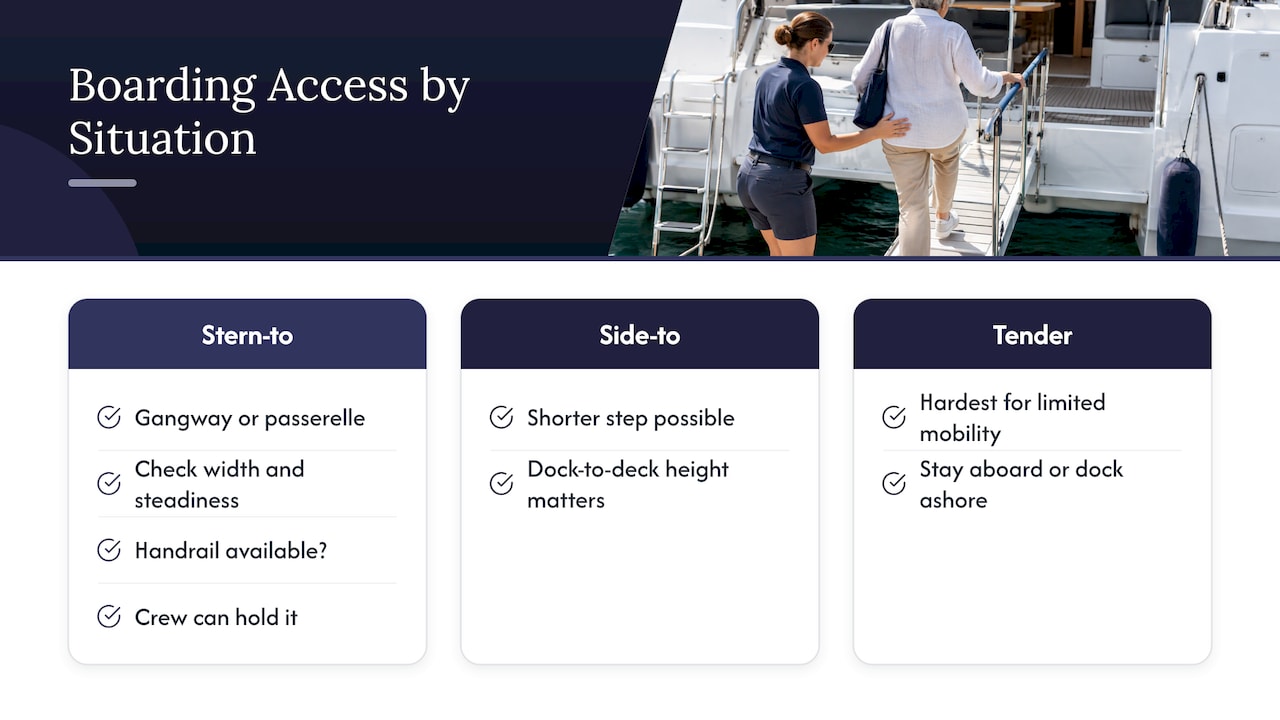
Most of the effort of a catamaran holiday happens at the dock, when the boat moves slightly, the gap to the quay changes and the person boarding has to cross it. Think through three situations.
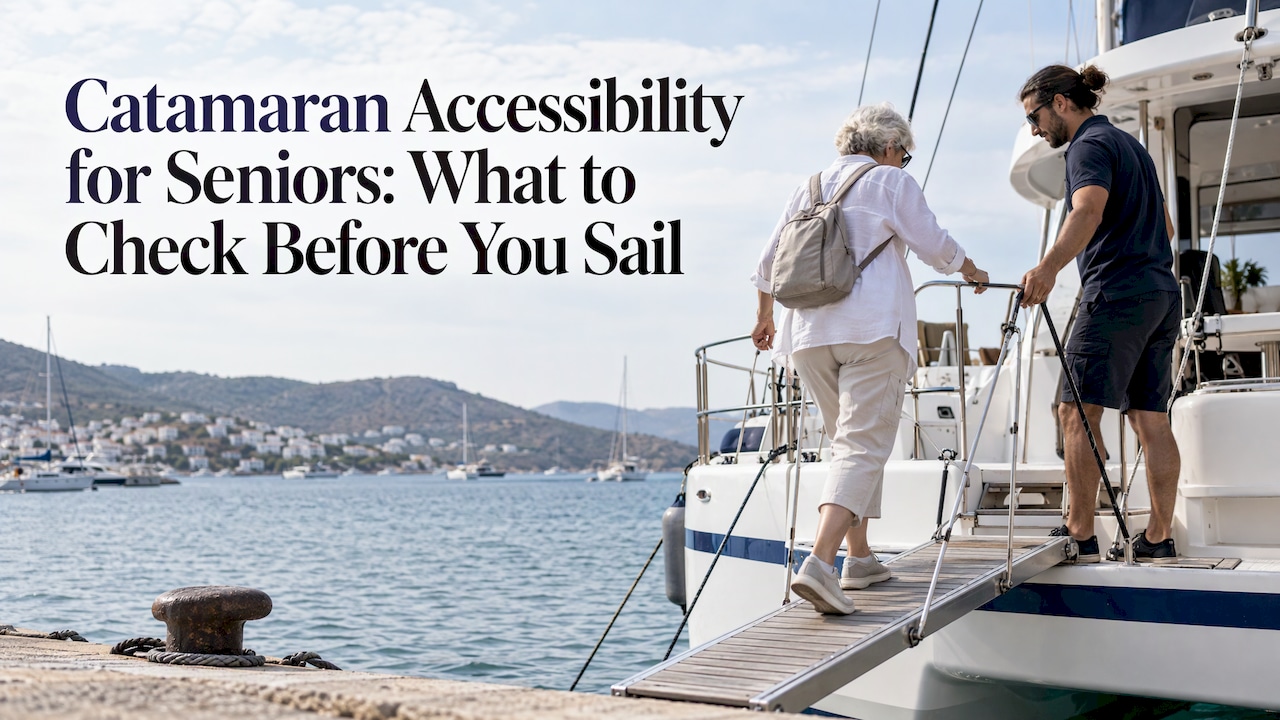
Stern-to mooring. In much of Greece, boats moor with the back toward the quay and cross on a gangway or passerelle. Ask how wide and steady it is, whether there is a handrail, and whether the crew can hold it while someone crosses.
Side-to mooring. In some marinas boats lie alongside a pontoon. This can mean a shorter step, but the height difference between dock and deck matters.
Tender transfers. When the boat anchors in a bay, you reach the shore by dinghy. This is the hardest moment for anyone with limited mobility, so plan on staying aboard or going ashore only where there is a dock.
Greece has shown it can be done thoughtfully. On 21 May 2025, the “Wheelchairs on Board” initiative at Alimos Marina let wheelchair users board a sailing yacht using a specially designed ramp, and included training in boarding, staying on board and navigation procedures. That is a useful model for what to ask any operator: how will this person get from the dock to the deck, who will help, and what happens at the next stop?
A yardstick for doorways and lifts
Yachts are not passenger ferries and the rules differ. Still, Greek ministry guidance for applicable passenger ships gives a feel for the dimensions that work for a wheelchair: a lift with internal dimensions of at least 110×140 cm and an entrance at least 85 cm wide. Measure the traveler’s own chair or walker, then compare it with the door widths of the boat you are considering. It is a handy way to turn “will it fit?” into a number.
Moving around the boat
Once aboard, life on a catamaran happens in a few places: the cockpit (the outdoor seating area at the back), the saloon (the indoor lounge and kitchen area), the cabins and the trampoline or foredeck at the front. For an older traveler, check these points:
- Level changes. Is there a step between the cockpit and the saloon? How high is it, and is there something to hold?
- Handholds. Boats move even in a calm anchorage. Look for rails along the walkways and grab points near the saloon door.
- Non-slip surfaces. Wet decks are slippery. Ask about the deck finish and bring shoes with grip.
- Shade and seating. Comfortable seating in shade lets an older traveler enjoy the day without moving around much.
- Safety briefing. At the start of the week the skipper explains where to stand, where to hold on and how to move when the boat is underway. Make sure everyone, including the older traveler, hears it.
A skipper also sets the rhythm of the day. Shorter hops, early arrivals in port and a long lunch swim stop are all easier to arrange when someone experienced is planning the route. If you wonder how that works in practice, our guide to a catamaran with a captain in Greece explains what the skipper handles and what stays up to you.
Cabins and bathrooms
This is where many families discover a surprise, because cabins are usually in the hulls and reached from the saloon by a few steps. Ask these questions:
- How do you reach the cabin? Count the steps and ask whether there is a handrail.
- How is the bed placed? A bed against a wall with space on one side is harder to climb into than one with open access.
- Where is the bathroom? Many boats have a private bathroom per cabin. Ask about the door width and whether there is room to turn.
- What is the shower like? A small compartment with a step up or a wet floor needs attention. Ask whether there is a seat or a handhold, and bring a non-slip mat.
- What is the headroom? Tall travelers may stoop in the hulls.
Also think about the night. Bring a small light for the way to the bathroom, and choose a cabin close to the steps if getting up at night is likely. If the group is booking several cabins, book the one that is easiest to reach for the person who needs it most, not the one with the best view.
Getting ashore and into the sea
Sailing in Greece is also about the places you stop: a taverna dinner on a quay, a village walk, a swim off the back of the boat. Accessibility here depends on the destination as much as on the boat. Greece’s tourism authority is candid that its mountainous terrain and centuries-old infrastructure make accessibility a work in progress that varies by destination. That means the route matters. Cobbled hillside villages can be a real challenge, while flat waterfront towns are easier.
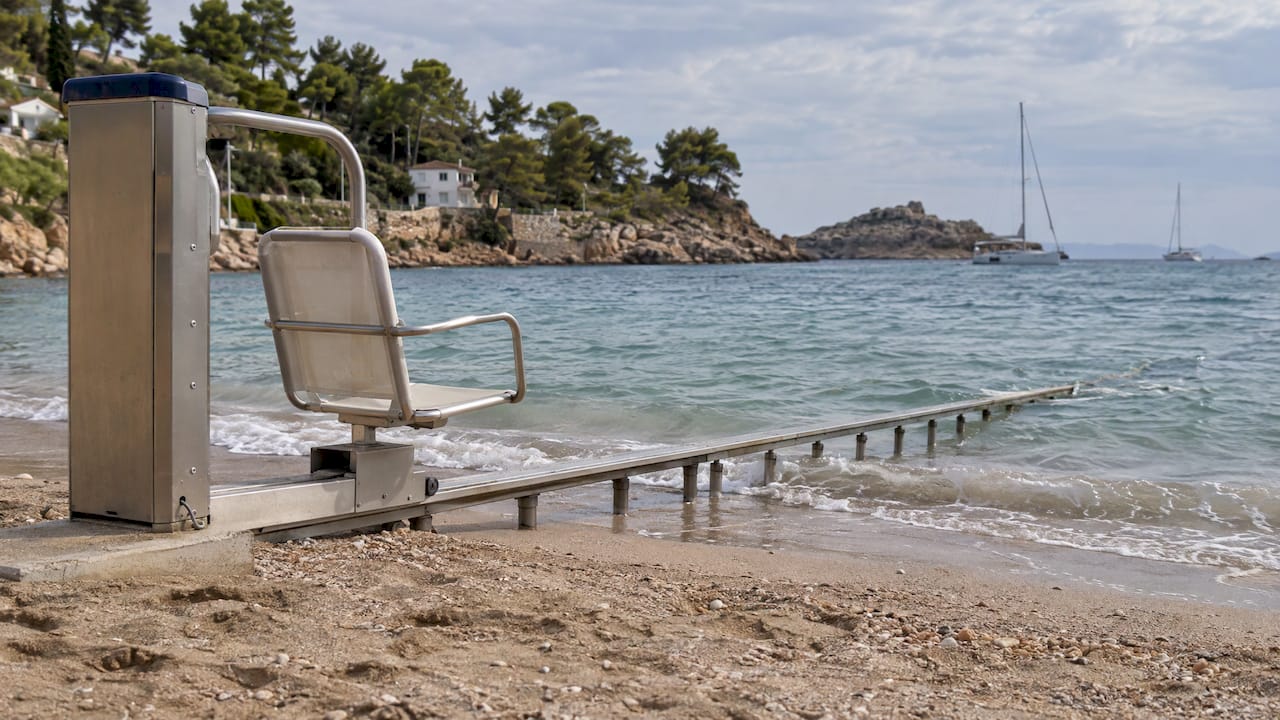
There is good news for swimmers. Seatrac chairs are installed at over 200 beaches across Greece, letting wheelchair users and others with mobility issues reach the sea on their own. If a beach stop matters to your traveler, mention it when planning the route so the skipper can build a day around it. For ideas on planning wheelchair-friendly outings on land, you can browse these wheelchair-accessible activities too.
Ports and ferries along the way
If your trip includes ferries or ship connections before or after the charter, Greek authorities have rules for them. Port terminal operators are obliged to take necessary measures to keep improving access for passengers with disabilities, and accessibility facilities for reduced-mobility passengers on ships are checked in annual Passenger Ship Safety Certificate inspections. The Hellenic Coast Guard also runs a section on the accessibility of Greek ports for people with disabilities and reduced mobility, which is worth checking when you plan transfers.
Choosing a route that suits slower travelers
A gentle route is the single biggest accessibility feature you control. Aim for:
- Short legs. Two to three hours of sailing, with arrival in the early afternoon.
- Marina stops. Docking at a quay or marina is easier than anchoring and taking a dinghy to shore.
- A rest day. Staying in one bay or port for a day gives everyone time to recover.
- A calm season. Many families prefer late spring or early autumn, when it is cooler and less crowded. Check seasonal conditions for the area you choose.
- An easy start. Knowing the departure marina and how to get there removes stress on day one. Our guide on getting from Athens Airport to Alimos Marina walks through the transfer, and our Athens marina guide compares the options.
The check-in day is also long. Our Greek yacht check-in guide explains the paperwork steps, so you know when the older traveler can sit down and rest while the rest of the group handles them.
Motion, health and comfort
Catamarans are known for sitting fairly level compared with many single-hull boats, but any boat moves, and sea conditions change. Practical steps for older travelers:
- Talk to a doctor first. Anyone with heart, balance, joint or medication concerns should discuss the trip with their own doctor before booking, including how to handle motion sickness and sun exposure.
- Bring medication and a list. Pack enough for the whole trip plus a few days, kept in hand luggage.
- Plan for heat. Hats, sunscreen, shade and plenty of water matter more than they seem.
- Know the nearest help. Tell the skipper about any condition at the start of the week so the route can take it into account.
Questions to ask before you book
Write these down and send them with the traveler’s details. Greece’s accessibility varies, so specific answers are worth more than general reassurance.
| Topic | What to ask |
|---|---|
| Boarding | How wide is the gangway? Is there a handrail? Who helps? |
| Pont | Any steps between cockpit, saloon and foredeck? Are there handholds? |
| Cabine | How many steps to reach it? Is the bed open on one side? |
| Salle de bains | Door width, room to turn, a seat or handhold in the shower |
| Itinéraire | Which stops are docks, and which are anchorages with tenders? |
| Shore | Is the terrain flat? Are there beach access aids nearby? |
| People | Who is the skipper, and who on board can help with each transfer? |
Notre perspective
We have watched the same pattern again and again: groups plan the sailing, the cabins and the swim stops, and the question of how Grandma or Dad will get aboard comes up last. It should come first.
Our view is that the best accessibility feature on a sailing holiday is a route and a boat chosen with real people in mind. That is why we place so much weight on personalized support from actual sailors at every step, and on skippers who have been professionally trained and who plan routes around the group, not the other way round.
A private week lets you set the pace: shorter legs, marina nights and a rest day in the middle. A group week brings company and shared fun, so an older traveler is never the only one who wants a slow morning. Both are open to you, and you can choose the one that suits your family.
Voile
Plan a week that works for everyone
If an older traveler is coming along, a private week keeps the itinerary in your hands. Our Greece Go Private week starts from 560 € per week per person, and you can pick the yacht or catamaran, departure date and route with the group’s needs in mind.
See the Greece Go Private sailing holiday, or compare it with séjours de voile privés et en groupe to see which format fits. If you are still choosing between them, our page on choosing a private or group sailing holiday sets out the differences. Tell us who is traveling and what they need, and we will talk through the boat and route with you.
FAQ
Is a catamaran a good choice for seniors?
Often yes, because the living areas are spacious and the boat tends to sit fairly level. But the details change from boat to boat, so check steps, door widths, the cabin route and the bathroom layout for the exact model you are considering.
Can someone in a wheelchair go on a sailing holiday in Greece?
It is possible with planning. Alimos Marina has hosted an initiative that let wheelchair users board a sailing yacht by ramp, with training for boarding and staying aboard. Boarding, cabin access and bathroom space should be settled with the operator before you book.
How do older travelers get ashore from a catamaran?
The easiest stops are marinas and quays, where you walk across a gangway. At anchorages you go ashore by dinghy, which is harder, so plan more dock nights and keep anchorage swims for days when everyone is comfortable.
Should we check with a doctor before the trip?
Yes. If the traveler has heart, balance, joint or medication concerns, ask their own doctor about motion, heat and the length of the trip before you book, and tell the skipper at the start of the week.
Sources
- Wheelchairs on Board, Alimos Marina
- Travelling Beyond Barriers, Visit Greece
- Hellenic Coast Guard, passenger rights report 2021–2022
- Hellenic Coast Guard, report 2023–2024
- Greek Ministry of Maritime Affairs, explanatory guidance on accessibility