
L’âge d’un voilier est l’un des facteurs les plus déterminants dans toute décision de location, car il influe directement sur la sécurité, la fiabilité et la qualité de votre séjour en mer. La plupart des personnes qui planifient un voyage à la voile se concentrent sur la destination et le prix, mais l’année de construction du bateau et son historique d’entretien peuvent faire toute la différence dans la qualité de l’expérience. L'âge d'un voilier est un critère important dans le choix d'une location, car il influe sur tout, de la fiabilité du moteur à l'état des équipements électroniques à bord. Des marques comme Jeanneau et Bavaria dominent les flottes de location en Méditerranée, et même leurs coques, pourtant de construction solide, présentent une usure notable après des années d'utilisation intensive. Comprendre ce que signifie concrètement l'âge d'un voilier vous permet de prendre les choses en main avant même de monter à bord.
Pourquoi l'âge d'un voilier est-il un facteur important pour la sécurité et la fiabilité d'une location ?
La raison la plus évidente pour laquelle il faut prêter attention à l’âge d’un bateau de location est la sécurité. Le gréement, c’est-à-dire l’ensemble des câbles et cordages qui maintiennent le mât en place, est soumis à une charge constante et à une fatigue continue. Les opérateurs de location prévoient généralement de remplacer le gréement tous les 7 à 10 ans, mais les bateaux très sollicités peuvent nécessiter une intervention plus rapide. Un bateau qui effectue 35 semaines de location par an subit des contraintes bien plus rapidement qu’un yacht privé.
Les chiffres parlent d'eux-mêmes. Au bout de cinq ans, un yacht de location a généralement accueilli environ 175 membres d'équipage et totalisé quelque 1 750 heures de fonctionnement du moteur. Un tel niveau d'utilisation met les systèmes mécaniques à rude épreuve, en particulier les composants périphériques tels que les filtres à eau, les courroies et les roues, qui ne sont pas toujours remplacés dans les délais prévus.
Au bout de cinq à sept ans, l'usure s'accélère. Les moteurs sont résistants, mais les composants périphériques tombent plus souvent en panne sur les yachts ayant dépassé les 1 500 heures de fonctionnement. Une panne de moteur en pleine traversée, dans la mer Égée ou le long de la côte croate, n'est pas seulement gênante. Elle peut s'avérer véritablement dangereuse si vous êtes loin d'un port de plaisance.
Voici les éléments à prendre en compte pour évaluer le niveau de sécurité d'un bateau en fonction de son âge :
- État du gréement : Demandez quand le gréement dormant a été remplacé pour la dernière fois et si un expert professionnel a validé cette opération.
- Heures de fonctionnement du moteur : Demandez le nombre d'heures de fonctionnement actuel du moteur et comparez-le à la date de mise en service du bateau.
- Registre d'entretien : Un opérateur sérieux fournit un historique complet des entretiens, et ne se contente pas d'une simple assurance verbale.
- Équipement de sécurité : Les radeaux de sauvetage, les fusées de détresse et les balises de détresse (EPIRB) ont tous une date de péremption. Il arrive que les bateaux plus anciens soient équipés de matériel périmé.
- État de la voile : Les voiles des bateaux de location très sollicités s'usent plus rapidement que celles des yachts privés. Vérifiez s'il y a des dommages causés par les UV et si les coutures sont usées.
Conseil de pro : Avant de signer un contrat, demandez à la société de location le nombre d'heures de fonctionnement du moteur et la date de la dernière révision mécanique complète. Si elle n'est pas en mesure de vous fournir ces informations dans les 48 heures, considérez cela comme un signal d'alerte.
En quoi l'âge d'un bateau influe-t-il sur le confort, les équipements technologiques et les performances ?
Au-delà de la sécurité, l’âge d’un bateau de location influence votre expérience quotidienne d’une manière que vous remarquerez dès le premier matin. Les bateaux plus récents, généralement ceux construits après 2020, sont équipés de traceurs de cartes qui intègrent l’AIS, les informations météorologiques et les données de profondeur sur un seul écran clair. Les bateaux plus anciens peuvent être équipés d’appareils électroniques obsolètes qui nécessitent davantage de compétences pour être utilisés et offrent une meilleure perception de la situation.
La manœuvre des voiles est un autre domaine où l'âge se fait rapidement sentir. Les winchs d'un Jeanneau Sun Odyssey ou d'un Bavaria C42 récent sont fluides et réactifs. Sur un bateau ayant connu sept saisons ou plus de location, des cliquets de winch usés et des systèmes d'enroulement grippés rendent chaque manœuvre plus difficile qu'elle ne devrait l'être. Cela est particulièrement important si votre équipage comprend des débutants ou des invités qui ne sont pas des marins expérimentés.
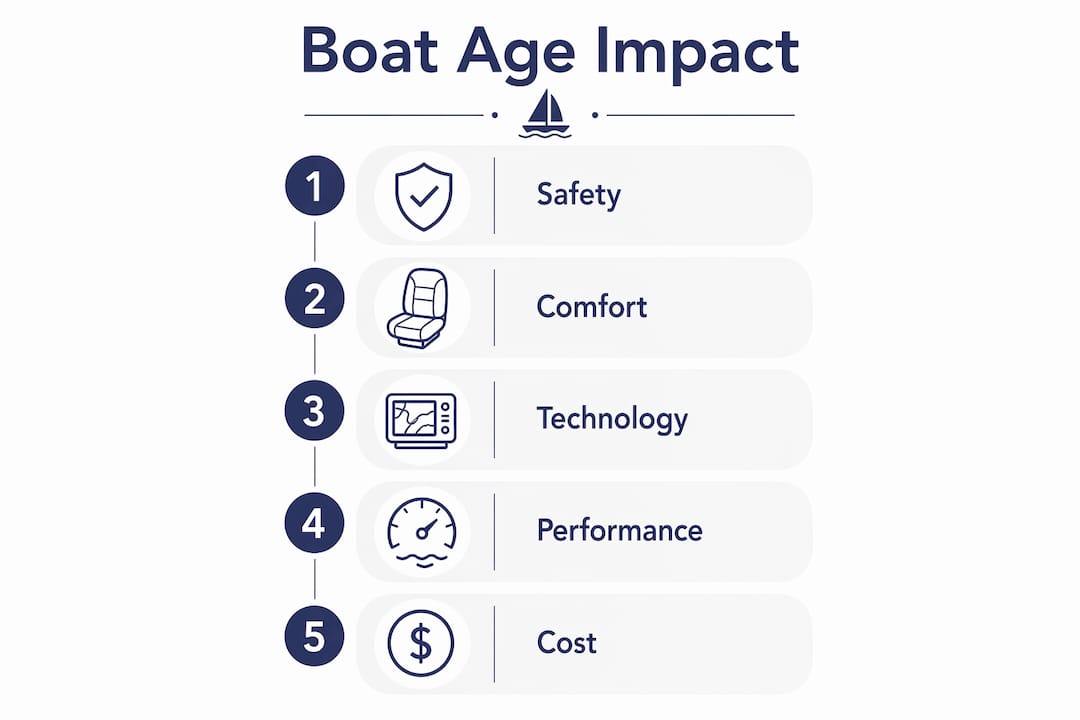
Les défauts esthétiques ont un impact sur l'expérience des passagers, même s'ils ne compromettent pas la sécurité de la navigation. Les coussins tachés, le gelcoat fissuré et les équipements arrivant en fin de vie sont monnaie courante sur les bateaux de plus de sept ans. Vous êtes en vacances, et l'état de votre espace de vie a son importance.
Le tableau ci-dessous compare les montants auxquels vous pouvez généralement vous attendre selon trois tranches d'âge :
| Fonctionnalité | 1 à 3 ans | 4 à 7 ans | 8 ans et plus |
|---|---|---|---|
| Électronique | Actuel, intégré | Fonctionnel, mais un peu dépassé | Probablement obsolète ou corrigé |
| Gréement | En pleine forme, peu de fatigue | À mi-parcours, inspectez soigneusement | Fatigue importante, vérifier les registres |
| État esthétique | Excellent | Bon à passable | En état correct à usé |
| Manœuvre des voiles | Fluide, facile | Généralement fiable | Cela pourrait demander davantage d'efforts |
| Électroménager | Nouveau | En état de marche, quelques traces d'usure | Risque accru de défaillance |
| Heures de fonctionnement du moteur | Faible | Modéré | Élevé, surveiller de près |
Un bateau ancien bien entretenu peut encore vous offrir une superbe croisière. Le mot clé, c'est « entretenu ». Un Bavaria de cinq ans qui a fait l'objet d'un entretien rigoureux chaque hiver sera toujours plus performant qu'un bateau de deux ans appartenant à un propriétaire négligent.
Quels sont les principaux éléments à prendre en compte pour évaluer l'âge d'un bateau de location ?
L'une des erreurs les plus courantes lors de la réservation d'une location de bateau consiste à confondre l'année de construction du bateau avec celle de sa rénovation. Les annonces de location de bateaux masquent souvent Cette différence est considérable. Une coque datant de 2010, dont l'intérieur a été rénové en 2024, n'est pas comparable à un bateau construit en 2024. Les éléments structurels, le gréement et le moteur ont toujours quinze ans.
Voici comment évaluer correctement l'âge d'un bateau avant de vous engager :
- Demandez la date de la commission. Il s'agit de la date à laquelle le bateau a été mis en service pour la location, et non pas simplement de l'année de construction de la coque. Il peut y avoir un écart d'un an, voire plus, entre ces deux dates.
- Demandez le cahier des charges de la remise en état. Une véritable remise en état comprend le gréement, la révision du moteur, la sellerie et l'électronique. Une remise à neuf esthétique se limite à la peinture et aux coussins. Assurez-vous de bien savoir de quel type de travaux il s'agit.
- Vérifiez le nombre d'heures de fonctionnement du moteur par rapport à la date de mise en service. Un bateau mis en service en 2018 et totalisant 3 000 heures de fonctionnement a été soumis à une utilisation intensive. Un autre, avec 800 heures au compteur, a été peu utilisé.
- Recherchez les rapports d'inspection de mi-saison. Les exploitants responsables procèdent à des inspections des installations en milieu de saison et à des révisions mécaniques hivernales. Demandez à voir les documents justificatifs.
- Soyez attentifs aux signaux d'alerte. Des réponses vagues concernant l'historique d'entretien, des photos ne montrant que l'intérieur et des annonces mettant en avant la mention “ récemment rénové ” sans donner de détails précis sont autant de signaux d'alerte.
Transparence concernant les années de construction et de rénovation C'est le signe le plus évident qu'il s'agit d'un opérateur digne de confiance. Si une entreprise n'est pas en mesure de vous communiquer la date de mise en service et le calendrier des travaux de rénovation dans les 48 heures suivant votre demande, cherchez ailleurs.
Conseil de pro : Lors de la réunion d'information préalable à la prise en charge du bateau, venez accompagné d'une deuxième personne pour vous aider à répertorier les différents systèmes du bateau. Enregistrez la visite guidée sur votre téléphone afin de disposer d'un document de référence en cas de problème en cours de voyage. Cela s'avère particulièrement utile sur les bateaux plus anciens, dont les systèmes sont plus complexes ou ont fait l'objet de réparations.
Dans quelle mesure l'âge d'un bateau influe-t-il sur le coût de la location et la stratégie de réservation ?
La location des bateaux les plus récents coûte plus cher, et la différence est bien réelle. Les modèles postérieurs à 2020 sur les itinéraires méditerranéens très prisés, comme la Grèce, la Croatie et la Sardaigne, affichent généralement un supplément par rapport à leurs équivalents de 2016 à 2019 de taille similaire. Ce supplément s'explique par une usure moindre, des équipements électroniques plus performants et un gréement plus récent.
Le moment choisi pour la réservation a une incidence directe sur ce point. Réserver 4 à 6 mois à l'avance permet de réserver des bateaux plus récents en bénéficiant de réductions pour réservation anticipée de 10 à 20%. Les réservations de dernière minute peuvent permettre d'économiser entre 15 et 30%, mais aboutissent presque toujours à l'attribution de bateaux plus anciens, car les modèles les plus récents sont réservés en priorité. Si vous tenez à disposer d'un bateau récent et bien équipé, réservez tôt et précisez bien vos choix.
Outre l'âge, plusieurs facteurs influent sur le coût total de votre location :
- Destination : La Grèce et la Croatie proposent des tarifs compétitifs. Les îles Vierges britanniques et Tahiti pratiquent des tarifs nettement plus élevés.
- Taille et type du yacht : Un catamaran coûte plus cher qu'un monocoque du même âge. Il offre plus d'espace, comporte davantage d'équipements et nécessite plus d'entretien.
- Saison : Les tarifs en haute saison, en juillet et août, sont de 20 à 40% plus élevés que ceux de la saison intermédiaire, en mai, juin ou septembre.
- Extras : Les honoraires du skipper, l'approvisionnement, les frais de port et le carburant ne sont souvent pas inclus dans le prix de base de la location.
Pour comparer des bateaux de différentes tranches d'âge, le plus judicieux est de prendre en compte le coût global, et pas seulement le prix affiché de la location. Un bateau plus ancien et moins cher, mais qui entraîne des frais de réparation imprévus en cours de voyage, n'est jamais l'affaire qu'il semble être sur le papier.
Quels conseils pratiques vous aident à choisir le bateau de location adapté à chaque tranche d'âge ?
Les affréteurs les plus expérimentés ne se focalisent pas uniquement sur l'âge du bateau. Ils accordent la priorité, avant tout, au historique d'entretien et à la réputation de l'opérateur. Un Jeanneau de cinq ans, dont l'historique d'entretien est bien documenté et qui est géré par une société d'affrètement réactive, constitue un meilleur choix qu'un bateau de deux ans proposé par un opérateur qui se fait discret une fois le paiement effectué.
Conditions de navigation à destination est plus important que beaucoup ne le pensent. Les experts recommandent de tenir compte de la régularité des vents locaux, mesurée par ce qu’on appelle le « sail score », au moment de choisir sa destination. Un bateau ancien parfaitement entretenu, naviguant sous les vents réguliers du Meltemi dans les Cyclades grecques, vous offrira une expérience de navigation bien plus satisfaisante qu’un bateau flambant neuf dans une destination où les vents sont imprévisibles et faibles.
Voici les mesures concrètes qui font toute la différence :
- Choisissez un bateau adapté au niveau d'expérience de votre équipage. Un bateau plus récent, équipé de systèmes de manœuvre des voiles modernes, est vraiment plus facile à manœuvrer pour des groupes dont les niveaux d'expérience sont variés. Les bateaux plus anciens, dotés de systèmes manuels, conviennent mieux aux navigateurs plus expérimentés.
- Vérifiez le réunion d'information sur la passation de pouvoir processus. Une remise en main propre minutieuse porte sur les dessalinisateurs, les batteries, les pompes de cale et l'équipement de sécurité. C'est en négligeant cette étape sur un bateau ancien que les petits problèmes finissent par devenir de gros problèmes.
- Renseignez-vous sur la politique de l'opérateur concernant l'âge de sa flotte. Les entreprises réputées retirent leurs bateaux de la flotte de location après un certain nombre d'années. Renseignez-vous sur ce délai.
- Consultez les avis pour voir s'il y a des plaintes concernant l'entretien. Les avis des clients qui mentionnent du matériel défectueux, des intérieurs tachés ou un service client peu réactif en disent plus long que n'importe quelle photo de l'annonce.
Conseil de pro : Si vous réservez un location de cabines Si vous optez pour un bateau en partage, renseignez-vous précisément sur l'âge du bateau et la date de sa dernière révision. Les locations de groupe sollicitent davantage le bateau que les locations privées ; le niveau d'entretien est donc d'autant plus important.
Principaux enseignements
L'âge d'un bateau de location n'a d'importance que s'il s'accompagne d'un mauvais entretien. Un yacht de cinq ans bien entretenu l'emportera toujours sur un yacht de deux ans négligé.
| Point | Détails |
|---|---|
| Tranche d'âge optimale | Les yachts de location âgés de 1 à 5 ans offrent le meilleur compromis entre un équipement récent et un prix raisonnable. |
| Pension alimentaire pour personne âgée | Un historique d'entretien documenté est un critère plus fiable que la seule année de construction pour évaluer la qualité d'un bateau. |
| Réservez à l'avance pour bénéficier des bateaux les plus récents | En réservant 4 à 6 mois à l'avance, vous êtes assuré d'obtenir des modèles plus récents et de bénéficier de réductions pour réservation anticipée allant de 10 à 20%. |
| Rénovation ou année de construction | Demandez toujours la date de mise en service et l'étendue complète des travaux de rénovation, et pas seulement l'année de construction de la coque. |
| Réunion d'information sur la passation de pouvoir | Consignez les informations techniques transmises lors de la passation de pouvoir afin d'éviter toute panne en cours de voyage, en particulier sur les navires anciens ou complexes. |
Mon point de vue sincère sur l'âge des bateaux et ce que la plupart des articles ne comprennent pas
J'ai vu trop de clients de location arriver à la marina en ne s'intéressant qu'à l'année de construction du bateau, au point de passer à côté de ce qui compte vraiment et qui se trouve pourtant juste sous leurs yeux. Une coque rutilante de 2022 appartenant à un propriétaire négligent peut s’avérer bien plus décevante qu’un Bavaria de 2017 qui a été choyé et correctement entretenu. L’année inscrite sur la coque n’est qu’un élément parmi d’autres.
Ce qui me semble plus révélateur, c’est la manière dont une société d’affrètement réagit lorsque vous lui posez des questions difficiles. Vous envoient-elles sans hésiter le relevé des heures de fonctionnement du moteur et le carnet d’entretien ? Expliquent-elles clairement l’étendue des travaux de rénovation, ou se contentent-elles de répondre par des arguments marketing ? La transparence est le véritable gage de qualité. Les sociétés qui se cachent derrière des photos sur papier glacé et des affirmations vagues du type “ récemment rénové ” sont celles qui mécontentent leurs clients.
L'autre élément que la plupart des articles négligent est le facteur « destination ». Des conditions de navigation stables dans un endroit comme les îles grecques ou la côte dalmate en Croatie contribueront davantage à la réussite de votre voyage que de vous demander sans cesse si le bateau a trois ou cinq ans. Un skipper sûr de lui, un itinéraire bien planifié itinéraire de navigation, et un bateau dont le carnet d'entretien est en règle l'emportera toujours sur un bateau plus récent qui ne présente pas ces garanties.
Posez des questions. Exigez de consulter les dossiers. Et choisissez votre opérateur avec autant de soin que vous choisissez votre destination.
- Voile
Trouvez le bateau de location idéal avec Sailarmada
Sailarmada propose des séjours à la voile en Grèce, en Croatie, en Italie, en Sardaigne et bien au-delà, en garantissant une transparence totale sur la flotte à chaque réservation. Vous pouvez consulter des annonces de yachts vérifiées, avec des informations claires sur leur année de construction, leur historique de rénovation et leurs normes d'entretien, afin de savoir exactement à quoi vous attendre.

Que vous recherchiez le tout dernier modèle Jeanneau, tout juste sorti de sa première saison, ou un classique bien entretenu à un prix plus attractif, l'équipe de Sailarmada vous aide à trouver le bateau qui correspond le mieux à votre équipage, à votre budget et à votre itinéraire. En réservant tôt, vous aurez accès aux meilleurs bateaux aux meilleurs tarifs. Parcourir les meilleures agences de location de bateaux et options de navigation privée pour commencer à organiser un voyage où le bateau est tout aussi intéressant que la destination.
FAQ
Quel doit être l'âge d'un bateau de location pour garantir la sécurité de la sortie ?
Les yachts de location âgés de 1 à 5 ans sont considérés comme le choix idéal, car ils sont équipés d'appareils électroniques modernes et d'un gréement qui n'a pas encore subi de fatigue importante. Les bateaux de plus de sept ans peuvent tout de même être sûrs, mais il est nécessaire de disposer d'un dossier d'entretien complet avant de réserver.
Une rénovation récente permet-elle à un ancien bateau de location d'être considéré comme un bateau neuf ?
Non. Une coque datant de 2010 et rénovée en 2024 n’est pas la même chose qu’un bateau construit en 2024. Les éléments structurels, le gréement et le moteur conservent leur âge d’origine ; il faut donc toujours demander à connaître l’étendue complète des travaux de rénovation en plus de l’année de construction de la coque.
Quelles questions dois-je poser à une société de location concernant l'âge du bateau ?
Renseignez-vous sur la date de mise en service, le nombre d'heures de fonctionnement actuel du moteur, la date du dernier entretien mécanique complet et l'étendue des travaux de rénovation, accompagnée de pièces justificatives. Si l'exploitant n'est pas en mesure de vous fournir ces informations dans un délai de 48 heures, considérez cela comme un signal d'alerte.
Un bateau plus récent garantit-il une meilleure expérience de navigation ?
Ce n'est pas forcément le cas. Les conditions de navigation sur le lieu de destination et les normes d'entretien de l'exploitant ont autant d'importance que l'année de construction. Un bateau plus ancien, bien entretenu, naviguant dans des vents réguliers, sera souvent plus performant qu'un bateau plus récent appartenant à un exploitant négligent.
En quoi le moment de la réservation influe-t-il sur l'âge du bateau qui m'est attribué ?
En réservant 4 à 6 mois à l'avance, vous aurez accès aux bateaux les plus récents de la flotte et bénéficierez souvent de réductions pour réservation anticipée allant de 10 à 20%. Les réservations de dernière minute donnent généralement droit à des bateaux plus anciens, car les modèles les plus récents sont réservés en priorité.