

Yes, early boarding is widely available on Mediterranean yacht charters, and for many sailors it’s worth every euro. Early boarding, sometimes called sleep-aboard, lets you step onto your yacht hours (or a full night) before the standard check-in time, often around 1 to 2 p.m. on turnover day, effectively gaining an extra sailing day. Expect fees roughly between €100 and €250 depending on the operator and base.
En bref :
- Early boarding fees typically range from €100 to €150, with higher charges of around €250 if it effectively grants an additional sailing day.
- Sleep-aboard allows boarding the night before, offering extra time on the yacht and often incurring a nightly rate rather than a flat fee.
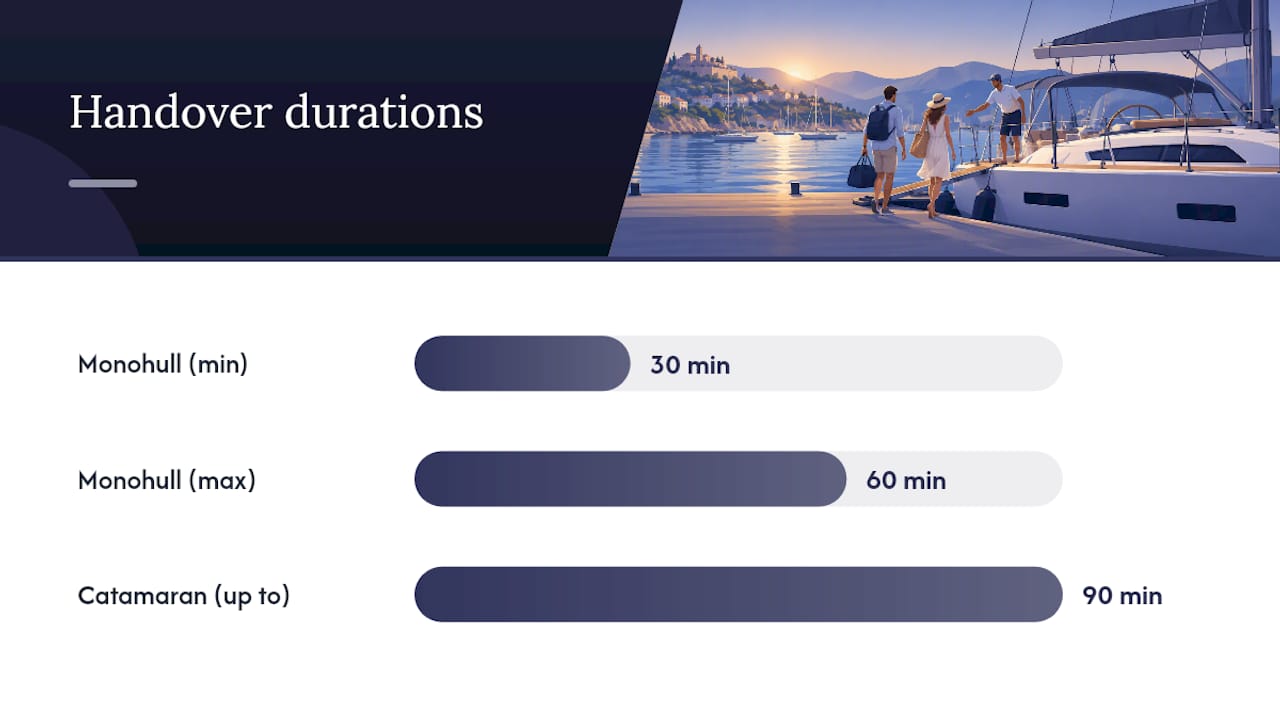
- The yacht handover process usually lasts 30 to 60 minutes for monohulls and up to 90 minutes for larger catamarans, depending on various factors.
- Smooth early boarding depends on the previous charter returning on schedule, staffing levels, and current maintenance or weather delays.
- Request early boarding or sleep-aboard at booking or 7 to 14 days prior, and always confirm policies directly with the charter operator.
Table des matières
- What early boarding and sleep-aboard actually mean
- How early boarding changes the handover experience
- Costs and pricing models: what you’ll actually pay
- When early boarding is genuinely worth the money
- Requesting early boarding and protecting your deposit at handover
- Alternatives if early boarding isn’t available
- SailArmada’s take on getting your charter off to a strong start
- Ready to lock in your sailing dates?
- Sources
- FAQ
What early boarding and sleep-aboard actually mean
Not all “early” options are created equal, and knowing the difference helps you ask for exactly what you want. Paid early boarding usually means the base prioritizes your yacht’s cleaning and provisioning so you can board earlier in the day, sometimes as early as 1 or 2 p.m. instead of the standard late-afternoon handover. Sleep-aboard goes a step further: you board the night before your charter officially starts, stow your gear, get familiar with the boat, and wake up ready to cast off at first light. The Charter App explains sleep-aboard as an operator-offered perk that’s especially handy if your flight lands late or you simply want a calmer start to your holiday.
Then there’s the quieter option: priority check-in or a courtesy early release, which some bases offer for free when the previous charter returns on time and the crew has capacity to turn the boat around quickly. This isn’t guaranteed and depends entirely on how busy the marina is that week.
Availability, pricing, and exact timing shift from one operator and base to the next, so what your friend got in Split last summer might not be on the table in Athens this year. Always confirm directly with your charter company rather than assuming a policy applies everywhere.
How early boarding changes the handover experience
Mediterranean charters run on a Saturday-to-Saturday rhythm at most bases: one group sails off in the morning, and the next boards that same afternoon once the boat has been cleaned, refueled, and checked. A standard handover typically takes 30 to 60 minutes for a monohull and up to 90 minutes for a larger catamaran, covering a walkthrough of systems, an inventory check, and paperwork.
Early boarding compresses that same process into a tighter window earlier in the day, which means the cleaning crew, provisioning team, and technician all need to move faster. That’s usually fine when everything is coordinated in advance, but it can create friction if the previous charter is delayed coming back or if maintenance work runs long.
A few things commonly affect whether early boarding actually happens smoothly:
- The previous charter must return the yacht on schedule, since a late return pushes everything back.
- Base staffing on turnover day determines how many boats can be prepped simultaneously.
- Any pending maintenance or technician visits take priority over early handovers.
- Weather and provisioning delivery schedules can shift the whole day’s timeline.
Whether you board early or at the standard time, expect the same documentation: a signed charter agreement, an inventory list to check off, and confirmation of the security deposit. Keep copies of everything, since these documents are your protection if a dispute comes up later.
Costs and pricing models: what you’ll actually pay
Fee structures vary, but two patterns show up again and again across Mediterranean operators. Some charge a flat early-boarding fee, commonly around €100 to €150 for boarding a few hours ahead of the standard time. Others price it closer to €250 when early boarding effectively unlocks a same-day departure and, in practice, an extra sailing day. Sleep-aboard is often billed differently, as a nightly rate for the extra night on board rather than a one-time handover fee.
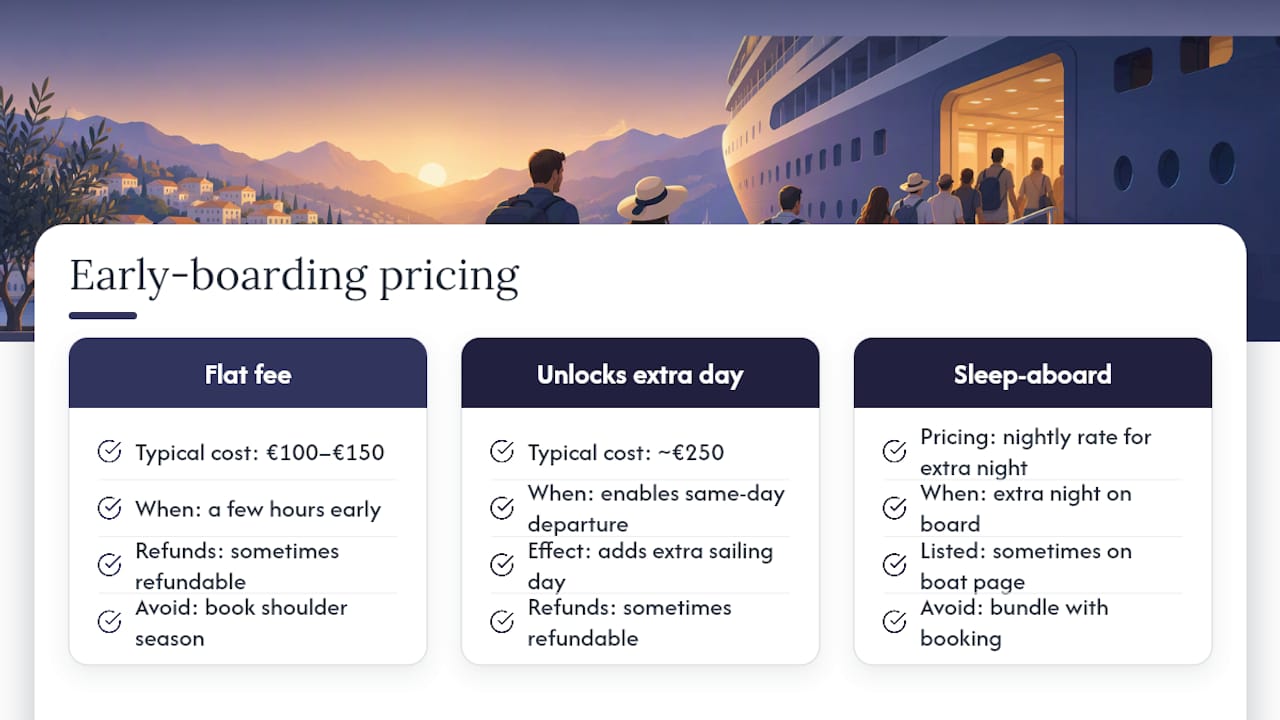
Some operator yacht listings even publish explicit early-boarding fees right on the boat’s page, which is the clearest way to budget since you’re not guessing. When a base doesn’t list a fee, treat any estimate as a starting point and confirm before you travel.
Refund policies differ too: some fees are locked in once paid, while others are refundable if the base can’t accommodate early boarding due to circumstances outside your control. To reduce or avoid the fee entirely, consider booking during shoulder season when bases are less rushed, asking politely whether a courtesy early release is possible, or bundling the request into your original booking package.
When early boarding is genuinely worth the money
The math is simple on a short charter: pay a fee once, gain hours or a full day of sailing you’d otherwise lose to paperwork and waiting around the marina. That extra time often means reaching a quieter anchorage before the afternoon crowds, or fitting in one more island on a tight itinerary. Sleep-aboard adds a second benefit, since you can stow provisions and settle the crew in the night before, cutting down on first-morning chaos.
The tradeoffs are worth weighing honestly. You’re paying extra on top of your charter fee, and if the base is genuinely swamped that day, an early boarding slot can still turn into a rushed, less thorough handover. Your plans also depend on the previous charter returning on time, which is outside your control.
Before deciding, ask yourself three questions: What time do you actually land, and how much dead time would you otherwise spend at the base? How long is your charter, since a 7-day trip feels the loss of a half day far more than a two-week one? And how packed is your first-day itinerary? If you’re flying in the morning of embarkation and have a tight route planned, early boarding tends to pay for itself quickly.
Requesting early boarding and protecting your deposit at handover
The best time to ask is when you book, or at the latest 7 to 14 days before arrival, giving the operator time to plan staffing. Send a short email with your exact arrival time and ask directly whether early boarding, sleep-aboard, or a courtesy early release is available for your dates.
Once you land, head straight to the base office rather than the boat. Confirm your provisioning order, ask about the cleaning status of your yacht, and let the staff know you’re flexible if it takes a little longer.
At handover itself, work through a clear checklist so nothing gets missed:
- Walk the hull and deck, checking for scratches, dents, or existing damage.
- Match the inventory list item by item against what’s actually on board.
- Test all electronics, including navigation instruments, chartplotter, and autopilot.
- Confirm safety gear: life jackets, flares, fire extinguishers, and the life raft’s service date.
- Photograph any existing damage before you leave the dock.
- Record fuel and water tank levels in writing.
- Keep signed copies of the charter agreement and inventory for your own records.
This same routine protects your security deposit, which can run into the thousands of euros, so it’s worth the extra fifteen minutes even if the base is trying to rush you through.
Staying calm, organized, and specific about your arrival time genuinely helps your case, even when you haven’t paid for early boarding.
Conseil de pro : Email your exact flight number and landing time to the base a few days ahead, since staff can often plan the turnover schedule around a known arrival far more easily than a vague “morning” estimate.
Alternatives if early boarding isn’t available
If early boarding isn’t offered or doesn’t fit your budget, sleep-aboard is often the next best option: you board the night before, get comfortable, and start sailing at a normal hour without losing sleep to travel logistics. It typically comes with its own nightly rate, so weigh that against how much a smoother first morning is worth to you.
Arriving a day early and booking a hotel near the marina is another solid fallback, especially useful if your flights only land the evening before anyway. You’ll need to arrange your own transfer to the base the next morning, but you avoid rushing straight from an airport to a handover.
Sometimes the simplest fix is adjusting your itinerary instead: accept the standard afternoon departure and trim your first day’s route, saving the more ambitious legs for later in the week when everyone’s settled in.
SailArmada’s take on getting your charter off to a strong start
Early boarding is often recommended for shorter charters or itineraries with an ambitious first day, and sleep-aboard for guests landing late the night before. When it makes sense, coordination can occur directly with bases on clients’ behalf, including a 4-point embarkation checklist covering arrival time, provisioning, boat readiness, and documentation before boarding. Good planning here sets the tone for the entire week.
- Voile
Ready to lock in your sailing dates?
If you’re still deciding between destinations, Grèce - Go Private is priced from €560 per week per person, and we check early-boarding and sleep-aboard availability with the base as part of setting up your booking. You won’t need to chase down policies yourself.
Whatever your arrival time looks like, tell us when you book and we’ll figure out the smoothest way to get you on board and sailing sooner.
Sources
- Yacht Charter Saturday to Saturday Explained – NauticEd
- How to go on a cruise earlier? – YACHTIC.com Blog
- Charter Yacht Handover Checklist (47 Points) | Boat Tomorrow
- sleep-aboard – The Charter App
FAQ
What is the difference between early boarding and sleep-aboard?
Early boarding lets you board the yacht a few hours ahead of the standard afternoon check-in, while sleep-aboard means boarding and staying on the boat the night before your charter officially begins. Both aim to give you more usable time, but sleep-aboard adds an overnight stay rather than just an earlier daytime slot.
How much does early boarding typically cost?
Fees commonly range from about €100 to €150 for a standard early-boarding slot, though some operators charge closer to €250 when it unlocks a same-day sailing departure. The exact amount depends on the base and how much extra time you’re gaining.
How long does a yacht handover usually take?
A typical handover takes 30 to 60 minutes for a monohull and up to 90 minutes for a larger catamaran, covering an inventory check, systems walkthrough, and paperwork. Bringing your own checklist and photographing existing damage helps the process go faster and protects your security deposit.
Can I request early boarding for free?
Sometimes, if the base has capacity and the previous charter returns on time, arriving early and asking politely at the office can result in a free early handover, though it’s never guaranteed. Paying for a confirmed early-boarding slot is the more reliable route if your schedule depends on it.
Does SailArmada arrange early boarding or sleep-aboard?
When booking a sailing holiday through a charter company, early-boarding and sleep-aboard availability may be checked with the base and arrival timing coordinated on behalf of clients, although availability and fees depend on the specific operator and destination.