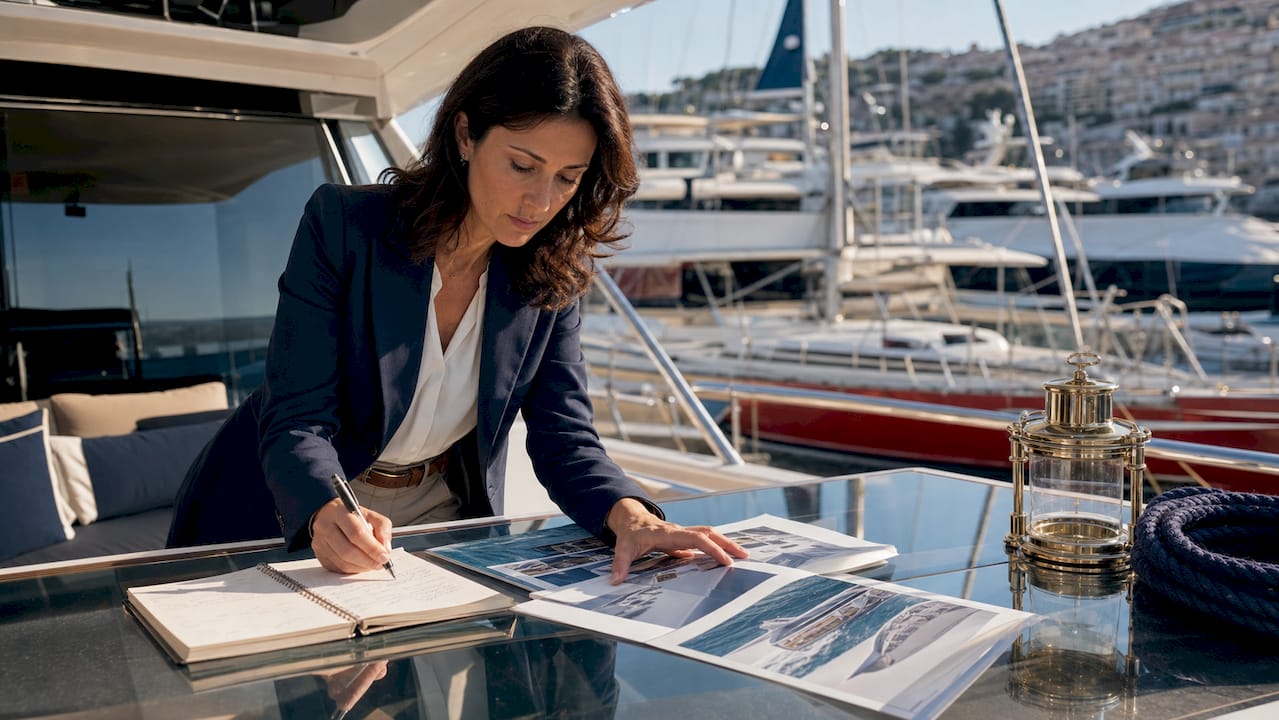
Choisir le bon yacht, c’est adapter précisément le type et les caractéristiques du bateau à vos préférences de navigation et à votre mode de vie. Si vous vous trompez, vous vous retrouverez avec un bateau trop complexe à manœuvrer, trop exigu pour votre groupe ou dont le tirant d’eau est trop important pour vos mouillages préférés. Si vous faites le bon choix, chaque réveil sur l'eau sera synonyme de liberté. Ce guide vous présente les différentes catégories de yachts, des questions d'auto-évaluation, les principales caractéristiques techniques, ainsi que les erreurs les plus courantes commises par les acheteurs et locataires novices, afin que vous puissiez prendre une décision en toute confiance et en toute connaissance de cause.
Quels sont les principaux types de yachts et en quoi diffèrent-ils les uns des autres ?
Le une adaptation parfaite au yacht Cela dépend de vos besoins, de votre budget, de vos préférences et de l'usage principal que vous comptez en faire. Ces quatre facteurs vous orientent d'emblée vers l'une des quatre grandes catégories suivantes : les yachts à moteur, les voiliers, les catamarans et les yachts d'expédition.
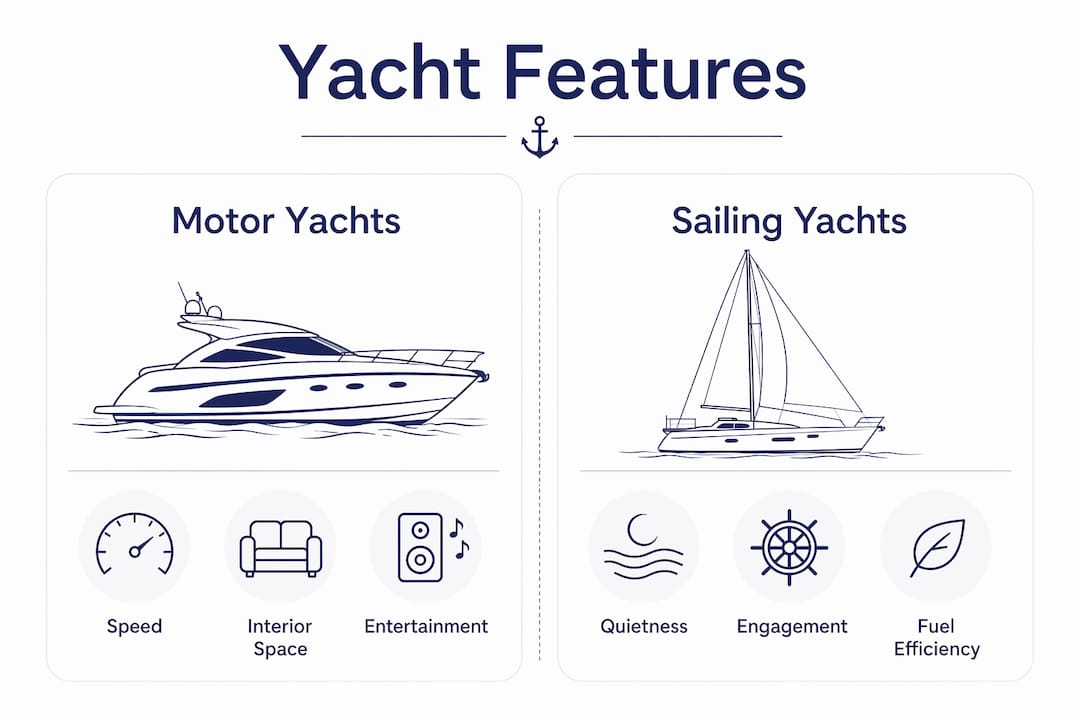
Yachts à moteur sont conçus pour allier confort et vitesse. Ils offrent un volume intérieur et un espace de vie plus spacieux que la plupart des voiliers, ce qui les rend très prisés pour les escapades du week-end et les locations d'entreprise. En contrepartie, ils présentent un coût de carburant plus élevé et une navigation plus bruyante.
Voiliers (les monocoques) offrent une expérience plus silencieuse et plus immersive sur l'eau. Les yachts à moteur résistent aux mers agitées Ils sont certes plus performants en vitesse, mais les voiliers offrent aux équipages expérimentés une connexion avec le vent et la mer qu’aucun moteur ne peut égaler. De plus, leur coût d’exploitation est nettement inférieur à long terme.
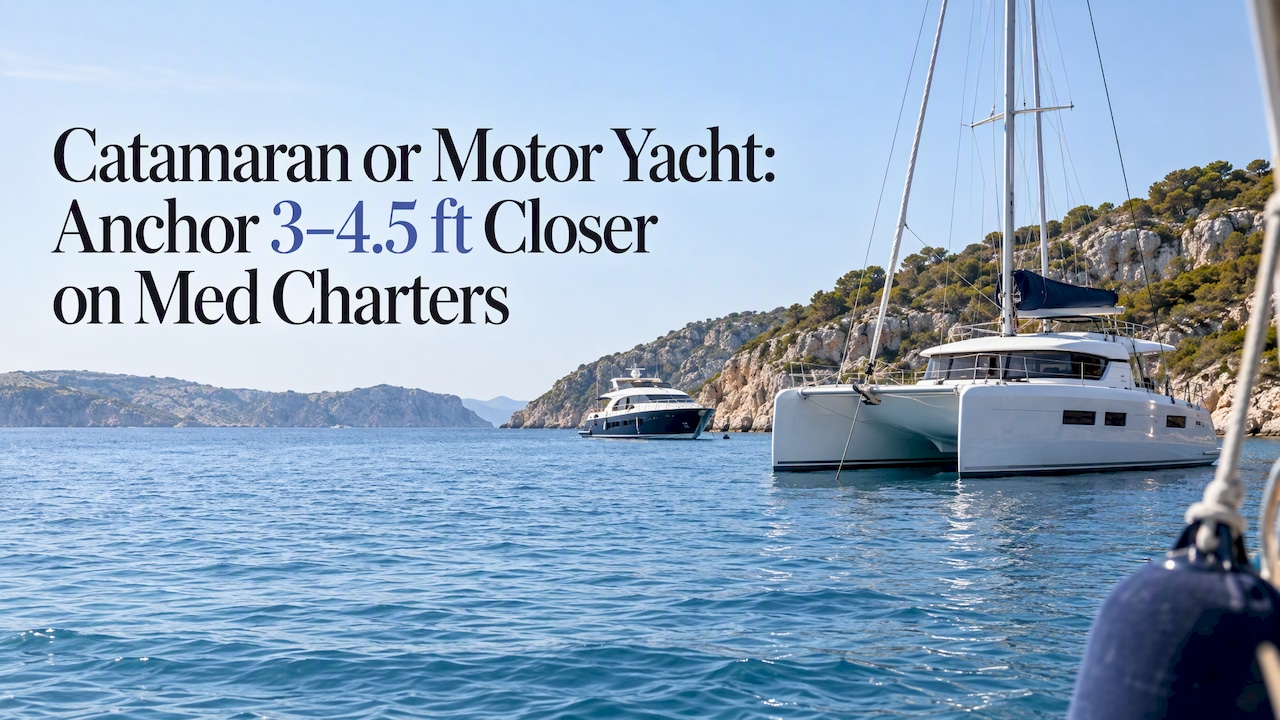
Catamarans constituent la catégorie de bateaux de location qui connaît la plus forte croissance, et ce n'est pas sans raison. Leur conception à double coque offre une plate-forme large et stable, dotée d'un pont spacieux et d'un faible tirant d'eau, souvent inférieur à 5 pieds. Ce faible tirant d'eau vous permet de jeter l'ancre dans des baies aux eaux cristallines et des zones de récifs inaccessibles à un monocoque dont le tirant d'eau est compris entre 5 et 7 pieds. Location de catamarans Ils sont particulièrement appréciés pour les voyages en groupe en raison de leur stabilité et de leur espace.
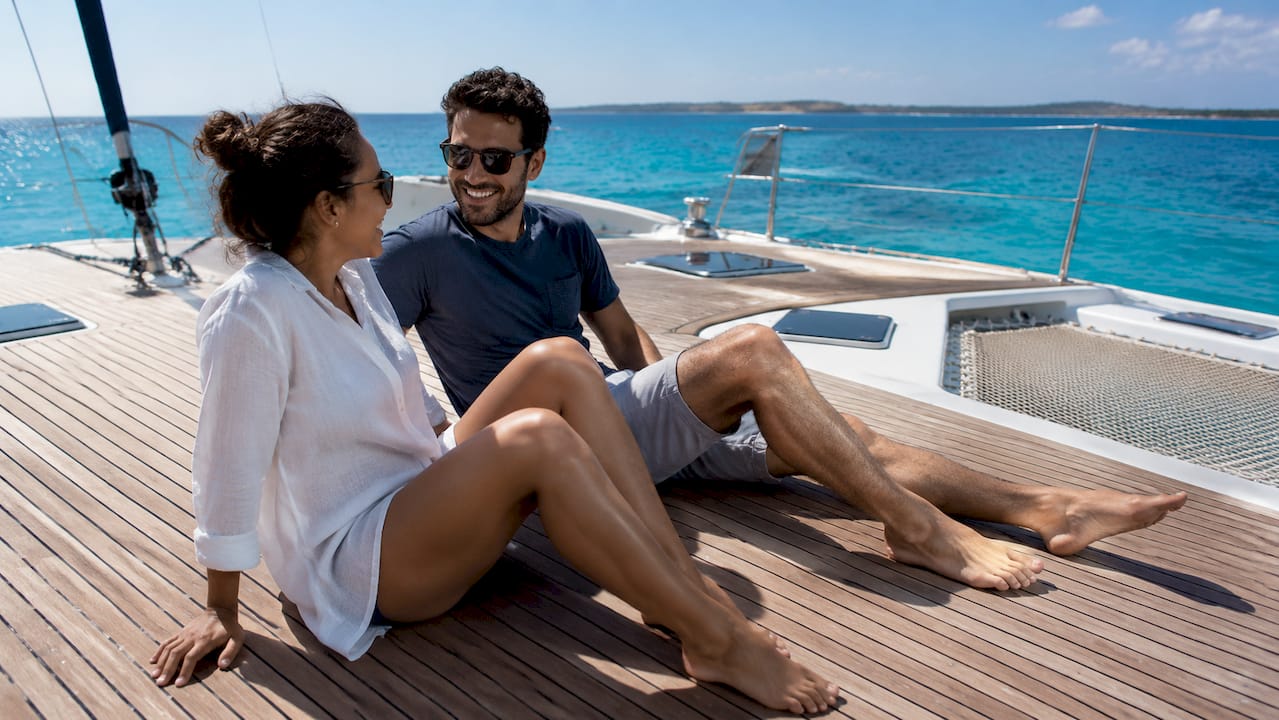
Yachts d'expédition (également appelés « yachts d'exploration ») sont spécialement conçus pour les croisières au long cours vers des destinations lointaines. Pensez à la Patagonie, à l'Arctique ou au Pacifique Sud. Ils disposent d'importantes réserves de carburant et d'eau, de coques renforcées et d'un équipement de sécurité complet. Ils ne constituent pas le choix idéal pour des semaines de navigation en Méditerranée ou des croisières aux Caraïbes.
| Type de yacht | Taille standard | Caractéristique principale | Utilisation optimale |
|---|---|---|---|
| Yacht à moteur | 40 à 100+ pieds | Vitesse, volume intérieur | Escapades du week-end, réceptions |
| Voilier | 35 à 80 pieds | Alimenté par l'énergie éolienne, coûts d'exploitation réduits | Croisière côtière, course à la voile |
| Catamaran | 40 à 65 pieds | Stabilité, faible tirant d'eau | Locations pour les familles et les groupes |
| Yacht d'expédition | 60 à 150+ pieds | Grande portée, conception robuste | Voyages en mer au large |
Conseil de pro : Si vous souhaitez louer avant d'acheter, louez coup sur coup un catamaran et un monocoque dans la même destination. Une semaine sur chacun vous en apprendra davantage sur vos préférences que n'importe quelle brochure ne pourrait jamais le faire.
Comment évaluez-vous votre mode de vie pour choisir le yacht qui vous convient ?
Devenir propriétaire d'un yacht en toute sérénité Commencez par une auto-évaluation honnête des personnes qui seront à bord et de l'effort que vous souhaitez consacrer à l'exploitation et à l'entretien. Avant de craquer pour un modèle en particulier, répondez honnêtement à ces cinq questions.
-
Où naviguerez-vous le plus souvent ? La Grèce, la Croatie et les Îles Vierges britanniques offrent des eaux calmes, idéales pour les voiliers et les catamarans. Les traversées en pleine mer vers des destinations telles que Tahiti ou les Açores exigent un bateau plus performant, mieux adapté à la navigation en haute mer et doté d'une plus grande autonomie.
-
Quelle est la taille habituelle de vos groupes ? Les yachts mesurant entre 45 et 65 pieds disposent généralement de 3 à 4 cabines et de plusieurs salles de bains, et peuvent accueillir entre 8 et 16 personnes selon leur configuration. Si vous naviguez régulièrement avec 10 amis, un monocoque de 38 pieds vous semblera très exigu dès le troisième jour.
-
Quel rythme préférez-vous ? Certains souhaitent parcourir 60 milles marins par jour et découvrir un nouveau port chaque soir. D’autres préfèrent jeter l’ancre dans une baie magnifique et y rester trois jours. C’est votre rythme de navigation qui détermine tous les paramètres, de la puissance du moteur à la capacité du réservoir de carburant.
-
Allez-vous embaucher un équipage ou naviguer seul ? A location d'un yacht avec équipage élimine la quasi-totalité des contraintes opérationnelles. Une location coque nue vous confie la responsabilité de la navigation, du mouillage et de la gestion des systèmes. Soyez honnête quant à votre niveau de compétence et à votre goût pour les responsabilités.
-
Quel est votre budget total, et pas seulement le prix d'achat ? Considérations budgétaires dépassent le prix d'achat pour inclure le carburant, l'équipage, l'entretien, l'assurance et les frais d'amarrage. L'exploitation annuelle d'un yacht à moteur de 60 pieds peut coûter autant que celle d'un appartement modeste.
Conseil de pro : Notez vos réponses avant de vous entretenir avec un agent immobilier. Les agents sont passés maîtres dans l'art d'aligner votre enthousiasme sur leur offre. Vos réponses écrites vous permettront de rester concentré sur ce dont vous avez réellement besoin.
Quelles sont les caractéristiques techniques les plus importantes à prendre en compte lors du choix d'un yacht ?
Comprendre les aspects techniques liés au choix d'un yacht vous évite les mauvaises surprises qui peuvent coûter cher. Pas besoin d'être ingénieur, mais vous devez savoir quelles caractéristiques techniques ont une incidence sur votre expérience au quotidien.
-
Dimensions et compatibilité avec les ports de plaisance. Plus grand ne veut pas toujours dire meilleur. Un yacht de 70 pieds, ça fait impression… jusqu'à ce que vous découvriez que votre port d'attache ne dispose que d'amarrages de 55 pieds. Vérification des dimensions des places d'amarrage dans les ports de plaisance Et le fait de vérifier la profondeur des canaux avant de s'engager permet d'éviter des problèmes logistiques et des erreurs coûteuses.
-
Brouillon. Le tirant d'eau correspond à la profondeur de la coque sous la ligne de flottaison. Les catamarans ont souvent un tirant d'eau inférieur à 5 pieds, tandis que de nombreux monocoques à voile ont un tirant d'eau compris entre 5 et 7 pieds. Si vous prévoyez d'explorer des mouillages peu profonds dans les îles grecques ou aux Bahamas, le tirant d'eau est un paramètre essentiel.
-
Autonomie. Les yachts à moteur consomment nettement plus de carburant que les voiliers. Calculez la longueur typique de votre trajet et vérifiez l'autonomie du bateau à vitesse de croisière. Se retrouver à court de carburant dans un mouillage isolé n'a rien d'une aventure romantique.
-
Type de moteur et entretien. Les moteurs diesel constituent la norme sur les yachts de haute mer en raison de leur fiabilité et de leur faible consommation. Les systèmes hybrides font leur apparition sur les nouvelles constructions et permettent de réduire les coûts de carburant lors des traversées courtes. Les voiliers sont dotés de systèmes mécaniques globalement plus simples, ce qui se traduit par des frais d'entretien moins élevés.
-
Essais en mer et inspections. Les inspections professionnelles et les essais en mer permettent de détecter des problèmes qui échappent aux acheteurs et d'éviter des mauvaises surprises coûteuses. Ne négligez jamais cette étape, même s'il s'agit d'un bateau presque neuf.
| Fonctionnalité | Pourquoi est-ce important ? | Question clé à se poser |
|---|---|---|
| Brouillon | Détermine les endroits où vous pouvez jeter l'ancre | Cela correspond-il à votre zone de navigation prévue ? |
| Autonomie | Limite ou autorise votre itinéraire | Quelle est l'autonomie à vitesse de croisière ? |
| Nombre de cabines | Indique le nombre de couchages | Est-ce que tout votre groupe y tient confortablement ? |
| Heures de fonctionnement du moteur | Indique l'usure et les besoins d'entretien | A-t-il été révisé dans les délais prévus ? |
En quoi les équipements et l'aménagement à bord influencent-ils votre expérience ?
Le l'importance du type de yacht pour le confort est plus important que ne le pensent la plupart des novices. L'aménagement d'un yacht détermine la façon dont votre groupe va cohabiter pendant plusieurs jours, voire plusieurs semaines. Bien choisir cet aménagement fait toute la différence entre un voyage dont tout le monde parlera avec enthousiasme et un voyage dont personne ne parlera plus jamais.
Commençons par les conditions d'hébergement. Un catamaran à quatre cabines, doté de quatre salles de bains privées (appelées « heads »), offre à chaque couple ou binôme une véritable intimité. Un monocoque à trois cabines avec une seule salle de bains commune convient parfaitement à une famille très soudée, mais peut être source de tensions au sein d'un groupe de huit adultes.
Au-delà des chalets, tenez compte des critères suivants en matière d'équipements :
- Espace sur le pont. C'est là que les catamarans ont l'avantage. Leur largeur offre un grand cockpit et souvent un filet trampoline à l'avant, idéal pour prendre le soleil et regarder la mer défiler sous vos pieds.
- Dimensions de la cuisine. Une cuisine spacieuse équipée d'un vrai four est indispensable si vous prévoyez de cuisiner à bord. Une cuisine plus petite suffit si vous dînez à terre tous les soirs.
- Rangement pour les sports nautiques. Si vous souhaitez disposer de planches de paddle, de kayaks, de matériel de plongée avec tuba ou d'un canot pneumatique à moteur, assurez-vous que le yacht dispose d'un espace de rangement dédié ou d'une plateforme de baignade suffisamment grande pour accueillir tout ce matériel.
- Systèmes de divertissement. Les enceintes Bluetooth, les traceurs de cartes à écran tactile et la climatisation font partie de l'équipement de série sur les yachts de location récents. Les bateaux plus anciens peuvent ne pas disposer de ces équipements de confort.
- Toit pare-soleil et sièges dans le cockpit. Un bimini (toit de protection au-dessus du cockpit) est indispensable pour naviguer en Méditerranée en juillet et août. Vérifiez que l'espace salon puisse accueillir confortablement tout votre groupe.
Il faut toujours trouver le juste équilibre entre taille, confort et maniabilité. Un yacht plus grand offre davantage de tout, mais nécessite plus de compétences, plus d'équipage et un budget plus important pour être exploité correctement.
Quelles sont les erreurs les plus courantes lors du choix d'un yacht ?
Les propriétaires sous-estiment souvent la complexité et les besoins en entretien des grands yachts dotés de nombreuses fonctionnalités, et regrettent de ne pas avoir privilégié la simplicité d'utilisation. Voici les erreurs les plus courantes et comment les éviter.
- Acheter un yacht trop grand, trop tôt. Un yacht à moteur de 70 pieds équipé d'un générateur, d'un dessalinisateur, d'un propulseur d'étrave et de stabilisateurs est un vrai plaisir quand tout fonctionne. Mais lorsque les systèmes tombent en panne en mer, cela devient un véritable travail à plein temps. Si vous êtes novice en matière de navigation de plaisance, commencez par un modèle plus simple.
- Ne pas tenir compte des contraintes liées au port de plaisance. Le yacht de vos rêves ne vous servira à rien s'il ne rentre pas dans votre poste d'amarrage ou s'il ne peut pas emprunter le chenal menant à votre port d'attache. Mesurez d'abord, rêvez ensuite.
- Sous-estimer les coûts d'exploitation. Le carburant, la mise à sec annuelle, la peinture antisalissure, l'entretien du moteur, l'assurance et les salaires de l'équipage font rapidement grimper la facture. Prévoyez chaque année au moins 10 à 15% du prix d'achat du bateau pour son entretien.
- On fait l'impasse sur l'expertise et les essais en mer. Les services d'un expert maritime professionnel coûtent entre quelques centaines et quelques milliers de dollars. Sauter cette étape pour faire des économies est l'une des décisions les plus coûteuses qu'un acheteur puisse prendre.
- Privilégier les fonctionnalités plutôt que l'ergonomie. Un yacht doté d'une superbe suite parentale et d'une salle de cinéma, ça a l'air incroyable. Mais s'il a un tirant d'eau de 8 pieds et que vous souhaitez explorer la Côte Turquoise en Turquie, vous passerez vos vacances au mouillage, loin du rivage.
“ N’achetez ou n’affrétez jamais un bateau sans vous être assuré de la taille de l’amarrage et de la profondeur du chenal de la marina de votre choix, afin d’éviter des erreurs coûteuses et source de complications. ” — WS Yacht Brokers
Conseil de pro : Demandez à votre courtier la liste des cinq réclamations les plus fréquentes formulées par les propriétaires du modèle qui vous intéresse. Un bon courtier vous la fournira. Un excellent courtier les aura déjà prises en compte dans ses recommandations.
Principaux enseignements
Pour choisir le bon yacht, il faut avant tout faire correspondre le type, la taille et les caractéristiques du bateau à votre mode de vie en mer tel qu’il est réellement, et non à celui auquel vous aspirez.
| Point | Détails |
|---|---|
| Adaptez le type de match à votre mode de vie | Les yachts à moteur conviennent à ceux qui recherchent le confort ; les catamarans conviennent aux groupes ; les voiliers conviennent aux plaisanciers passionnés. |
| Le tirage au sort détermine les destinations | Les catamarans de moins de 5 pieds peuvent accoster dans des zones peu profondes inaccessibles aux monocoques dont le tirant d'eau est compris entre 5 et 7 pieds. |
| Un budget qui va au-delà du simple prix affiché | Les coûts d'exploitation annuels s'élèvent souvent à 10 à 15% du prix d'achat, carburant, équipage et entretien compris. |
| Vérifiez d'abord si le port de plaisance vous convient | Vérifiez les dimensions de l'embarcadère et la profondeur du chenal avant de vous engager dans l'achat d'un bateau ou dans une location à long terme. |
| Toujours procéder à une inspection et à des essais en mer | Les inspections réalisées par des professionnels permettent de détecter les problèmes cachés et vous évitent les mauvaises surprises coûteuses après l'achat. |
Ce que j'ai appris après avoir observé pendant des années les gens choisir leur yacht
Ce que je constate le plus souvent, c'est que les gens choisissent un yacht en fonction de son apparence à quai plutôt qu'en fonction de ses performances dans la vie de tous les jours. Un superbe yacht à moteur de 65 pieds rend très bien en photo. Mais si vous êtes un couple souhaitant passer deux semaines à explorer les îles grecques avec un petit groupe d'amis, un catamaran de 45 pieds vous apportera davantage de bonheur au quotidien.
La deuxième erreur consiste à sous-estimer l’équipage. On part souvent du principe que tout se mettra en place au fur et à mesure. Parfois, cela fonctionne. Mais le plus souvent, cela entraîne du stress, des disputes et un voyage qui s’achève prématurément. Si vous n’avez pas confiance en vos compétences en navigation, réservez d’abord une location avec équipage. Passez une semaine à observer comment un skipper expérimenté interprète les conditions météo, manœuvre l'ancre et navigue dans les ports de plaisance exigus. Cette formation vaut bien plus que n'importe quel cours en ligne.
Troisième conseil que je donne toujours : louez avant d'acheter. La Méditerranée regorge de destinations magnifiques où vous pourrez tester un catamaran une année, puis un monocoque à voile l'année suivante. Sailarmada vous facilite la tâche en proposant des séjours à la voile soigneusement sélectionnés en Grèce, en Croatie, en Italie et bien au-delà. Lorsque vous serez prêt à acheter, vous saurez exactement ce que vous voulez et pourquoi.
Le plaisir de trouver le yacht idéal est bien réel. Lorsque le bateau correspond à votre mode de vie, chaque traversée se fait en toute simplicité et chaque mouillage semble avoir été conçu spécialement pour vous. Ce sentiment vaut la peine de prendre le temps de faire le bon choix.
- Voile
Prêt à trouver le yacht de vos rêves sur l'eau ?
Sailarmada vous évite d'avoir à deviner quel yacht choisir en vous proposant le bateau le mieux adapté à votre groupe, à votre destination et à votre style de navigation. Que vous soyez attiré par la stabilité d'un catamaran dans les îles grecques ou par le charme classique d'un voilier le long de la côte croate, la flotte soigneusement sélectionnée par Sailarmada répond à ces deux types de souhaits.
Vous avez le choix entre vacances privées en voilier pour profiter d'une totale liberté, ou rejoignez une flottille où un skipper expérimenté vous guidera. Chaque itinéraire est conçu pour allier exploration, détente et plaisir authentique sur l'eau. Si vous hésitez encore, jetez un œil à vacances à la voile en Grèce, en Croatie et en Italie C'est un excellent point de départ. Le yacht idéal et l'itinéraire parfait sont plus à portée de main que vous ne le pensez.
FAQ
Quel est le meilleur type de yacht pour ceux qui louent pour la première fois ?
Les catamarans constituent le choix le plus populaire auprès des locataires novices, car leur plate-forme large et stable ainsi que leurs cabines spacieuses rendent l'expérience confortable et accessible. Leur faible tirant d'eau offre également davantage de possibilités de mouillage dans des destinations prisées telles que la Grèce et la Croatie.
Comment savoir quelle taille de yacht me convient ?
Commencez par déterminer la taille de votre groupe. Les yachts de 45 à 65 pieds peuvent généralement accueillir entre 8 et 16 personnes réparties dans 3 à 4 cabines, ce qui en fait la catégorie la plus pratique pour les croisières en famille ou entre amis. Prévoyez une cabine de plus que ce dont vous pensez avoir besoin pour garantir un véritable confort.
Quelle est la différence entre un yacht à moteur et un voilier ?
Les yachts à moteur offrent davantage d'espace intérieur, des vitesses plus élevées et une meilleure maniabilité dans des conditions de mer agitée, tandis que les voiliers procurent une expérience plus calme et plus traditionnelle, avec des coûts d'exploitation moins élevés. C'est votre style de croisière préféré et votre budget qui détermineront lequel vous convient le mieux.
Dois-je louer un yacht avant d'en acheter un ?
Oui. La location vous permet de tester différents types de bateaux en conditions réelles avant de vous engager dans un achat. Passer une ou deux semaines à bord d'un catamaran et d'un monocoque à voile dans la zone de navigation qui vous intéresse vous permettra de mieux cerner vos préférences que n'importe quelle fiche technique.
Quels sont les coûts cachés dont je dois tenir compte lors de l'achat d'un yacht ?
Au-delà du prix d'achat, prévoyez un budget pour le carburant, les salaires de l'équipage, la mise à sec annuelle, la peinture antisalissure, l'entretien du moteur, l'assurance et les frais de port. Ces frais d'exploitation peuvent atteindre 10 à 15% de la valeur du bateau chaque année ; veillez donc à les intégrer dès le départ dans votre budget global de possession.