La terminologie des yachts de luxe désigne le vocabulaire spécialisé qui couvre la structure du yacht, les espaces à bord, les rôles de l'équipage et les règles de conduite à respecter par les passagers ; il est utile pour tout passager d'une croisière de location de s'y familiariser avant de monter à bord. Des termes tels que cabine, cuisine de bord, et place d'amarrage ne se limitent pas à une simple touche nautique. Ils décrivent des espaces réels, des règles concrètes et des attentes bien précises qui façonnent l’ensemble de votre expérience en mer. Que vous réserviez une semaine dans les îles grecques, que vous naviguiez le long de la côte croate ou que vous preniez la mer dans les îles Vierges britanniques, maîtriser le vocabulaire du yachting vous permettra de vous sentir plus à l’aise et plus en confiance dès le premier jour.
Le vocabulaire des yachts de luxe : les pièces et les espaces à bord
Le noms de pièces sur un yacht que vous rencontrerez comprennent la cabine, le salon, la cuisine, les toilettes, la passerelle et le flybridge, chacun correspondant à un espace fonctionnel distinct du bateau. Il ne s’agit pas là de termes arbitraires. Ils traduisent la logique de fonctionnement du yacht et vous aident à comprendre où aller, à quoi vous attendre et comment l’équipage organise son travail pour assurer votre confort.
Cabines, cabines de luxe et suites
A cabine est le terme générique désignant tout espace de couchage à bord. A cabine Il s'agit d'une cabine plus spacieuse et plus intime, dotée de finitions haut de gamme, que l'on retrouve généralement sur les yachts à moteur de luxe et les superyachts. Une suite va encore plus loin, en proposant souvent un coin salon privé ou un dressing. On peut comparer cette progression à celle des chambres d'hôtel : chambre standard, chambre de luxe, suite.
Le salon, la cuisine et les toilettes
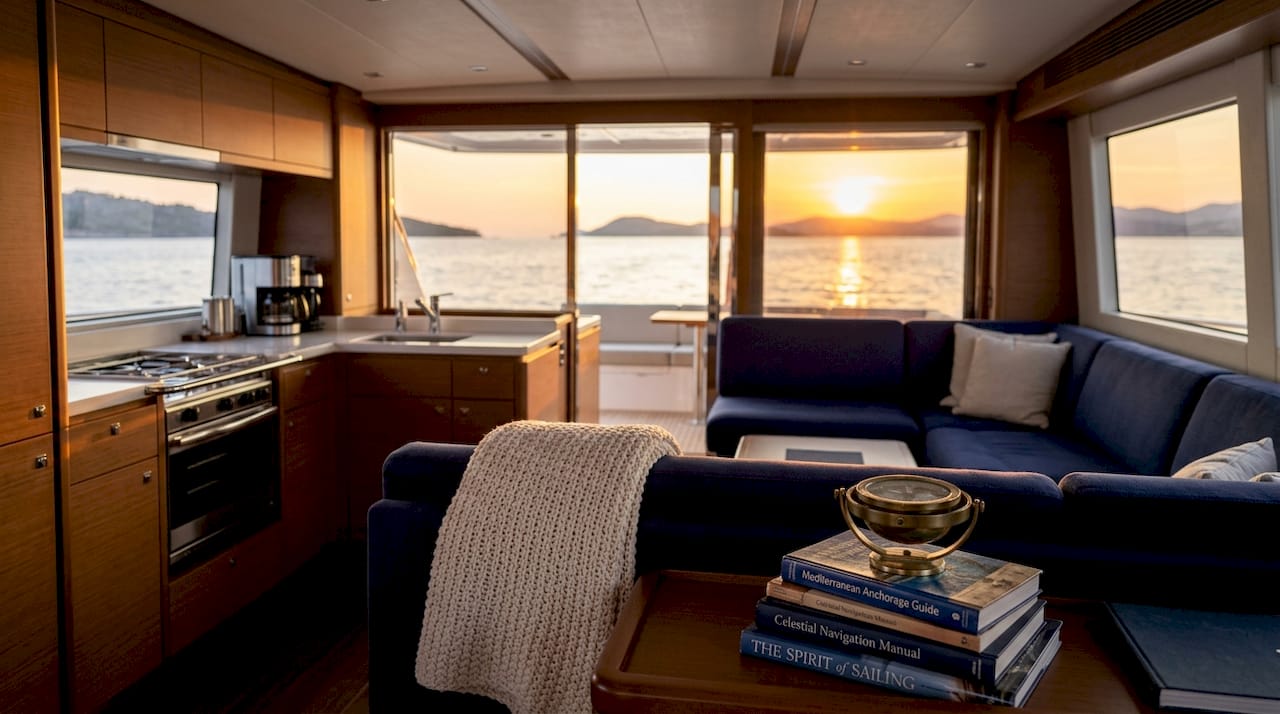
Le salon est l'espace principal dédié à la vie sociale et au quotidien, comparable au salon du hall d'un hôtel ou à votre salon chez vous. Le cuisine de bord c'est la cuisine, et c'est l'un des espaces les plus essentiels au bon fonctionnement de tout yacht. La tête c'est la salle de bains. Ces trois termes reviennent sans cesse lors des briefings de l'équipage ; les connaître vous évitera donc toute confusion dès le premier jour.
Pont et flybridge
Le pont est le poste de commande d'où le capitaine dirige et supervise la navigation. Le flybridge Il s'agit d'un pont en plein air surélevé au-dessus du pont principal, souvent équipé de sièges, d'un deuxième poste de pilotage et de transats. Lors d'un après-midi chaud en Méditerranée, le flybridge est l'endroit où l'on a envie d'être.
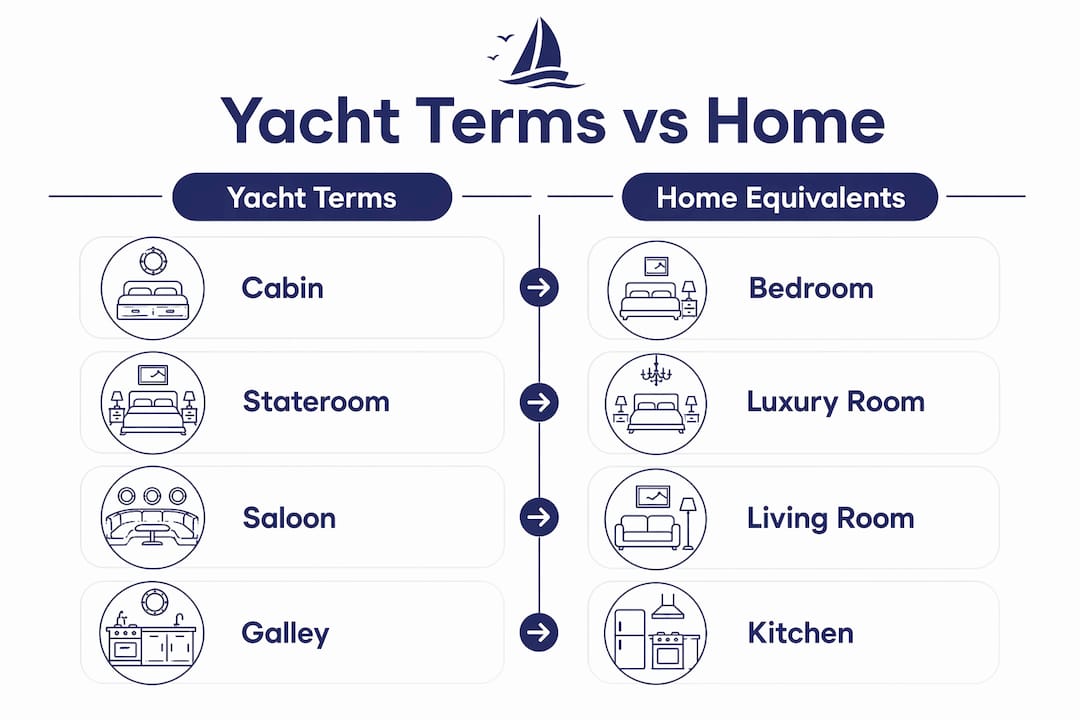
Voici un guide rapide pour associer les termes utilisés dans le domaine du yachting à leurs équivalents courants :
| Terme nautique | Chez soi ou dans un établissement équivalent à un hôtel |
|---|---|
| Cabine | Chambre à coucher |
| Cabine | Chambre d'hôtel de luxe |
| Salon | Salon ou hall d'hôtel |
| Cuisine de bord | Cuisine |
| Tête | Salle de bains |
| Flybridge | Terrasse sur le toit |
Conseil de pro : Lorsque l'équipage vous fera visiter le yacht au début de votre croisière, essayez de faire le lien mental entre chaque terme nautique et son équivalent courant. En moins d'une heure, vous n'aurez plus aucun doute.
Que signifie exactement le terme “ poste d'amarrage ” sur un yacht ?
Place d'amarrage est l'un des termes les plus souvent mal compris du vocabulaire de base de la navigation de plaisance, et ce à juste titre. Il revêt en effet deux sens totalement différents selon le contexte. Le double sens du mot « couchette » couvre à la fois un espace de couchage à bord et une place d'amarrage attribuée dans une marina. Une mauvaise interprétation peut être source de véritable confusion lors de la planification de votre voyage.
En matière d'hébergement, le terme « couchette » désigne tout lit fixe présent à bord d'un navire. A couchette double est un lit double, tandis qu'un couchette simple ou couchette de pilote Il s'agit d'une couchette plus étroite, que l'on trouve souvent dans les quartiers de l'équipage ou dans les cabines plus petites. En terminologie portuaire, votre « poste d'amarrage » désigne l'emplacement précis d'une marina où le yacht est amarré, équipé d'un raccordement au courant de quai, d'un raccordement à l'eau et des services de la marina.
Il est tout aussi utile de connaître les termes relatifs à l'accostage avant d'arriver au port. A glissement Il s'agit d'un type particulier d'amarrage où le yacht se glisse entre deux jetées en forme de doigt. Un amarrage désigne une bouée fixe ou un point d'ancrage en pleine mer, loin d'un port de plaisance. A quai Il s'agit de la structure physique à laquelle on amarre le yacht, bien que ce terme soit souvent utilisé de manière imprécise pour désigner la marina elle-même.
| Terme | Contexte | Ce que cela signifie |
|---|---|---|
| Couchette (à bord) | Le sommeil | Une couchette ou un lit superposé à l'intérieur du yacht |
| Place d'amarrage (port de plaisance) | Amarrage | Emplacement attribué dans un port de plaisance, avec raccordements aux réseaux |
| Glissement | Amarrage | Place d'amarrage entre deux jetées en forme de doigt |
| Amarrage | Ancrage | Bouée fixe ou point d'ancrage en pleine mer |
| Quai | Général | Structure physique utilisée pour l'arrimage |
Conseil de pro : Quand quelqu’un dit “ on a réservé une place ”, vérifiez rapidement le contexte. S’il s’agit de la marina, c’est votre place d’amarrage. S’il s’agit de l’hébergement pour la nuit, c’est votre lit. Le contexte de la conversation vous mettra toujours sur la bonne piste.
Les règles de savoir-vivre que tout passager d'un yacht de location devrait connaître
Les règles de conduite à respecter à bord des yachts de luxe Ce n'est pas seulement une question de convention sociale. L'équipage veille au respect de ces normes dans le cadre des protocoles de sécurité et de la qualité du service, et connaître le vocabulaire associé vous permettra de vous comporter comme un client chevronné dès votre embarquement.
Voici les principaux termes relatifs à l'étiquette et leur signification concrète :
- Zone sans talons. Les talons hauts abîment les ponts en teck et présentent un risque de glissade. Il est d'usage de se promener pieds nus ou de porter des chaussures de pont à semelles souples. L'équipage vous demandera souvent d'enlever vos chaussures au moment de l'embarquement, et certains yachts mettent des chaussures de pont à la disposition de leurs invités.
- Pourboire. En Europe, les pourboires sur les charters de luxe représentent entre 10 et 15% du prix de base de la location, et entre 15 et 20% aux États-Unis et dans les Caraïbes. Vous le remettez au capitaine à la fin de la location, et c'est lui qui le répartit entre les membres de l'équipage. Ce n'est pas facultatif sur les locations avec équipage. C'est la norme attendue.
- Règlement relatif au tabac. Il est interdit de fumer à l'intérieur de pratiquement tous les yachts de luxe ; le tabagisme est limité aux zones extérieures prévues à cet effet. Pour des raisons de sécurité et d'odeurs, la cigarette électronique est assimilée au tabagisme. Ne jetez jamais de mégots par-dessus bord.
- Zones de confidentialité. Les espaces réservés à l'équipage, tels que la cuisine et la passerelle, sont des zones de travail en activité. Les passagers sont priés de ne pas y pénétrer sans y avoir été invités. Il en va de même pour les cabines et les espaces privés des autres passagers.
- Les règles de bonne conduite sur les réseaux sociaux. Le fait de partager la position du yacht ou des photos d'autres passagers sans autorisation est considéré comme une grave atteinte à la vie privée. Veuillez toujours demander l'accord du capitaine ou de la chef de cabine avant de publier quoi que ce soit.
Ces règles existent car un yacht de luxe est à la fois un lieu de vie, un lieu de travail et un navire soumis au droit maritime. Leur respect garantit la sécurité de tous et le bon déroulement de l'expérience.
Conseil de pro : Avant d'embarquer, renseignez-vous auprès de votre courtier en location de yachts sur les règles spécifiques à bord. Certains yachts appliquent des règles plus strictes que d'autres en matière de tabac ou de photographie ; en vous informant à l'avance, vous éviterez ainsi des situations embarrassantes avec l'équipage.
Qui fait quoi : les principaux rôles et titres au sein de l'équipe
Comprendre les rôles de l'équipage sur un yacht avec équipage Cela vous aide à adresser vos demandes à la bonne personne, ce qui accélère le service et rend les interactions plus naturelles. La hiérarchie au sein de l'équipe est claire, et le fait de s'y conformer plutôt que de la contourner fait partie des qualités d'un bon client.
Voici les principaux rôles que vous rencontrerez :
- Capitaine. Le capitaine détient l'autorité suprême sur le navire, sa sécurité et son itinéraire. Toutes les modifications d'itinéraire, les décisions liées aux conditions météorologiques et les questions de sécurité relèvent de sa compétence. Adressez-vous au capitaine avec respect et suivez ses instructions sans discuter lorsqu'elles concernent la sécurité.
- Chef de cabine. La chef de cabine supervise l'ensemble du service à bord, notamment les repas, l'entretien des cabines et le confort des passagers. Si vous avez besoin de quelque chose dans votre cabine, si vous souhaitez une boisson en particulier ou si vous avez une demande spécifique concernant votre régime alimentaire, la chef de cabine est votre premier interlocuteur.
- Chef. Sur les grands yachts, un chef dédié se charge de toutes les tâches culinaires depuis la cuisine. En général, vous discuterez de vos préférences alimentaires et de vos restrictions diététiques avec le chef ou la chef de cabine au début de la croisière.
- Matelot. Les matelots s'occupent des tâches physiques à bord du yacht : mouillage, amarrage, gestion des jeux aquatiques et entretien du pont. Ce sont également eux qui s'occupent du matériel de sports nautiques et des trajets en annexe jusqu'au rivage.
- Ingénieur. L'ingénieur gère l'ensemble des systèmes techniques à bord, des moteurs à la climatisation en passant par les installations électriques. Les passagers ont rarement l'occasion d'interagir directement avec lui, mais le simple fait de savoir que ce poste existe explique pourquoi certains problèmes techniques sont résolus si rapidement.
La structure de l'équipe a pour but de vous offrir une expérience fluide, et adresser vos demandes à la bonne personne est le moyen le plus efficace d'obtenir exactement ce que vous souhaitez, quand vous le souhaitez.
En quoi la terminologie nautique reflète le fonctionnement réel d'un yacht
Chaque terme dans le Glossaire des caractéristiques des yachts existe parce qu’elle décrit un élément doté d’une fonction spécifique, et comprendre cette fonction permet d’apprécier la réflexion qui sous-tend la conception d’un yacht de luxe. La cuisine en est un parfait exemple. Conception de la cuisine d'un superyacht Elle a été soigneusement conçue autour des processus de lavage, de cuisson et de préparation, et des chefs expérimentés ont été consultés tout au long de la construction afin d'optimiser la rapidité et la qualité. L'emplacement de la cuisine à bord du yacht influe directement sur la rapidité avec laquelle les plats arrivent à votre table et sur le silence dans lequel l'équipage peut travailler pendant que vous vous détendez.
La même logique s'applique aux espaces. Le pont et le flybridge sont surélevés pour offrir une bonne visibilité et faciliter la navigation. Le salon est situé au centre pour favoriser les interactions sociales. Les quartiers de l'équipage sont délibérément séparés des espaces réservés aux invités afin de préserver l'intimité de chacun. Une fois que vous maîtrisez ces termes, vous cessez de percevoir le yacht comme un labyrinthe déroutant de couloirs et commencez à le considérer comme un espace soigneusement conçu, pensé pour votre confort.
La terminologie permet également de cerner les modalités du service. Lorsque la chef de cabine vous dit qu’elle va “ préparer votre cabine pour la nuit ”, vous savez que celle-ci sera mise en ordre pour la soirée. Lorsque le capitaine parle de “ jeter l’ancre ”, vous savez que vous allez passer la nuit au large d’un port de plaisance. Ces expressions véhiculent des informations pratiques, et les reconnaître vous permet d’anticiper ce qui va se passer plutôt que d’attendre qu’on vous le dise.
Principaux enseignements
Connaître la terminologie propre aux yachts de luxe avant d'embarquer permet de transformer une expérience qui pourrait s'avérer déroutante en une expérience agréable et sereine dès le premier jour.
| Point | Détails |
|---|---|
| Les noms des salles indiquent leur fonction | Des termes tels que « cuisine », « salon » et « toilettes » désignent des zones fonctionnelles spécifiques, et ne sont pas de simples appellations décoratives. |
| “Le mot ” berth » a deux sens | Le contexte permet de déterminer si le terme « poste d'amarrage » désigne un espace de couchage à bord ou une place d'amarrage dans un port de plaisance. |
| Les termes liés à l'étiquette renvoient à de véritables règles | Les zones « sans talons », les règles relatives au tabagisme et les normes en matière de pourboires sont des règles obligatoires, et non des suggestions facultatives. |
| Les rôles des membres d'équipage orientent vos demandes | Le fait d'acheminer les demandes vers le membre d'équipage compétent (commandant de bord, hôtesse de l'air, chef de cuisine) permet d'offrir un service plus rapide et plus personnalisé. |
| La terminologie reflète la logique de conception | Comprendre la terminologie nautique vous aide à vous repérer dans l'agencement du yacht et à anticiper le déroulement des prestations autour de vous. |
Pourquoi ça vaut vraiment le coup de passer un peu de temps à apprendre le jargon avant d'embarquer
Voici ce que j’ai remarqué après avoir aidé pendant des années des clients à préparer leur première croisière de luxe : ceux qui arrivent en connaissant ne serait-ce qu’une poignée de termes clés profitent nettement mieux de leurs premières 24 heures. Non pas parce que l’équipage les traite différemment, mais parce qu’ils se comportent différemment eux-mêmes. Ils montent à bord avec assurance, sans hésitation. Ils expriment clairement leurs souhaits au lieu d’attendre de savoir à qui s’adresser.
Je commencerais par me concentrer sur le vocabulaire lié aux règles de savoir-vivre. Des termes comme “ zone sans talons ” et “ pourboire ” peuvent sembler anodins jusqu’à ce que l’on se rende compte qu’ils ont des conséquences bien réelles : la réparation d’un pont en teck endommagé coûte des milliers, et un équipage qui reçoit un pourboire insuffisant s’en souvient. Il ne s’agit pas là de simples convenances sociales. Ce sont les règles de fonctionnement d’un espace partagé, et les connaître est une marque de respect.
Je vous encourage également à vous renseigner sur l'agencement précis de votre yacht avant votre arrivée. La plupart des courtiers en location fournissent un plan de pont. Associez les pièces aux termes utilisés dans ce guide, et vous aurez ainsi une image mentale du bateau avant même de quitter le quai. Ce type de préparation transforme une location de yacht de luxe, qui n’est plus simplement une expérience subie, en une expérience dont vous profitez pleinement.
- Voile
Organisez votre location de yacht de luxe avec Sailarmada
Prêt à mettre en pratique votre nouveau vocabulaire nautique ? Sailarmada est spécialisée dans l'organisation de séjours à la voile sur mesure en Méditerranée, des îles grecques baignées de soleil aux côtes spectaculaires de la Croatie et de la Sardaigne, avec des skippers expérimentés qui veillent à ce que chaque passager se sente comme chez lui dès le premier jour.
Que vous organisiez un voyage en groupe ou une escapade familiale en toute intimité, l’équipe de Sailarmada vous accompagne dans les moindres détails, notamment en matière d’étiquette, d’attentes vis-à-vis de l’équipage et de ce qu’il faut emporter. Découvrez toutes les possibilités avec le guide de la location de bateaux privés et découvrez comment une croisière avec équipage complet transforme des vacances en une expérience véritablement inoubliable. Vous pouvez également parcourir vacances sur un yacht sur mesure pour trouver la formule la mieux adaptée à la taille de votre groupe, à votre style et à votre destination.
FAQ
Que signifie le terme “ galley ” sur un yacht de luxe ?
La cuisine d'un yacht, appelée « galley », est l'endroit où le chef prépare tous les repas destinés aux invités et à l'équipage. Sur les super-yachts, l'aménagement de la cuisine est soigneusement étudié afin d'optimiser le déroulement des opérations culinaires et la rapidité du service.
Quelle est la différence entre une cabine et une chambre ?
Le terme « cabine » désigne de manière générale tout espace destiné au couchage à bord, tandis qu’une « cabine de luxe » est une cabine plus spacieuse et plus somptueusement aménagée, que l’on trouve généralement sur les navires haut de gamme et les super-yachts.
Quel montant faut-il donner comme pourboire lors d'une location de yacht de luxe ?
Le pourboire sur les croisières de luxe représente généralement entre 10 et 15% du prix de base de la location en Europe, et entre 15 et 20% aux États-Unis et dans les Caraïbes ; il est remis au capitaine à la fin du voyage afin qu'il le répartisse entre les membres de l'équipage.
Peut-on fumer sur un yacht de luxe ?
Il est interdit de fumer à l'intérieur sur la quasi-totalité des yachts de luxe ; le tabagisme est limité à certaines zones extérieures. Le vapotage est considéré au même titre que le tabagisme, et les passagers doivent toujours demander l'autorisation à l'équipage avant d'allumer une cigarette.
À qui faut-il s'adresser pour toute demande à bord d'un bateau affrété avec équipage ?
Adressez vos demandes de service directes (repas ou besoins concernant votre cabine) à la chef de cabine, vos questions sur l'itinéraire au capitaine, et celles concernant les sports nautiques ou les activités sur le pont au matelot. En adressant correctement vos demandes, vous obtiendrez des résultats plus rapides et de meilleure qualité.