

Yes, you can sail the Greek islands with your dog or cat, and a private charter is the easiest way to do it. A private boat is your own floating home: no ferry crates, no hotel pet rules, no leaving your best friend behind while you go island hopping. The catch is that a pet-friendly week is decided before you ever step on deck: by the paperwork, by the boat, and by how you plan your shore stops. Here is how to get all three right.
We built our private Greece weeks around exactly this kind of flexibility, with skippers and a team of actual sailors who help you shape the trip. Details below.
TL;DR
- A private charter gives you control over who and what comes aboard, so it suits pets far better than a group cabin or a ferry-hopping trip.
- Pets entering Greece from outside the EU need a microchip, a valid rabies vaccination and an official health certificate, and they must arrive through an authorized entry point.
- Greek beach law is strict: dogs are welcome on free beaches on a leash, but organized beaches need signage and Blue Flag beaches generally say no.
- Confirm the pet arrangement with us before you book, so the boat, the route and the crew all fit your animal.
Table des matières
- Why a private charter works for pets
- Before you book: what to settle about your pet
- Paperwork: bringing a pet into Greece
- Planning an itinerary around your pet
- Keeping your pet safe and comfortable on board
- A pet-friendly week, step by step
- Ready to plan your week?
- FAQ
- Sources
Why a private charter works for pets
On a group holiday, you share a boat with other guests who may have allergies, fears or simply different expectations. On a private charter, the boat is yours, so the only people to please are your own crew. Your dog gets a routine, a shaded spot and a swim stop when you choose one.
It also fixes the biggest headache of traveling with an animal in Greece: public transport. Greek legislation lets animals up to 10 kg travel in a secure crate on passenger ships, taxis and other public transport, and on ships animals must stay crated or leashed and muzzled in common areas, sometimes for an extra charge. Bigger dogs face more limits. When you sail your own route, you skip most of that.
Notre Semaines de voile privées en Grèce start from €560 per week per person, with a choice of sailboat or catamaran, experienced skippers and your own departure date. If you want a broader view of how private weeks work, our Vue d'ensemble des croisières privées is a good start.
Before you book: what to settle about your pet
A pet on board is not a surprise you spring at check-in. Settle these points when you plan the trip, and tell us about your animal at the very start so we can match boat and route.
- Species, size and number. A calm 10 kg dog and two large dogs are different questions for deck space and cabin layout.
- Boat type. Catamarans have wide, flat trampolines and big cockpits, which many owners find easier for a dog to move around on. Monohulls heel more under sail. Our guide to catamaran versus sailing boat Il passe en revue les compromis.
- Cleaning and damage terms. Ask what the charter terms say about pet hair, scratches and a cleaning charge, and get the answer in writing before you pay.
- Your crew. Everyone on board should be comfortable with the animal, including the skipper.
- Shore time. Decide how often your pet needs to get off the boat and plan stops accordingly.
Our team is made of people who sail, so you can talk the setup through with someone who knows what a week on deck looks like. We can also help you pick the right boat from the options we offer, and our family catamaran guide shows what space to expect.
For a deeper dive on routines aboard, read our pet friendly sailing holiday guide.
Paperwork: bringing a pet into Greece
This is the part that goes wrong most often, so take it slowly. The rules depend on where your pet is coming from.
Traveling within the EU
The European Commission explains that non-commercial pet travel inside the EU follows Delegated Regulation (EU) 2026/131. In short: your pet travels with you (or with an authorized person under a written declaration), carries a microchip, and has a rabies vaccination that is valid, which starts 21 days after the primary vaccination. Up to five pets can travel per vehicle.
Arriving from the United States
If you fly in from the US, the USDA’s page on pet travel from the United States to Greece describes the new certificates that apply since October 2026 under EU rules 2026/131 and 2026/848. For a non-commercial trip, the certificate is valid for 30 days after issuance, must be USDA-endorsed within 10 days of your arrival in the EU, and covers onward travel within the EU for up to six months as long as the rabies vaccination stays valid. Rules like these get updated, so read the official page again a few weeks before you fly and ask your vet to do the same.
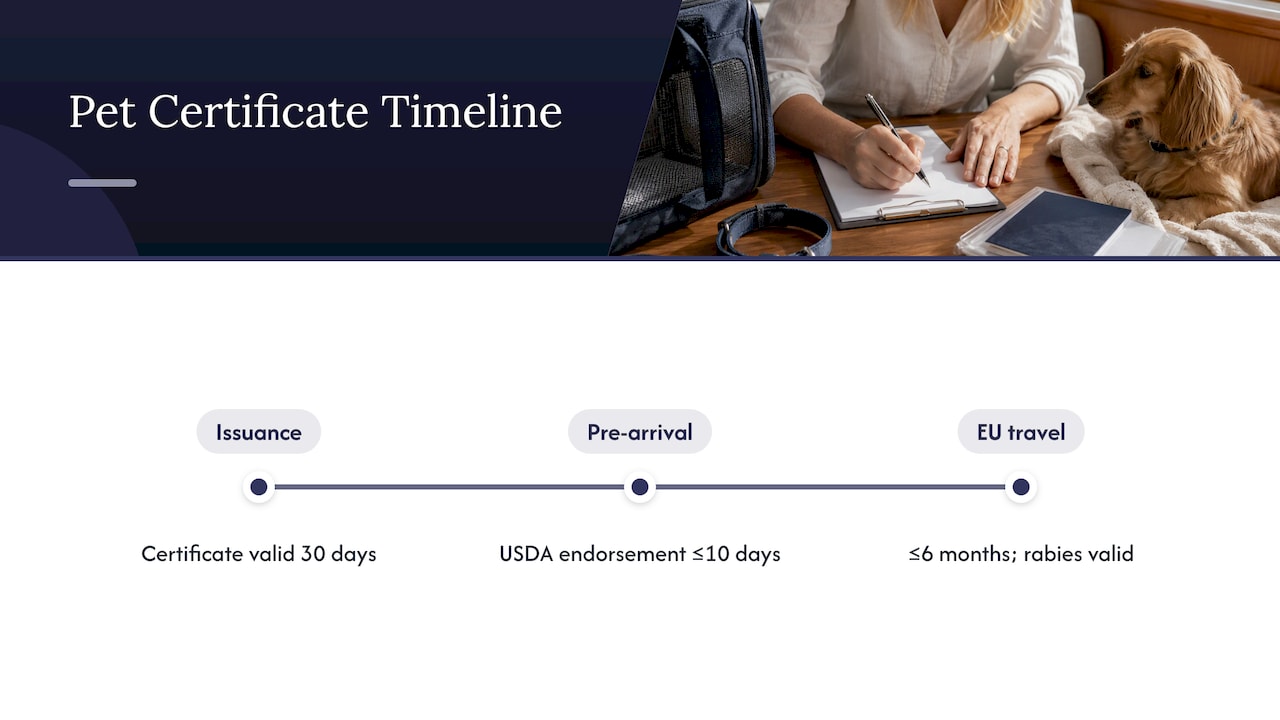
One practical tip: do the vet appointments in the right order. The microchip must come before the rabies vaccination, or the vaccination may not count.
Where your pet can enter
Pets arriving by private transport, including a yacht, must come in through an authorized border inspection post. VisitGreece lists them: the airports of Athens and Thessaloniki, the ports of Piraeus and Thessaloniki, and island posts on Syros, Kalymnos, Kos, Rhodes, Chios, Lesvos, Limnos, Samos, Corfu, Kefalonia, Heraklion and Chania. If your pet flies into Athens and you board in a nearby marina, the airport is your entry point and the rest of the journey is simple.
Carry the passport or health certificate at all times. VisitGreece’s guidance also says to confirm fees and policies with every carrier when you book, because they differ.
Planning an itinerary around your pet
A pet-friendly route is shorter on sailing hours and longer on shore access. Think of it as a week of short hops: two to three hours of sailing in the morning, then a quiet bay, a swim and a walk.
We publish plenty of ideas in our Mediterranean island hopping guide. For pets, look for anchorages with easy beach landings and for harbors with a village behind them, where a morning walk costs nothing.
What Greek beach law means for your dog
Per ProtoThema’s June 2026 report on Law 4830/2021, the rules look like this:
| Beach type | Dogs allowed? | What you need |
|---|---|---|
| Free (non-organized) beach | Yes, on shore and in the sea | Supervision, plus a collar and leash outside the water |
| Organized beach (sunbeds, bar) | Only if the operator posts a sign permitting pets | Check the sign before you land |
| Blue Flag beach | Generally no, except assistance dogs | Choose another bay |
The good news for sailors is that a boat gives you a lot of free beaches and quiet coves to choose from. Our skippers can point you to bays where a dog can swim without a fuss.
Archaeological sites and tavernas
Since April 2023, Greek Ministry of Culture rules allow dogs at more than 100 archaeological sites, and there are free kennels at 110 others for up to two hours, according to VisitGreece. Dogs must be leashed, larger dogs muzzled, and crowded sites such as the Acropolis and Knossos stay off limits. That makes a morning at a smaller site a lovely stop; save the famous ones for a time when someone can stay with the dog on board.

Many seaside tavernas have terraces where a dog can lie under the table. Our list of the best Greek tavernas by boat helps you plan dinner stops where you can dock right in front.
Keeping your pet safe and comfortable on board
The Greek summer sun and a hot deck are the main things to manage. These habits help on any boat:
- Shade first. Use the cockpit awning or the saloon during the hottest hours, and keep fresh water in a bowl that will not slide.
- A life vest for your dog. Ask your vet or a pet shop for a properly fitted one, so a slip off the stern is a non-event.
- A toilet routine. Plan shore breaks around meals. Some dogs need a patch of grass or a mat on board as a fallback.
- Practice at home. A short day on a boat before the trip tells you a lot about how your pet handles motion. If your animal gets queasy or anxious, talk to your own vet about it before the week.
- Pack the basics. Food for the whole week, medication, a towel, a leash, poop bags and the paperwork in a waterproof pouch.
- Plan a vet. Note the nearest vet on your route before you leave the marina.
On arrival, our guide to Greek yacht check-in explains what happens at the base, so you know when to bring your pet aboard and how long handover takes.
A pet-friendly week, step by step
Here is the simple version of how it comes together:
- Choose your dates and tell us about your pet.
- Pick a boat that gives your animal room: many families lean toward a catamaran.
- Get your vet appointments and certificates in order, in the right sequence.
- Land at your entry point and carry the documents with you.
- Sail short legs, stop at free beaches and quiet bays, and keep the pace relaxed.
- Keep a routine for water, shade and walks, every day.
Need help with the boat side? Our guide pour faire vos achats pour une semaine de navigation covers the provisioning, including pet food and extras you will want on board.
What we think about sailing with pets
We see the pet question as a planning question, not a yes-or-no one. A private week gives you the freedom to set the pace, pick the bays and keep your animal close, and that is the whole point of choosing private sailing over a crowded holiday.
Our routes are curated by experienced, professionally trained skippers from CAPETAN.club, and we give you personal support from people who actually sail. That means you can talk through the boat, the route and your pet before you commit, with someone who understands the logistics of a week afloat.
For families and groups of friends, that is the best of both worlds: the flexibility of a private yacht, with transparent pricing and a boat chosen to fit your crew, four-legged members included.
Voile
Ready to plan your week?
If you want your dog or cat on deck, start with a private week in Greece: you choose the boat, the dates and the pace. Prices start from €560 per week per person, and our team will help you shape the trip around the whole crew. See the Semaine de voile privée en Grèce and tell us about your pet when you get in touch.
If your plans include other countries, our private weeks in Croatie start from €560 per week per person and in Turquie from €530. Pet entry rules differ by country, so check each one’s official page.
FAQ
Can I bring my dog on a yacht charter in Greece?
It depends on the boat and the arrangement, so raise it at the very start of your booking. A private charter is the simplest setup because you control who comes aboard. Tell us your pet’s species and size, and we will help you plan around it.
Do I need a health certificate to bring a pet to Greece?
For pets coming from outside the EU, yes: a microchip, a valid rabies vaccination and an official health certificate. USDA guidance for travelers from the US sets the timing, including USDA endorsement within 10 days of EU arrival. Your own vet can walk you through each step.
Are dogs allowed on Greek beaches?
On free beaches, yes, on a leash and under supervision outside the water. Organized beaches only allow them where a sign says so, and Blue Flag beaches generally do not. Pick quiet coves, and your dog can swim most days.
Can my dog visit the Acropolis?
No. Crowded sites such as the Acropolis and Knossos do not admit dogs, though more than 100 other archaeological sites do. Plan a short stop at a smaller site, or keep the famous ones for a day when someone stays on board.
Sources
- Essentials of Travelling to Greece with your Pet, VisitGreece
- Around Greece with Your Pet, VisitGreece
- Pet Travel From the United States to Greece, USDA APHIS
- Travelling with a pet within the EU, European Commission
- What the law says about pets on beaches, ProtoThema