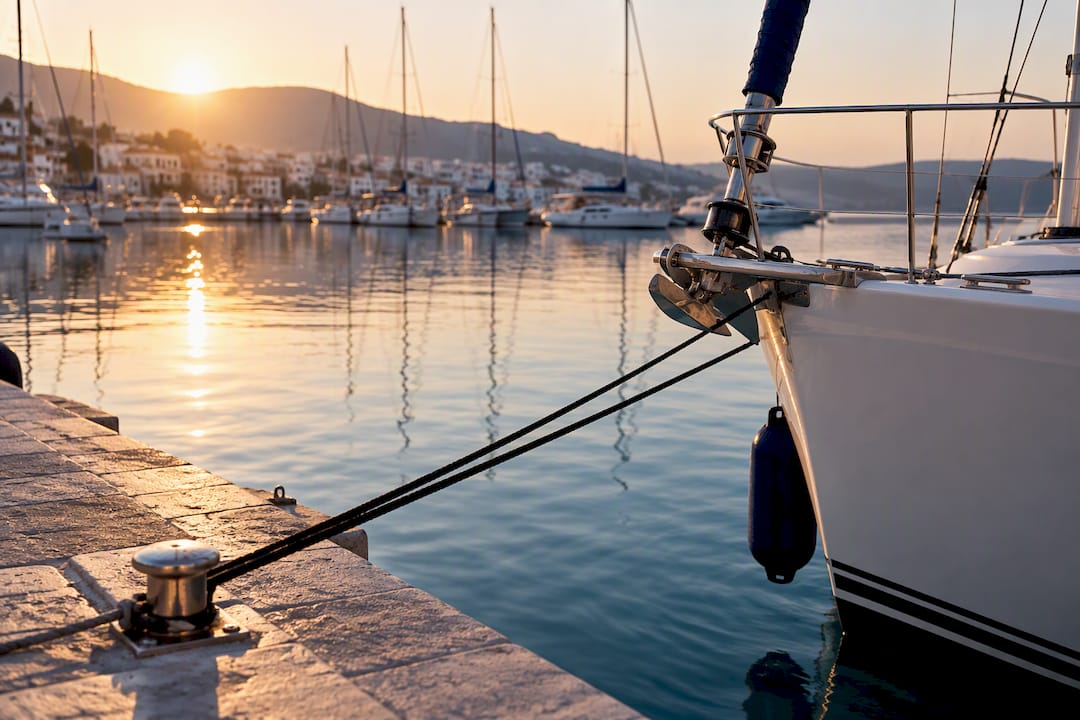
Yes, sleeping at anchor is genuinely restful once you trust the set. The three actions that make that trust possible: confirm the anchor has dug in with a proper power-set, verify your scope and swing room against the chart, and arm at least two independent alarms before anyone closes their eyes. Groups like the Nautical Institute and BoatUS have spent decades refining these basics, and experienced skippers often lean on routines like this every night out.
En bref :
- Proper scope ratios of 5:1 in calm conditions and up to 7:1 in wind or swell are essential for overnight anchoring safety.
- Using a full anchoring system, including chain, snubber, kellet, and stern anchor, significantly reduces swing and helps maintain a secure set.
- Confirming anchor set and bearings for at least an hour and adjusting scope carefully can prevent drag incidents during the night.
- Selecting sheltered anchorages with suitable seabed and ample swing room minimizes risks of drifting or collision.
- Modern GPS and phone alarm systems are reliable tools when set with an appropriate radius, and testing alarms before sleep prevents false triggers.
Table des matières
- How Do You Get a Good Night’s Sleep at Anchor?
- What Makes Up a Reliable Anchoring System?
- How Do You Properly Set and Test an Anchor Before Dark?
- How Do You Choose an Anchorage With Enough Swing Room?
- Which Monitoring Tools Actually Prevent a Bad Night?
- What Should You Do If the Anchor Alarm Goes Off?
- How Do You Reduce Boat Motion for Better Sleep?
- Why Does Anchor Anxiety Keep You Awake, and What Helps?
- What Are the Legal Rules Around Anchoring Overnight?
- What Do Experienced Skippers Actually Do Before a Night at Anchor?
- Want Someone Else Handling the Anchor Watch?
- Sources
How Do You Get a Good Night’s Sleep at Anchor?
A solid night at anchor comes down to a short routine you run before anyone climbs into a bunk, not a lucky guess about the weather. Most of the anxiety that keeps sailors checking the chartplotter every twenty minutes traces back to skipping one of these five steps, not to some unpredictable danger lurking offshore.
Here’s the sequence worth memorizing:
- Check your scope and rode. Let out 5:1 (rode length to depth at high tide) in calm, sheltered conditions, and bump that to 7:1 if wind or swell is building overnight, a ratio BoatUS recommends as standard practice.
- Power-set the anchor. Reverse gently, then increase throttle in stages, watching for the bow to hold steady rather than creep forward.
- Take bearings. Line up two fixed points on shore, or drop a GPS waypoint, so you have an instant reference if anything shifts overnight.
- Confirm swing room and show your anchor light. Make sure nearby boats and hazards stay clear of your full swing circle, then switch on the all-round white light required after dark.
- Set your alarms and brief the crew. Arm the chartplotter alarm and a phone backup, then agree on who checks what and when.
Run through it once, methodically, and you’ll spend far less time lying awake wondering if you missed something.
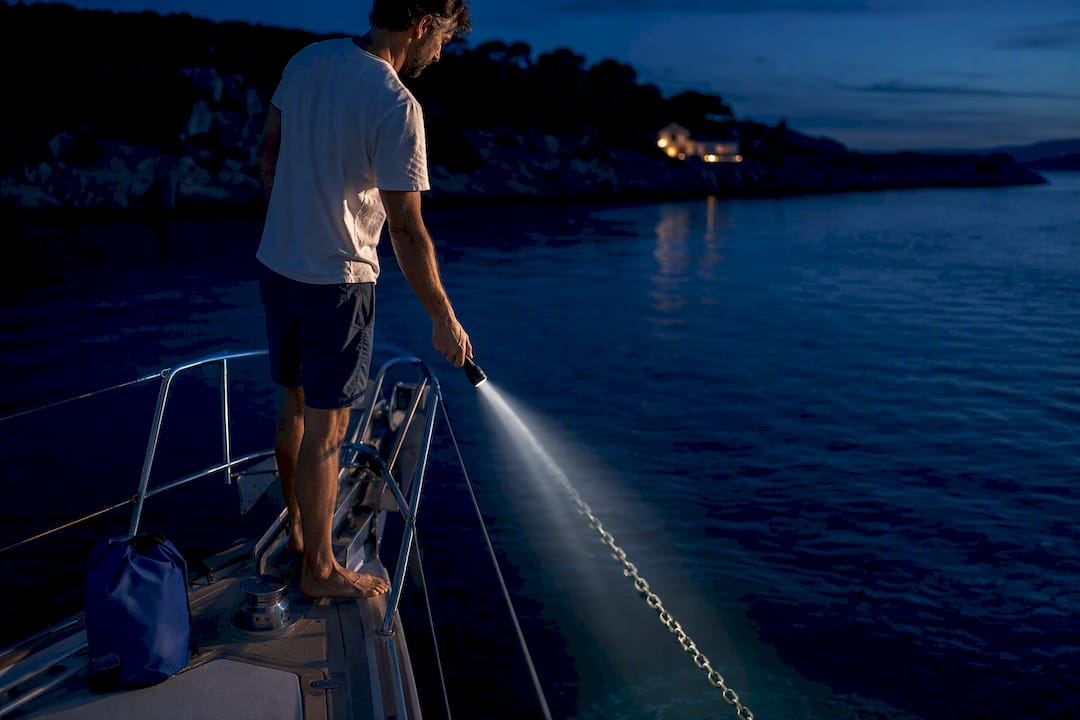
Conseil de pro : Do your final scope and bearing check with a flashlight in hand, not just a headlamp. Standing at the bow with a strong beam lets you actually see the rode angle in the water, which tells you more about your set than any gauge on the helm.
What Makes Up a Reliable Anchoring System?
An anchor by itself is only one piece of the puzzle. What actually keeps a boat still enough to sleep on is the full chain of gear between the seabed and your cabin, and how well those pieces work together.
Chain behaves differently from rope under load. Its weight lies along the seabed and absorbs shock through catenary sag, which is why most cruising boats run at least a partial chain rode rather than pure line. Rope stretches under sudden load, which sounds like a cushion but actually transmits more snatch into the bow fittings than a properly weighted chain does.
A snubber or bridle takes that idea further. Attaching a length of stretchy line between the chain and the boat’s cleats absorbs shock loads from wave action and takes tension off the windlass, which matters most in choppy anchorages where every gust jerks the bow. A bridle, rigged to both bow cleats rather than a single point, also holds the boat’s heading steadier against wind and current, cutting down on the side to side yaw that ruins sleep.
That yaw matters more than most sailors realize. The Nautical Institute notes that a boat swinging 40 degrees off its anchor line can triple the load the anchor has to hold compared to sitting head to wind, which is exactly the kind of spike that can break a marginal set at 3 a.m.
A kellet, a weight clipped partway down the rode, pulls the chain lower in the water and reduces that swing further, while a stern anchor can pin the bow into the wind entirely. None of this works if you’re fixated on one anchor brand solving every problem. As one detailed breakdown of modern anchoring systems puts it, holding ground is a system outcome, not a single-product one.
- Ancre : provides initial bite into the seabed
- Chain or rode: absorbs shock and sets the catenary curve
- Snubber or bridle: cuts snatch loads and stabilizes heading
- Kellet: dampens swing by weighting the rode
- Stern anchor: locks the bow into the wind for minimal yaw
How Do You Properly Set and Test an Anchor Before Dark?
Setting an anchor is a five-step process, and rushing any one of them is how boats end up dragging at 2 a.m. instead of resting quietly through the night.
- Approach into the wind or current, whichever is stronger. This keeps your bow pointed the direction the boat will actually settle, so you’re not fighting the elements while lowering gear.
- Lower the anchor steadily rather than dropping it in a pile. A controlled descent lets the chain lay out straight on the bottom instead of tangling on top of the anchor itself.
- Pay out scope as you drift back, aiming for 5:1 in calm conditions or 7:1 if forecasts call for wind or swell, following the same ratios BoatUS and West Marine both recommend for overnight holding.
- Back down in gentle stages, increasing throttle every 30 seconds or so, until you’re running near cruising RPM in reverse. If the bow holds firm and the chain goes taut without the boat creeping forward, the anchor has dug in.
- Settle and verify. Watch your bearings, glance at the GPS track, and give it time.
That last step trips up more sailors than any other. Experienced cruisers often wait at least an hour after setting, actively watching for drift, before calling an anchorage sleep-safe. That waiting period gives the seabed and the rode time to seat properly and lets any early tidal or wind shift expose a weak set while you’re still awake and alert to fix it.
If the anchorage fills up later in the evening and you’re feeling cramped, shortening scope is an option, but do it carefully. Bring in chain gradually while the engine idles in gear, watch your bearings the entire time, and be ready to let scope back out if the shorter rode starts sawing at the bottom instead of holding firm.
Conseil de pro : Pick two shore bearings that form roughly a right angle to each other, not two points in a straight line. A single bearing can shift subtly and fool you; a right-angle pair makes even small drift obvious within a minute or two.
Sailors who charter with a skipper can skip most of this stress. Sailarmada’s compétences essentielles pour la location de yacht guide covers what a guest should still understand, even when someone else is running the set.
How Do You Choose an Anchorage With Enough Swing Room?
The anchorage you pick matters as much as the technique you use once you’re there. A poor choice, thin holding, an exposed approach, a crowded corner, turns even a textbook power-set into a restless night.
Start with the chart. Look for seabed marked as sand or mud, both of which grip an anchor far better than rock or thick weed, and steer clear of designated channels, cable areas, or anything flagged as a hazard. Depth matters too: too shallow and you risk touching bottom on a falling tide, too deep and your scope ratio balloons into more chain than most windlasses comfortably manage.
Shelter counts for more than scenery. An anchorage tucked behind a headland or reef that blocks the prevailing wind and swell removes half the variables that cause trouble overnight, according to the practical guidance in this beginner’s overnight anchorage guide. Wide open water might look inviting at sunset, but a wind shift at midnight turns it into a washing machine.
Swing room is simple arithmetic once you know the formula: multiply your depth by your scope ratio, add your boat’s length, then add a safety margin for other boats’ swing circles and any nearby hazards. A boat in 10 feet of water on a 7:1 scope needs 70 feet of rode alone, plus its own length, plus room to spare.
- Confirm seabed type and depth on the chart before dropping anchor
- Choose shelter from the forecast wind direction over an exposed but scenic spot
- Calculate swing radius using depth times scope, plus boat length and a margin
- Leave generous space from neighboring boats to avoid overlapping swing circles
- Keep engine noise, generator hours, and deck lighting considerate of boats nearby
That last point is worth taking seriously. A cramped anchorage with boats swinging into each other’s space, or one boat running a generator at 11 p.m., turns everyone’s night worse. Good anchoring etiquette is part of what makes an anchorage restful for the whole fleet, not just your own boat.
Which Monitoring Tools Actually Prevent a Bad Night?
Modern boats have more ways to watch an anchor than ever, and picking the right combination matters more than owning the most expensive one. A chartplotter’s built-in anchor alarm draws a virtual circle around your set position and sounds if the GPS track drifts past it, which works well as long as the unit stays powered and the radius is set sensibly.
Phone apps offer a useful backup, particularly ones built specifically for anchor watch rather than general navigation, since they run independently of the boat’s electrical system if your battery drops. West Marine’s guidance on anchoring points out that GPS-based anchor alarms are one of the most reliable low-cost tools for catching drift early, precisely because they don’t rely on you noticing anything visually.
- Set your alarm radius wide enough to allow for normal swing but tight enough to catch real drift, typically your swing radius plus 20 to 30 feet
- Run a phone app as backup to your chartplotter alarm, not as a replacement
- Keep the alarm volume audible below deck, not just at the helm
- Charge devices fully before sleep and keep a backup power source on hand
- Plan for weak GPS or cell signal in remote anchorages by adding a visual bearing check as a manual fallback
A radius set too tight is almost worse than no alarm at all, because it triggers on normal swing and trains the crew to ignore it. That’s how a real drag event gets missed at 4 a.m., buried under three false alarms from earlier in the night.
Conseil de pro : Test your alarm the moment you set it, not the next morning. Walk away from the helm for two minutes after arming it and see if you can actually hear it from the cabin where you’ll be sleeping.
What Should You Do If the Anchor Alarm Goes Off?
An alarm at 2 a.m. is not a crisis by itself. It’s a prompt to run a short, prioritized checklist calmly, and most situations resolve within minutes once you know the order of operations.
- Check your bearings and GPS position immediately. Compare what you see now against what you recorded when you set the anchor, and figure out whether you’ve actually moved or the alarm radius was just too tight.
- Wake the crew and start the engine. Even if you decide the set is fine, having the engine running and someone alert removes the risk of drifting into another boat while you sort things out.
- Decide on a response. If you’ve genuinely dragged, you can often reset in place by paying out more scope and re-setting with reverse throttle, rather than relocating entirely.
- Consider a second anchor or a new spot. If the seabed clearly won’t hold, whether from weed, rock, or simply too much wind, move to deeper shelter or a different patch of chart-confirmed sand.
- Call for help if conditions exceed the boat’s capability. A coastguard channel or a run to the nearest marina berth beats gambling on a set that keeps failing.
For multi-person crews, rotating anchor watch in two or three hour blocks keeps everyone rested enough to respond well if something does go wrong. Sailarmada’s flotilla sailing safety procedures guide breaks down how group charters organize exactly this kind of watch handover.
How Do You Reduce Boat Motion for Better Sleep?
Motion, more than noise or unfamiliarity, is usually what actually disrupts sleep at anchor. A boat yawing back and forth on its rode rolls and jerks in a way that flat, still water never would, and there are concrete ways to cut that down before bed.
A stern anchor or a small drogue set off the back of the boat limits how far the bow can swing side to side, pinning the hull into a steadier heading through the night. A bridle does similar work from the front, distributing load across both bow cleats so the boat settles into wind rather than hunting for it, and a kellet weighting the rode further dampens the swing that causes rolling.
- Deploy a stern anchor in exposed spots where yaw is the main source of discomfort
- Rig a bridle to both bow cleats rather than a single point to stabilize heading
- Add a kellet on the rode in choppy conditions to reduce snatch and swing
- Orient sleeping berths fore and aft rather than across the beam when possible, since lengthwise motion is easier for the body to absorb than side to side rocking
- Keep earplugs or a white noise source on hand for lapping water and halyard slap
Conseil de pro : If seasickness is a concern for anyone aboard, have them sleep with their head toward the bow rather than the stern. It sounds minor, but it noticeably reduces the disorienting effect of pitch motion for a lot of people.
When conditions genuinely won’t settle down, no rigging trick beats a protected marina berth for a guaranteed calm night. Sailarmada’s guide to yacht type and onboard comfort also covers how catamarans and monohulls differ in motion characteristics, which matters as much as anchoring technique for a genuinely restful trip.
Why Does Anchor Anxiety Keep You Awake, and What Helps?
The sleeplessness that shows up at anchor rarely comes from an anchor that’s actually failing. It comes from uncertainty, the nagging feeling that something might be wrong, which drives sailors to check the chartplotter every twenty minutes instead of sleeping through a set that’s holding perfectly well.
A completed checklist and a properly armed alarm remove most of that uncertainty at the source, because they replace vague worry with a concrete answer: either the alarm has gone off, or it hasn’t. Psychology Today’s overview of anchoring as a mindfulness technique describes how a simple grounding practice, focusing attention on a fixed point or a slow breath, can interrupt exactly this kind of repetitive worry loop.
A short breathing exercise works well on board precisely because it requires no equipment. Inhale for four counts, hold for four, exhale for six, and repeat it five or six times while lying in the bunk. It won’t fix a genuinely bad set, but it quiets the low-level anxiety that turns a good set into a sleepless night anyway.
- Trust the checklist once it’s complete, rather than re-checking gear that’s already been verified
- Respond to alarms, not to intuition, since a properly set alarm will tell you if something changes
- Split overnight checks into scheduled watch shifts for larger crews instead of everyone half-monitoring all night
- Use a short breathing exercise if worry persists after the checklist is done
What Are the Legal Rules Around Anchoring Overnight?
Anchoring rules vary considerably by country, and by specific stretch of coastline within that country, so checking local regulations before dropping anchor matters as much as checking the seabed. Many popular Mediterranean cruising areas restrict anchoring in posidonia seagrass meadows, a protected marine habitat, and fine boats that anchor on it regardless of whether the skipper knew the meadow was there.

Marine parks and nature reserves frequently ban anchoring entirely within their boundaries, sometimes offering mooring buoys as the only permitted overnight option. Harbor authorities in many towns also restrict anchoring within a certain distance of marked channels, ferry routes, or designated swimming areas, and these zones are usually marked on official charts rather than left to guesswork.
Some countries require a permit or advance notice for overnight anchoring in specific bays during peak season, particularly where anchorages get crowded enough to raise safety concerns. Others simply apply general maritime law, allowing anchoring anywhere outside a marked channel or exclusion zone as long as the vessel doesn’t create a hazard to navigation.
None of these rules are universal, which is exactly why checking the current chart notices and local harbor authority guidance for your specific cruising ground matters more than relying on general habit from a different coastline. A skipper managing the passage plan will typically already know which bays are open and which require a mooring buoy instead.
What Do Experienced Skippers Actually Do Before a Night at Anchor?
Experienced skippers often run some version of the same sequence before calling it a night: check the set, confirm the scope, glance at the forecast one more time, and brief the crew on what the anchor alarm sounds like before anyone heads to their cabin. It’s a routine built from repetition, not improvisation, and it’s exactly why guests on a skippered charter tend to sleep better than they expected to on their first night aboard.
Guests often get a short walkthrough at the start of the week about what the anchor light means, how watch handover works if the skipper needs backup overnight, and what to do if they wake up and something feels off. That briefing does most of the work in reducing first-night anxiety, because it replaces the unknown with a clear plan.
Anchoring overnight on someone else’s watch feels different from managing it solo, and that difference is the whole point of chartering with a skipper in the first place.
- Voile
Want Someone Else Handling the Anchor Watch?
If reading through five steps, two alarm systems, and a swing radius formula sounds like more than you want to manage on your own vacation, a skippered charter solves that problem directly by putting an experienced professional in charge of every anchor set, every night, for the whole trip. Some companies pair guests with skippers who run this exact routine as second nature, often in popular sailing destinations such as Greece, Italy, Croatie, Sardinia, and Turkey.

You get the crystal clear water, the secluded coves, and the quiet nights at anchor, without ever needing to learn a power-set technique or wake up at 3 a.m. to check a bearing. The skipper handles the anchoring system, the scope, the alarms, and the watch rotation, so your only job is deciding which cove looks good for a swim in the morning. Browse Sailarmada’s private sailing options to see what a fully skippered week actually includes, or check available dates and start planning your own stress-free nights on the water.
Sources
- Holding ground: why modern anchoring systems matter more than ever
- The science of anchoring
- Anchoring & Mooring — BoatUS study guide
- How to Anchor a Boat | West Marine
- Anchoring: a strategy for weathering life
Recommandé
- Principales compétences en voile à maîtriser : 10 indispensables pour les nouveaux navigateurs
- Votre liste de contrôle pour une sortie en voilier : préparez vos bagages intelligemment et naviguez en toute liberté
- Conseils de sécurité pour les vacances en mer qui ont de l'importance
- Guide des vacances en voilier pour les familles et les amis, étape par étape