August in Greece is busy, and it is busiest around August 15. But “busy” is not the same everywhere or every week. Early August is easier than the middle of the month, the second half thins out, and a few regions stay quiet even at the peak. Plan your week around those differences and you can still have a gorgeous, spacious week on the water. At Sail Armada, we build Greek sailing weeks around exactly this kind of timing and route choice, starting from €560 per week per person on a private Greece charter.
TL;DR
- August is peak season. The week around August 15 is the busiest, and the days from about August 19 on are noticeably calmer.
- The crowd is not only sailors: ferries, hotels and harbors fill with Greek families on holiday, which is what makes mid-August ports tight.
- Corfu, Lefkas, the Saronic Gulf and the famous Cyclades fill first. The southern Peloponnese and quieter Cycladic islands stay roomier.
- Arrive at your anchorage early in the afternoon, build slack into your route, and pick your base before the 15th.
- Crowds and wind are linked: the meltemi pushes boats into the same sheltered bays, so plan for both together.
Table des matières
- Why August feels so crowded on the water
- August week by week
- What the August 15 rush really looks like
- Where it gets most crowded
- Where it stays roomier
- The meltemi and the crowd: plan for both
- How to plan an August route that feels spacious
- Private week or group week in August?
- Notre perspective
- Ready to plan your August week?
- FAQ
- Sources
Why August feels so crowded on the water
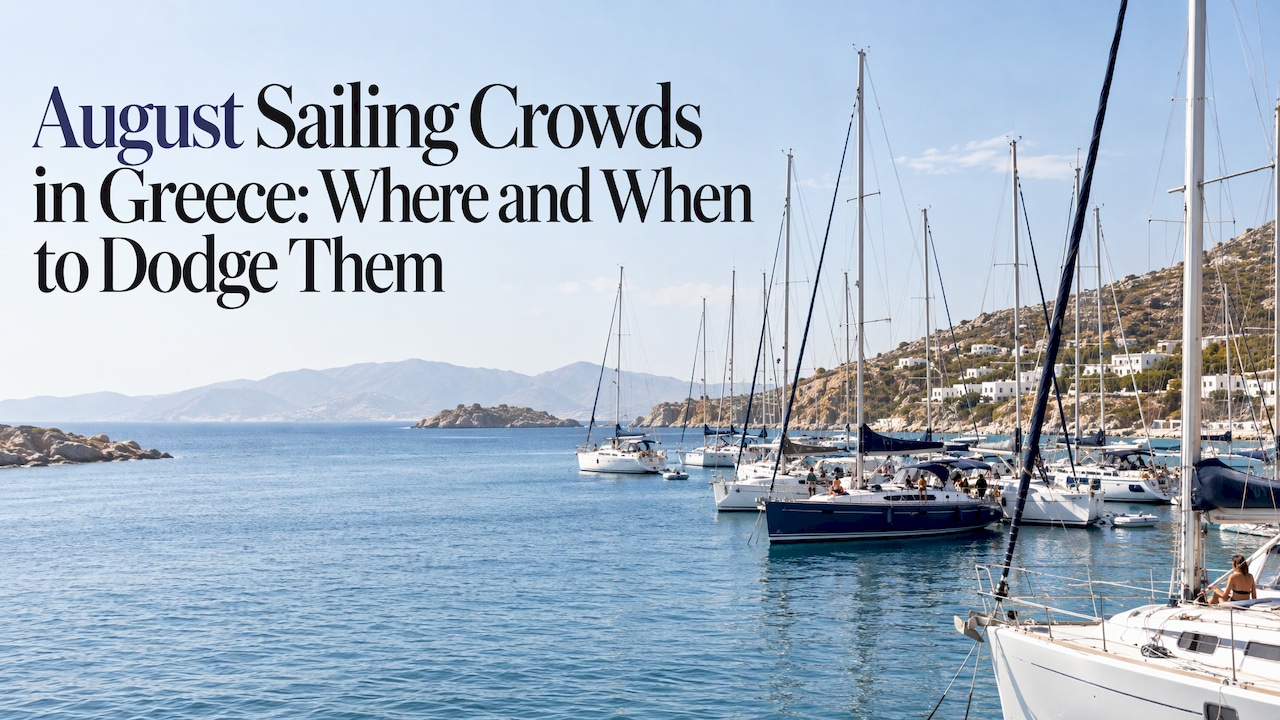
Two groups share Greece’s harbors in August. One is the charter fleet, which peaks in July and August. The other is Greek families, who take their main summer break around the mid-August holiday. Together they fill ferries, island restaurants and quay space at the same time.
That second group is the part many first-time sailors miss. A guide to Greece in August describes August 15, the Dormition of the Virgin Mary, as a major religious holiday and a domestic travel date, with ferries, flights and roads especially crowded. Cycladic Spaces adds that Athens goes quiet as locals head to their home islands, leaving packed ports, full tavernas and last-minute rooms that get expensive fast.
In 2026, August 15 fell on a Saturday, and the same source expected an even busier weekend because of it. The date itself is fixed each year, so check the weekday when you pick your dates: a holiday that lands on a weekend stretches the rush.
August week by week
The month is not one block. Here is how it breaks down, based on the August guides we found:
| Period | Qu'attendre | Good for |
|---|---|---|
| August 1 to 10 | Already peak season, but generally easier than mid-month | Crews who can only go early and want a lively but manageable week |
| August 11 to 18 | One of the busiest stretches of the Greek summer, around the August 15 holiday | Crews who want the festival atmosphere and will book berths and ferries early |
| August 19 to 31 | Still hot and busy, but domestic holiday traffic gradually eases | Crews who want the best balance of summer weather and space |
The weekly split comes from the August guide by SantoriniDave. Another August planning guide says crowds start thinning by about August 20 to 25, and that arriving between August 16 and 20 and staying into early September catches better conditions than the first half of the month. Tripaholics also notes that once Greek families return to cities like Athens to prepare for work and school, popular spots become easier to navigate and restaurant service feels more personal.
So if your dates are flexible, a Saturday start in the third week of August is a smart pick. If they are not, the route choices below do the work.
What the August 15 rush really looks like
It helps to see the scale. Pollar reported that 42,275 passengers left Attica’s three ports on August 13, 2026, including 23,665 from Piraeus to the Aegean and 7,267 from Rafina. The next day, gale-force winds of up to 9 Beaufort halted sailings from Rafina and Lavrio.
That combination is the real lesson for sailors. A crowd and a strong wind arrive together, and boats and ferry passengers all crowd into whatever harbor is safe.
What that means on the ground, per the sources above:
- Ferries and flights sell out. Breezy Routes says routes from Piraeus and Thessaloniki can sell out three to four weeks ahead for the August 12 to 16 window. If your crew arrives separately, book their travel first.
- Some island services close on the day. Banks, offices and many ordinary shops shut on August 15, while hotels, restaurants and tourist businesses in popular places generally stay open. Provision the boat on the 14th.
- Small islands peak hard. A Skiathos guide calls August 10 to 17 typically the busiest week of the year on the island, with ferries from Volos heavily booked by domestic travelers.
- Tinos is a pilgrimage destination. It is especially busy around the holiday.
There is an upside. The same sources describe the holiday evening as a highlight: church service first, then the village square with food, music and dancing. If your boat is already tied up somewhere small on the 15th, you are in the best seat for it.
Where it gets most crowded
A Greek sailing season guide names Corfu, Lefkas and the Saronic Gulf as the most crowded sailing areas in July and August. It adds that Mykonos, Ios, Santorini, Kos and Rhodes draw many non-sailing tourists on top of the charter fleet.
Three patterns explain why:
- Short hops from Athens. The Saronic Gulf is close to the capital, so it fills with weekenders and charter boats alike. Our Itinéraire du golfe de Sarone shows 7, 14 and 21 day plans for groups, and in August it works best when you start early and keep the last hour of each day flexible.
- Famous villages with small quays. In the Ionian, popular stops can be full by mid-afternoon. A 2026 guide notes that villages such as Sivota and Fiskardo fill by 14:00.
- Icon islands. Santorini, Mykonos, Paros and busy parts of Crete stay crowded and expensive for most of the month, even after August 15.
If you are starting from Athens, the marina is the first place you feel the rush. Our Athens marina guide covers five marinas to book for June to August so arrival day does not turn into a scramble.
Where it stays roomier
Two kinds of places work well in August: places with more water between harbors, and places the holiday crowd does not target.
The southern Peloponnese
YachtLifestyle calls it the Greek coast that peak season forgot. It suggests quiet nights at Porto Kagio or Gerolimenas, the lagoon at Elafonisos without the flotilla of charter yachts that crowd Ionian anchorages, and a finish in Monemvasia’s small harbor, which has around 30 visitor berths in 3 to 4 meters of depth.
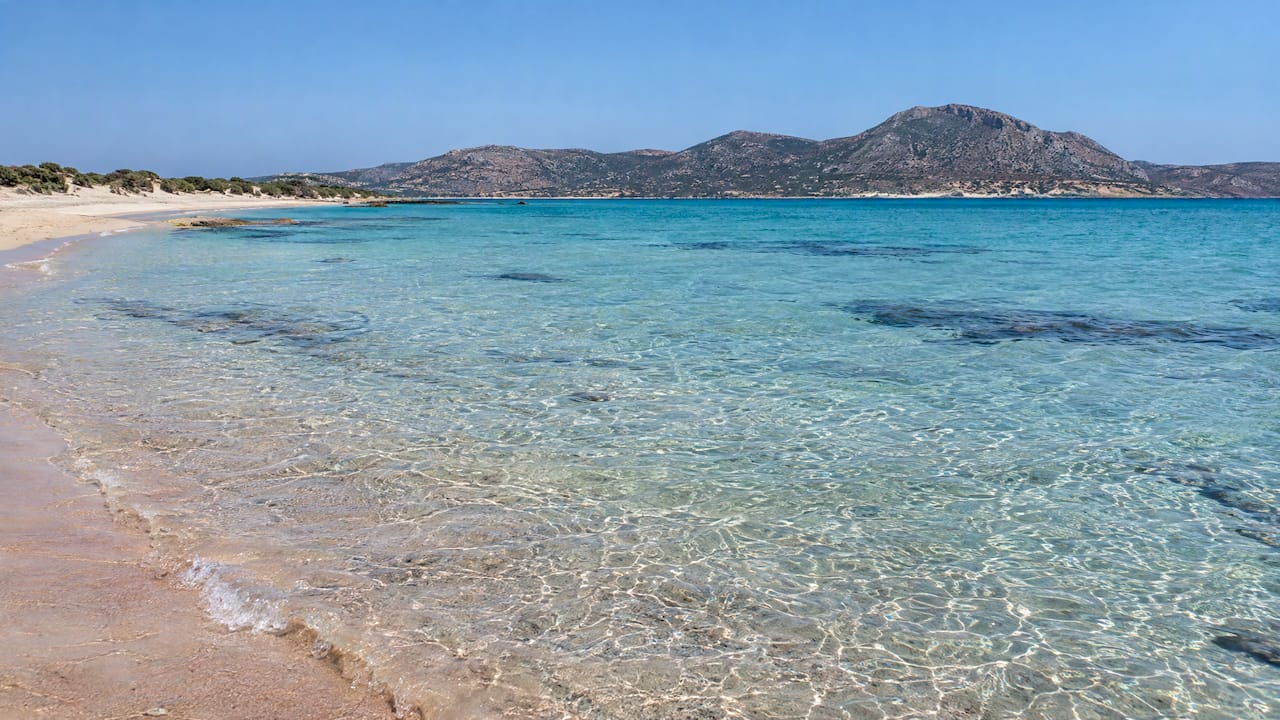
The trade-off is distance and facilities. Legs are longer and marinas are fewer, so a confident skipper and a well-stocked boat matter. That is the case for sailing with a skipper in August: someone who knows the long legs and has a plan for provisioning.
Quieter Cyclades
Un August islands guide lists Crete, Naxos and Rhodes as islands that handle crowds better than the most famous ones. A 2026 island roundup says Milos and Antiparos stay noticeably quieter than Mykonos or Santorini, as do Paxos and a few of its neighbors. Treat these as direction, not a guarantee: a quiet island on August 5 can feel very different on August 14.
Midweek and early-day logic
Crowds at anchorages have a rhythm. Charter boats leave in the morning, reach the famous bays by early afternoon and settle in before evening. If you move early and choose a smaller bay over a famous one, you often get a better swim and a better night.
The meltemi and the crowd: plan for both
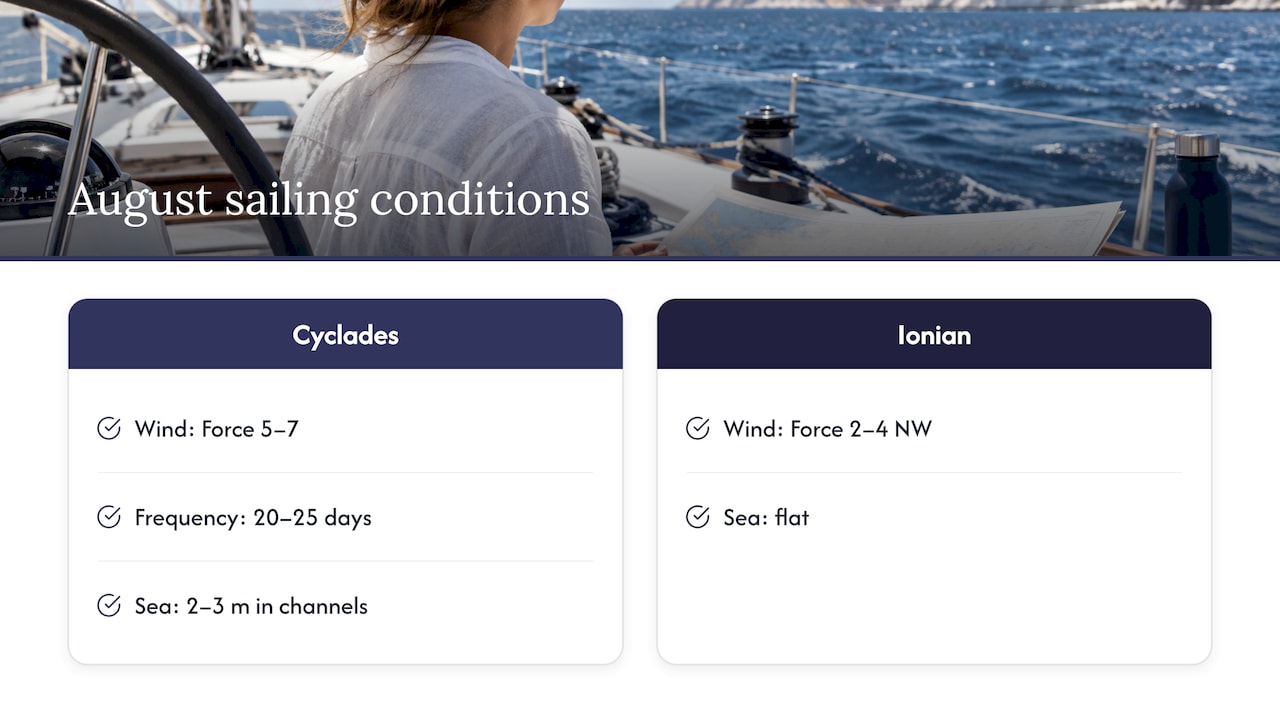
The meltemi is the dry northerly wind that blows across the Aegean in summer. A 2026 August guide reports it blows Force 5 to 7 on roughly 20 to 25 days of the month in the Cyclades, with 2 to 3 meter seas in channels like Mykonos to Tinos and Paros to Naxos. In the Ionian, August winds are typically Force 2 to 4 from the northwest with flat seas, which suits beginners and families.
The Hellenic National Meteorological Service forecast for the last week of August 2026, as reported by Athens Times, had northerly winds of 4 to 6 Beaufort in the east and locally 7 across the Aegean. So even after the holiday crowd leaves, the wind does not.
Why this matters for crowds: when the wind builds, everyone wants the same few sheltered harbors. Our guide to sailing the meltemi in Greece explains the strong wind days and how to route around them. A good August plan has a sheltered fallback harbor for every long leg.
How to plan an August route that feels spacious
This is the part that makes the difference. Use these steps, in order.
- Pick your week first. If you can, choose a start after August 15. If you cannot, accept that the middle of the month is the rush and plan for it.
- Choose the area to match your crew. First-timers and families tend to do well in the Ionian’s gentler winds. Crews who want island variety and are comfortable with wind can head to the Cyclades. Crews who want space and do not mind distance can look at the southern Peloponnese.
- Keep legs short in the Cyclades. Short hops leave room to change plan if the meltemi picks up.
- Arrive early. Aim to reach popular villages before early afternoon. If you will arrive late, choose an anchorage over a quay.
- Pick your base before the 15th. Cycladic Spaces advises this, and a buffer if you fly home straight after.
- Provision on the 14th. Many shops close on the day.
- Réservez tôt. Greek charters fill fast in summer. Our guide on when to book a yacht charter explains the timing, and it matters even more for August.
For route ideas beyond one island group, our Idées pour une croisière sur les îles de la Méditerranée lay out Greek routes with yacht options.
Private week or group week in August?
Both work. A private charter lets your crew decide when to leave, which is the best tool against crowds: you can be the first boat out of the harbor. A group sailing holiday adds company and a ready-made plan, which suits solo travelers and anyone who wants a social week. Either way, the choice of boat matters in a busy month. Catamarans give a crew more deck and cabin space when a harbor is full, and we explain why in why groups choose catamarans.
If you are weighing Greece against other places for August, our page on why charter in Greece covers privacy, value and the sailing itself.
Notre perspective
We love Greece in August. The water is warm, the evenings are long and the island holiday spirit is hard to beat. The crowds are real, but they follow a pattern, and a pattern can be planned around.
Our routes are curated by experienced, professionally trained skippers from CAPETAN.club, and that is what we lean on in August. A skipper who has made the same crossings in peak weeks knows which bay to choose, when to leave and where to shelter when the wind builds. You get the flexibility of a private week or the company of a group week, with transparent pricing, detailed boat options and support from actual sailors at every step.
Our advice is simple: pick your dates with the 15th in mind, keep your legs short, leave early and let a local-minded skipper steer you toward the quieter corners. That is how a crowded month turns into a spacious week.
Voile
Ready to plan your August week?
If you want a Greek week with room to breathe, our private Greece charter starts from €560 per week per person. You choose the dates, the yacht or catamaran and the route, and the skipper helps you stay ahead of the crowd.
See the Greece – Go Private week or look at our vacances en groupe à la voile if you would rather sail with company.
FAQ
Is August a bad time to sail in Greece?
No, but it is the busiest time. The weather is hot and settled, and the sea is warm. The trade-offs are fuller harbors, higher prices and the meltemi in the Aegean. With early arrivals, short legs and a sensible area choice, many crews have a great week.
Is late August better than mid-August?
Usually yes for crowds. Sources describe the days from about August 19 on as easing as Greek families return home, and a stay from August 16 to 20 into early September catches better conditions than the first half of the month. The heat and wind remain, so plan accordingly.
Which area is best for a first-time August sailor?
The Ionian is often a good fit because August winds are typically Force 2 to 4 with flat seas. It can be busy in popular villages, so arrive early. For more space, a skipper can build a route toward quieter anchorages.
How far ahead should I book for August?
As early as you can. Ferries and flights for the August 12 to 16 window can sell out three to four weeks ahead, and charters fill earlier still. Our booking timing guide explains the pattern.
Sources
- Greece in August: Weather, Best Islands & Travel Tips
- Why Late August is the Best Time to Visit Greece
- Panagia Greece Guide: What to Expect on 15 August
- Strong winds halt Greek island ferries for August 15
- Greece in August: Everything You Need to Know Before You Go
- Skiathos in August 2026: Peak Season Insider Tips
- When to sail Greece: Greek sailing holidays season
- The southern Peloponnese in August
- Weather Tomorrow in Greece: Heatwave & Meltemi Winds
Recommandé
- Evitez le chaos de l’arrivée : Réservez ces 5 marinas d’Athènes pour juin-août
- L’habillement marin en Grèce : règles non écrites pour les marins
- Short Hops Sailing Routes in Greece: Easy Legs and Quiet Bays
- Évitez les pénalités portuaires : Règlement pratique de la navigation en Grèce pour les Skipperyachts