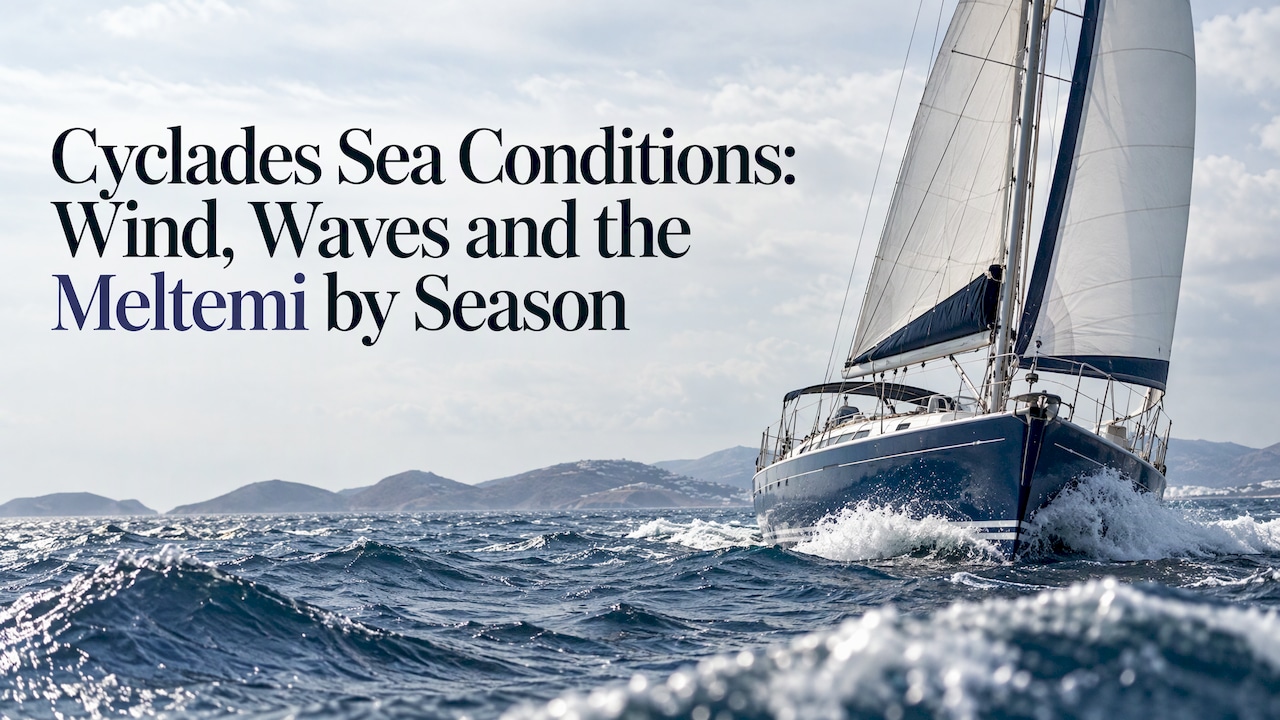
The Cyclades have a warm, dry Mediterranean summer, and the sea is shaped by one thing above all: the meltemi, a northerly wind that fills the Aegean from late spring to early autumn. May, June and September are gentler, July and August are the windiest, and the sea is lively in the straits between islands even when the open water looks calm. Plan your route around the wind, not against it, and the Cyclades are some of the best sailing you will ever do. Skippers who know these waters turn a breezy week into long, fast, sunny sails and quiet evenings in sheltered bays.
This guide explains what the sea does, when, and where, in plain words, so you can pick your dates and your route with confidence.
TL;DR
- The meltemi is a persistent north to northeast wind. The professional yacht owners’ association epest.gr says the season runs from around the end of May to around the end of October, strongest in July and August.
- It usually blows from about 8 a.m. to 8 p.m., peaks around 2 p.m. and drops after sundown, so mornings and evenings are the calm part of the day.
- Straits between islands, such as Tinos and Kythnos, Paros and Naxos, and Cavo Doro, can feel 25 to 40% windier than open water, with short, steep waves.
- Sail north first and come home south with the wind behind you, leave early, and keep a nearby backup harbor.
- May, June and September are the easiest months for first-time and family crews.
Table des matières
- The big picture: a sunny sea with a strong northern wind
- What is the meltemi, exactly?
- The windiest month in the Cyclades
- A day in the life of the wind
- How the sea changes from island to island
- Waves and swell: short, steep and wind-made
- Planning a route around the conditions
- How to check the forecast before and during your trip
- What about the ferries?
- Safe and comfortable on a windy day
- Notre perspective
- Sail the Cyclades with a skipper who knows the wind
- FAQ
- Sources
The big picture: a sunny sea with a strong northern wind
Cycladic summers are dry and sunny, with generally pleasant sailing from May through October. What changes from week to week is not the sky but the wind. Rain is rare in high season, visibility is superb and the water is warm, so almost every question about sea conditions comes down to wind strength and direction, and how the islands bend it.
A quick map of the year:
| Period | Qu'attendre | Fits |
|---|---|---|
| Mai à juin | Meltemi is weaker, with lighter and more variable days | Families, first-timers, relaxed groups |
| Juillet et août | Meltemi at its strongest, with long windy spells | Confident crews who like to sail hard |
| Septembre | Meltemi eases toward the end of the month | Mixed groups, warm sea, fewer boats |
| Octobre | Meltemi season ends around the end of the month | Experienced crews, shorter days |
| Winter | Strong Aegean gales | Not a charter season |
The seasonal pattern comes from the Hellenic Professional Yacht Owners Association, which says the meltemi is weaker in May and June, stronger in July and August, and disappears in the fall. In winter, the same source notes Aegean winds can reach force 8 to 9 on the Beaufort scale (the standard 0 to 12 wind-force scale), with extra intensity in the Kafireas straits and the Cyclades.
If you want the season-by-season view for the whole Mediterranean, our guide to Mediterranean sailing seasons puts the Cyclades next to Croatia, Italy and Turkey.
What is the meltemi, exactly?
The meltemi (plural meltemia) is a steady flow of air from the north or northeast across the Aegean. e-meteo.gr, a Greek weather service, describes it as a persistent northerly to northeasterly flow, mainly from late spring to early autumn, with its main season from June to September. It is driven by low pressure over the eastern Mediterranean and Asia Minor, combined with higher pressure over the Balkans. Air flows from the high to the low, and the Aegean sits in between.
Three things are worth knowing as a guest on board:
- It is not a storm. A meltemi day is sunny and clear. The wind is strong, but the sky is blue and the temperature is pleasant.
- It comes in spells. According to the yacht owners’ association, meltemia last on average 2 to 4 days. They can blow continuously for three or four days in sunny skies, reaching force 6 and sometimes 7 to 8.
- It is local. The same source notes it is at its most intense in the northern Aegean, particularly the Cyclades region, and e-meteo.gr points out that it varies a lot in channels, around capes and on lee shores.
Direction
In the northern Cyclades, YACHT magazine’s area guide says the wind blows about 80% of the time from the northeast, and more from the north in the center. For a sailing week, this means northbound legs are upwind and southbound legs are downwind, which shapes the whole itinerary (more on that below).
Strength
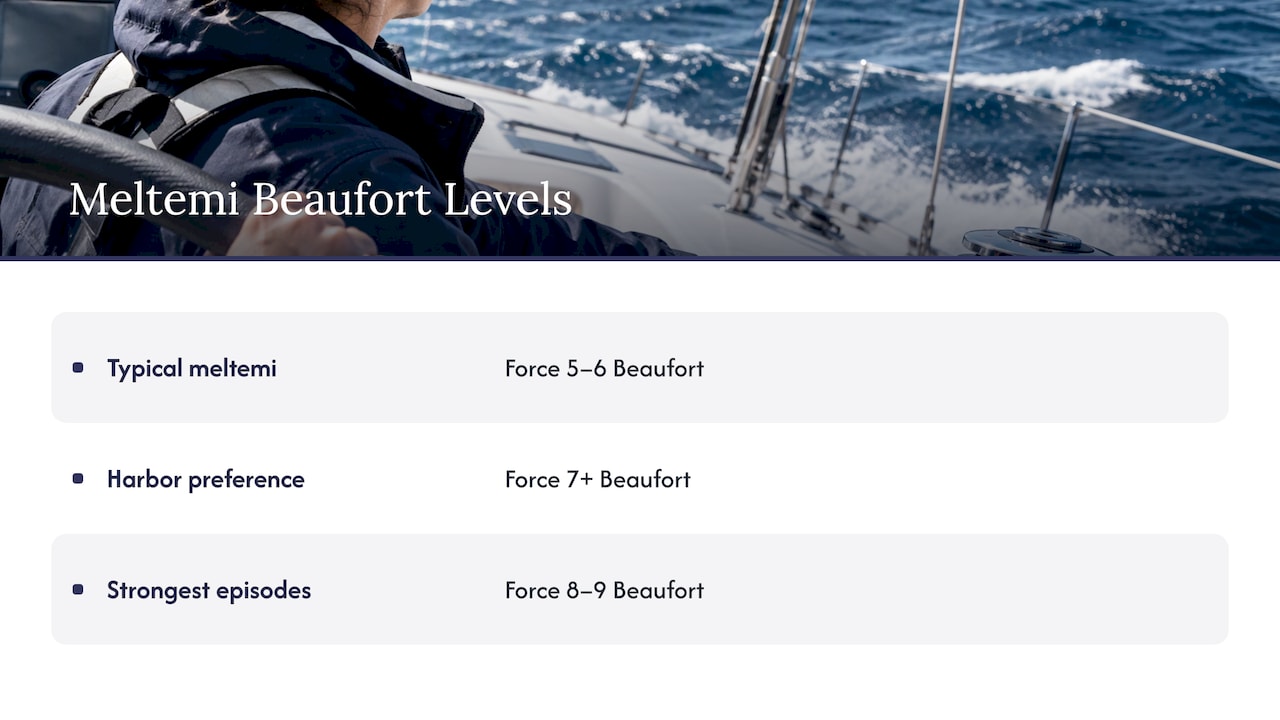
YACHT magazine puts the typical meltemi at 5 to 6 Beaufort, with spells that can last for days at 8 to 9 in the strongest episodes. Force 5 to 6 is roughly a strong breeze: white caps on the water, a good, fast sail, and a boat that heels or, on a catamaran, simply flies along. Force 7 and above is where experienced skippers start choosing harbors over open water.
The windiest month in the Cyclades
July and August. The yacht owners’ association and the YACHT guide agree that the meltemi is strongest in these two months, and YACHT notes it subsides by the end of September. If you like big, sporty sailing, this is your window. If you want to swim from the boat all afternoon, anchor in open bays and cook on deck without anything flying away, think May, June or September.
We have written a full page on this topic, sailing the meltemi in Greece, if you want to go deeper on strong-wind weeks.
A day in the life of the wind
The meltemi follows the sun. Here is a typical day:
- Early morning: calm to light wind. The best time for swimming, coffee on deck and the longest leg of the day.
- En fin de matinée : the wind builds as the land heats up. By about 9 a.m. the heat over the Turkish mainland is already pulling air south and west, according to the MeteoNav guide to the Cyclades.
- Midday to late afternoon: the peak. MeteoNav says the system reaches its maximum of 7 to 8 Beaufort in the strongest spells. The yacht owners’ association puts the peak around 2 p.m.
- Soirée : the wind falls quickly after sundown, and returns at dawn.
The lesson is simple and every skipper lives by it: sail in the morning, be in harbor or at anchor by mid-afternoon, and enjoy the calm evening. It is why a well-planned Cyclades week feels relaxed even in August.
How the sea changes from island to island
The Cyclades are a scatter of islands with deep channels between them, and the wind does not behave the same in each place.
Straits and capes: the fast lanes
MeteoNav reports that wind accelerates by 25 to 40% in the straits between Tinos and Kythnos, between Paros and Naxos, and at Cavo Doro (the channel off southern Evia, north of Andros), compared with open water. The waves there become short, steep and often cross, and there can be strong local currents. YACHT magazine gives a similar rule of thumb: the wind can increase by one or two Beaufort forces between islands.
The yacht owners’ association also names the waters around Icaria and Cavo Doro as places where meltemi waves are hard on small recreational vessels. This is exactly the kind of knowledge you want a professional skipper to hold in their head, so that you never meet it by surprise.
Mountain islands: gusts from above
MeteoNav warns that islands with strong relief, such as Amorgos, Tinos and Andros, can produce sudden, violent downdraft gusts known as williwaws. Experienced skippers watch the water for dark, wrinkled patches that show where a gust is coming, and reef the sails early. For guests, it means that an anchorage under a high cliff can be gusty even when the sea looks flat.
The lee side: the quiet bays
The same wind that makes a channel lively makes the southern side of an island peaceful. Anchor on the lee side, away from the northerly, and you get flat water, clear swimming and a quiet night. Choosing the right side of the island for the night is half the art of Cyclades sailing.
Waves and swell: short, steep and wind-made
In the Cyclades, waves are mostly wind waves rather than long ocean swell. That means they build as the meltemi builds and calm down when it eases, and they are steepest where the wind accelerates through a channel. For reading forecasts, it helps to know that meteo.gr defines wave height as the average trough-to-crest height of the highest third of waves. Individual waves can therefore be noticeably larger than the number on the map.
What this means on board:
- In open water on a typical meltemi day, expect a lively, bouncy sea, not a dangerous one.
- In the narrow straits, expect short, choppy waves. Secure everything below and on deck before you leave.
- Early starts mean flatter water, because the wind has not yet built the waves.
- A catamaran is more stable and flatter under sail, which many families and groups appreciate on windier days. Our comparison of a catamaran vs a sailing boat explains the difference.
Planning a route around the conditions
The golden rule: go north first, come home downwind
The meltemi blows from the north, so the heavy lifting should come early. Sail the harder, upwind legs at the start of the week while the crew is fresh and the wind may be lighter, then enjoy fast, easy downwind sailing on the way back south. YACHT magazine adds a rule of thumb for the meltemi period: when you sail south, plan about two-thirds of your sailing time for the return journey, because you will have a long way to go back against the wind.
MeteoNav’s guide is blunt about the alternative: sailing north or west against a strong meltemi works only if you leave very early, before dawn, or sail at night. A holiday is not the time for that, so a good itinerary avoids it altogether.
Leave early, arrive early
Plan departures for the morning, and aim to be settled in the next harbor or bay by early afternoon. That also gives you time to swim, wander the village and find a table before the evening crowd.
Keep a plan B
A sensible skipper always knows a sheltered harbor within an hour or two of sailing, in case the wind builds. Shorter hops between nearby islands give you more of those options. Our short hops sailing routes show how easy legs and quiet bays can fit together, and the Cyclades sailing itinerary gives you day-by-day plans tested by skippers.
Choose your month for your crew
- Families with young children: June or September, when the wind is gentler and the water is warm.
- Groups of friends who want to sail properly: July or August, with a skipper who knows the straits.
- Mixed groups and first-timers: late May, June or September, for the best balance of breeze and calm.
If you are comparing the Cyclades with another Greek region, our guide to Dodecanese vs Cyclades sets out how the sea differs. For timing the whole trip, see the le meilleur moment pour un voyage en bateau en groupe.
How to check the forecast before and during your trip
Wind measured on land does not always describe the sea, as e-meteo.gr points out, so use a marine forecast rather than a town weather app. Useful tools include:
- Wind and wave maps for Greek seas. Meteo.gr publishes wind-force and wave-height maps for Greek seas in 3-hour steps.
- Official nautical publications. Le Hellenic Navy Hydrographic Service publishes Sailing Directions for Greek coasts (three volumes in English), describing coasts, dangers and ports, along with nautical charts and Notices to Mariners.
- Your skipper’s daily briefing. On a skippered week, checking the marine forecast each morning and choosing the day’s route is the skipper’s job, which leaves you free to enjoy the sea.
Because conditions change from day to day, a forecast is a guide for the next few days, not a promise for the week. Check it close to departure, and again each morning.
What about the ferries?
Many guests combine a sailing week with ferry travel to or from the islands, so it helps to know that ferry decisions depend on more than a single number. The Hellenic National Meteorological Service, quoted by Parapolitika, said each ship has its own limits, and that restrictions depend on wind direction. With northerly winds that create less swell, large ships are restricted mainly at force 9 and travel normally at force 8. The same report described 8 to 9 Beaufort winds in the northern Cyclades and at Cavo Doro.
The practical tip: on strong meltemi days, leave a buffer in your travel plans around the start and end of your week. Our guide on when to book a yacht charter also helps you plan the timing of your trip.
Safe and comfortable on a windy day
A few habits make windy days easy for everyone on board:
- Listen to the skipper’s briefing and follow it. Lifejackets, and clipping on when asked, are part of normal sailing.
- Stow loose items below and secure the dinghy and cushions before leaving the dock.
- Keep one hand for yourself while moving around the boat, and move low and slowly in rougher water.
- If you are prone to seasickness, look at the horizon, stay in fresh air, eat lightly and drink water. If you are unsure about medication, speak to your doctor or pharmacist before your trip.
- Use sun protection: the wind keeps you cool, but the Aegean sun is strong.
Notre perspective
The Cyclades do not need to be tamed, they need to be understood. The meltemi is part of what makes these islands so alive: crisp air, clear light, and sailing that is fast and fun when the route is planned well.
That is why we work with professionally trained skippers from CAPETAN.club, who curate our routes. A good route lets the wind carry you, puts the longer legs in the morning, and ends the day in a bay that suits the night.
We also think the best Greek sailing weeks combine the freedom of a private boat with the fun of a group, with personal support from real sailors at every step. You choose the yacht or catamaran, the dates and the pace, and the sea does the rest.
Voile
Sail the Cyclades with a skipper who knows the wind
If you would rather spend your week swimming, exploring and sharing long dinners than studying wind charts, our Semaine de voile privée en Grèce starts from €560 per week per person. You choose your yacht or catamaran and your dates, and sail routes curated by experienced skippers.
Want more ideas first? Browse all our vacances en mer en Grèce, or see our vacances en groupe à la voile if you would like to join others.
FAQ
What is the windiest month in the Cyclades?
July and August are the windiest months. The yacht owners’ association et YACHT magazine both say the meltemi is strongest then. It eases through September and fades by the end of October.
Is the sea rough in the Cyclades in summer?
It is lively rather than rough on most days, and it varies by place. The wind and waves build in the afternoon and in the straits between islands, while mornings and the lee sides of islands are calm. A skipper plans the day so you travel in the quieter hours.
What is the best month for a family sailing holiday in the Cyclades?
June and September are the usual favorites, with a weaker meltemi and warm water. May can also be pleasant. If you want help choosing, our guide to sailing seasons lays out each month.
At what wind speed are Greek ferries cancelled?
There is no single figure. According to the Hellenic National Meteorological Service, as reported by Parapolitika, each ship has its own limits, and large ships are restricted mainly at force 9 with northerly winds. Always check with the operator on the day.
Where can I see the Cyclades wind and wave forecast?
Meteo.gr publishes wind and wave maps for Greek seas in 3-hour steps. Check them close to departure and each morning, as the forecast changes with the weather pattern.
Sources
- Navigation in Greece, Hellenic Professional Yacht Owners Association
- Area info: Yacht charter Greece: the Cyclades, YACHT
- What is the Meltemi?, e-meteo
- Sailing and meltemi strategies in the Cyclades, MeteoNav
- Sailing maps for Greek seas, meteo.gr
- Nautical Publications, Hellenic Navy Hydrographic Service
- Ferry ban hits Aegean as 9 Beaufort winds strike Cyclades, Parapolitika
Recommandé
- 16 jours de vent fort et des rafales à 100 km/h : naviguez dans le Meltémi en Grèce
- Quelles sont les saisons de navigation ? Votre guide de la Méditerranée
- Tout savoir sur les saisons de voile en Méditerranée : guide 2026
- Skipper a testé l'itinéraire de navigation dans les Cyclades avec des programmes prêts jour par jour