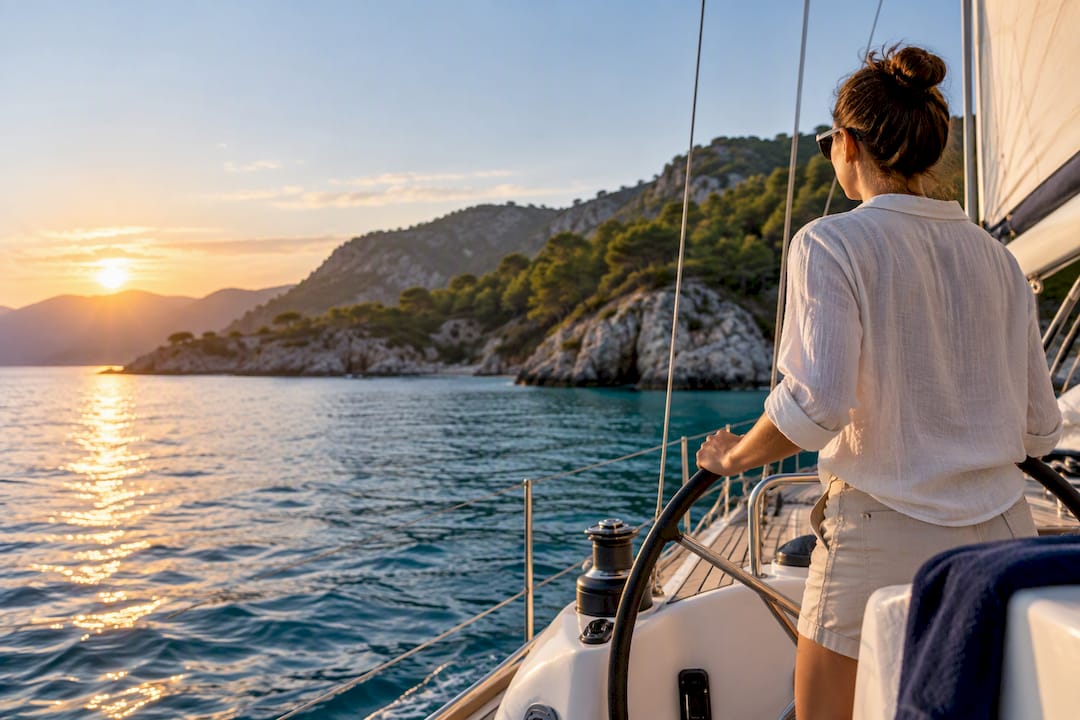
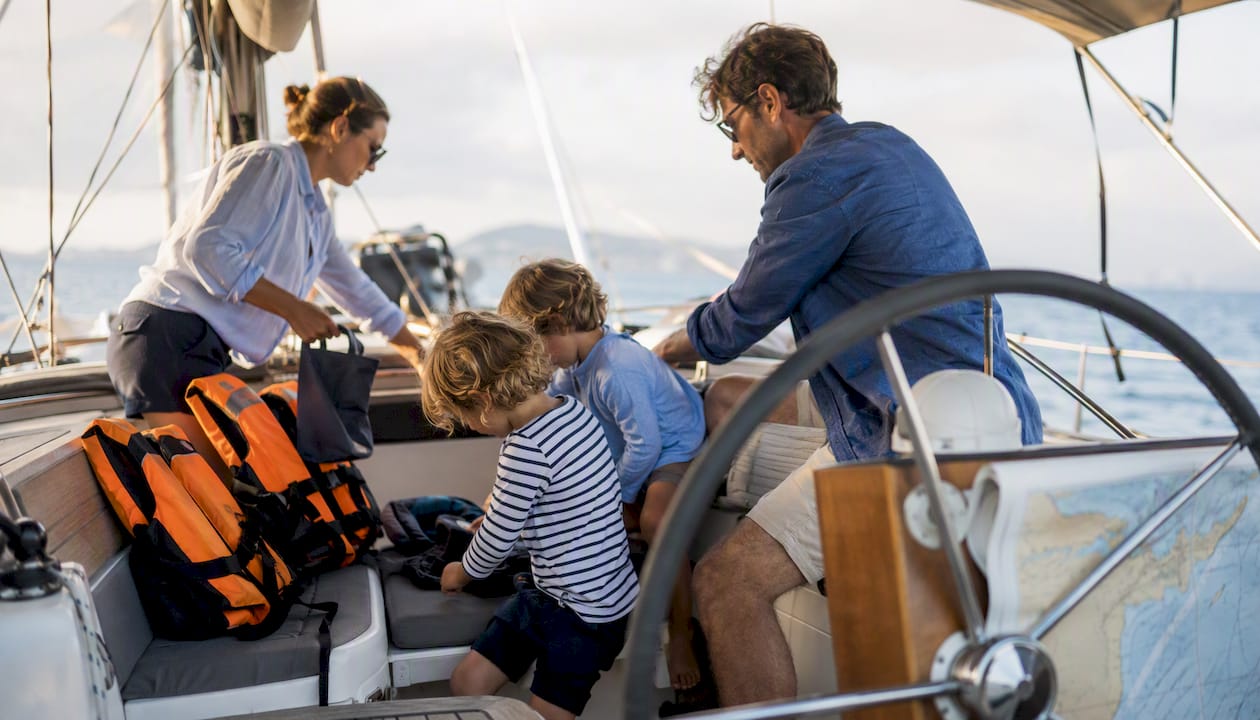
Start by locking down three things before anything else: correctly fitted personal flotation devices (PFDs) for every child, a boat with enclosed deck space or safety netting, and a daily rhythm built around short legs and predictable anchor times. Get those right, and the rest of the trip falls into place.
Here’s what to tackle first:
- Check every child’s lifejacket for fit, crotch strap, and grab handle before departure day, not on the dock.
- Assign a safety buddy for each child, a designated adult responsible for that child’s location at all times.
- Plan legs of 10–20 nm per day maximum for younger kids, keeping passages short enough that seasickness and boredom don’t have time to set in.
Le RYA recommends involving children in simple onboard tasks from the very first sail, and Sailarmada’s family charters are built around exactly that kind of structured, skipper-led experience. For a first family sail, your go/no-go criteria are simple: wind under 15 knots, a protected bay or coastal route, a child who can follow basic instructions, and a boat with deck netting or a cockpit enclosure. If all four are in place, you’re ready to go.
Principaux enseignements
Family sailing with children is safe and genuinely rewarding when you lock down fitted PFDs, short daily legs, and a clear emergency plan before you leave the dock.
| Point | Détails |
|---|---|
| Fit PFDs before departure | Check crotch strap and grab handle; child-sized PFDs need at least 100 N buoyancy. |
| Keep daily legs short | Aim for 10–20 nm per day with children under 10 to prevent fatigue and seasickness. |
| Assign a safety buddy | One designated adult per child, responsible for that child’s location at all times. |
| Pack a child-specific first-aid kit | Include pediatric dosages, rehydration sachets, and a doctor-approved motion-sickness remedy. |
| Sailarmada for family charters | Curated itineraries with child equipment on request, experienced skippers, and family-friendly routes. |
Table des matières
- What does a complete guide to sailing with kids cover first?
- How do you keep kids engaged and happy on a sailing trip?
- What should you pack for kids on a sailing trip?
- How do you plan a family-friendly sailing itinerary?
- What sailing tasks can kids actually do on board?
- What’s your emergency plan if something goes wrong?
- What’s the best age to start sailing with kids?
- Why family sailing is worth every bit of the effort
- Sailarmada makes family charters genuinely easy to set up
- Sources
What does a complete guide to sailing with kids cover first?
Safety is the non-negotiable foundation of every family sail, and it starts with gear that actually fits.
The safety checklist every family needs
Every child on board needs a USCG-approved or ISO-rated PFD sized to their weight, not their age. The crotch strap is the detail most parents miss: without it, a PFD can ride up over a child’s face in the water. Grab handles on the back of the jacket let adults lift a child out of the water quickly. Check the fit by lifting the child by the jacket’s shoulders; if it rises above their chin, it’s too big.
Beyond PFDs, a well-set-up family boat needs:
- Harnesses and tethers for children on deck in any wind above 15 knots or at night
- Filet de sécurité along the lifelines and around the bow, especially for toddlers
- A child-specific first-aid kit with pediatric dosages clearly labeled (more on this in the packing section)
- Waterproof ID bracelets for every child, with your boat name, phone number, and marina
- A life-raft policy for offshore passages: brief every adult on its location and deployment
Charter guidance from GetBoat recommends requesting safety netting, child-sized PFDs with at least 100 N buoyancy, and non-slip decking when booking. Most charter companies will supply these on request, but you need to ask at least two weeks ahead.
Onboard rules that stick
A 60–90 second safety huddle before every departure is worth more than a long briefing once a week. Cover four things: who’s the safety buddy for each child today, which zones are no-run areas (foredeck, companionway steps), when kids must be clipped in or wearing PFDs, and the one-word signal for “stop and hold on.” Keep it short, keep it consistent, and kids will internalize it within a few days.
Reflected UV off the water increases sun exposure by roughly 25–40% compared to being on land. Apply SPF 50+ sunscreen every 90 minutes on the water, and dress kids in UPF-rated clothing from the first hour out.
For seasickness, the key rule is early intervention. Ginger chews and fresh air at the helm work for mild cases. Sailboats that seasickness patches are not approved for children under 12, so consult a pediatrician before departure for age-appropriate alternatives.
For emergencies, every adult on board should know three steps: shout “man overboard” and point continuously at the person in the water, throw a life ring immediately, and keep eyes on them without looking away. Designate one adult as the pointer, one at the helm, and one to handle communications on VHF Channel 16.
Conseil de pro : Run a man-overboard drill with a fender as the “victim” in a calm anchorage before your first open-water passage. PBO recommends practicing in calm conditions so the steps become automatic, and kids can play an age-appropriate role like pointing and counting.
How do you keep kids engaged and happy on a sailing trip?
Boredom is the enemy of a peaceful passage, and the fix is structure, not screens.
Age-grouped activity ideas
Toddlers (2–5): Sensory wins. A bucket of seawater and a few cups on the cockpit floor keeps a two-year-old busy for 20 minutes. Waterproof foam mats on the cabin sole create a safe play zone. Bring a portable potty and a small fan for hot anchorages.
School-age (6–12): This is the golden age for involvement. Kids this age can handle the lookout role, track the boat’s position on a paper chart, and help pull in a light sheet. Waterproof journals for nature spotting (birds, fish, cloud shapes) turn a long passage into a game. RYA guidance specifically recommends meaningful onboard roles to reduce restlessness and build confidence.
Teens (13+): Give them real responsibility. Steering under supervision, helping set the anchor, or managing the radio check-in. Teens disengage fast when they feel like passengers; a genuine task with a clear outcome keeps them present.
A sample daily rhythm that works
| Heure | Activité |
|---|---|
| 08:30 | Breakfast, safety huddle, depart |
| 08:30–12:00 | Morning sail (10–20 nm max) |
| 12:00 | Anchor, swim, lunch |
| — | Nap/quiet time (toddlers), free activity (older kids) |
| 16:00–17:30 | Shore exploration or snorkeling |
| 17:30 | Anchor set, dinner prep begins |
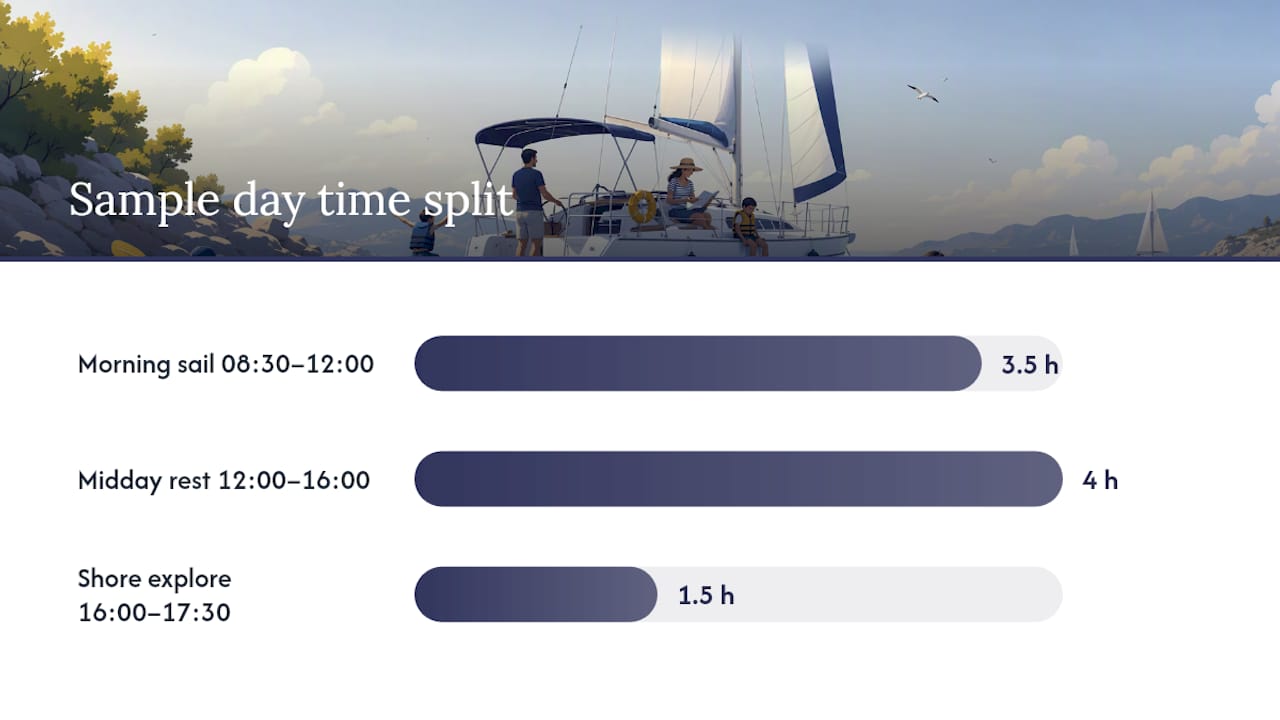
Anchoring by 17:00–17:30 is a widely recommended practice for family sailing because it preserves swim time, keeps bedtimes predictable, and gives adults time to decompress before dinner. Check out family-friendly sailing destinations for routes built around this kind of rhythm.
For entertainment during longer passages, rotate a small selection of toys every two days rather than bringing everything out at once. Audiobooks and podcasts work well at sea because kids can listen while watching the water. Travel card games, nature-spotting checklists, and simple drawing challenges round out a low-tech rotation that doesn’t rely on signal.
Conseil de pro : The real role of activities on a sailing trip isn’t just entertainment. Short, meaningful tasks build a child’s sense of ownership over the trip. Rotate the “lookout” role every 30 minutes so every child gets a turn.
What should you pack for kids on a sailing trip?
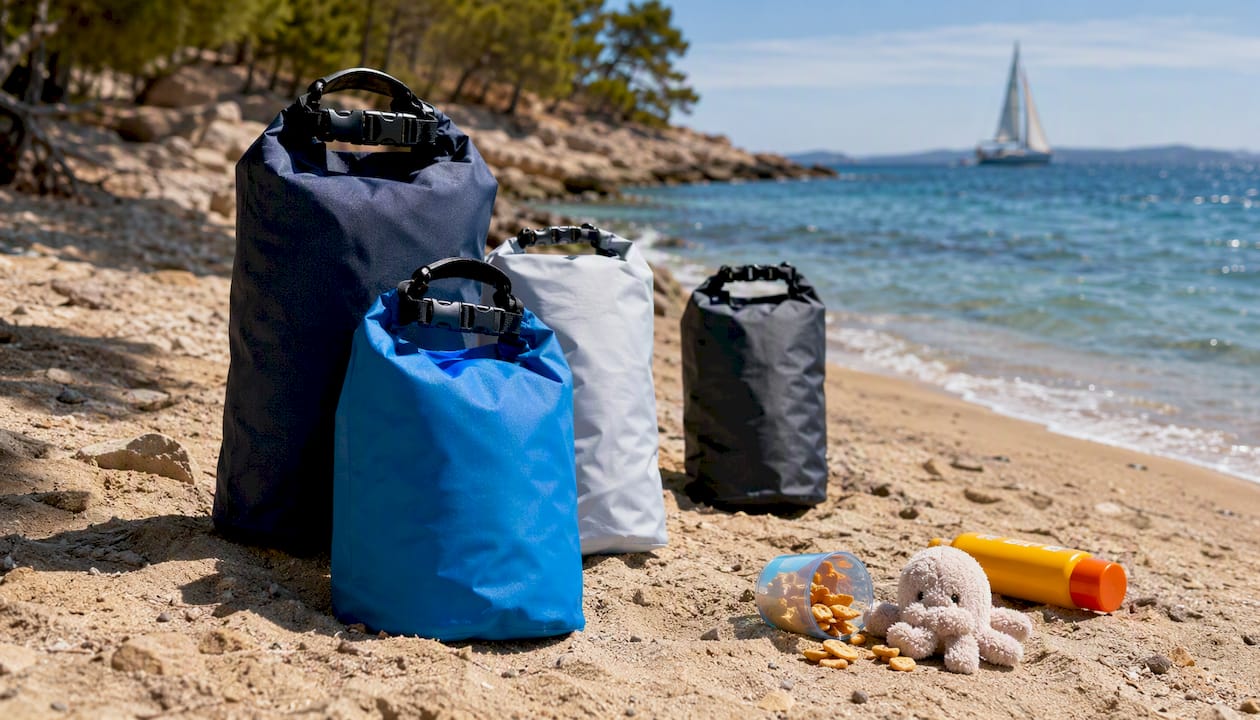
Pack light, pack smart, and pack one labeled dry bag per child.
The family sailing packing list
La sécurité :
- Child-sized PFD (USCG/ISO-rated, correct weight range)
- Harness and tether for each child
- Waterproof ID bracelet (boat name, phone, marina)
- Safety whistle attached to each PFD
Vêtements :
- UPF 50+ rash guards and swim shirts (at least 3 per child)
- Non-slip deck shoes or water sandals
- Warm fleece layer for evening passages
- Wide-brim hat with chin strap
Health and meds:
- Child-specific first-aid kit: pediatric pain reliever, antihistamine, rehydration sachets, antiseptic wipes, blister plasters, tweezers
- Pediatric thermometer
- Prescription meds with dosage chart
- Pediatrician-approved motion-sickness remedy (not patches for under-12s)
- SPF 50+ sunscreen (plan for reapplication every 90 minutes)
Comfort and entertainment:
- Waterproof journal and pencils
- Travel card games and small puzzles
- Nature-spotting checklist (laminated)
- Audiobook downloads (offline)
Food and snacks:
- High-protein snacks for passages (nuts, cheese, crackers)
- Ginger chews for mild seasickness
- Reusable water bottles (one per person, labeled)
Documentation:
- Passports and travel insurance documents in a waterproof pouch
- Pediatrician contact and medical summary
- Charter company emergency number
| Objet | Why it matters for kids | Charter request note |
|---|---|---|
| Filet de sécurité | Prevents toddlers from reaching lifelines | Request at booking, 2+ weeks ahead |
| Child PFD (100 N+) | Correct buoyancy for small body weight | Specify child’s weight when requesting |
| Highchair or booster | Safe seating at the saloon table | Available from many charter companies |
| Port-a-crib | Safe sleep space for infants | Confirm availability before booking |
| Non-slip cockpit mat | Reduces slip risk on wet surfaces | Often available; confirm with charter |
Sailarmada’s personalized charter options let you request child-specific equipment when booking, from safety netting to baby gear. For shore-day packing, a beach packing checklist covers the extras that make a family swim stop genuinely relaxing.
Conseil de pro : Pack one labeled dry bag per child with their daily essentials: sunscreen, a snack, a small toy, and a change of clothes. It speeds up shore trips and stops the “where’s my stuff?” argument before it starts.
How do you plan a family-friendly sailing itinerary?
Short legs, protected anchorages, and at least one flex day per week. That’s the formula.
Daily distance and timing
For families with children under 10, aim for 10–20 nm per day. That’s roughly 2–4 hours of sailing, which is long enough to feel like an adventure and short enough to avoid the fatigue spiral that turns a great trip into a miserable one. Compact island routes with 5–10 nm legs and protected anchorages are ideal for first-time family charters because they keep seasickness minimal and give kids a new swimming spot every day.
- Choose protected bays over open anchorages whenever possible. Calm water means better sleep, less motion sickness, and safer swimming.
- Prioritize marinas with shore access at least every two to three days. Shops, playgrounds, and medical access matter when you’re traveling with children.
- Build a sample daily structure: morning sail (depart by 08:30, arrive by 12:00), midday anchor and swim, afternoon shore time, anchor set by 17:30.
- Plan one flex day per week with no sailing at all. Use it for a longer beach stop, a town visit, or simply staying put if the weather turns.
- Book marinas 2–4 weeks ahead during peak season. Popular family-friendly anchorages fill up fast in July and August.
For destination ideas built around this kind of rhythm, top family sailing holiday ideas covers routes across the Mediterranean that work well with children on board.
Conseil de pro : When booking your charter, note the flex day in your request and ask the skipper to flag one or two “bonus” anchorages along the route. Skippers who know the area will have a secret bay that doesn’t appear on any list.
What sailing tasks can kids actually do on board?
Giving kids a real job changes the whole dynamic. They stop being passengers and start being crew.
Teaching kids simple sailing skills
The RYA’s approach to involving children in navigation planning, lookout duties, and basic ropework is grounded in a simple truth: kids who feel useful don’t get bored. Here’s how to teach a single task in five steps:
- Explain what the task is and why it matters (“You’re the lookout. You watch for other boats and tell me if you see one.”)
- Demonstrate once, slowly, with commentary.
- Supervised try: let them do it with you right there.
- Praise the effort, not just the result.
- Répéter the next day until it’s second nature.
| Age range | Task | Safety control needed |
|---|---|---|
| 4–6 | Lookout (cockpit only) | Adult within arm’s reach |
| 6 | Pulling a light sheet | Adult supervising, no winch use |
| — | Reading a paper chart | Seated at chart table, no deck access |
| 10–13 | Steering under supervision | Adult at helm, calm conditions only |
| 13+ | Radio check-in (VHF) | Adult present, scripted call format |
Track progress with a simple sticker chart or a logbook entry after each passage. Kids love seeing their “crew record” grow, and it gives them something to show off when they get home.
Conseil de pro : Use playful names for tasks to make them stick. Call the headsail the “wind kite,” the anchor chain the “sea chain,” and the lookout role the “captain’s eyes.” Kids remember names they invented themselves even better.
What’s your emergency plan if something goes wrong?
Every family on the water needs a short, memorized emergency plan. Post it somewhere visible.
Emergency checklist for families
- Homme à la mer : Shout “man overboard,” throw a life ring, point continuously, do not look away. Helm turns back immediately. One adult points, one steers, one calls VHF Channel 16.
- Lost child on shore: Immediate head count at a pre-agreed meeting point. One adult stays at the meeting point, one contacts the marina or harbor master, one retraces the last known route.
- Medical emergency: Assess, stabilize, call VHF Channel 16 for coast guard assistance. Have the child’s medical summary and current meds list ready to read out.
- Communications: VHF Channel 16 is the international distress and calling channel. Every adult on board should know how to operate the radio.
| Fonction | Homme à la mer | Lost child | Medical emergency |
|---|---|---|---|
| Captain | Helm, maneuver back | Coordinate search | Assess, call coast guard |
| Safety buddy | Point continuously at MOB | Stay at meeting point | Assist captain, monitor child |
| Health buddy | Throw life ring, prepare recovery | Retrace last route | Administer first aid, read med summary |
For longer passages, PBO recommends subscribing to an offshore medical support service so you can reach a doctor by phone or radio if a child needs assessment before you can reach shore. Know the nearest hospital to every anchorage on your route before you leave.
Conseil de pro : Build an “emergency folder” in both digital and waterproof paper format. Include each child’s passport copy, medical summary, current medications with dosages, the charter company’s emergency number, and the coordinates of the nearest marina with medical access. Keep the paper version in a bright waterproof pouch clipped inside the companionway.
What’s the best age to start sailing with kids?
There’s no hard minimum, but there is a practical readiness threshold.
The RYA notes that children from around age eight can participate in some introductory motor-cruising formats, and their Start Yachting course is a two-day introduction suitable for families. That said, plenty of families sail successfully with infants and toddlers, provided the boat setup is right.
Here’s a practical age-based checklist:
- Infants (0–2): Focus is entirely on equipment. Port-a-crib, infant PFD, safety netting, and a calm coastal route with no offshore passages. Day sails only.
- Toddlers (2–5): Enclosed cockpit or deck netting is non-negotiable. PBO documents converting a guest cabin into a dedicated play and nap zone as a practical solution. Stair gates near the companionway prevent unsupervised deck access.
- School-age (6–12): Ready for active crew roles, short passages, and basic sailing education. This age group benefits most from a skippered charter where a professional handles the boat while parents focus on the kids.
- Teens (13+): Can handle genuine responsibilities and often become the most enthusiastic crew members on board.
Conseil de pro : Start with two or three day sails before committing to a week-long charter. A skippered charter for your first multi-day trip takes the navigation pressure off parents and lets everyone focus on enjoying the experience. For kids’ water gear guidance, the same sizing and fit principles that apply to surf gear apply to sailing PFDs.
Why family sailing is worth every bit of the effort
Here’s an honest take: family sailing is not the easiest vacation you’ll ever plan. The logistics are real, the safety prep takes time, and there will be at least one passage where someone is seasick and someone else is bored. But the reward is genuinely different from anything a resort holiday offers.
At Sailarmada, we’ve seen families arrive nervous and leave planning their next trip before they’ve even unpacked. What changes them isn’t the scenery, though crystal-clear water and secluded bays help. It’s the shared experience of doing something real together. Kids who steer a boat for the first time, spot a dolphin from the bow, or help set the anchor in a gorgeous bay carry that confidence home with them. Parents who watch it happen tend to agree: it’s one of the most connected, screen-free weeks their family has ever had.
The safety framework in this guide isn’t meant to make sailing feel intimidating. It’s meant to make it feel manageable, because it is. Short legs, the right boat, a good skipper, and a child who knows their job on board: that’s the whole formula. The Mediterranean, with its protected bays, calm summer winds, and short island hops, is one of the best places in the world to make it happen.
Sailarmada makes family charters genuinely easy to set up
Planning a private family sailing holiday with Sailarmada means you get a curated itinerary, an experienced skipper, and a boat set up for your family before you arrive. You can request safety netting, child-sized PFDs, a highchair, and a port-a-crib at the time of booking, and the team builds the route around short daily legs and family-friendly anchorages.
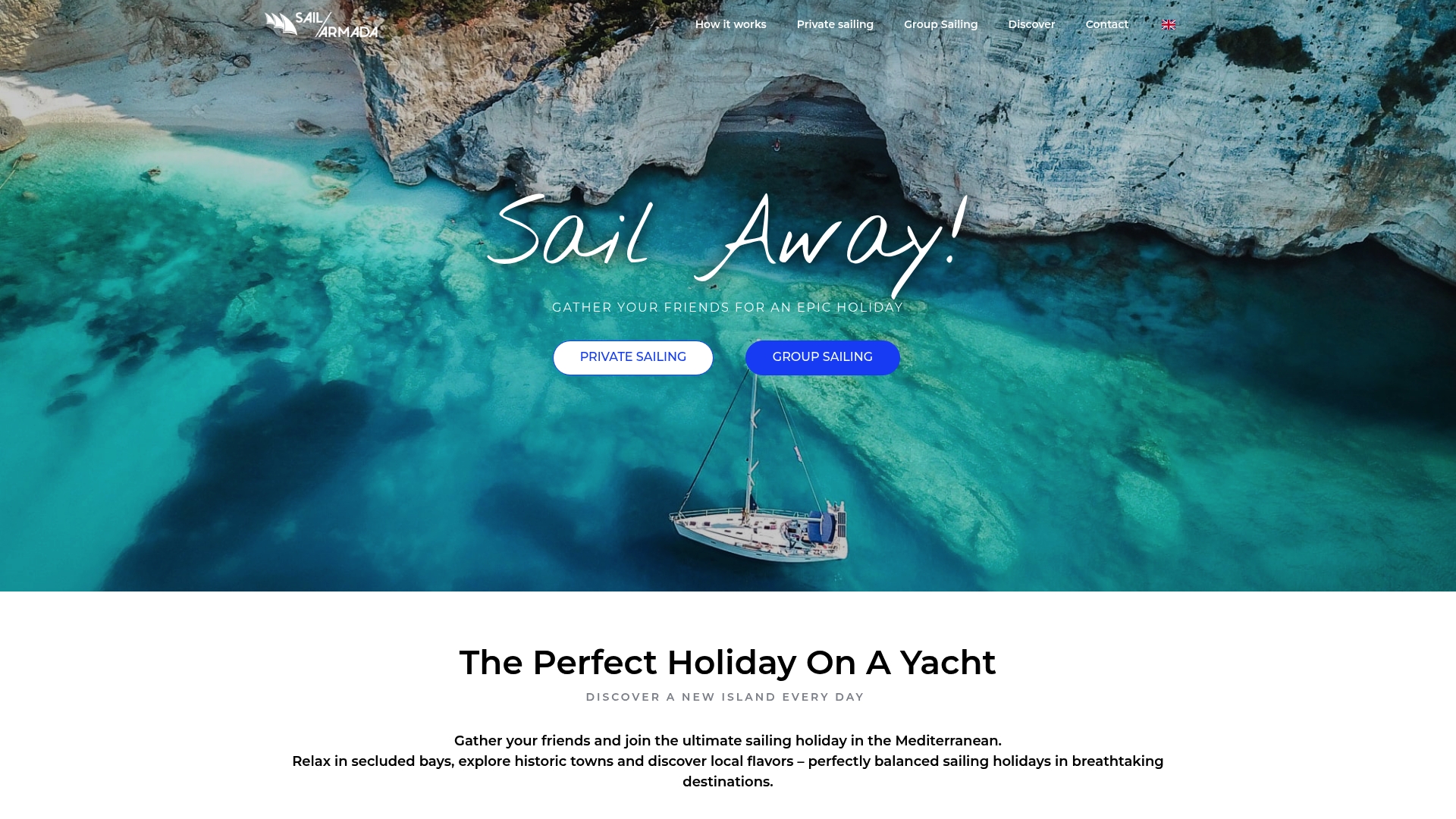
The difference from booking a bare boat yourself is that the hard decisions are already made: which anchorages work for kids, where the nearest medical access is, which passages are calm enough for a first family sail. Sailarmada’s vacances en famille à bord d'un voilier cover Greece, Croatia, Italy, and beyond, with flexible departure dates and the option to go private or join a group flotilla. Browse available dates and request your child safety setup when you book.
Sources
- Family sailing: Top tips for cruising with kids
- Yacht Charter with Kids: Family Sailing Tips & Safety Guide | GetBoat Blog
- Sailing with family: tips to keep your children safe & happy on board – Practical Boat Owner
- Tips for Yachting in Croatia with Kids -> Lazy Travel Blog
- Sailboats
Recommandé
- Caractéristiques des yachts adaptés aux familles : votre guide complet pour 2026
- Guide des vacances en voilier pour les familles et les amis, étape par étape
- Voyage en voilier en famille : votre guide complet
- Comment réserver des vacances en voilier : un guide étape par étape pour les familles et les groupes