One-way yacht charters are a real option, not a workaround: you can book a delivery or mile-build passage, a formal one-way drop-off through a charter operator, or a fully crewed one-way trip, depending on your skills and budget. Experienced sailors chasing sea miles usually get the best deal on delivery charters. Vacationers who want the flexibility without the workload should look at operator drop-offs or a crewed booking, ideally arranged through a curated service that already knows which bases allow it.
En bref :
- Delivery or mile-build charters are often the cheapest option but come with longer, less predictable passages based on operator schedules.
- Formal one-way drop-offs have set itineraries, usually with little or no surcharge, designed for leisure rather than delivery crew needs.
- Crew or skippered charters are ideal for those without offshore experience, as they handle navigation, safety, and docking.
- Costs beyond the base rate include repositioning fees, marina charges, fuel policies, and possible VAT, which can significantly increase the total price.
- Repositioning specials and last-minute off-season deals often waive or reduce the one-way fee, especially in regions with dense marina networks like the Mediterranean.
Table des matières
- What Are the Different Types of One-Way Yacht Charter?
- How Does One-Way Charter Logistics Actually Work?
- What Drives the Cost of a One-Way Yacht Charter?
- Who Should Attempt a One-Way Charter, and What Should You Know First?
- What Should You Ask Before Booking a One-Way Charter?
- What’s the Full Cost Breakdown, Including Hidden Fees?
- How Long Do One-Way Yacht Charters Typically Run?
- What Are the Cancellation and Refund Terms for One-Way Bookings?
- Where Are One-Way Charters Most Commonly Available?
- Our Take: Stop Treating One-Way Charters Like a Niche Trick
- Ready to Book a One-Way Sailing Route?
- Sources
What Are the Different Types of One-Way Yacht Charter?
Not every one-way booking works the same way, and knowing the difference before you start browsing saves you from asking a broker the wrong question. There are three main models on the market right now, and each one asks something different of you.
Delivery or mile-build charters exist because operators need to move yachts from one base to another between seasons, and they would rather fill that empty passage than sail it alone. These trips run on the operator’s schedule, not yours, and they often come with a real discount because you are helping solve a logistics problem for the company. The trade-off is longer passage days and less predictable timing, since weather and operational needs can shift a departure by days.
Formal one-way drop-offs are the more polished version of the same idea. A growing number of brokers now publish standing one-way offers across Mediterranean bases, some with no surcharge at all when the repositioning happens to line up with what the operator needed anyway. These are structured itineraries with set start and end points, built for guests rather than delivery crew.
Crewed one-way charters put a skipper (and sometimes a full crew) in charge of navigation, docking, and safety, which removes the qualification barrier entirely.
A quick way to sort yourself into the right lane:
- Want to log sea miles and don’t mind a working passage: look at delivery/mile-build offers.
- Want a set itinerary between two ports without returning the boat: look for a formal one-way drop-off.
- Traveling with family or without offshore certification: book crewed or skippered, one-way included.
- Chasing the lowest price and flexible dates: watch for repositioning specials that waive the one-way fee.
Industry bodies like IYBA list repositioning and delivery charters as standard practice, not a niche loophole, which is worth knowing before you assume you’re getting an unusual deal.
How Does One-Way Charter Logistics Actually Work?
The mechanics behind a one-way booking are simpler than most first-timers expect, but a few steps trip people up if nobody explains them in advance.
- Confirm pickup and drop-off marinas first. Not every base accepts arrivals from a one-way charter, and berth space at the destination marina isn’t guaranteed just because the operator sold you the route.
- Clarify who books the arrival berth. Some operators handle this as part of the charter; others expect you to reserve and pay for the destination slip yourself.
- Understand the repositioning fee structure. This charge covers the cost of getting the yacht (and often a delivery crew) back to its home base, and it’s usually calculated by distance and season rather than a flat rate.
- Check the fuel and provisioning policy. One-way routes sometimes end at a marina with limited refueling access, so ask whether you return the tank full, empty, or at a set level.
- Ask about border documentation. If your route crosses a national boundary, such as a run between Greek and Turkish waters, requirements vary by country and by operator, so confirm this directly rather than assuming it’s included.
Conseil de pro : Ask for the repositioning fee in writing before you pay a deposit. Verbal quotes on one-way surcharges have a habit of growing once the operator sees your dates.
Interactive charter platforms with searchable maps and calendars, like 12 Knots, make it far easier to spot which bases currently have open one-way slots instead of calling around blind.
What Drives the Cost of a One-Way Yacht Charter?
The number on a listing rarely tells the full story, and the gap between the base rate and your final invoice usually comes down to a handful of predictable factors.
- Repositioning or one-way fee, charged when the operator has to move the yacht back to its original base.
- Carburant, which can be billed as a flat charge or metered on return.
- Droits de port de plaisance at both departure and arrival, especially in high-demand harbors during peak months.
- Advance Provisioning Allowance (APA) on crewed charters, typically collected upfront to cover fuel, food, and dockage during the trip.
- VAT and local taxes, which vary by cruising region and can add a meaningful percentage to a crewed charter’s total.
- Skipper or crew fees, separate from the base charter price on anything beyond bareboat.
A delivery or mile-build passage can run at a steep discount compared with a standard charter, since operators offering these trips are effectively subsidizing the cost in exchange for help repositioning the boat. On the other end, a fully crewed one-way charter carries APA, staffing, and often a one-way surcharge stacked together, so it lands well above a comparable round-trip booking.
Off-season and last-minute windows are where the real savings show up. Brokers regularly post repositioning specials when a boat needs to move and the calendar is tight, and operators will sometimes waive the one-way fee entirely just to fill the slot. If your dates are flexible, that’s the gap to watch.
Who Should Attempt a One-Way Charter, and What Should You Know First?
Bareboat one-way charters generally require documented offshore experience, and delivery passages raise that bar further. Delivery crew listings consistently call for offshore passage experience and comfort with longer, less predictable days at sea, since these routes prioritize getting the boat where it needs to go over a relaxed vacation pace.
If your group includes less experienced sailors, kids, or anyone who just wants to enjoy the water without standing watch, a skippered or fully crewed one-way charter removes the risk without removing the flexibility. Before you commit to any route, confirm a few things:
- Passage plan and estimated daily sailing hours, especially on multi-day legs.
- Weather window flexibility and what happens if conditions force a delay.
- Watch system expectations on overnight passages.
- Onboard safety and emergency equipment, confirmed against current standards.
- Insurance coverage details, including what the charter contract says about liability for damage during a one-way route specifically, since repositioning trips sometimes carry different terms than a standard round-trip booking.
What Should You Ask Before Booking a One-Way Charter?
A good one-way booking comes down to asking the right questions early, not after you’ve already paid a deposit.
- Is a one-way drop-off actually permitted on this route, and is there a documented surcharge or is it waived under current conditions?
- Who is responsible for booking the arrival marina berth, the operator or you?
- What is the fuel policy, and is it the same for a one-way trip as it would be for a round-trip charter?
- What does the damage deposit cover, and how is it refunded after a one-way handover where the boat won’t be inspected at your home marina?
- Is a skipper available if you decide you want one closer to departure, and how does that change the price?
- What are the cancellation terms, specifically for one-way and repositioning bookings, since these often differ from standard charter policies.
On timeline, confirm your route and skill requirements at least two to three months out for peak season, since one-way slots and delivery windows get claimed faster than standard round-trip charters. Pay your deposit only after the fee schedule is in writing, and keep a copy of the signed contract page covering repositioning charges and the damage deposit. At handover, bring your sailing certification or CV (for bareboat), a copy of the signed contract, and proof of the deposit payment. Our step-by-step Mediterranean charter guide walks through the full paperwork checklist if this is your first time chartering in the region.
What’s the Full Cost Breakdown, Including Hidden Fees?
The advertised charter rate is just the starting line. Beyond the base price, expect a security or damage deposit collected before departure, refundable only after the yacht is inspected, which can be harder to coordinate on a one-way route if the inspection happens at an unfamiliar marina.
Add the repositioning fee itself, which some listings bury in fine print rather than the headline price. Marina fees at both ends can vary sharply by season and popularity of the port, and fuel is sometimes billed at a flat estimate that doesn’t match what you actually burned. Crewed charters carry the APA on top, usually 30 to 40 percent of the base charter fee, collected in advance and settled against actual expenses at the end of the trip. VAT applies in many cruising regions and is calculated on the base charter rate, not the extras. Ask specifically whether the one-way surcharge is included in the quoted total or added afterward. This single question catches more billing surprises than any other part of the process.
How Long Do One-Way Yacht Charters Typically Run?
Most one-way charters fall somewhere between one and three weeks, with the exact length shaped by the distance between departure and arrival bases rather than a fixed vacation format. A short hop between neighboring islands might wrap in five to seven days, while a longer repositioning passage, moving a yacht between two distant regions, can stretch past two weeks depending on weather windows and required stops.
Delivery and mile-build charters tend to run on the tighter end of practical timing, since operators want the boat back in service as fast as conditions allow. Formal one-way drop-offs booked through a broker or curated service usually follow a more relaxed, vacation-paced schedule, giving you extra days to actually enjoy the ports along the route instead of treating them as fuel stops. If your dates are firm, confirm the expected passage duration before booking. A route that looks short on a map can run longer than expected once you factor in weather holds.
What Are the Cancellation and Refund Terms for One-Way Bookings?
Cancellation policies on one-way charters often run stricter than standard round-trip terms, mainly because operators have already committed to a repositioning plan that’s harder to rebook on short notice. Deposits are typically non-refundable past a certain point, commonly 60 to 90 days before departure, though this window varies by operator and season.
Where one-way charters diverge most from standard bookings is in how last-minute cancellations affect the boat’s schedule. If you cancel a delivery or repositioning slot close to departure, the operator may lose the arrangement that made the discount possible in the first place, which is why some contracts apply steeper penalties on one-way routes than on comparable round-trip charters. Always ask whether trip insurance is available and whether it specifically covers one-way or repositioning bookings, since some standard travel insurance products exclude them. Get the cancellation schedule in writing before you pay anything beyond a holding deposit.
Where Are One-Way Charters Most Commonly Available?
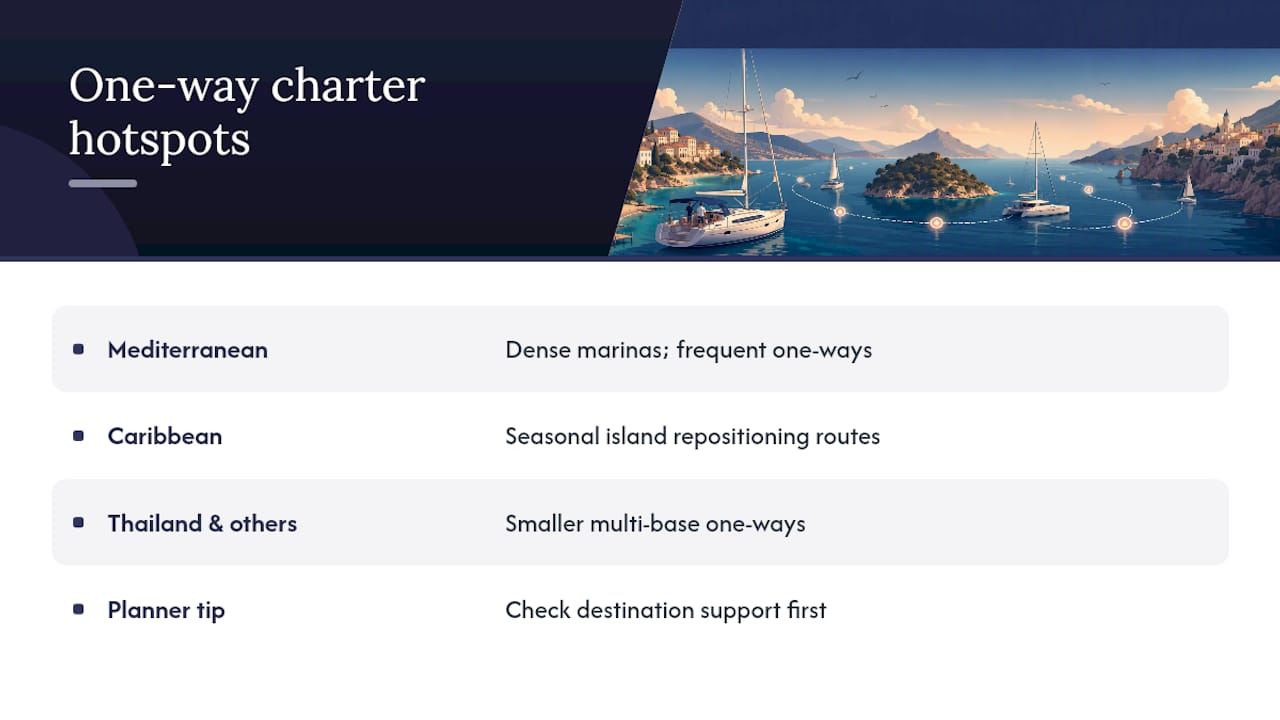
One-way availability tends to cluster around regions with multiple charter bases close enough together to make repositioning practical. The Mediterranean is the strongest example: Greece, Croatia, Italy, and Turkey all host dense networks of marinas, which is exactly why brokers list one-way offers so heavily across these regions. A yacht finishing a season in one Greek island group, for instance, often needs to reposition toward a different base before winter layup, which opens a window for a discounted one-way passage.
Outside the Mediterranean, one-way options show up in the Caribbean, where seasonal repositioning between island charter bases follows a similar logic, and operator guides describing specific island-to-island one-way runs illustrate how these routes get planned around passage length and weather. Thailand and other multi-base regions offer similar patterns on a smaller scale. If you’re set on a specific one-way route, checking options de destination first tells you which regions realistically support it before you start comparing individual operator quotes.
Our Take: Stop Treating One-Way Charters Like a Niche Trick
Most advice on one-way charters treats them as a clever hack, something you stumble into if you’re lucky enough to find the right deal. That framing undersells what’s actually a well-established part of how the charter industry operates. Operators need boats moved between bases every season, and that need creates real, recurring opportunities for sailors willing to work with the schedule instead of against it.
The mistake we see most often is picking a charter model based on price alone rather than matching it to actual skill level. A delivery passage that looks like a bargain becomes a stressful, even risky, trip for a crew that isn’t ready for consecutive long passage days and unpredictable weather calls. The reverse mistake happens too: experienced sailors overpaying for a fully crewed one-way trip they didn’t need. The right first move isn’t hunting for the lowest number on a listing. It’s being honest about your crew’s offshore experience, then choosing the model built for that reality.
- Voile
Ready to Book a One-Way Sailing Route?
If chasing down operator availability and repositioning fine print sounds like more work than the actual vacation, that’s exactly the gap such a curated service fills. Rather than piecing together quotes from scattered broker listings, you get an itinerary built around your group size, experience level, and preferred route, with the one-way logistics already worked out on the operator side.
When you request a quote, expect a straightforward conversation about your dates, crew experience, and whether a bareboat, skippered, or fully crewed setup fits your trip best, including realistic guidance on which bases currently support one-way drop-offs. Browse options de navigation privée to see current itineraries, or check current pricing examples to get a sense of what a one-way route in your preferred region typically costs before you reach out for a personalized quote.
Sources
Curated sailing holidays across the Mediterranean and select destinations further afield, working with catamarans and sailing boats for both private groups and organized group sailing weeks, make one-way planning less of a headache: instead of cold-calling operators to find out which bases allow a drop-off this month, a service working from an existing operator network can point you toward negotiated repositioning specials as they come up.
Rather than handing you a generic list of boats, the approach centers on matching your group size, experience level, and preferred route to an itinerary that already accounts for one-way logistics, from berth arrangements to the right yacht for your crew. If you’re weighing a delivery-style passage against a fully crewed one-way trip, that’s a conversation worth having with someone who already knows which Mediterranean bases make it easy and which ones add friction. Our guide de la location de yachts privés covers how curated itineraries get built around exactly this kind of flexibility.