Planifier un voyage à la voile sans connaître les saisons de navigation, c'est un peu comme préparer ses vacances sans vérifier la météo. Vous aurez peut-être de la chance ou vous vous retrouverez à lutter contre des vents de 30 nœuds dans un mouillage bondé, tout en payant le prix fort pour ce privilège. Les saisons de navigation sont des fenêtres de temps définies par des conditions météorologiques favorables, des conditions de vent et des schémas climatiques régionaux qui rendent une destination réellement agréable sur l'eau. Et pour couronner le tout, ces fenêtres sont très différentes selon l'endroit où vous souhaitez naviguer.
Table des matières
- Principaux enseignements
- Qu'est-ce qu'une saison de navigation ?
- Mois par mois : La météo de la navigation en Méditerranée
- Configuration des vents et flexibilité des itinéraires
- Comparaison des saisons méditerranéennes à l'échelle mondiale
- Mon avis sur le moment de naviguer
- Planifiez votre saison de navigation avec Sailarmada
- FAQ
Principaux enseignements
| Point | Détails |
|---|---|
| Saison méditerranéenne : avril à octobre | La plupart des navigateurs trouvent les meilleures conditions entre mai et septembre, les mois d'avril et d'octobre étant des options intermédiaires abordables. |
| Le mois de septembre est le bon moment | Des eaux chaudes, des vents stables et une moindre affluence font de septembre le mois le plus propice à la navigation en Méditerranée. |
| L'été est synonyme de foule et de vents violents | Les mois de juillet et d'août apportent prix de l'affrètement en période de pointe et des vents puissants de Meltemi dans la mer Égée. |
| Réserver 6 à 9 mois à l'avance pour l'été | Les charters de la saison intermédiaire sont plus disponibles, mais les semaines de pointe se vendent rapidement si l'on s'y prend à l'avance. |
| La région façonne la saison | Les Caraïbes atteignent leur apogée de novembre à avril, tandis que la navigation côtière en Amérique du Nord se déroule de mai à octobre. |
Qu'est-ce qu'une saison de navigation ?
Une saison de navigation est la période de l'année au cours de laquelle les conditions météorologiques, le vent et les conditions de mer dans une région spécifique s'alignent pour rendre la navigation sûre, confortable et véritablement amusante. Il n'existe pas de saison mondiale unique. Les océans, les mers et les côtes ont des rythmes complètement différents, déterminés par leurs propres systèmes climatiques, leurs moussons, leurs alizés et leurs cycles de tempêtes.
Voici un bref aperçu de la situation dans les principales régions de navigation :
| Région | Principale saison de navigation | Principaux facteurs météorologiques |
|---|---|---|
| Méditerranée | D'avril à octobre | Haute pression estivale, vents de fonte |
| Caraïbes | De novembre à avril | Alizés de l'est |
| Côte Est de l'Amérique du Nord | De mai à septembre/octobre | Conditions estivales tempérées |
| Grands Lacs (Amérique du Nord) | Juin à septembre | Saison courte en raison du gel hivernal |
| Thaïlande / Asie du Sud-Est | De novembre à avril | Saison sèche, mousson du nord-est |
La saison de navigation dans les Caraïbes s'étend de novembre à avril, poussée par des alizés réguliers d'est en ouest qui rendent les traversées fluides et prévisibles. Pendant ce temps, les Saison de la côte est de l'Amérique du Nord s'étend approximativement de mai ou juin à septembre ou octobre, les Grands Lacs étant coupés encore plus tôt en raison de la glace hivernale.
Mais c'est en Méditerranée que la plupart des voyageurs européens et internationaux réalisent leurs rêves de navigation. Et pour cause. Elle offre :
- Des eaux cristallines et des paysages spectaculaires de la Croatie à la Grèce en passant par la Turquie
- Une saison longue et généreuse qui s'étend sur six mois ou plus
- Un éventail de conditions adaptées aux compétences au fil des mois
- Des destinations de classe mondiale accessibles en une semaine d'affrètement
La saison méditerranéenne se divise en trois phases : la haute saison (juillet et août), la basse saison (mai, juin, septembre et octobre) et une véritable basse saison, de novembre à mars, au cours de laquelle la plupart des opérations de charter ferment complètement leurs portes.
Mois par mois : La météo de la navigation en Méditerranée
Comprendre le rythme du calendrier de navigation en Méditerranée, c'est ce qui fait la différence entre un voyage dont on parlera toujours et un voyage que l'on préférerait oublier. Voici comment se déroule la saison.
| Mois | Température de l'air (°C) | Température de la mer (°C) | Force du vent | Les foules | Prix |
|---|---|---|---|---|---|
| Avril | 16 à 20 ans | 16 à 18 ans | Léger à modéré | Très faible | Très faible |
| Mai | 20 à 25 | 18 à 21 ans | Modéré | Faible | Modéré |
| Juin | 24 à 28 | 22 à 24 | Modéré | Modéré | Modéré à élevé |
| Juillet | 28 à 33 | 25 à 27 | Fort (Meltemi) | Très élevé | Pic |
| Août | 28 à 33 | 25 à 27 | Fort (Meltemi) | Très élevé | Pic |
| Septembre | 24 à 28 | 22 à 24 | Stable, modéré | Modéré | Modéré |
| Octobre | 18 à 23 | 20 à 22 | Variable | Faible | Faible |
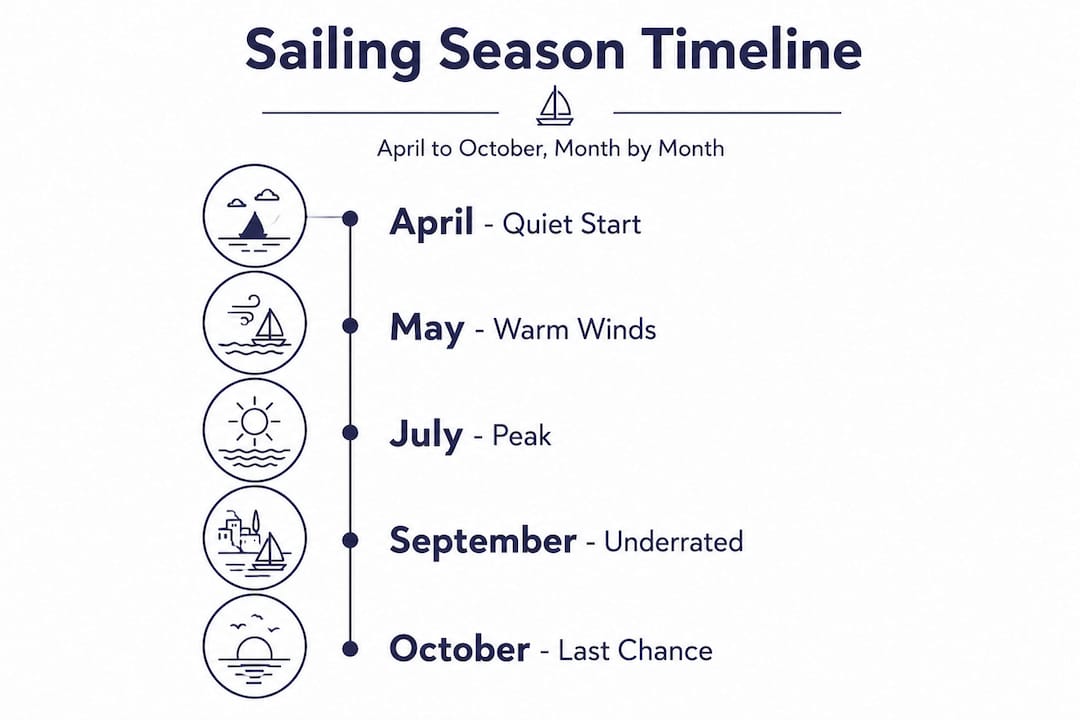
Avril et octobre sont le secret le mieux gardé des voyageurs à petit budget. Les prix des charters chutent de 30 à 40% en avril par rapport aux mois de pointe, et le mois d'octobre permet de réaliser des économies de 25 à 40%. Vous avez des mouillages pour vous tout seul et des propriétaires de tavernes qui sont vraiment heureux de vous voir. En contrepartie, les températures sont plus fraîches et le temps peut être instable, en particulier vers la fin du mois d'octobre.
Mai et juin est un véritable " sweet spot " pour de nombreux navigateurs. Le temps est chaud et ensoleillé, la mer est calme et les endroits populaires sont magnifiques sans être insupportables. Les prix se situent confortablement en dessous des niveaux les plus élevés et il est encore possible de trouver de la place dans les marinas les plus populaires sans avoir à tourner en rond pendant une heure.
Juillet et août sont les mois que la plupart des familles choisissent instinctivement, et environ 55% des réservations de charters méditerranéens tombent pendant ces deux mois. La température de la mer atteint 25 à 27°C et la lumière du jour s'étend jusqu'au soir. Mais vous devrez payer les prix les plus élevés, vous battre pour un espace de mouillage et faire face aux vents puissants de l'après-midi dans une grande partie de la région.
Septembre est véritablement le mois le plus sous-estimé du calendrier. Rapport des marins 7 à 10 heures de navigation productive Les températures de l'eau se maintiennent entre 22 et 24°C par jour, et les foules de touristes se sont sensiblement raréfiées. Les écoles ont repris leurs cours dans toute l'Europe, ce qui signifie que les plages et les marinas ressemblent davantage à ce que vous aviez imaginé lorsque vous avez rêvé de naviguer.
Conseil de pro : Si vous êtes flexible et que la navigation est plus importante pour vous qu'un mois spécifique, septembre est le mois idéal pour réserver. Vous bénéficiez de presque tout ce qu'offre l'été avec une fraction du stress et souvent du coût.
Configuration des vents et flexibilité des itinéraires
La meilleure période pour naviguer en Méditerranée n'est pas seulement une question de température. C'est le vent qui fait avancer votre bateau, et la compréhension des régimes de vent saisonniers influencera tout, de votre itinéraire à votre routine quotidienne.
Le Meltemi est le phénomène météorologique le plus connu de la Méditerranée. Il s'agit d'un vent fort et sec du nord ou du nord-ouest qui balaie la mer Égée en juillet et en août. Il est constant, ce que les marins expérimentés apprécient, mais il atteint fréquemment les forces 5 à 7 sur l'échelle de Beaufort. Pour les plaisanciers et les novices, ces conditions peuvent rendre une journée sur l'eau plus épuisante qu'exaltante.
Voici les principaux conseils de navigation saisonniers pour faire face aux réalités du vent en Méditerranée :
- Choisissez votre région par mois. La mer Ionienne (ouest de la Grèce) est abritée du Meltemi et nettement plus calme en juillet et août que la mer Égée. Si vous souhaitez naviguer en haute saison, la mer Ionienne, la Croatie ou la côte turque sont des options plus clémentes.
- Respecter le mois d'octobre après le 20. La fiabilité des conditions météorologiques diminue fortement à la fin du mois d'octobre en raison des systèmes dépressionnaires de l'Atlantique qui arrivent de l'ouest. Si vous naviguez tard dans la saison, prévoyez une certaine souplesse dans votre itinéraire et ne vous engagez pas à respecter un horaire fixe entre les îles.
- Arriver tôt dans les marinas. Les files d'attente pour les ports de plaisance commencent à se former dès 16 heures en haute saison. Les navigateurs qui prévoient d'arriver en début d'après-midi évitent à la fois les files d'attente et les vents thermiques les plus forts de l'après-midi.
- Adaptez le mois à votre niveau de compétence. La fin du mois de mai, le début du mois de juin et le mois de septembre sont les mois préférés des équipages moins expérimentés, car les conditions de vent sont prévisibles sans être excessives. Si vous êtes novice en matière de voile, ces mois vous donneront de bien meilleures bases.
- Réserver au bon moment. Pour obtenir un bateau en haute saison, il faut réserver 6 à 9 mois à l'avance. Pour les mois intermédiaires, la disponibilité est meilleure et vous trouverez souvent des tarifs réduits ou des bateaux surclassés au même prix.
La vérité la plus profonde sur les schémas météorologiques de la navigation est que la préparation l'emporte sur le timing parfait. Connaître son itinéraire, comprendre les outils de prévision du vent et rester flexible dans son plan quotidien vous sera plus utile que n'importe quelle carte idéale de la saison de navigation.
Comparaison des saisons méditerranéennes à l'échelle mondiale
Une fois que vous avez compris le rythme méditerranéen, le comparer à d'autres régions vous permet de choisir plus judicieusement où et quand vous rendre.
| Destination | Meilleurs mois de navigation | Risque d'ouragan ou de tempête | Niveau de compétence recommandé |
|---|---|---|---|
| Méditerranée (Grèce, Croatie) | De mai à septembre | Faible | Tous les niveaux |
| Caraïbes (BVI, Sainte-Lucie) | De novembre à avril | Saison des ouragans : Juin à novembre | Tous les niveaux |
| Thaïlande (région de Phuket) | De novembre à avril | Mousson : De mai à octobre | Tous les niveaux |
| Côte Est de l'Amérique du Nord | Juin à septembre | Tempêtes tropicales : Août à octobre | Intermédiaire |
| Grands Lacs | Juin à août | Courte saison, variable | Tous les niveaux |
Les Caraïbes attirent des marins du monde entier précisément parce que leur saison est à l'opposé de celle de la Méditerranée. Alors que les eaux de l'Europe deviennent froides et imprévisibles, les Caraïbes offrent des vents alizés chauds et réguliers de novembre à avril. C'est l'une des meilleures raisons d'envisager une stratégie de destinations consécutives : Méditerranée en été, Caraïbes en hiver.
Pour voyages à la voile en groupe et en famille, Mais c'est la Méditerranée qui l'emporte par sa variété et son accessibilité. Vous pouvez vous installer à Athènes, Dubrovnik ou Palerme et atteindre des dizaines d'îles extraordinaires en une semaine. L'infrastructure du tourisme nautique est mature, l'anglais est largement parlé dans les marinas, et même les marins les moins expérimentés peuvent se sentir vraiment à l'aise avec un skipper à bord.
La côte est des États-Unis offre des conditions de navigation vraiment agréables entre juin et septembre, mais sa saison est comprimée et les conditions météorologiques sont moins prévisibles que les systèmes anticycloniques de l'été méditerranéen. Les Grands Lacs offrent une belle navigation en eau douce dans une courte fenêtre de juin à août, avec la contrainte supplémentaire qu'ils gèlent solidement en hiver.
Mon avis sur le moment de naviguer
J'ai vu beaucoup de marins réserver les mois de juillet et d'août simplement parce que c'est la période où tout le monde part. Je comprends. L'idée de l'eau chaude et des longues soirées dorées est vraiment irrésistible. Mais d'après mon expérience, les mois intermédiaires offrent toujours un meilleur voyage pour la plupart des gens, en particulier pour les débutants et les familles.
Il y a quelque chose dans le fait d'avoir une baie isolée pour soi seul, ou d'entrer dans une taverne de village où l'on est la seule table, que l'on ne peut tout simplement pas acheter au mois d'août. Les mois de mai, juin et septembre offrent cette possibilité. L'eau est encore chaude, les vents sont maîtrisables et l'ensemble de l'expérience ressemble davantage aux vacances en voilier que vous aviez imaginées avant de vérifier les prix en juillet.
Ce que j'ai appris après avoir vu d'innombrables voyages se concrétiser, c'est que les marins qui apprécient le plus leurs semaines ne sont pas ceux qui ont trouvé le temps parfait. Ce sont ceux qui ont compris leur saison, ont planifié leur itinéraire de manière réfléchie, et sont restés flexibles lorsque la mer avait d'autres idées. Cette combinaison est toujours préférable à la chasse à la haute saison.
- Voile
Planifiez votre saison de navigation avec Sailarmada
Savoir quand naviguer est une chose. Trouver le bon bateau, le bon itinéraire et le bon équipage pour y parvenir, c'est là que Sailarmada intervient. Que vous soyez attiré par les eaux turquoises de la Grèce en juin, par les côtes spectaculaires de la Croatie en septembre, ou par quelque chose de plus exotique comme la Thaïlande ou les îles Vierges britanniques pendant les mois d'hiver, Sailarmada construit des vacances à la voile en fonction de votre saison idéale, et non d'un calendrier fixe. Découvrir location de yachts privés qui s'adaptent à votre emploi du temps et à la taille de votre groupe. options de réservation pour les groupes qui permettent de répartir les coûts et de maximiser le plaisir. La saison méditerranéenne se remplit rapidement, donc plus vous commencez à planifier tôt, plus vous aurez de choix.
FAQ
Quelles sont les saisons de navigation en Méditerranée ?
La saison de navigation en Méditerranée s'étend d'avril à octobre, avec des pics de fréquentation de juin à août et l'équilibre le plus confortable entre le temps, la foule et le prix en mai, juin et septembre.
Quelle est la meilleure période pour naviguer en Grèce ?
Septembre est généralement considéré comme le meilleur mois pour naviguer en Grèce. La température de l'eau se maintient entre 22 et 24°C, les vents sont stables et modérés, et les mouillages sont beaucoup moins fréquentés qu'en juillet et en août.
Que sont les vents de fonte et quand se produisent-ils ?
Le Meltemi est un vent fort de nord ou de nord-ouest qui souffle sur la mer Égée, principalement en juillet et en août. Il peut atteindre la force 5 à 7, ce qui rend les conditions difficiles pour les marins inexpérimentés.
Combien de temps à l'avance dois-je réserver un charter ?
Pour la haute saison, en juillet et août, il est fortement recommandé de réserver 6 à 9 mois à l'avance. Les mois de l'arrière-saison offrent plus de disponibilités et souvent de meilleurs prix avec une fenêtre de réservation plus courte.
Le mois d'octobre est-il une bonne période pour naviguer en Méditerranée ?
Le début du mois d'octobre est une excellente option, avec des prix plus bas et des mers chaudes qui tournent encore autour de 20 à 22°C. Après le 20 octobre, les systèmes météorologiques de l'Atlantique rendent les conditions moins prévisibles ; il convient donc de faire preuve de souplesse dans tout itinéraire de fin octobre.