
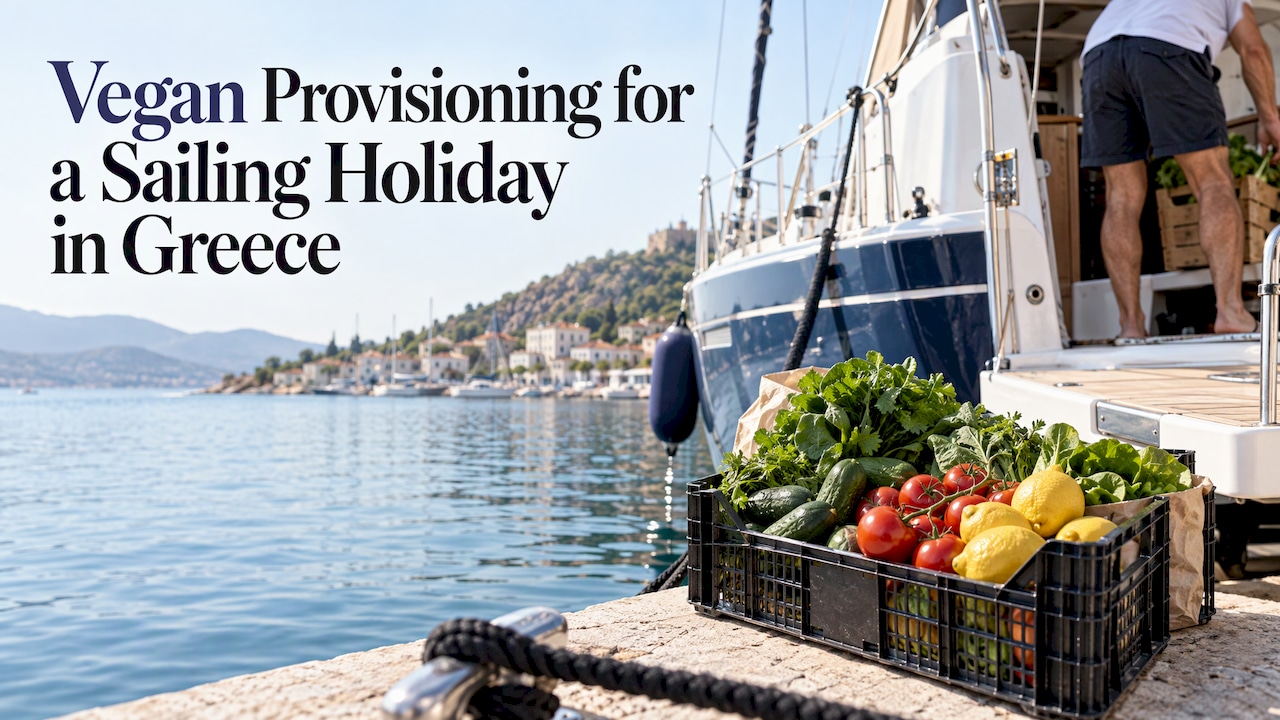
Eating vegan on a boat in Greece is easy once you plan it: tell your skipper before you pay, do one big shop at the base, and top up fresh produce along the way. Greek cooking already runs on tomatoes, beans, olive oil, greens and herbs. Your galley is mostly a matter of choosing the right staples and knowing where the gaps are (plant milk, tofu, specialty spreads), because those gaps appear fast on smaller islands.
This guide walks you through the whole thing, from the message you send before booking to a sample shopping list for a week at sea.
TL;DR
- Tell the skipper or charter team about vegan needs in writing at booking, so the shopping is done with your diet in mind.
- Build the week around pantry heroes: pasta, rice, lentils, chickpeas, canned tomatoes, olives, nuts and good olive oil.
- Plan roughly 1.2 kg of food per person per day, then adjust for appetite and how often you will eat ashore.
- Do the big shop at your base marina and use midweek stops for bread, fruit and vegetables.
- Carry the specialty items (plant milk, vegan butter, tofu, protein snacks) from the start, since small islands often don’t stock them.
Cuprins
- Tell your skipper before you pay
- What to stock: a Greek vegan galley
- How much to buy
- Where to shop and restock
- Keeping vegan food fresh in a small galley
- Reading labels in Greece
- Our view from the helm
- Plan your vegan week on the water
- Întrebări frecvente
- Surse
Tell your skipper before you pay
The most useful vegan move happens weeks before you step on deck. Provisioning is done before the cruise starts, so whoever does the shopping needs to know your diet while there is still time to act on it.
One Greek boat operator makes the same point in its guide to vegan and allergy requests on board: requests go in at booking, in writing, and the crew confirms what it can do before you pay. Its rule of thumb is a good one: taking an ingredient out of a dish is easy, but replacing it needs warning.
A short message does the job. Include:
- How strict you are (no honey? no wine fined with animal products? no shared pans?).
- How many people on board are vegan, and how many are not.
- Any allergies on top of that, such as nuts or soy, since nuts and soy are vegan staples that some guests cannot eat.
- Your must-have items, such as plant milk for coffee or a particular spread.
If you are on a private charter with friends, you often do the provisioning yourselves or with the skipper’s help, so the same message goes to your group chat. Decide who is in charge of the list before anyone buys anything.
What to stock: a Greek vegan galley
The good news: the Greek pantry is already close to vegan. A week on the water can look like this, built on pieces you will find in any supermarket near a charter base.
Fresh produce
Greece is a gift here. Think tomatoes, cucumbers, onions, potatoes, peppers, eggplants, courgettes, salad leaves, lemons, and big handfuls of basil, parsley, dill and oregano. Seasonal fruit such as watermelon, grapes, oranges and melons makes the best no-cook dessert on a hot afternoon, and it travels well. Lists published by charter-provisioning guides cover many of the same fresh items, plus giant beans and mushrooms.
Buy tomatoes in mixed ripeness, some ready for day one and some firm for day five. Keep lemons and onions in a shaded, ventilated spot rather than the fridge, which you will want for the more delicate things.
The pantry
This is where vegan cooking on a boat becomes easy, because most of it needs no refrigeration:
- Pasta (short and long) and rice
- Dried or canned lentils, chickpeas, cannellini and other beans
- Canned peeled tomatoes and tomato paste
- Olives, capers, pickles and sun-dried tomatoes
- Nuts, almonds, pistachios and seeds
- Oats and cereal
- Olive oil, vinegar, mustard, salt, dried herbs
- Stock cubes (check the label, since some contain dairy)
- Flour for flatbreads, if you like to bake
- Dark chocolate and biscuits that are free of milk and egg
Canned and dried legumes are the quiet heroes. A tin of chickpeas, a lemon, a handful of herbs and a drizzle of olive oil is a lunch you can make in five minutes while the boat sits at anchor.
Plant-based extras to bring from home or buy at the start
These are the items that disappear as you leave bigger towns: oat, almond or soy drinks (long-life cartons keep without a fridge until opened), plant-based cream, hummus, tahini, vegan butter, tofu or tempeh, and any protein snacks you rely on. A marina supplier on Kos, for example, lists oat, almond and soy drinks and plant-based cream in its online catalog, which shows the sort of range you can order at a larger base. Smaller harbors may offer far less.
If you like prepared lunches to eat on day one, a few high-protein vegan lunch combos give you ideas for protein-heavy bowls you can rebuild on board with beans, grains and seeds.
Greek dishes that happen to be vegan
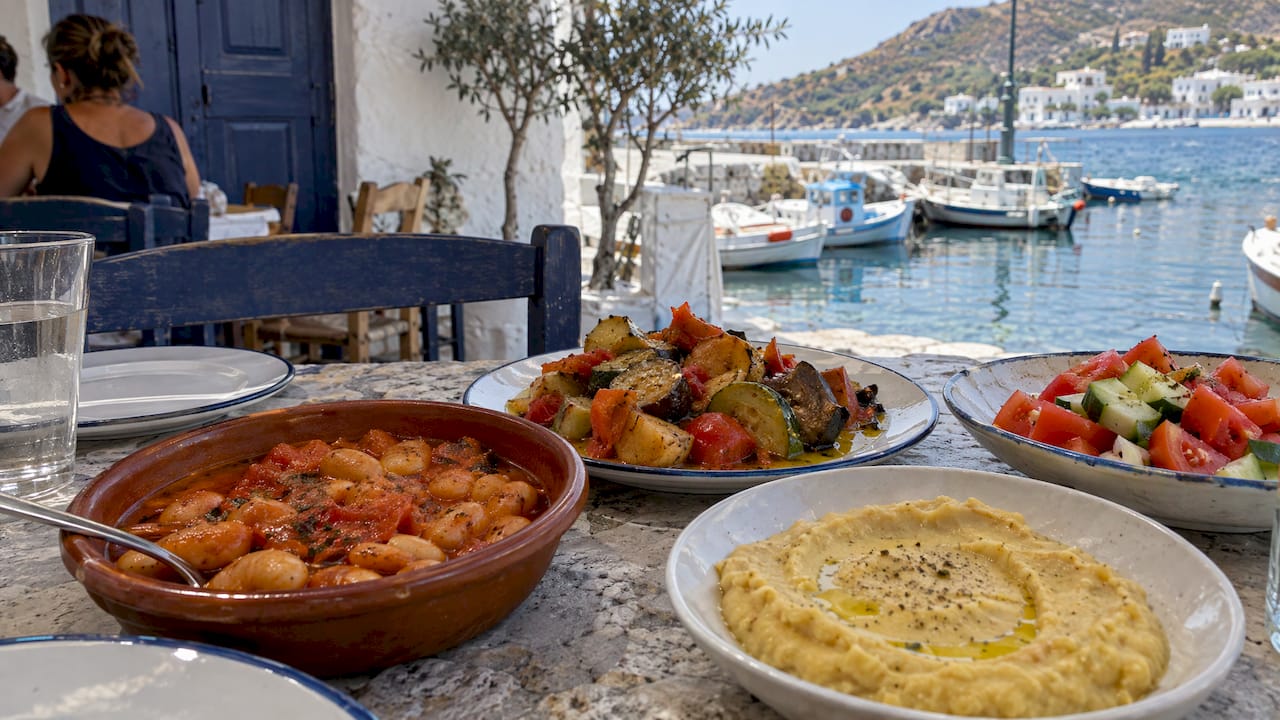
When you eat ashore, look for classics that are often made without animal products: tomato and cucumber salads (ask for no feta), gigantes baked beans, fava purée, briam (baked vegetables), horta (wild greens), fasolada (bean soup), and stuffed tomatoes and peppers made with rice. Kitchens vary, so ask about each one: butter, stock and cheese sneak in. The words that help are χωρίς κρέας, γάλα, αυγά ή τυρί (without meat, milk, eggs or cheese). Honey is μέλι, which is worth knowing because it turns up in desserts and some snacks.
How much to buy
Underbuying is a bigger risk than overbuying, because a hungry crew after a day of swimming and sailing eats more than people expect at home.
A useful starting point comes from a provisioning calculator that plans breakfast, lunch and dinner for 7 days plus 2 spare days and arrives at 33 kg of food, or 1.2 kg per person per day. Use that as your baseline, then trim for the meals you plan to eat in tavernas.
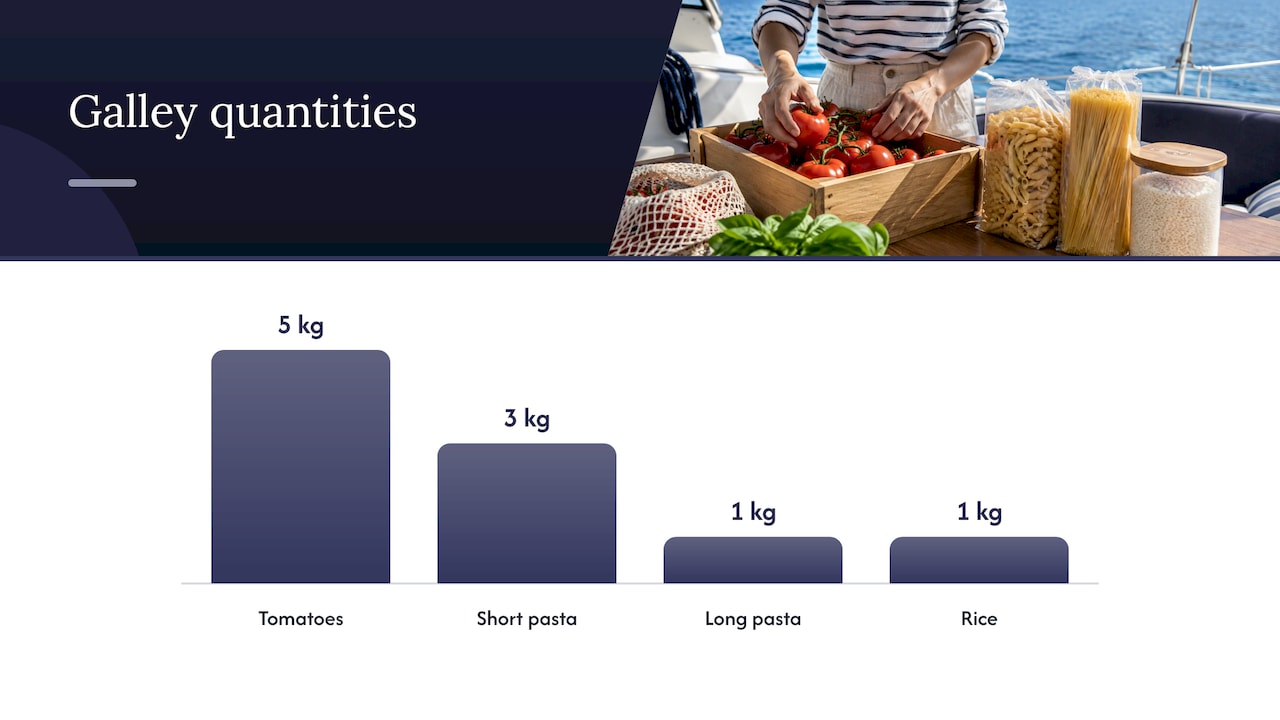
For concrete quantities, an Italian sailing magazine published a basic galley for six adults on a one-week cruise. Its list includes 3 kg of short pasta, 1 kg of long pasta, 1 kg of rice, 3 cans of beans (cannellini or borlotti), 3 cans of chickpeas, 4 cans of peeled tomatoes, 5 kilos of tomatoes, 2 liters of extra-virgin olive oil and 5 lemons. All of that is already vegan. The same list also has tuna, feta and eggs, so if your whole boat is vegan, swap those for extra legumes, nuts, tofu and a second jar of tahini.
A sample week for six vegan sailors
Here is how that could look, as a planning sketch rather than a rule:
| Meal | Idea | Key ingredients |
|---|---|---|
| Mic dejun | Oats with fruit and nuts | Oats, plant milk, seasonal fruit, almonds |
| Masa de prânz | Chickpea and tomato salad with bread | Canned chickpeas, tomatoes, cucumber, lemon, olive oil |
| Snack | Hummus and crackers, watermelon | Hummus, crackers, fruit |
| Dinner at anchor | Lentil pasta or rice with roasted vegetables | Pasta or rice, eggplant, courgettes, canned tomatoes |
| Dinner ashore | Taverna night | Ask for beans, greens, salads, no cheese |
Mix two or three dinners cooked on board with two or three eaten ashore, and the shopping list shrinks without anyone feeling short-changed. For a deeper look at how to scale a list to your group, our guide to catamaran meal planning breaks down meals by day, and our page on shopping for a week of sailing covers the practical side.
Where to shop and restock
The rhythm that works: one big shop at the base, then small top-ups.
The big shop at the base marina
Larger bases have supermarkets and suppliers with better stock and more reliable delivery. This is where you buy the pantry, the cartons of plant milk, and anything specialty. Many suppliers deliver straight to your berth. In Rhodes, for example, a local supplier says it delivers to Rhodes Marina, Mandraki, Kolona and Lindos and accepts special dietary requests. When you ask any supplier for vegan substitutions, get them in writing along with the delivery time, so nothing is guessed on the day.
Our own walkthrough, the yacht provisioning process, explains how ordering, delivery and timing usually fit around check-in.
Midweek top-ups
Fresh produce, bread and drinks are what you top up on the way. Villages and small ports often have a minimarket or greengrocer close to the quay, and many have a bakery. Hours vary on smaller islands, especially outside peak season, so shop when you arrive rather than planning to do it the next morning. Treat these shops as the place for tomatoes, bread, fruit and herbs, not for specialty vegan items, which are best carried from the start.
A simple restocking routine
- Check the fridge and the pantry on the morning of each sailing day.
- Write a three-item list: what runs out first, what is needed for dinner, what is fresh.
- Shop at the first sizable town you reach, and ask the skipper which stops are best for supermarkets.
- Keep one emergency meal that needs no fridge (pasta, a jar of sauce, canned beans) for the day the wind or a closed shop changes your plan.
Keeping vegan food fresh in a small galley
A boat fridge is small, warm and shared. A few habits help:
- Use the fridge for plant milk once opened, hummus, tofu and cut produce. Keep everything else outside it.
- Cook the most perishable things first (leafy greens, mushrooms, tofu) and save the sturdier ones (potatoes, onions, carrots, cabbage) for later in the week.
- Wash and dry salad leaves, then store them wrapped in a cloth.
- Use sealed containers so a swell doesn’t turn the fridge into a salad.
- Cook beans and rice in batches, cool them quickly and use them within a day or two.
We have gathered more on this in our guide to keeping food fresh and safe on a boat. If anyone in your group has a medical condition or a severe allergy, talk to your doctor about safe food handling and storage before you travel.
Reading labels in Greece
Most packaged food in Greek supermarkets carries labels in Greek, often with an English line too. A few words go a long way: γάλα (milk), αυγό (egg), τυρί (cheese), βούτυρο (butter), μέλι (honey) and ζελατίνη (gelatin). Biscuits, stock cubes, sauces, chocolate and crisps are the products where hidden milk and egg most often show up, so read the ingredients before they reach the cart. If you are unsure, the photo-and-translate function of your phone camera works well in the aisle. For allergies, treat the allergen line on the label as the starting point and ask the staff when in doubt.
Our view from the helm
We have watched a lot of groups plan a week afloat, and the happiest ones do two things: they talk about food early and they keep it simple. Vegan crews tend to be the best prepared, because they already think about what goes on the plate.
Our routes are curated by experienced skippers from CAPETAN.club, sailors who know which harbors have a proper market and which are better for a quiet swim and a pasta dinner. That local knowledge is the difference between a rushed supermarket sprint and a relaxed shop with a clear plan.
That is why we like private sailing for vegan groups: you set the menu, the skipper knows the stops, and nobody has to explain themselves at every table. If you prefer company, our group holidays give you the social side with the same flexibility. Either way, let us know about your diet at the start, and we will help you build the plan around it.
Go Sailing
Plan your vegan week on the water
If you are ready to turn the list into a real trip, a private week in Greece starts from €560 per week per person on our Grecia devine privată page, where you choose the boat, the dates and the pace. Prefer the company of other sailors? Browse our vacanțe de navigatie de grup and tell us about your diet when you enquire.
We are real sailors, and we are happy to talk menus, marinas and the best places for a supermarket stop before you commit to anything. For more ideas on what to cook, see our collection of yacht food ideas and how we help guests plan menus.
Întrebări frecvente
When should I tell the skipper I am vegan?
As early as you can, ideally at booking and in writing. Provisioning is done before the cruise, so early notice means your diet is built into the shopping rather than patched in afterward. Add details such as allergies and any must-have items.
Is it hard to eat vegan in Greece?
Not at all. Many traditional dishes are built on beans, vegetables, greens, rice and olive oil. The things to double-check are cheese, butter, honey and stock, so ask in each taverna and read labels in shops.
How much food should I buy per person?
A good baseline is about 1.2 kg of food per person per day, based on a provisioning calculator that plans three meals for a week plus two spare days. Reduce it if you will eat out several evenings, and add a little for hungry swimmers.
Can I find plant milk and tofu on the islands?
Larger bases and towns usually have them, but small islands often don’t. Buy plant milk, tofu and specialty spreads at your starting base and use midweek stops for fresh produce, bread and fruit.
Surse
- Vegetarian, Vegan and Allergies on a Santorini Boat
- Yacht charters provisioning Greece
- Order Yacht Provisions Online, Kos Marina
- Boat provisioning calculator
- The perfect galley: how many provisions to bring on board
- Island Stores, Rhodes
Recomandate
- Planificarea meselor pe catamaran: aprovizionare și gătit ușor
- Lista de verificare în 4 puncte pentru îmbarcare pentru evitarea incidentelor dietetice pe ambarcațiuni închiriate
- Cum să pregătești mâncarea pe un iaht: un ghid practic pentru bucătării mici
- Excursie cu barca cu pânze pentru întreaga familie: Ghidul tău complet