Using a marine toilet is simple once you know the order: check the seacocks are open, add water, do your business, flush, then pump dry until the bowl and the pipe are empty. Only toilet paper goes in besides what comes from you, and the valves get closed afterward if your skipper asks. That’s it. The rest of this guide explains why each step matters, so the heads on your sailing holiday never become the story of the week.
If you’re a first-timer on a boat, relax. Almost everyone looks at the lever and the little pump with a touch of suspicion the first time. By day two it’s second nature.
TL;DR
- Open seacocks, set the lever to “wet”, pump in some water, use the toilet, flush, then switch to “dry” and pump until it’s empty.
- Nothing goes in that you haven’t eaten first, apart from toilet paper. No wet wipes, no sanitary products, no paper towels.
- Most smells come from waste left sitting in the discharge hose, so finish with generous pumping.
- Tank water on a charter is for washing, not drinking. Buy bottled water and plan the quantities before you sail.
- On our skippered holidays, your skipper walks you through the heads on day one. Ask, because every boat is a little different.
Table des matières
- How a marine toilet works, in plain words
- Step by step: using a manual marine toilet
- What goes in the toilet (and what never does)
- What if my boat has an electric toilet?
- Smells, blockages and what to do about them
- Greek harbors, bays and where the waste goes
- Drinking water on a charter: tank water is for washing
- Our take: why the heads briefing matters
- Ready for a week where all this is covered?
- FAQ
- Sources
How a marine toilet works, in plain words
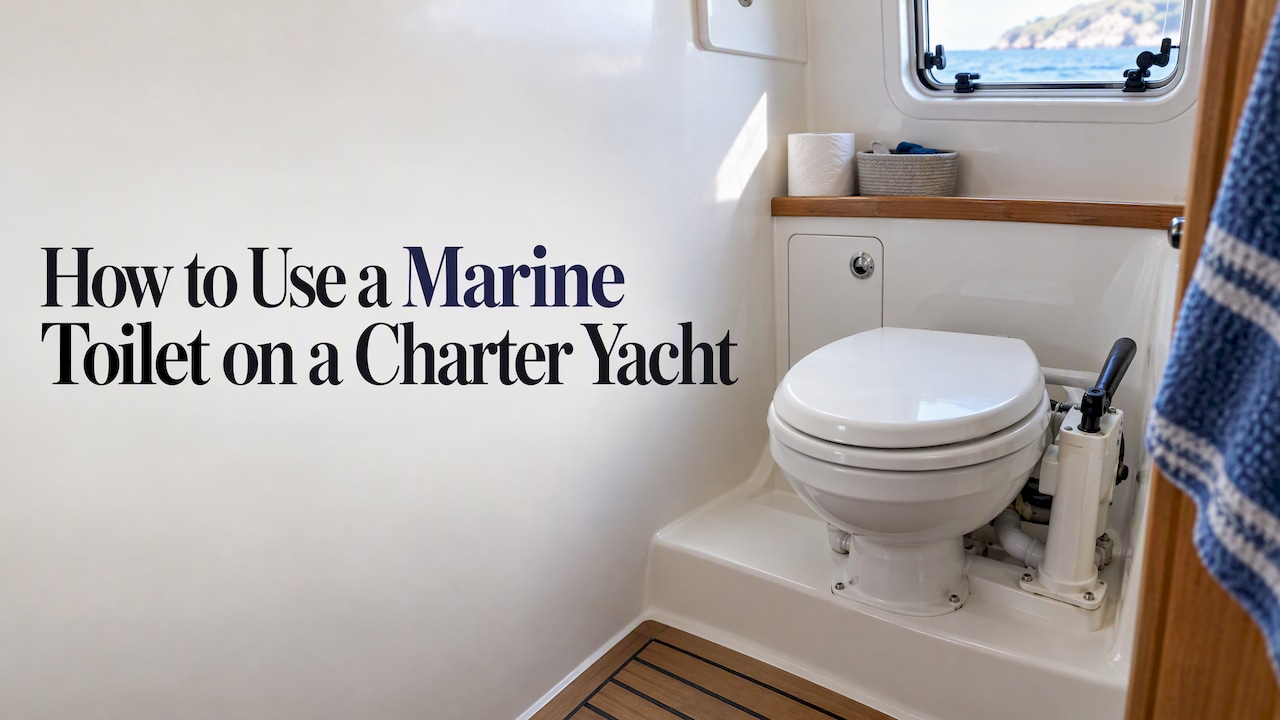
A marine toilet (sailors call it “the heads”) is a small pump with a bowl on top. On most charter yachts it’s a manual one: you work a handle up and down, which pulls water in from the sea and pushes everything out through a hose. Some boats have an electric version where you press a button instead, and the principle is the same.
Two things make it different from the toilet at home:
- It uses sea water, and it has openings in the hull. The valves that let water in and out are called seacocks. They sit below or near the waterline, so how you treat them matters for the safety of the boat.
- The pipes are narrow and the pump is delicate. A blockage is much harder to fix on a boat than at home, so what you put in matters a lot.
The maker of the widely used Jabsco manual toilets says correct operation is essential for the safety and comfort of the crew and the craft. That’s a serious sentence for a toilet, and it’s fair.
Step by step: using a manual marine toilet
Boats differ, so look at the labels near the toilet and listen to your skipper’s briefing. The general routine follows what the Jabsco instructions et this guide to the heads describe.
1. Check the seacocks
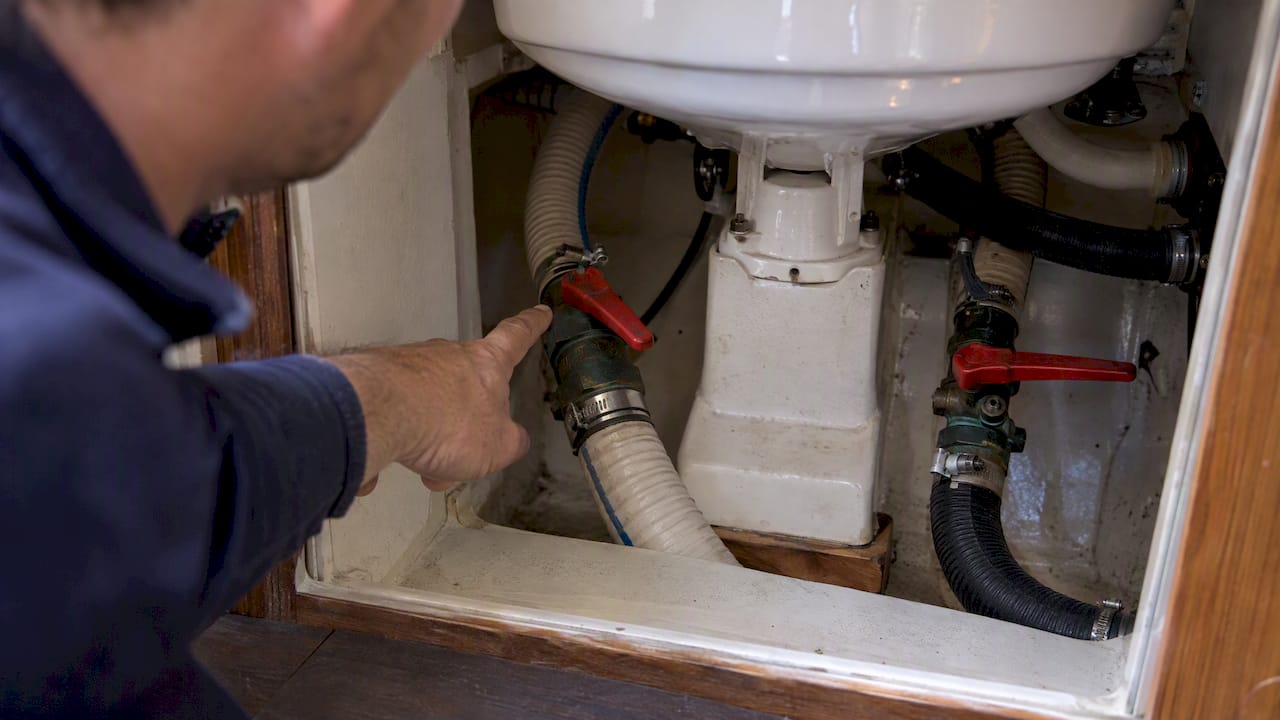
Before first use, make sure the seacocks are open. Your skipper will show you where they are and which ones you should touch. Usually there’s an inlet (water in) and an outlet (waste out), and sometimes a handle on the toilet itself that controls the flow.
2. Set the lever to “wet” and add water
Move the lever or switch to the “wet” position (it may be marked “flush” or have a symbol). Pump a few strokes to bring fresh sea water into the bowl. A little water in the bowl makes everything that follows easier, and it helps to keep the bowl clean.
3. Use the toilet, sitting down
This is a boat. It moves, even in a calm marina, and spray can reach the cabin. Many charter briefings ask everyone to use the toilet only in a sitting position, and it’s a good habit for every crew member, whoever you are.
4. Flush
With the lever still on “wet” (or “flush”), pump steadily until the bowl is clear. This sends the waste into the discharge pipe.
5. Pump dry
Now switch to “dry” and keep pumping until the bowl is empty and the pipe is clear. Jabsco’s guide says that for the discharge pipe you should allow about 7 full up and down strokes per meter of pipe. On a boat with a long run of hose, that can mean more pumping than you’d guess.
This step is the one beginners skip. Sailing instructors say the most common mistake is underpumping, which leaves waste in the hose and gives you an unpleasant smell in the cabin. Jabsco puts it the same way: finish on “dry” until the bowl is empty.
6. Close the valves if your skipper says so
Seacock habits vary by boat, and the rule is the skipper’s call. As a general principle, closing the seacocks after use and whenever the boat is left unattended protects against water coming back in through damaged or siphoning plumbing. If your boat’s routine is that the crew leaves them open and the skipper closes them at night, follow that. Don’t guess: ask.
Quick reference
| Step | Lever position | What you do |
|---|---|---|
| Before use | “Wet” | Pump a few strokes to add water |
| After use | “Wet” / “Flush” | Pump until the bowl clears |
| To finish | “Dry” | Pump until bowl and pipe are empty |
| Leaving the boat | As the skipper instructs | Valves closed per the boat’s routine |
What goes in the toilet (and what never does)
The golden rule is short: nothing goes in that you haven’t eaten first, with toilet paper as the only exception. Even small amounts of wet wipes, sanitary products or paper towels will almost certainly block the system, and clearing that is unpleasant for everybody.
Some practical points:
- Use a little paper, not a lot. Thin toilet paper breaks down best. Some boats ask you to put paper in a small bin instead, and the skipper will say so.
- Bin everything else. Wipes (even the ones labeled “flushable”), cotton buds, sanitary items, dental floss, hair and food scraps go in the bin, not the bowl.
- Don’t pour in cleaning products or chemicals unless the skipper has okayed them. They can harm the pump seals.
- Tell someone right away if something feels stuck. A strong pull on a blocked pump can break it. A skipper can often clear a small problem in minutes. A big one takes longer.
The Hallberg-Rassy owner’s manual makes a point that fits any boat: marine toilets are delicate, and the proper sequence is what keeps the whole crew safe and comfortable.
What if my boat has an electric toilet?
It works the same way, minus the arm workout. You usually press a button or a switch to flush, and a motor does the pumping. A few habits still apply: don’t put wipes in, don’t hold the button down endlessly, and ask which switch controls the dry cycle. Electric toilets need battery power, so if the boat has been at anchor all night and the lights are dim, the skipper may suggest a few manual pumps or running the engine first. Ask rather than force it.
Smells, blockages and what to do about them
An odor in the heads almost always has one of three causes:
- Not enough dry pumping. Waste sits in the hose. Pump more.
- The bowl was left dry and warm. Pump a little fresh water into the bowl after use.
- A small blockage or a valve left closed. Tell your skipper.
One more point for hot weeks: a closed, sun-baked cabin makes any smell stronger. Open the hatch and the porthole in the heads after use if it’s safe.
Greek harbors, bays and where the waste goes
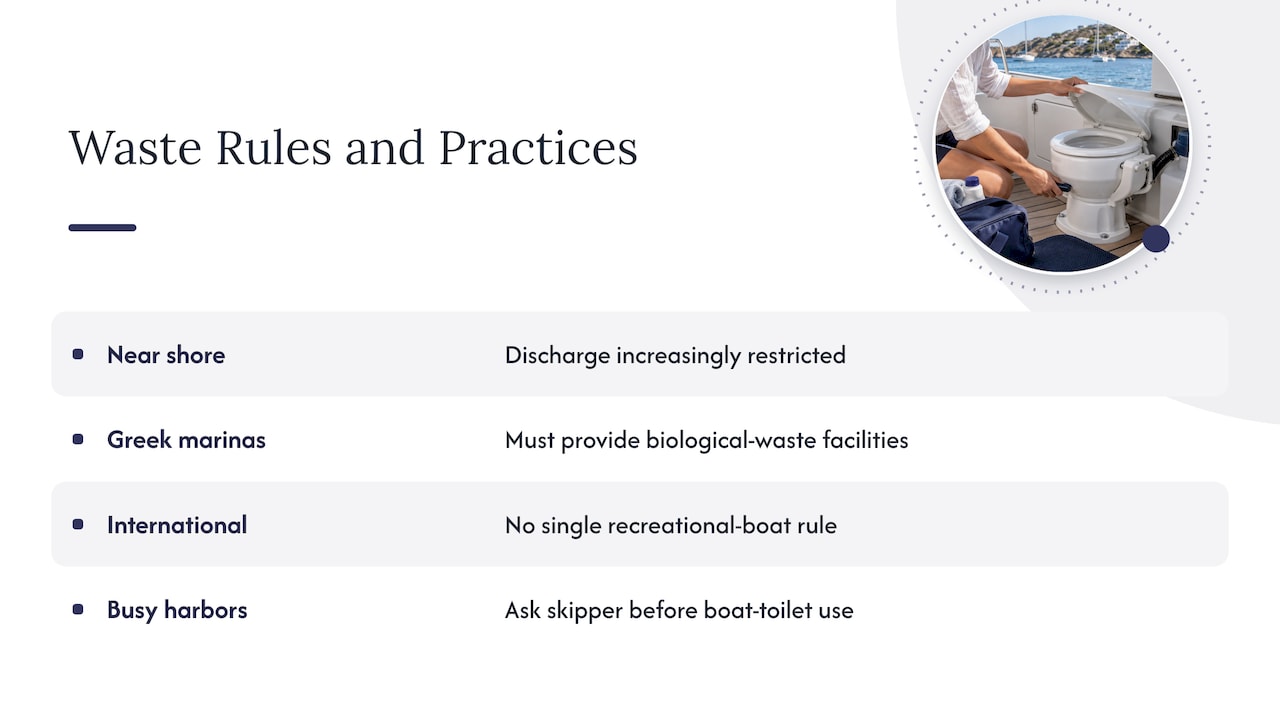
You may wonder where it all ends up. In the Mediterranean, rules are tightening on discharge close to shore. Environmental regulations increasingly restrict overboard discharge in harbors, marinas and protected bays, and marinas in Greece are required by law to provide facilities for collecting and disposing of biological waste, according to the Greek Ministry of Tourism. Internationally, there is no single black water rule for recreational boats, so it depends on where you are.
The practical rule for guests is easy: in marinas, in ports and in crowded anchorages, use the marina’s shore toilets and showers whenever you can, especially overnight, and ask your skipper before using the boat toilet while you’re tied up in a busy harbor. Your skipper handles the boat’s tanks and pump-outs and knows the local habits. For the bigger picture of what a stop costs and how a berth works, our guides to marina fees in Greece et navigating Mediterranean marinas are good reading before you go.
The same care for the sea applies to the hull. If you’re curious about how boat owners keep a hull and waterline clean between seasons, this guide to hull cleaning steps and timing is a useful read, though on a charter that’s the base’s job, not yours.
Drinking water on a charter: tank water is for washing
While we’re on plumbing, here’s the question that comes up right after the toilet one: can you drink the water on the boat? In most cases, no. Most charterers don’t drink from the boat’s tanks, so you’ll buy bottled water, ideally in big jugs you use to refill your own bottles, which cuts plastic.
Tank water is for the rest of daily life: washing hands and face, brushing teeth, showers and dishes. If you swim a lot, you’ll want a quick rinse afterward, so water adds up faster than you expect.
How much bottled water should you bring? One provisioning guide suggests at least 50 liters of bottled drinking water for six people over a week, and closer to 70 liters in August heat. It also notes a typical tank on a 40-footer is 300 to 400 liters. A Greek charter operator’s advice quoted by a traveler is similar: keep at least two six-packs of 1.5 liter mineral water on board, because the water on boats and on the islands isn’t generally considered drinkable. That’s one person’s report, so treat it as a rule of thumb and ask your charter base or skipper on the day.
Tips that help:
- Buy the heavy stuff at the first supermarket near the base. Carrying water down a dock in July is no fun.
- Keep some bottles in the fridge or in the shade.
- Drink more than you think. Sun and sea air dry you out.
- Save tank water: short showers, water off while you soap up, swim and rinse once.
The same logic applies to the toilet. Sea water does the flushing, so you aren’t using up the tanks every time.
Our take: why the heads briefing matters
We sail with groups of friends, families and solo travelers who’ve never touched a marine toilet, and a good share of them mention it before we’ve said a word about routes. Fair enough. It’s the one piece of equipment that every single person on board uses, so it’s worth a proper two-minute demo on day one.
Here’s what we’ve found works on a sailing holiday:
- Do the demo with everyone, not just the first person who asks. Kids and teenagers included.
- Put the rules on a note in the heads. A small card that says “toilet paper only” saves more arguments than any speech.
- Treat it like part of the crew routine, not an embarrassment. When it’s normal to ask, nobody hides a problem until it’s a big one.
- Use marina facilities on harbor nights. It keeps the boat fresh and it’s kinder to the port.
Our routes are curated by experienced, professionally trained skippers from CAPETAN.club, and one of their jobs is exactly this: to make the practical stuff painless so the rest of the week is about swimming, sunsets and long lunches. Our skippers know how their boats work, and they’d always rather answer a silly question than fix a blocked pump.
- Voile
Ready for a week where all this is covered?
If you want a sailing week where your skipper handles the boat and shows you how everything works, take a look at our private sailing holidays in Greece, available from 560 € per person per week. Prefer to go with other travelers? Our vacances en groupe à la voile mix the freedom of a private charter with the company of a crew. If you’re still choosing between the two, our page on private or group sailing holidays walks you through it.
And if you want to know what daily life aboard looks like beyond the toilet, a regular day on a sailing holiday is a good place to start. For the jargon you’ll hear on board, there’s a handy yacht terminology guide for first-time guests.
FAQ
Do I have to close the seacocks every time I use the toilet?
On many boats the rule is to close them after use and whenever the boat is unattended, because open valves below the waterline are a sinking risk if a hose fails. Routines differ between boats, though, so follow your skipper’s briefing. If you’re not sure, ask before you touch anything.
How do I unclog a marine toilet?
Don’t force the pump, and tell your skipper straight away. Most blockages come from paper in excess or from things that shouldn’t have gone in, such as wipes. The skipper may be able to clear it with extra pumping on the right settings, or by opening the line, which is not a guest job.
Why does the toilet smell, and how do I stop it?
Usually waste has been left in the discharge hose. Finish every use by pumping on “dry” until the bowl and pipe are empty, and add a little fresh water to the bowl afterward. If the smell stays, mention it to the skipper, since it could be a valve or a small blockage.
Can I drink the water on a charter boat?
Most charterers don’t drink from the tanks and buy bottled water instead. Use tank water for showers, dishes and teeth, and ask your base or skipper about your boat. Plan on roughly 50 to 70 liters of bottled water for six people for a week, depending on the heat.
Is a marine toilet different from an electric one?
The system behind it is similar, but an electric toilet uses a button and a motor instead of a hand pump. The rules about what goes in stay the same, and it still needs power, so ask your skipper how it works on your boat.
Sources
- Operating instructions for Jabsco manual marine toilet, Jamestown Distributors
- How to Use a Marine Toilet on a Boat, learntosail.io
- Manual Toilets, Jabsco (Xylem)
- Marine Head, SailBP training
- Hallberg-Rassy 412 owner’s manual
- Greek Ministry of Tourism, tourist harbors procedure
- Black Water Regulations for Yachts and Boats
- Charter: Provisioning Tips, SAIL Magazine
- Managing Water Use on a Multi-day Sailing Expedition, Modern Sailing
- Provisioning a Yacht for a Week, Boat Tomorrow
- Don’t Drink The Water?, Rick Steves Travel Forum