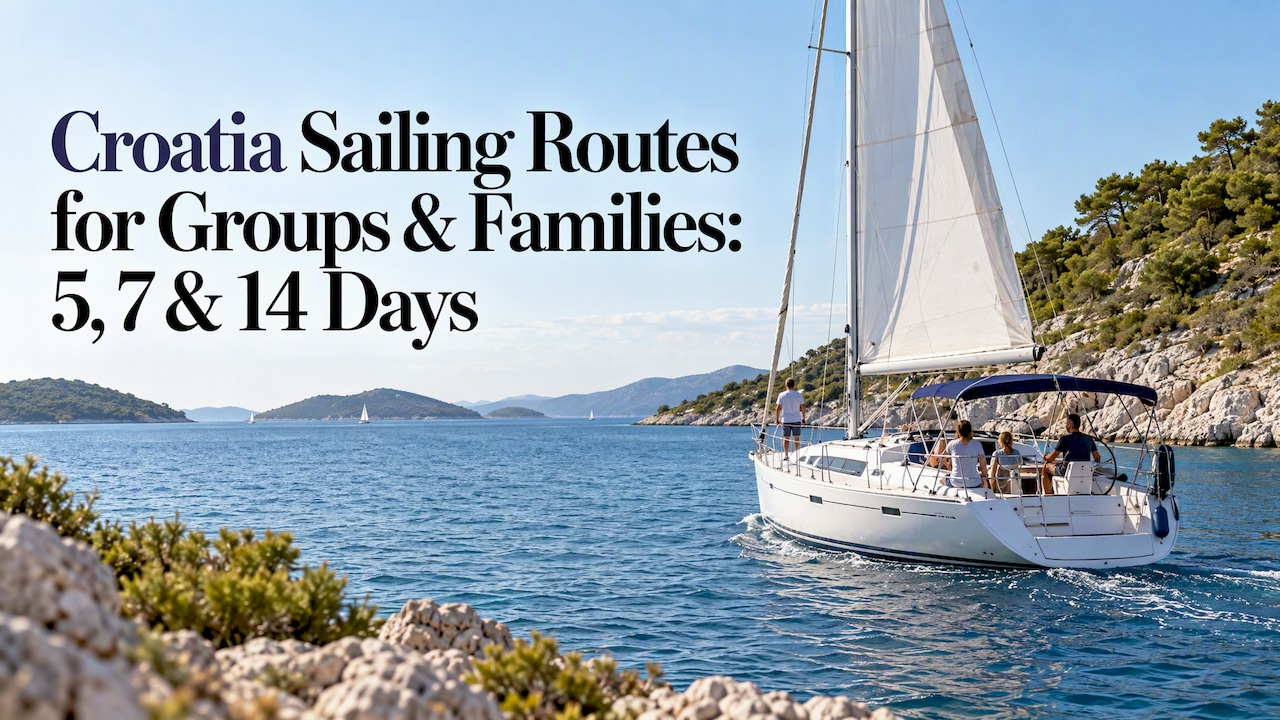
If you have 5 days, start from Split or Trogir and loop the central islands like Hvar and Brač. A full week lets you run the classic Split to Dubrovnik route through Korčula and Mljet. Two weeks give you room to combine the Kornati Islands with the southern Dalmatian coast at a relaxed, island-hopping pace.
Pe scurt:
- A 5-day itinerary is best suited for first-timers or groups with limited time, limiting stops to 3-4 islands with short hops under 20 nautical miles.
- The 7-day route balances variety and pacing, typically covering 5 to 7 stops with longer legs up to 30 nautical miles, ideal for families and friends.
- A 14-day trip allows combining northern Kornati sailing with the southern Dalmatian coast, including multiple national parks and rest days for a relaxed experience.
- Reserve mooring spots and park tickets well in advance, especially for Mljet and Kornati, and be prepared for changing weather conditions like the bura and jugo winds.
- Book early for peak summer months, verify legal permits beforehand, and consider a private skippered charter for maximum flexibility and ease.
Cuprins
- At-a-glance: comparing 5-, 7-, and 14-day itineraries
- Detailed 5-day Croatia sailing itinerary (day-by-day with legs and timings)
- Detailed 7-day Croatia sailing itinerary (day-by-day classic Dalmatian loop)
- Detailed 14-day Croatia sailing itinerary (day-by-day for a relaxed two-week trip)
- Choosing your start base, charter style, and timing
- Permits and regulations to check before you charter in Croatia
- Moorings, national parks, and booking practicalities
- Packing, provisioning, and simple onboard routines
- Safety and navigation: skipper tips and red flags
- SailArmada expertise: how curated charters translate to real itineraries
- Local customs and etiquette for sailors
- Sea conditions and navigation challenges in Croatian waters
- Overnight accommodations: onshore versus on the boat
- Environmental considerations in Croatian protected areas
- Who should pick each itinerary
- SailArmada Croatia – Go Private: book your own version of these routes
- FAQ
- Surse
- Authoritative sources to verify regulations and park booking rules
At-a-glance: comparing 5-, 7-, and 14-day itineraries
Picking the right length comes down to how much ground (or water) you actually want to cover, and how much lounging time you want baked in. A short trip rewards tight, efficient sailing. A longer one rewards patience and detours.
- 5 days: best for first-timers, bachelor or bachelorette groups, or anyone squeezing a sailing week into a long weekend. Expect 3 to 4 islands, short hops, and a lively, social pace. Start from Split or Trogir.
- 7 zile: the classic choice for families and groups of friends who want variety without rushing. Covers 5 to 7 stops, mixing busy harbor towns with quiet coves. Start from Split, Trogir, or Dubrovnik depending on direction.
- 14 days: ideal for slower travelers, sailing enthusiasts, or anyone wanting to combine northern and southern Dalmatia. Covers 10 or more stops with built-in rest days. Start from Zadar or Šibenik if heading south, or Split if looping both directions.
Swapping a starting base is usually simple: Split and Trogir sit close enough to use interchangeably, while Zadar and Šibenik work best for routes pointed toward the Kornati Islands rather than the Dubrovnik sailing itinerary loop to the south.
Detailed 5-day Croatia sailing itinerary (day-by-day with legs and timings)
A 5-day Croatia sailing itinerary from Split works best when you keep legs under 20 nautical miles so there’s time to swim, explore, and still make port before the evening rush for berths.
- Day 1: Split to Hvar Town (roughly 20 nautical miles, about 4 hours sailing). Settle into the boat, provision in Split, and aim for an afternoon arrival in Hvar Town. Walk the old fortress and grab dinner near the harbor.
- Day 2: Hvar to Pakleni Islands and back, or on to Vis (10 to 20 nautical miles). The Pakleni Islands just offshore from Hvar are perfect for a slow morning swim stop. Groups craving more distance can push on to Vis instead, trading a lazy day for a livelier one.
- Day 3: Vis to Komiža or Stiniva Bay (short hop, under 10 nautical miles). Vis Island rewards a full day: Komiža’s waterfront tavernas and the dramatic cliffs around Stiniva Bay are both worth the stop. The Blue Cave on nearby Biševo is a popular detour if conditions allow.
- Day 4: Vis to Brač, Bol or Milna (roughly 20 to 25 nautical miles, 4 to 5 hours). Bol’s Zlatni Rat beach is one of the most photographed stretches of coast in Croatia, while Milna offers a quieter, more sheltered anchorage for groups who prefer fewer crowds.
- Day 5: Brač back to Split (around 15 nautical miles, 2 to 3 hours). A short final leg leaves time for a last swim stop before handing back the boat in the afternoon.
Sfat profesional: Keep day 5 short and simple. Marinas want boats back early, and a relaxed final morning beats a stressed dash to make a return deadline.
If wind direction turns against you, the Split to Hvar to Vis to Brač loop reverses cleanly: start toward Brač first and finish in Hvar, since both islands sit roughly equidistant from Split and either direction works depending on the forecast. Trogir-based sailors can follow the identical route, since it adds barely any extra distance to day one.
This itinerary suits groups who want a true taste of island life without the logistics of a long trip: enough ground to feel like a real adventure, but short enough that nobody needs two weeks off work. For a longer version of this same region, see the 7-day route below, which adds Korčula and the Dubrovnik approach.
Detailed 7-day Croatia sailing itinerary (day-by-day classic Dalmatian loop)
The 7-day Croatia sailing itinerary from Split to the Dubrovnik area is the route most charter companies build their default week around, and for good reason: it hits the biggest island names without feeling rushed.
- Day 1: Split to Milna, Brač (roughly 12 nautical miles, 2 to 3 hours). An easy first leg to settle in, with a calm anchorage and a short walk into the village.
- Day 2: Milna to Hvar Town (around 15 nautical miles, 3 hours). Hvar’s harbor gets busy, so aim to arrive by early afternoon to secure a berth before the fleet rolls in.
- Day 3: Hvar to Vis (roughly 18 nautical miles, 3 to 4 hours). Spend the afternoon exploring Komiža or booking a side trip to the Blue Cave if the weather window allows.
- Day 4: Vis to Korčula Town (around 30 nautical miles, 5 to 6 hours). This is the longest leg of the week, so start early. Korčula’s walled old town, sometimes called a smaller Dubrovnik, is worth the extra miles.
- Day 5: Korčula to Mljet National Park (roughly 20 nautical miles, 4 hours). Mljet’s saltwater lakes inside the national park are a highlight of the whole trip. Arrive early enough to buy park tickets and still have daylight to kayak or swim the lakes.
- Day 6: Mljet to the Elaphiti Islands or toward Dubrovnik (around 20 to 25 nautical miles). Depending on your return base, either loop through the Elaphiti Islands for a last quiet night or push straight toward Dubrovnik for city time.
- Day 7: Final approach to Dubrovnik or back to Split area depending on charter base, with a short morning leg and afternoon free to explore the Old Town walls.
Sfat profesional: Book your Mljet National Park entry the morning you arrive rather than waiting. Rangers check tickets, and queues build fast once day-trip boats from the mainland show up.
If strong northerly winds (the bura) move in, skip the long Vis-to-Korčula leg and reroute through Pelješac’s sheltered channel instead, adding a stop at Pelješac’s wine villages while you wait out the weather. This same framework works equally well sailed in reverse from a Dubrovnik sailing itinerary starting point, which simply flips the order and ends in Split.
Detailed 14-day Croatia sailing itinerary (day-by-day for a relaxed two-week trip)
Two weeks is enough time to properly combine a Kornati sailing itinerary in the north with the classic Dalmatian run south, without the daily grind of constant repositioning.
- Days 1 to 3: start from Zadar or Šibenik and spend three days threading the Kornati Islands National Park, a maze of over a hundred bare limestone islets. Anchor in quiet coves like Vrulje Bay and budget a full rest day here.
- Days 4 to 5: sail south to Skradin or Krka National Park for a freshwater detour, then continue toward Trogir for a night of harbor life after days of isolated anchorages.
- Days 6 to 8: follow the central route through Hvar and Vis, mirroring the 5-day itinerary above but with an added rest day on each island instead of rushing through.
- Days 9 to 10: spend two full days at Mljet National Park rather than one, giving time to properly explore both saltwater lakes and hike to the Benedictine monastery on the smaller lake’s island.
- Days 11 to 12: continue to Korčula and the Pelješac peninsula, with a full day set aside for wine tasting given the extra time available.
- Days 13 to 14: finish toward Dubrovnik, with the final day held loose as a buffer in case weather pushed any earlier leg back.
Booking Kornati and Mljet mooring buoys ahead of arrival matters more on a 14-day trip than a 5-day one, since you are more likely to land there in peak weeks. Combining north and south in two weeks works best starting from Zadar heading south, rather than trying to loop back north again, since repositioning a boat against the prevailing routing adds unnecessary mileage.
Choosing your start base, charter style, and timing
Split sits at the geographic center of the Dalmatian coast, which makes it the most flexible base for both the 5-day and 7-day routes above. Trogir, just 20 minutes from Split’s airport, offers the same access with a smaller, quieter marina. Zadar and Šibenik point you toward the Kornati Islands and the north, while Dubrovnik works best as a one-way endpoint or starting point for the south, given the limited island clusters within easy range to its north.
- Split or Trogir: best for central Dalmatia, Hvar, Brač, and Vis loops.
- Zadar or Šibenik: best for the Kornati Islands and Krka National Park.
- Dubrovnik: best for one-way southern routes through the Elaphiti Islands, Mljet, and Korčula.
Bareboat chartering suits groups with a certified sailor aboard who wants full independence. A skippered charter removes the pressure of navigation and mooring decisions entirely, which sailing in Croatia as a beginner often calls for, especially for families or mixed-experience groups who would rather spend the week relaxing than studying charts.
Sfat profesional: Book your charter dates as early as possible for July and August, since the most popular boats and the best Kornati and Mljet moorings sell out months in advance.
June and September offer warm water with noticeably fewer crowds, while a guide to Mediterranean sailing seasons can help you weigh the tradeoffs between peak-season energy and shoulder-season calm.
Permits and regulations to check before you charter in Croatia
Before you book, confirm a few administrative details so nothing stalls your trip once you arrive. The Ministry of the Sea’s chartering guidance publishes the current rules, forms, and authorization lists that govern charter activity in Croatian waters.
- Cabotage authorization: foreign-flagged vessels up to 24 meters typically need cabotage authorization, or a Croatian-registered charter partner, before operating commercially in Croatia.
- eCrew registration: charter companies must submit crew and passenger details through the eCrew system before departure, so confirm your operator handles this.
- Technical inspection: foreign-flagged hulls up to 24 meters need a survey from a Recognized Organization accepted by the flag state, per the official chartering manual for 2026.
- Navigation safety fee: first-entry vessels pay this fee on arrival, with eNautika offering an online payment option instead of handling it at a harbor office.
Ask your charter company to confirm each of these before you sign anything.
Moorings, national parks, and booking practicalities
National parks like Kornati and Mljet require advance tickets, and rangers actively patrol anchorages to check them, so keep both printed and electronic receipts on board. Popular mooring buoys and small konoba berths fill early in July and August, often by midafternoon.
- Reserve ahead where possible: many small harbor restaurants (konobas) take mooring reservations only by phone, so call a day or two out.
- Arrive early: aiming for a late morning or early afternoon arrival dramatically improves your odds of a berth.
- Have a backup anchorage ready: if your first-choice harbor is full, nearby bays usually offer safe, free anchoring as a fallback.
Sfat profesional: Call ahead the night before for any berth you really want. A five-minute phone call beats arriving to find the harbor master shaking his head.
Packing, provisioning, and simple onboard routines
Bring passports or ID, boat and travel insurance documents, and any regular medications in carry-on bags rather than checked luggage. Pack soft duffel bags instead of hard suitcases since boat storage is limited.
- Documente: passports, charter contract, insurance papers, and any required park ticket confirmations.
- Aprovizionare: stock up on basics in Split or your starting base, then top up at smaller island markets as you go rather than overbuying on day one.
- Daily routines: a quick morning check of lines, bilge, and battery levels keeps small issues from becoming big ones later in the week.
Safety and navigation: skipper tips and red flags
Check the forecast each morning, since Croatia’s bura and jugo winds can shift conditions quickly along exposed channels. Avoid open-water crossings when small craft warnings are posted, and know Channel 16 is the VHF frequency for emergencies. Walk away from any operator unwilling to show proof of insurance, a valid charter license, or a clear handover checklist.
SailArmada expertise: how curated charters translate to real itineraries
Our Croatia routes are designed to reflect realistic sailing legs rather than theoretical distances. Skippers adjust stops as needed for weather, crowds, or group preferences. This flexibility, along with transparent pricing and support from experienced sailors, helps ensure smooth trips.
Local customs and etiquette for sailors
Croatian harbor culture runs on a few unspoken rules worth knowing before you arrive. Stern-to or bow-to mooring in a marina usually means a crew member on the dock will help with lines, and a small tip for that help is appreciated but never required.
Keep noise down in small harbors after around 10 or 11 at night, since many konobas and anchorages sit close to homes and other boats. When anchoring near other yachts, give enough swing room so nobody drags into their neighbor overnight. Flying a dinghy flag or showing a clear anchor light after dark is both courteous and often legally expected.
Tipping is customary at waterfront restaurants and for marina staff who assist with mooring, typically rounding up the bill or leaving a modest cash tip. Dress for towns and churches with a bit more coverage than beach attire, especially in Dubrovnik’s Old Town or smaller island villages where locals still live year round. A friendly greeting in basic Croatian, even just “dobar dan” for good day, tends to go a long way with harbor masters and shop owners alike.
Sea conditions and navigation challenges in Croatian waters
Croatian waters are generally forgiving for intermediate sailors, but two named winds shape most of the planning. The bura is a strong, gusty northeasterly that can arrive with little warning, particularly in the Kvarner Gulf and around exposed channels near Pag and Rab. The jugo is a warmer southeasterly that builds more gradually but can bring sustained rough seas over a day or two.
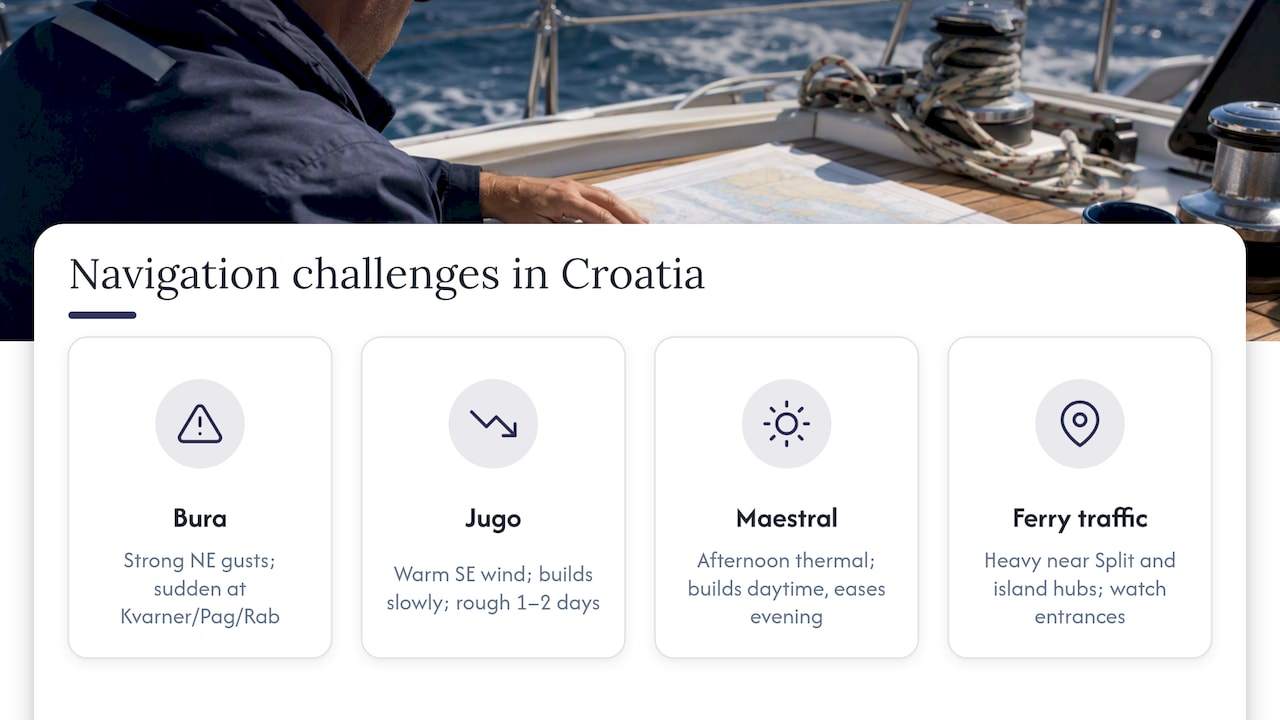
Channels between islands, like the passage near Pelješac or the open stretch between Vis and the mainland, can funnel wind and create choppier conditions than the forecast for open water might suggest. Ferry traffic is heavy around Split and the main island hubs, so keep a lookout near harbor entrances. Tidal range in the Adriatic is minimal, which simplifies anchoring compared to many other sailing regions, but afternoon thermal winds known as the maestral are common and genuinely useful: they tend to build through the day and die down by evening, which is why most charter routes plan longer legs for morning hours.
Overnight accommodations: onshore versus on the boat
Sleeping aboard is the default for most Croatia sailing itineraries, and cabins on a typical charter catamaran or monohull are comfortable enough for a full week without feeling cramped. Staying on the boat also means you wake up anchored in a quiet bay rather than a hotel room, which is a big part of the appeal.
Some groups prefer to break up a longer trip with a night or two ashore, particularly in Dubrovnik or Hvar Town, where boutique hotels and guesthouses offer a change of pace and a proper hot shower. This works well bookending a 7- or 14-day itinerary, staying ashore the night before boarding and the night after disembarking, rather than mixing it into the middle of the trip where it adds logistics.
Environmental considerations in Croatian protected areas
Kornati and Mljet National Parks both enforce no-anchor zones in sensitive seagrass areas, with designated mooring buoys provided specifically to protect the seabed. Using these buoys rather than dropping anchor in protected zones is both the law and the simplest way to avoid damaging fragile marine habitat that took decades to establish.
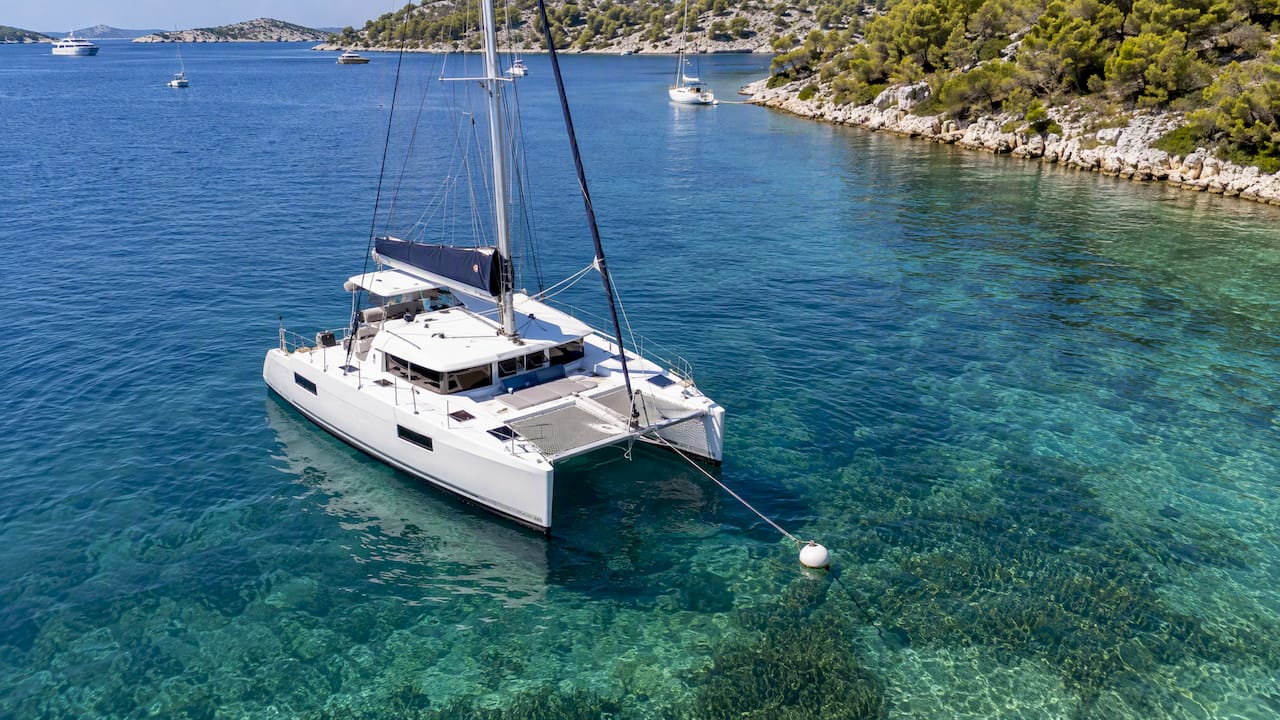
Pack out all trash rather than leaving it at remote anchorages, and avoid discharging greywater or blackwater near swimming areas or inside park boundaries. Reef-safe sunscreen is a small choice that adds up across the thousands of boats sailing these waters each season. Respecting speed limits near shorelines also protects seagrass beds from prop damage and reduces erosion along smaller island coves.
Who should pick each itinerary
Families with younger kids tend to do best on the 5-day loop or a gentler stretch of the 7-day route, where shorter legs mean less time underway and more time swimming. Active groups of friends usually want the full 7-day classic for the mix of nightlife and scenery. Slower travelers and couples often get the most out of 14 days. Whatever you choose, build in flexibility: the best itineraries bend with the wind rather than fight it.
- Sail
SailArmada Croatia – Go Private: book your own version of these routes
Every itinerary above maps directly onto our Croația - Go Private sailing weeks, built for groups and families who want their own boat, their own schedule, and a skipper who already knows these islands.
- Private boat, private pace: no joining a fleet of strangers, just your group and a skipper trained through CAPETAN.club.
- Flexible routing: your skipper can shift the 5-, 7-, or 14-day plan above based on wind, crowds, or what your group actually wants to do.
- Pricing starting at a weekly rate per person, with boat options and exact details on the Croatia – Go Private page.
Reach out through the booking page to check dates and get a quote tailored to your group size and preferred route.
FAQ
Which month is the best for sailing in Croatia?
June and September offer warm water with far fewer crowds than July and August, making them a strong choice for sailors who want pleasant weather without the peak-season rush for moorings. A Mediterranean sailing seasons guide can help you weigh seasonal tradeoffs in more depth.
How much does a 7-day sailing trip to Croatia cost?
Our own Croatia – Go Private itinerary starts starting at a weekly rate per person, covering a private skippered boat built around routes like the 7-day Dalmatian loop described above. Exact pricing depends on boat type, group size, and travel dates.
What are the best islands to sail in Croatia?
Hvar, Brač, Vis, Korčula, and Mljet appear across nearly every well-built Croatia sailing itinerary, each offering a distinct mix of harbor towns, quiet anchorages, and national park scenery. The Kornati Islands further north add a wilder, less developed alternative for a longer trip.
What are some good sailing tours in Croatia?
A 5-day central Dalmatia loop from Split, a 7-day classic route to Dubrovnik through Korčula and Mljet, or a 14-day combination of the Kornati Islands and southern Dalmatia all suit different travel styles. Choosing a skippered option like our Croatia – Go Private itinerary takes the route-planning pressure off entirely.
Authoritative sources to verify regulations and park booking rules
Before you charter, confirm current cabotage, eCrew, and fee requirements directly with the official sources below rather than relying solely on secondhand summaries.