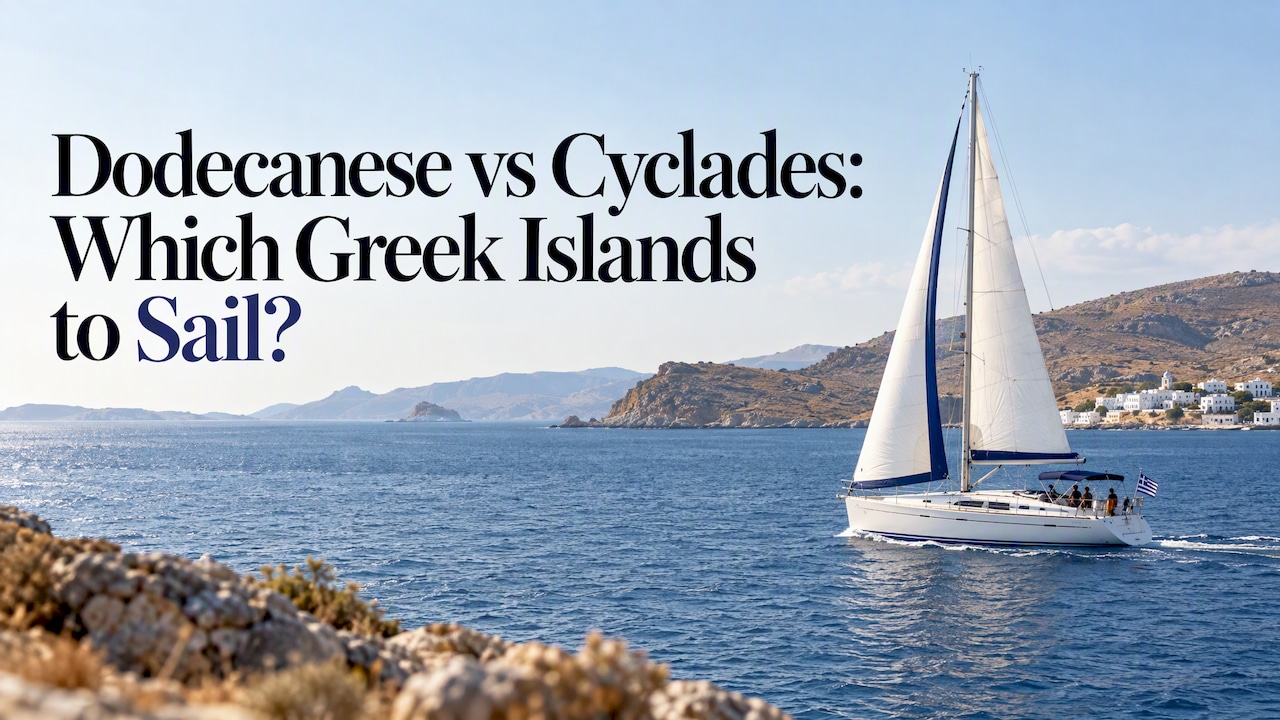
Choose the Cyclades if your crew wants the postcard Aegean: whitewashed lanes, sunset bars, buzzing harbors and short hops between islands. Choose the Dodecanese if you want a slower week with medieval walls, Italian-era architecture, volcanic landscapes and quieter anchorages. Both are superb by boat. They just feel very different once the anchor is down.
Below we compare them the way a skipper would: wind, distances, harbors, towns, crowds and the kind of crew each one suits. At the end you’ll find a simple way to decide, plus a few questions we hear a lot.
TL;DR
- Ciclade: iconic white-and-blue villages, lively nightlife, short legs between islands, but the Meltemi wind can be strong in midsummer.
- Dodecanese: medieval and Italian-influenced towns, more varied scenery, a calmer pace and a base in the southeast, close to Turkey’s coast.
- First-time or mixed-ability crew: the Dodecanese, or the Cyclades outside July and August, usually feel easier.
- Party and photo crew: the Cyclades win on energy and iconic views.
- Either way: keep your itinerary flexible and have a Plan B harbor for every day.
Cuprins
- The quick comparison
- Two island groups, two personalities
- Wind: the Meltemi decides a lot
- Distances, hubs and how the week flows
- Crowds, prices and the “which is cheaper” question
- Which one suits your crew?
- Our perspective
- Plan your week with us
- A simple way to decide
- Întrebări frecvente
- Surse
The quick comparison
| Ciclade | Insulele | |
|---|---|---|
| Vibe | Cosmopolitan, iconic, lively | Historic, varied, relaxed |
| Architecture | White-and-blue Cycladic villages | Medieval castles, neoclassical and Italian-influenced towns |
| Position | Central Aegean | Southeast Aegean, near Turkey |
| Island hopping | Many islands, short legs | Fewer big hubs, more space between some islands |
| Wind | Meltemi is a major factor | Meltemi eases out, a gentler feel |
| Typical hub port | Piraeus (ferries) | Rhodes (ferries) |
| Cel mai bun pentru | Friends who want sunsets, bars and postcards | Crews who want history, nature and quiet bays |
The hub ports and general split come from Visit Greece’s sailing guide. Now the detail behind each row.
Two island groups, two personalities
The Cyclades: the Aegean dream
The Cyclades take their name from the circle they form around the sacred island of Delos. Visit Greece describes them by their rugged white-and-blue architecture and cosmopolitan nightlife, with Mykonos and Santorini as the best-known names. The group is split into four subgroups: the North, Middle, Little and Southern Cyclades. Naxos is the largest island.
That structure is a gift for sailors. Islands sit close together, so you can plan a morning swim in one bay, lunch in another and a harbor dinner in a third without a long passage. If your group pictures narrow streets, bougainvillea, windmills and a sundowner with the whole village glowing, this is the place.
Want ready-made routes? Our skipper-tested Cyclades sailing itinerary lays out day-by-day plans.
The Dodecanese: history with a sea view
The Dodecanese, the “Twelve Islands”, sit in the southeastern Aegean. Rhodes is the group’s capital and the fourth-largest Greek island, and Visit Greece’s Rhodes page pairs its medieval character with lace-like beaches and pine-covered mountains. The wider Dodecanese overview talks about medieval grandeur meeting unspoiled nature.
The islands also have a distinct identity because of their history under Italian rule until 1947. You notice it in the neoclassical buildings of towns like Symi and Rhodes, which look nothing like a classic Cycladic village. For many guests that “time capsule” feel is the draw: it’s Greece, but not the Greece on every brochure.
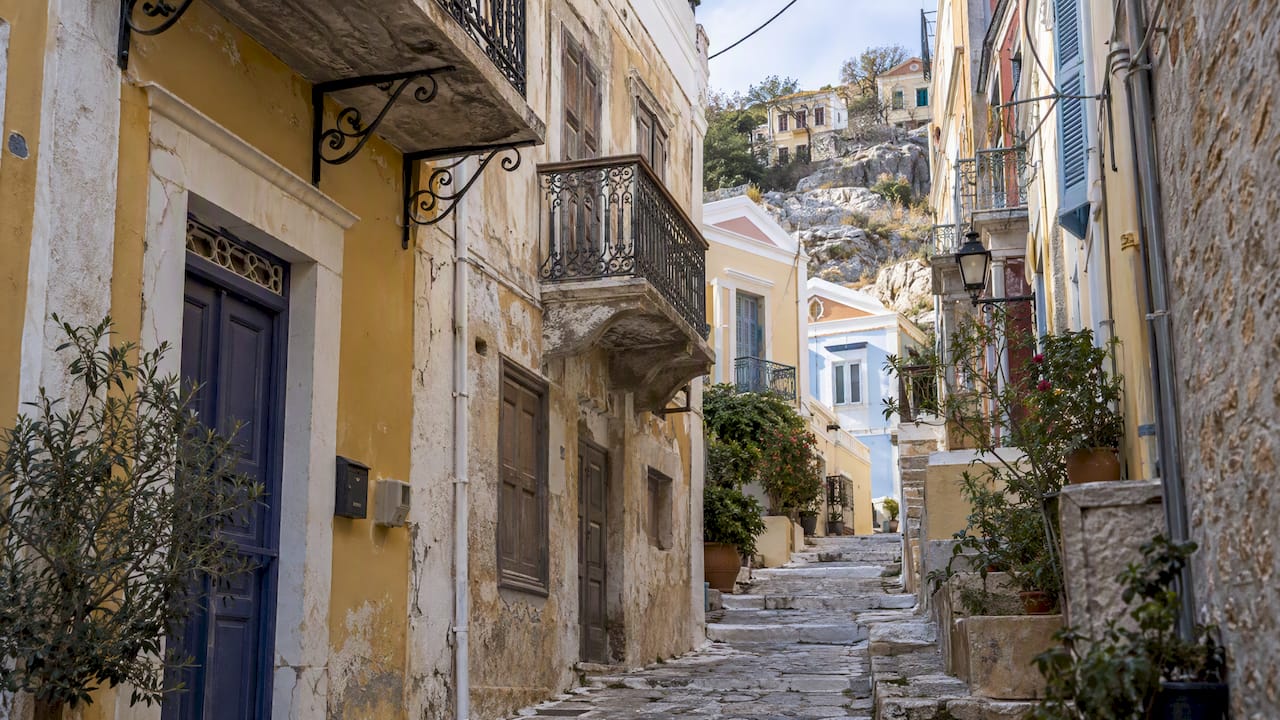
Scenery varies a lot too. Local guides point to volcanic craters on Nisyros and the butterfly valleys of Rhodes, which is plenty of reason to get off the boat and explore.
noastre 7 to 10 day Dodecanese itineraries for mixed-ability crews show how those islands link up.
Wind: the Meltemi decides a lot
If there’s one thing to understand before choosing, it’s the Meltemi. This northerly wind typically blows from the north-northeast in July and August, often at 15 to 25 knots, according to Visit Greece. It cools the summer heat beautifully, but it can make conditions demanding for less experienced sailors in the central Aegean, which is exactly where the Cyclades sit.
What does that mean in practice?
- In the Cyclades in midsummer, expect lively sailing, and plan routes that avoid long upwind legs. Knowing which side of an island gives you shelter is half the skill. Your skipper does this for you, but you should expect some days where the plan changes.
- In the Dodecanese, the same wind is part of the picture, but the Aegean’s southeast corner generally offers a more relaxed sailing environment, according to the same Visit Greece sailing guide.
- Outside the peak weeks, both groups can feel gentler. The sailing season runs well beyond summer, and Visit Greece notes peak activity from mid-July through October.
We’ve written a full guide to sailing the Meltemi in Greece if you want the long version. The short version: don’t fear it, respect it, and let an experienced skipper read the forecast.
Distances, hubs and how the week flows
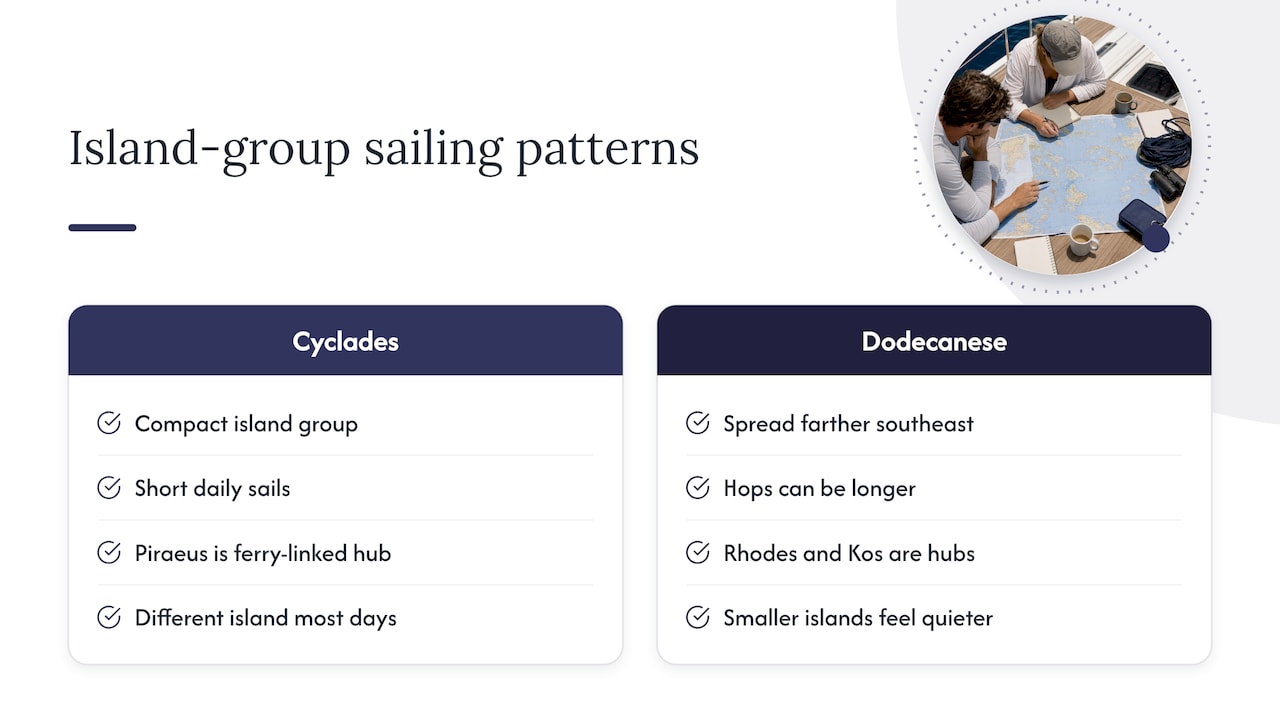
The Cyclades are compact. A typical day is a short sail, a swim stop, then a harbor or bay for the night. That makes them ideal for groups that like variety: a different island and a different vibe almost every day. The ferry-linked hub for the area is Piraeus.
The Dodecanese stretch farther southeast. Rhodes and Kos act as the big hubs, with larger ferry networks linking them to smaller, more secluded islands. Hops can be a bit longer, but the reward is that the smaller islands often feel noticeably quieter.
One honest caution that applies to both: Greek weather can reshuffle schedules. Even the big ferries have to adjust, and operators like Hellenic Seaways publish itinerary changes when conditions turn, including a late-July 2026 notice that shifted departures from Piraeus. If you’re connecting a ferry, a flight or a crew change around your sailing week, build in a buffer day. A private charter gives you freedom, but the sea still has the final say.
Crowds, prices and the “which is cheaper” question
People often ask which group is the quieter one. The Dodecanese generally are, with travel guides describing them as less visited than the Cyclades and known for tranquil beaches and medieval architecture. The Cyclades, by contrast, include some of the most famous destinations in Greece, which means popular harbors in July and August can fill early.
To put numbers on it, the South Aegean region, which covers both groups, recorded 8,558,966 arrivals in 2025 and 41,838,969 overnight stays, about 26.8% of the national total, according to ELSTAT’s 2025 accommodation data. That’s a lot of visitors sharing one region, so where you go and when you go matter. Going in shoulder season or choosing smaller islands is the easiest way to feel the difference.
On cost, the biggest swing factors are not the island group. They’re the season, the boat type, the number of people sharing, and whether you add a skipper. Splitting a yacht or catamaran between friends or family brings the per-person price down a lot. Our guide to Cât costă o vacanță pe yacht walks through it.
Which one suits your crew?
Pick the Cyclades if…
- You want iconic views, sunsets and lively harbor evenings.
- Your group loves short sails and a new island every day.
- You’re traveling outside the strongest Meltemi weeks, or your crew is comfortable with some breeze.
- You like a bit of a social scene: beach clubs, tavernas that fill up, people-watching.
Pick the Dodecanese if…
- You’re drawn to castles, old towns and a layered history.
- You want varied nature: volcanic landscapes, pine forests, quiet coves.
- Your crew includes beginners, kids or anyone who prefers a calmer sea.
- You’d rather find a secluded bay than a crowded bar.
Or combine them
The two groups meet in the middle of the Aegean, and some routes link them, as Google results for “Cyclades and Dodecanese in one trip” show. A longer holiday of two weeks can touch both. If you’re curious about lesser-known options, take a look at our picks of the best unknown Greek islands for sailing, și a noastră Greek island hopping routes explained.
Our perspective
We get this question constantly, and the honest answer is that there’s no wrong pick, only a pick that fits your crew. Our routes are curated by experienced, professionally trained skippers from CAPETAN.club, and the thing they say most often is that the island group matters less than the match between the plan and the people on board.
A group of friends who want a big, social, sunset-heavy week will love the Cyclades even with a lively breeze. A family with first-timers will often have a more relaxed week in the Dodecanese. And if you can’t decide, a skipper-led week lets you adapt: if the wind is up, you tuck into a sheltered harbor and enjoy a long lunch instead of fighting it.
We’d also gently push back on the idea that the Meltemi is a problem. Treat it as part of the rhythm of the Aegean. Knowing the lee side of an island and having a Plan B harbor is what separates a stressful week from a brilliant one, and that’s the job of a good skipper. Whichever you choose, you’ll wake up with an endless swimming pool outside your cabin and a sea view that never switches off.
- Sail
Plan your week with us
Ready to turn the comparison into a booking? Our Grecia devine privată option starts from 560 € per week per person, with a skipper, a choice of yacht or catamaran and flexible departure dates. Prefer company? Browse our vacanțe de navigatie de grup to join a curated route, or see the Greece destination page for more on where we sail. Not sure whether private or group fits you? Our short guide to the private or group sailing holiday decision can help.
A simple way to decide
- Pick your month. July and August mean more Meltemi in the central Aegean. May, June, September and October are usually friendlier for a mixed crew.
- Pick your crew’s energy. Nightlife and photogenic harbors point to the Cyclades. History and quiet bays point to the Dodecanese.
- Pick your comfort level. Beginners and families lean Dodecanese, or Cyclades off-peak. Confident sailors can enjoy either.
- Leave a buffer. Add a spare day around flights and ferries, and keep a Plan B harbor in mind.
- Talk to a real sailor. We’ll help you match boat, route and dates to your group.
Întrebări frecvente
Is the Dodecanese or the Cyclades better for sailing?
Neither is better outright. The Cyclades offer short hops and iconic scenery but more exposure to the Meltemi in midsummer. The Dodecanese offer a more relaxed sailing environment, with history and varied landscapes. Match the choice to your crew and your travel month.
Which is less crowded, the Dodecanese or the Cyclades?
The Dodecanese are generally less visited and feel more tranquil, especially on the smaller islands. The Cyclades include some of Greece’s most famous islands, so popular harbors can fill up in peak summer. Traveling in shoulder season helps in both.
Can I sail both island groups in one trip?
Yes, though it works best with at least two weeks, since the Dodecanese are farther southeast. In a single week, most crews enjoy it more by choosing one group and exploring it properly.
When is the best time to sail the Aegean?
The Meltemi usually peaks in July and August, often at 15 to 25 knots, so many mixed crews prefer the shoulder months. Visit Greece notes sailing activity continues through October. Ask your skipper about conditions for your specific dates.
Surse
- Visit Greece: Cyclades
- Visit Greece: Dodecanese
- Visit Greece: Rhodes
- Visit Greece: Sailing in Greece
- Hellenic Seaways: itinerary modifications 28.07.26 to 02.08.26
- ELSTAT: accommodation arrivals and overnight stays, 2025
Recomandate
- Itinerarii de navigație de 7 până la 10 zile în Dodecanez pentru echipaje cu niveluri mixte de experiență
- Moduri de a explora insulele grecești: Ghidul tău de călătorie pentru 2026
- Cele mai bune insule grecești mai puțin cunoscute pentru navigarea cu barca cu pânze în 2026
- Skipper a testat itinerariul de navigație în Ciclade cu planuri gata de făcut zi de zi