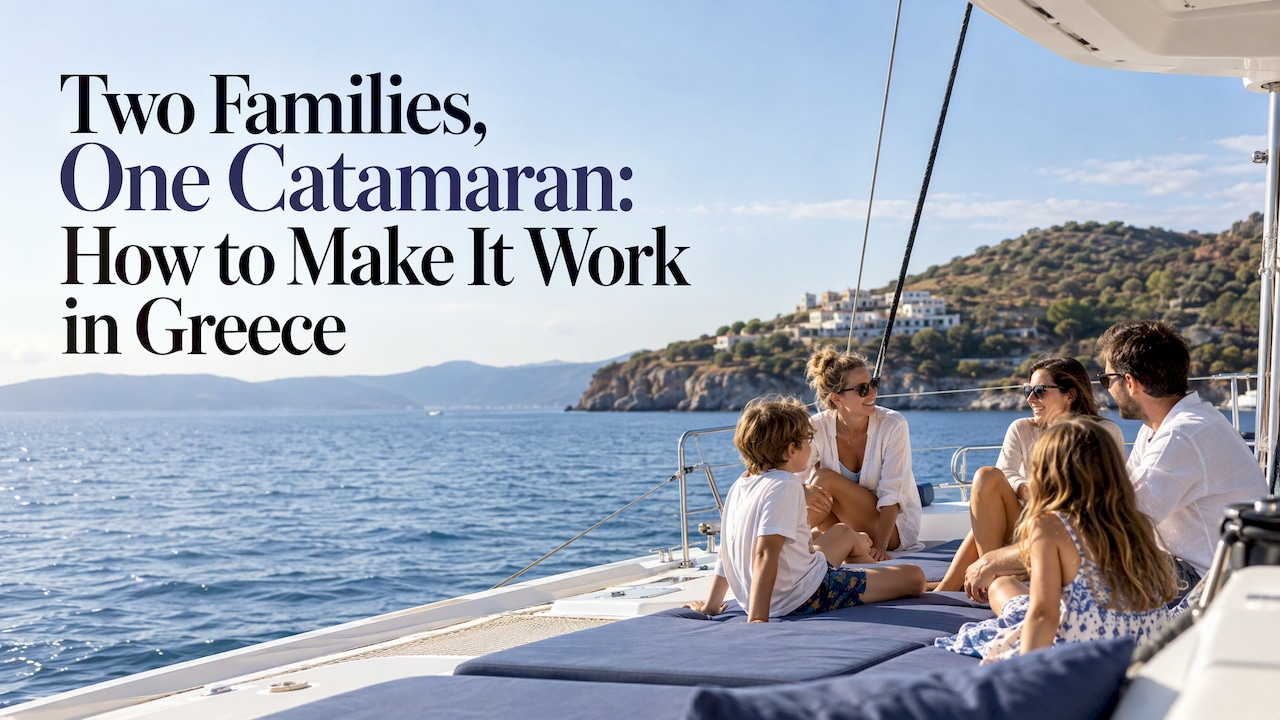
Yes, two families can share one catamaran in Greece, and it is one of the happiest ways to do a sailing week. The trick is planning four things before you book: how many cabins and bathrooms you need, who pays for what, whether you sail with a skipper, and a route that keeps both the toddlers and the teenagers smiling. Get those right and you get a floating villa with an endless swimming pool, a new beach every day and zero arguments about where to have dinner.
TL;DR
- Plan around cabins, not beds: one cabin per couple or family unit, plus a separate one for each teenager if you can.
- Greece has plenty of larger catamarans, and demand for six-cabin yachts is rising because groups often travel as 11 or 12 people.
- Agree the money rules in writing before departure: a shared pot for boat costs, personal spending kept separate.
- Sailing with a skipper means nobody has to hold a licence, and parents actually get to relax.
- Pick the route for the shortest hops and the best swim stops, not the most islands.
Cuprins
- Can two families really share a catamaran?
- Cabins, berths and bathrooms: what to compare
- Privacy and personal space on board
- Agreeing on costs, meals and jobs before you leave
- Skipper or bareboat: which suits two families?
- Choosing a route and season both families will love
- Viziunea noastră
- Ready to plan your own shared week?
- Întrebări frecvente
- Surse
Can two families really share a catamaran?
They can, and catamarans are the natural choice. Two hulls mean cabins sit well apart, the saloon and cockpit are big enough for everyone to gather at one table, and the boat sits flatter under sail, which is kind to small stomachs. If you want the longer case for why groups gravitate to them, we put it together in our guide on De ce aleg grupurile catamarane.
The real question is size. Many yachts in Greece are built with five guest cabins for up to ten guests, but family groups often turn out larger once grandparents, teenagers or a nanny join in, which is driving demand for six-cabin yachts, according to a Greek charter specialist quoted there.
A quick way to size up your group:
- Count every person who will sleep aboard, including babies and any helper.
- Check the boat’s cabină count, not only its berth count. A boat that “sleeps 10” may do so with sofa beds you will not want to use for a week.
- Check the number of bathrooms (heads). Two families on one shared bathroom is where holidays go wrong.
- Leave a little slack. A boat that is full to the last berth feels smaller by Wednesday.
If you are unsure how many cabins a given boat size usually has, our page on how many cabins a catamaran charter has walks through it. And if the multi-family idea is new to you, what a multi-family yacht charter is acoperă elementele de bază.
Cabins, berths and bathrooms: what to compare
Two boats with the same cabin count can feel completely different. Here is what we would put side by side before choosing.
| What to compare | Why it matters for two families |
|---|---|
| Number of double cabins | Each couple wants a real double, ideally in a separate hull from the other couple |
| Bunk or small cabins | Perfect for kids, handy for a teen who wants a door to close |
| Number of bathrooms | One per cabin is the comfortable standard for a shared week |
| Cabin position (hull and bow or stern) | Bow cabins can be livelier at anchor; stern cabins are often calmer |
| Owner’s version vs. charter version | An owner’s version trades cabins for space, so recount carefully |
| Saloon and cockpit seating | Everyone should fit at one table for dinner |
A sixth cabin is a small detail that changes the week. As the same charter specialist put it, teens get breathing room, grandparents are not squeezed into awkward setups and a nanny can stay close to the kids without turning the boat into a puzzle. If your group is eleven or twelve strong, it is worth looking for exactly that.
For how to split the rooms once you have a boat, our cabin allocation guide for groups is a good companion. A tip we like: do not allocate by family on day one. Let the families rank their preferences, then trade. Often one family wants the quiet hull and the other would rather be close to the galley.
Privacy and personal space on board
This is the question people are shyest about, so let us be direct: on a catamaran you will be together most of the day, and that is the point. But the layout helps you carve out private pockets.
- Separate hulls. Put each family in its own hull where the layout allows. The two sides are joined by the saloon, so you share the living space but not the wall.
- Front lounge and foredeck nets. On many catamarans these become the grown-ups’ spot at sunset and the teenagers’ spot all afternoon.
- Flybridge or aft deck. A second place to sit means two conversations can happen at once.
- Daily rhythm. Mornings are naturally quiet, swim time is loud, and evenings are for the shared table. Agree that mid-afternoon is “free time” and everyone can nap, read or snorkel solo.
What about a single-cabin boat? It is a wonderful option for one couple or a small family, but it is not the layout for two families. If you are curious about the format anyway, we explain it in single cabin catamarans.
Agreeing on costs, meals and jobs before you leave
Most friction between families on holiday is not about the boat, it is about money and chores that nobody talked about. Have a ten-minute video call before you book and settle these.
Pick a treasurer and a shared pot
Choose one person to manage a shared pot that covers the boat-level costs: the charter fee, the skipper if you have one, fuel, marina fees, provisioning and end-of-charter cleaning. Keep individual costs outside it: restaurant meals ashore, personal drinks and water sports add-ons. Each family pays its fair share into the pot up front and the treasurer reports back at the end.
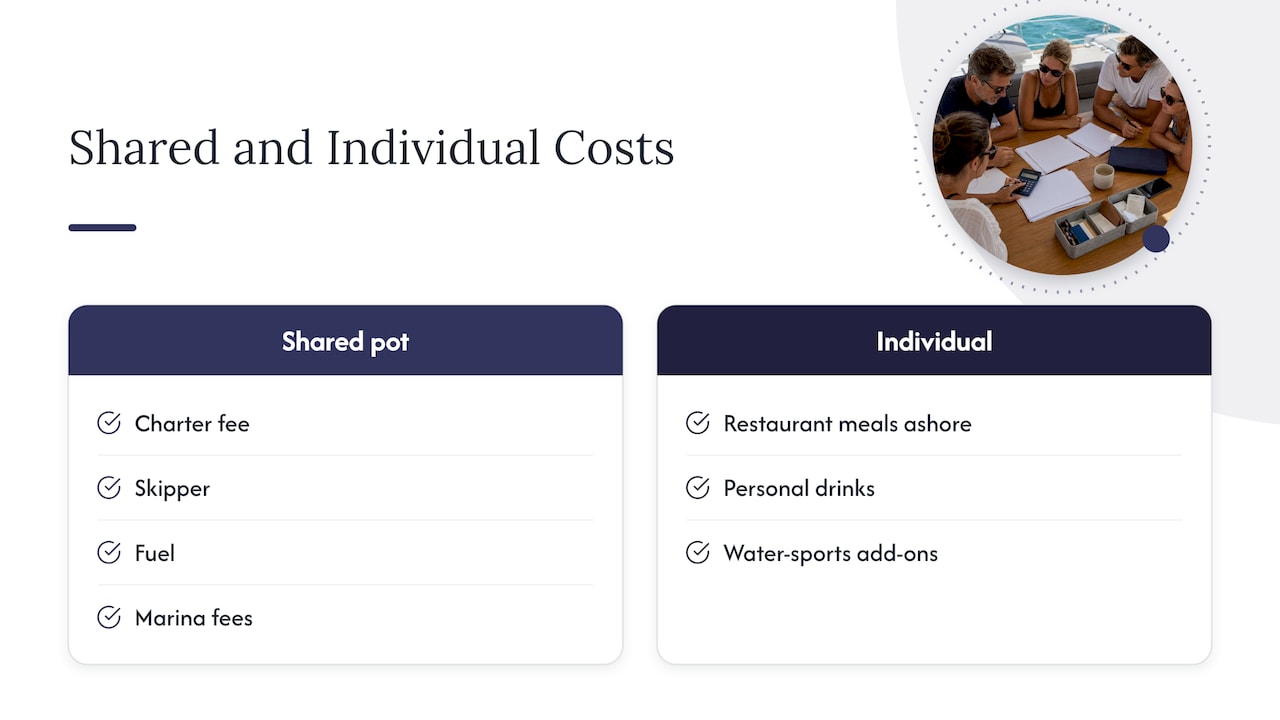
If the families are different sizes, decide whether to split per family or per person. Per person is usually fairer when one family has four members and the other has two. A shared expense app takes the maths off the treasurer’s plate, and this walkthrough on how to split costs fairly shows a simple way to calculate each share.
Settle the budget lines
Two costs surprise first-timers in Greece. One is the transit log, the cruising paperwork for the boat in Greek waters, which is a fee paid to Customs and is normally handled by the charter base or skipper. The other is the extra spending that sits outside your charter price: fuel, marina and mooring fees, provisioning and cleaning. Ask for a clear list of what is and is not included in your quote, and set aside a cushion for these. Our guide to Greece catamaran costs lays out what to budget and how prices move with boat size and season.
Provisioning and cooking
Name two people to run provisioning, ideally one from each family, so both sets of food preferences are covered. Share a short list of allergies and fussy eaters first. Then split the week: breakfast and lunch on board, dinner in a taverna on at least a few nights, because eating by the harbor is half the charm of Greece.
For menus, galley tips and shopping logistics, see our guides on managing meals on a catamaran și family provisioning trip.
Divide the on-board jobs
Kids love having a role. Give each a small job: fender duty, deck sweep, snack captain. Grown-ups can rotate cooking and washing up, so no one feels they are on a working holiday.
Skipper or bareboat: which suits two families?
In Greece you can charter a boat bareboat, meaning you run it yourselves, or with a skipper who handles navigation, mooring and safety. For two families with children, we nearly always point people to the skipper option.
Bareboat charters require someone aboard with a recognized offshore sailing qualification and sufficient experience, and charter bases check certificates before handing over the keys. Rules and accepted certificates can change, so confirm with the charter base well ahead of departure what they will accept. With a skipper, that question is handled for you.
What you gain with a skipper:
- Parents stay parents. No one has to anchor in a swell while a toddler needs lunch.
- Local knowledge. A skipper knows which bay is calm tonight and where the best grilled octopus is.
- Safer mooring in busy harbors, where Greek-style stern-to docking can be stressful for first-timers.
- A neutral decision-maker on route and timing, which spares the two families from negotiating every morning.
Our article on a catamaran with captain in Greece explains how it works day to day. Should you prefer to compare boat types before choosing, catamaran vs barcă cu vele will help.
Choosing a route and season both families will love
Greece offers several very different sailing areas, and the best one depends on your children’s ages and your crew’s tolerance for wind.
- Ionian islands (west coast): generally gentler sailing and short hops between green, sheltered bays. A comfortable first choice for families with small kids.
- Saronic Gulf (near Athens): close to the airport, with short legs and lively harbor towns, good for a shorter or first trip.
- Ciclade: iconic whitewashed villages and clear water, though the Aegean can be breezier in high summer, better for families with older kids and some sailing appetite.
- Dodecanese and Sporades: quieter and more off the beaten path, great once you have a bit of experience.
A few planning rules that keep both families happy:
- Aim for two to four hours of sailing a day, not six. Kids get restless, and you want time to swim.
- Book a mix of anchor nights in quiet bays and harbor nights with a playground, ice cream and a taverna.
- Choose shoulder months, late spring or September, if you prefer calmer days and quieter bays. July and August are hot and busy, but they are the school-holiday weeks for most families.
- Keep one buffer day. Weather changes plans, and a flexible skipper will turn that into a bonus swim stop.
Want ideas beyond Greece? Our Ghid de navigație în familie în Marea Mediterană compares other options, and our destinations page shows where else we sail.
Viziunea noastră
We have seen it again and again: the best family sailing holidays are the shared ones. Two families on one catamaran split the cost, double the fun for the kids and give the grown-ups someone to share the sunset with. Kids who barely knew each other on Saturday are inseparable by Tuesday.
That is why we build our private sailing weeks around flexibility. You choose the destination, the boat and the dates, and our routes are curated by experienced, professionally trained skippers from CAPETAN.club. They know the bays, they plan realistic daily distances, and they keep the week relaxed for everyone from the youngest crew member to the grandparents.
Our advice is simple. Talk through cabins and costs early, bring a skipper along so you can enjoy your holiday, and pick a route with short hops and plenty of swimming. We back that up with transparent pricing and personal support from actual sailors at every step, so you are never planning alone.
Go Sailing
Ready to plan your own shared week?
If you are picturing two families, one boat and a week of swimming off the back step, our private sailing holidays in Greece are built for exactly that. Pick your dates, your catamaran and your route, and we will help you shape the rest. Prices start from €560 per person per week, and you can see the details on our Pagina privată a navelor de croazieră din Grecia.
Want to compare options first? Take a look at vacanțe de navigație individuale sau în grup to decide which format suits your families, or explore our Kid Sailing holidays if your crew is mostly under twelve.
Întrebări frecvente
How many people can two families fit on one catamaran?
It depends on the boat. Many yachts in Greece have five guest cabins for up to ten guests, and larger six-cabin boats suit groups of eleven or twelve. Count cabins and bathrooms, not only berths, so everyone has a proper bed.
Do we need a sailing licence to charter a catamaran in Greece?
For a bareboat charter, the person in charge needs a recognized offshore qualification, and the charter base will check it. If you sail with a skipper, they take care of the navigation and the boat’s papers. Confirm current requirements with your charter provider before you book.
How should we split the cost between two families?
Set up a shared pot for the charter fee, skipper, fuel, marina fees, provisioning and cleaning, and keep restaurants, personal drinks and activities separate. Decide upfront whether to split per family or per person, and nominate one treasurer to track it.
What is the best time of year for a family catamaran trip in Greece?
Many families like late spring and September for calmer, quieter days, while July and August suit school holidays. Choose the sailing area to match your crew: the Ionian is usually gentler, while the Cyclades can be breezier.
Surse
- Families Choose Greece Luxury Yacht Charters Over Resorts, Digital Market Reports
- Yacht Fees for entering Greece, Noonsite
- Split Costs Fairly as a Couple: 5 Steps to Calculate Each Share, Crew’s Canvas
Recomandate
- Catamarani cu căpitan în Grecia: Cum funcționează și ce trebuie să știi
- Catamaran în Europa: ghidul dvs. mediteranean de navigație de familie
- 3 confirmări pentru rezervările de nave de marină grecești pentru grupuri familiale
- Costuri pentru catamarane în Grecia: $2.500–$30.000 pe săptămână, ce buget să alocați