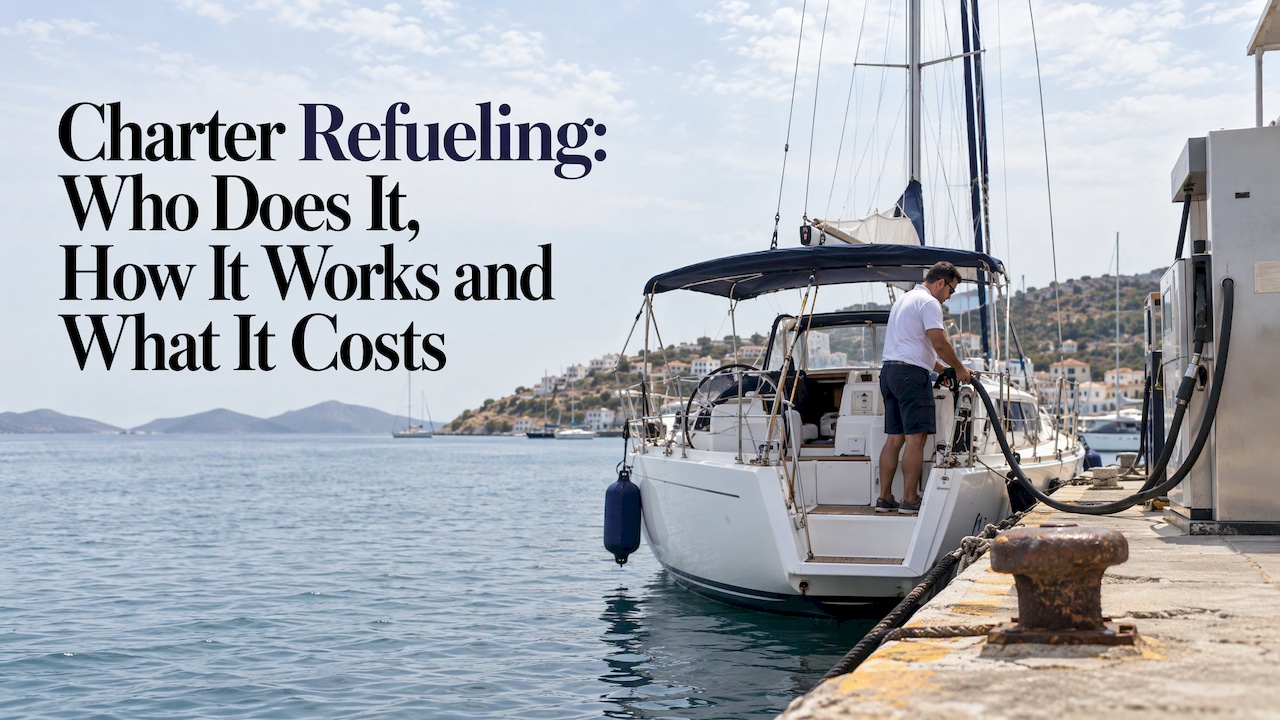
On a sailing charter in Greece, refueling is a small, planned stop that your skipper handles, not a chore that lands on your holiday. The boat takes on diesel at a fuel dock or from a fuel truck, the amount used is measured against the level at handover, and the bill is settled separately from your weekly price. What you control is how much you motor, and that is worth understanding before you book.
This guide walks through the whole thing for groups of friends, families and first-time charterers: who is responsible, when the tank gets filled, how fuel is billed, what the Greek fuel scene looks like, and the safety habits that apply at the pump.
TL;DR
- Fuel is usually a running cost on top of the charter fee, so budget for it separately and ask how it will be settled before you pay.
- On a skippered or guided holiday the skipper decides when and where to refuel. Guests don’t drive the boat to the pump.
- Fuel use is compared between handover and the end of the week, so the main way to keep the bill down is to sail more and motor less.
- In Greece, diesel comes from marina and port pumps and, in many ports, from fuel trucks arranged through the port authority. Some islands, such as Mykonos, require telephone approval first.
- Stay off the boat, or at least clear of the fuel point, during refueling, and keep phones and cigarettes away from it. Your skipper will tell you what to do.
Cuprins
- Is fuel included in the charter price?
- Who actually refuels the boat?
- When does the boat get refueled?
- How fuel use is measured and charged
- Fuel in Greece: how it actually works
- Safety at the fuel dock
- How to keep the fuel bill low
- Our point of view
- Where to go next
- Întrebări frecvente
- Surse
Is fuel included in the charter price?
As a rule of thumb on Mediterranean charters, the weekly price covers the boat, and diesel is accounted for separately according to what the boat actually burns. The reason is simple: two groups on the same catamaran can use very different amounts of fuel. One has a week of steady meltemi wind and sails almost everywhere. The other hits calm days and motors between islands.
Because the rule varies by boat and by booking, treat “is fuel included?” as a question for every quote, whoever you book with. Our Greece private week starts from €560 per person per week, and we recommend reading our short guide to the three fuel numbers to ask about before booking a Mediterranean charter so you can compare quotes on equal terms.
Three things are worth pinning down in any quote:
- Whether fuel is in the price or billed afterward. If it is billed, you want to know the basis of the bill.
- How consumption is measured. Usually this is the tank level or a log kept at handover and at the end.
- Whether a generator, air conditioning or water maker adds to the diesel bill. On a catamaran, these systems matter, which is why the engine alone is not the full picture.
Who actually refuels the boat?
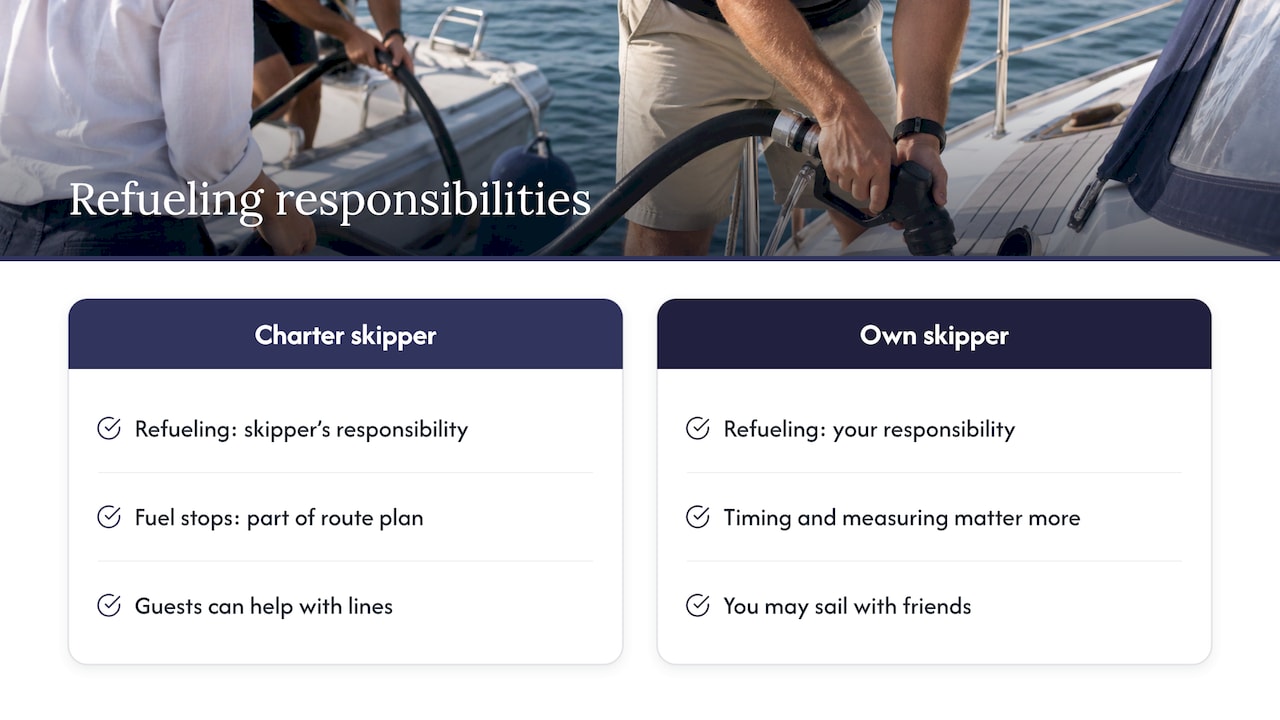
On a charter with a skipper, the skipper. They know the boat’s tank sizes, the fuel gauge quirks, which docks suit a catamaran’s width and which ones are best avoided on a windy afternoon. Guests are welcome to watch and help with lines, but nobody expects you to know how to approach a fuel quay in a crosswind.
That is one of the quiet advantages of a curated holiday. All of our routes are led by experienced, professionally trained skippers from CAPETAN.club, so questions like “where do we fuel up and when?” are part of the route plan, not something your group has to research on a Saturday morning.
If you are a skipper yourself, joining a flotilla or chartering a boat your friends will sail, the responsibility is yours, and the sections below on timing and measuring matter even more.
When does the boat get refueled?
There are three natural moments, and a good skipper plans around them.
Mid-week, when the tank runs lower
Diesel tanks on charter boats are sized for a week of mixed sailing and motoring, but a calm stretch can change that. Skippers tend to top up when they pass a convenient fuel dock, not when the gauge is nearly empty. Running low somewhere remote is the situation everyone wants to avoid, particularly in a country with thousands of islands and uneven fuel access.
Before a long or exposed crossing
If the next day includes a longer hop or a windward leg where the engines will carry more of the load, a stop at a fuel quay the evening before makes sense. It also fits the rhythm of a sailing week: you arrive, the skipper fuels up, you walk into town for dinner.
At the end of the week
The last day typically includes a refuel or a final fuel reading so that the week’s consumption can be settled. This is also the day to confirm what you owe, rather than discovering it as you head to the airport. The boat’s return time is tight on a Saturday-to-Saturday schedule, so fuel stops are planned so they do not eat into your last morning.
If you are curious how Saturday handovers shape the week, our page on curated Saturday charters in Greece explains the rhythm.
How fuel use is measured and charged
The cleanest systems are boring ones. The tank level or engine and generator hours are noted at check-in. At the end of the week the boat is refueled or read again, and the difference is what the week used. That is why a careful handover matters: if the starting level is vague, the end figure is arguable.
During check-in you will typically see the skipper and the base go through the boat, its equipment and its paperwork. Our guide to getting through Greek yacht check-in in 90 minutes covers the steps, and the fuel reading belongs in that routine alongside the equipment list.
A few practical habits help everyone:
- Take a photo of the fuel gauge at handover and again at the end, with the date visible.
- Keep the receipts from each fuel stop. Receipts show litres and the price per litre, so any difference between what was bought and what was billed can be explained.
- Ask for the settlement in writing, with litres and price per litre listed, not a single lump sum.
What does a week of fuel really come to?
That depends on the boat, the wind and how much your group wants to stop in different places. For a realistic picture of how much a catamaran week can burn, see our article on catamaran fuel consumption over a week of sailing. The short version is that the engines are not the only consumer, and sailing whenever the wind allows is the biggest saving you can make.
Fuel in Greece: how it actually works
Greece is not one big marina chain. Fuel reaches boats in a few different ways, and knowing the pattern helps you understand what your skipper is doing.
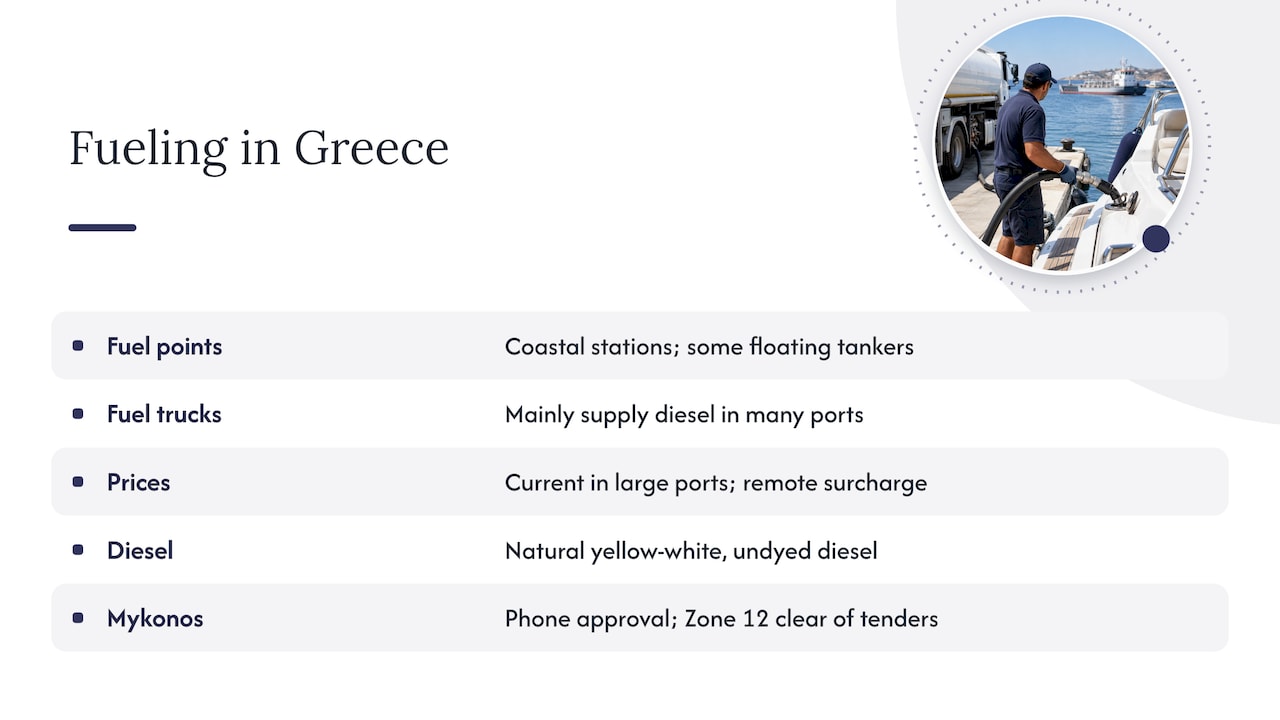
Fuel quays and pumps. Larger marinas and ports have fuel points where boats come alongside. Most oil companies have built a coastal network of fuel stations on the islands and the mainland coast, according to the Hellenic Professional Yacht Owners’ guide to marinas and anchorages, and some have even built small tankers that act as floating fuel installations for yachts.
Fuel trucks. The same source notes that in many Greek ports diesel is supplied to yachts mainly by fuel trucks arranged under the care of the regional port authorities, with information available on VHF channel 12. That is why your skipper may phone ahead or call on the radio instead of just pulling up to a pump.
Price differences. According to the same guide, in larger ports fuel is charged at current prices, while in more remote areas a small surcharge covers the extra transport. In practice, that is a reason to fuel in a bigger port when the route allows it, and one more reason to leave the timing to a skipper who knows the route.
Fuel type. All vessels must use diesel with the natural yellow-white color of oil, meaning it is not dyed, per the same Greek yacht owners’ guide. It is a detail that matters for the skipper, not for guests, but it explains why the fuel point will always ask what the boat needs.
Island-specific rules. Some places add a local step. In Mykonos, telephone approval is required before refueling, and in the Old Port (Zone 12) refueling is only allowed when it does not obstruct the cruise ship tenders, according to the Mykonos municipal port fund. If your route includes Mykonos, expect your skipper to plan fuel around those rules, probably by fueling elsewhere before or after.
Water is the other thing to top up
The same guide advises skippers to keep adequate water reserves on board because some islands face water shortages in summer. Fuel and water stops are often combined, so a stop at a quay may cover both.
Safety at the fuel dock
Refueling is a routine job, but diesel and a boat full of people deserve a few clear habits. Your skipper will give the briefing, and the points below are the usual common-sense rules.
- Guests step off or stay clear of the fueling point while the nozzle is in. Children stay on a seat or on the quay with an adult, not near the filler.
- No smoking, no open flames, no vaping anywhere near the fuel point. This includes the barbecue on the stern.
- Engines and generator off, and hatches near the filler closed, while fuel goes in.
- Phones stay in pockets. Taking photos of the pump is fine from a distance; leaning over the filler is not.
- Wipe up spills at once and tell the skipper, who can use the right absorbent. Nothing should be rinsed into the harbor.
- Take the skipper’s lead on lines and fenders. Fuel quays can be tight, and a catamaran’s beam makes the approach more delicate than it looks.
If you are the skipper on a self-led charter, follow the boat’s own handover instructions for the filler cap, the vent and the tank gauge, and ask the base if anything differs from what you know.
How to keep the fuel bill low
Most of the fuel you burn is a decision, not an accident. A few ways to shape the week:
- Plan legs around the wind. A route with a bit of flexibility lets you sail on the good days and rest in a bay on the calm ones.
- Don’t motor to hit a timetable you don’t have. A sailing week is not a ferry schedule. A late lunch swim stop is often the best part of the day.
- Be generator-aware. Air conditioning, hot water and cooking equipment can run on the generator, so shorter, smarter use cuts diesel too. Ask the skipper which systems are worth using at anchor.
- Choose shorter hops. Island chains in the Cyclades or the Ionian are made for this. Our Idei pentru o excursie cu barca în insulele mediteraneene show routes that keep legs manageable.
- Pick the right boat for your priorities. If low fuel use matters to your group, the difference between a sailing catamaran and a motor yacht is large; see how they compare on anchoring and handling.
Our point of view
Fuel is one of those topics nobody wants to think about on holiday, and that is exactly why it should be clear from the start. We built our holidays around routes curated by experienced skippers, so the practical questions, such as where to fuel, when to stop and how to avoid a rushed last day, are part of the plan instead of a surprise.
We also believe the best way to pay less for fuel is to sail more. A group that has a skipper who reads the wind, knows the quays and keeps an eye on the generator will almost always have a calmer week than a group figuring it out alone. That is the kind of practical support you get from actual sailors at every step.
If you like the idea of a week where the logistics are handled and the sea is the main event, a private week with your own group or a seat on a group route are both made for it.
Go Sailing
Where to go next
If you are ready to compare real options, our private weeks give your group the whole boat and a skipper-led route. The Greece private week starts from €560 per person per week, Croatia also from €560, Turkey from €530 and Italy from €870. You can see the Greek option on the Greece Go Private page, or browse our vacanțe de navigatie de grup if you’d rather join a crew and share the boat with new friends.
Not sure whether private or group suits you? Our page on choosing between private and group sailing lays it out.
Întrebări frecvente
Do we have to return the boat with a full tank?
It depends on the booking terms, which is why it is worth asking before you pay. Some arrangements ask for a full tank at the end, others measure what the week used and settle it afterward. Either way, your skipper plans the final fuel stop so it fits the return time.
Can guests help refuel the boat?
Guests are welcome to help with lines and fenders if the skipper asks, but the fueling itself is for the skipper. Keep children and phones clear of the filler, and stay away from any smoking or flames near the fuel point.
What happens if we run low on fuel mid-week?
It should not come to that on a planned route, because skippers refuel when a convenient quay or truck is available. In Greece, diesel is available at many ports, either at a pump or by truck arranged through the port authority, and VHF channel 12 is the channel to ask on, as noted in the yacht owners’ guide.
Does the generator use fuel too?
Yes. On a catamaran, the generator runs from the same diesel supply as the engines, so long periods of air conditioning or other power-hungry use at anchor add to the total. Your skipper can tell you which systems are worth running and for how long.