
Calculate that percentage on the base charter fee only, never on the APA, VAT, or any extras billed separately. The captain collects the tip at the end of the charter and divides it among the crew.
TL;DR:
- Tipping typically ranges from 5% to 15% of the base charter fee, with 10% being the industry standard for most Mediterranean charters.
- In the United States and the Caribbean, gratuities often go as high as 15% to 20%, reflecting broader local tipping customs.
- Tips are collected by the captain and distributed through a pool system based on role, rank, and service length, not split evenly among crew members.
- Do not include payments for extras like VAT, fuel surcharges, or the APA when calculating the tip, which only applies to the initial charter fee.
- When leaving gratuity, most guests give it on the final evening either in cash or via broker escrow, timing and method should be agreed upon beforehand.
Table of Contents
- How Much to Tip a Yacht Crew: Percentages and Real Numbers
- Who Actually Receives the Tip on a Yacht Charter?
- Do You Tip on the Base Fee or the Full Bill?
- When and How Should You Hand Over the Gratuity?
- Adjusting Your Tip for Service, Yacht Size, and Charter Length
- Sailarmada’s Practical Checklist for Handing Over the Gratuity
- Why Getting the Tip Right Matters More Than People Realize
- Book a Charter Where Gratuity Never Has to Be a Guessing Game
- Sources
- FAQ
How Much to Tip a Yacht Crew: Percentages and Real Numbers
That 5% to 15% window comes from MYBA, the trade association whose guidelines shape almost every broker contract in the charter world. Ten percent has become the default because it rewards good service generously without feeling like a blank check, and most Mediterranean crews expect to land somewhere close to it.
Where you sail shifts that number more than you might think. Mediterranean charters typically settle around 10% to 12% for solid, professional service, while charters in the United States and the Caribbean tend to run hotter, often 15% to 20%, a pattern tied to broader American tipping culture and a service model built around it. If you’re chartering in Greece and comparing notes with friends who sailed the British Virgin Islands, don’t assume their number applies to you. It doesn’t.
Numbers make this easier to picture:
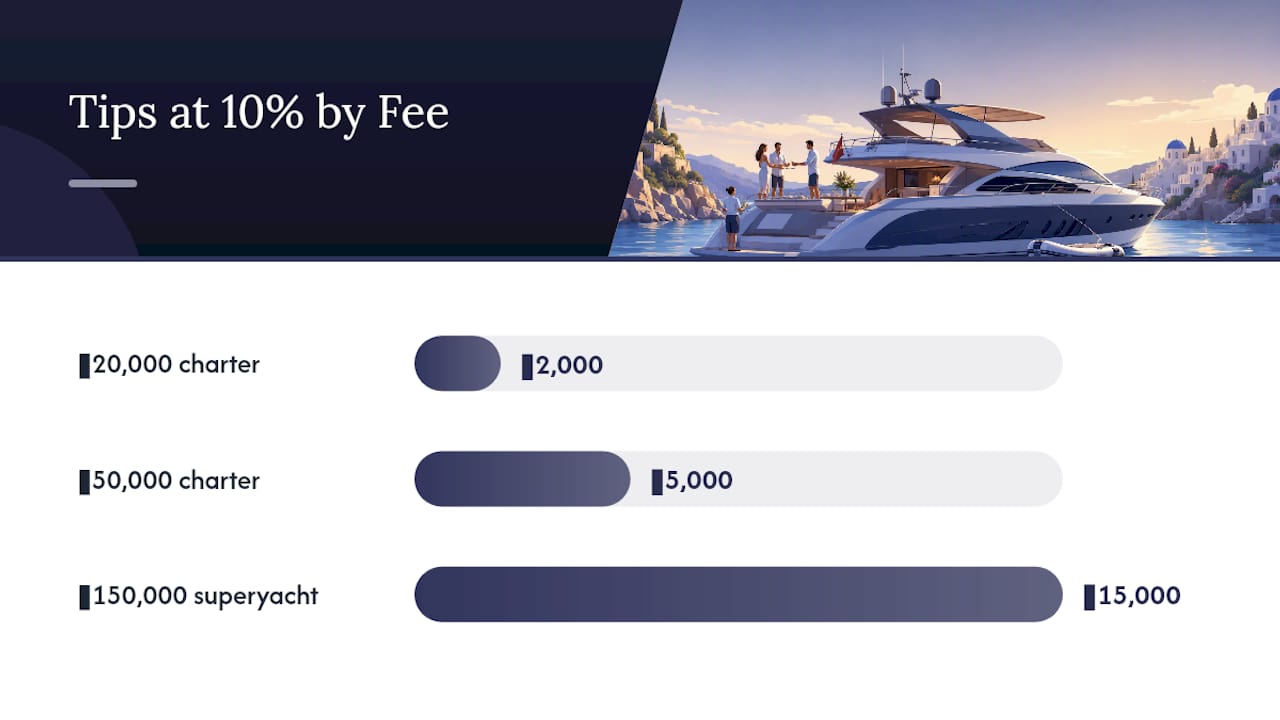
- A €20,000 week-long base charter fee at 10% comes to €2,000 for the crew.
- A €50,000 charter at 10% comes to €5,000, still a meaningful sum but proportionally lighter per crew member as boat size and headcount grow.
- A €150,000 superyacht charter at 10% comes to €15,000, which is why many charterers on the largest yachts trim toward 5% to 8% rather than 10% to 15%. The absolute dollar amount does the heavy lifting even at a lower percentage.
Pro Tip: If you’re staring at a six-figure charter fee and the standard percentage feels absurd, remember the crew size scales too. A 40-meter yacht carries far more hands than a 15-meter sailing catamaran, so the tip pool is being split more ways even as the total grows.
Day charters follow a looser rule of thumb: 10% to 15% of the day rate, or a flat amount if the day rate is modest. A four-hour afternoon sail with a skipper and one crew member doesn’t need the same ceremony as a week-long handover, but it still deserves something in hand before you leave the dock.
Who Actually Receives the Tip on a Yacht Charter?
The captain collects the full gratuity and distributes it, almost always through a tip pool weighted by role, rank, and tenure rather than split evenly by headcount. That system exists for a good reason: the guests interacting with the captain and the stews all week rarely see the engineer keeping the generators running or the chef who has been up since 6 a.m. prepping breakfast.
A few practical points worth knowing before you hand over the envelope:
- Behind-the-scenes crew (engineer, chief stew, chef) typically earn a full share even though guests barely see them.
- On larger yachts, the captain may use a points or shares system that adjusts payouts by rank and years of service rather than dividing the total equally.
- A small personal extra for one standout crew member is fine, but hand it over privately, after the main gratuity has already gone through the pool, so it doesn’t undercut how the group tip gets shared.
- If any crew member hints or asks directly about the tip during the charter, that’s a red flag. Flag it to your broker rather than handling it on the water.
The pooled model protects morale. It also means your gratuity is never really a tip to one person; it’s compensation flowing to an entire team that spent the week making your holiday run smoothly.
Do You Tip on the Base Fee or the Full Bill?
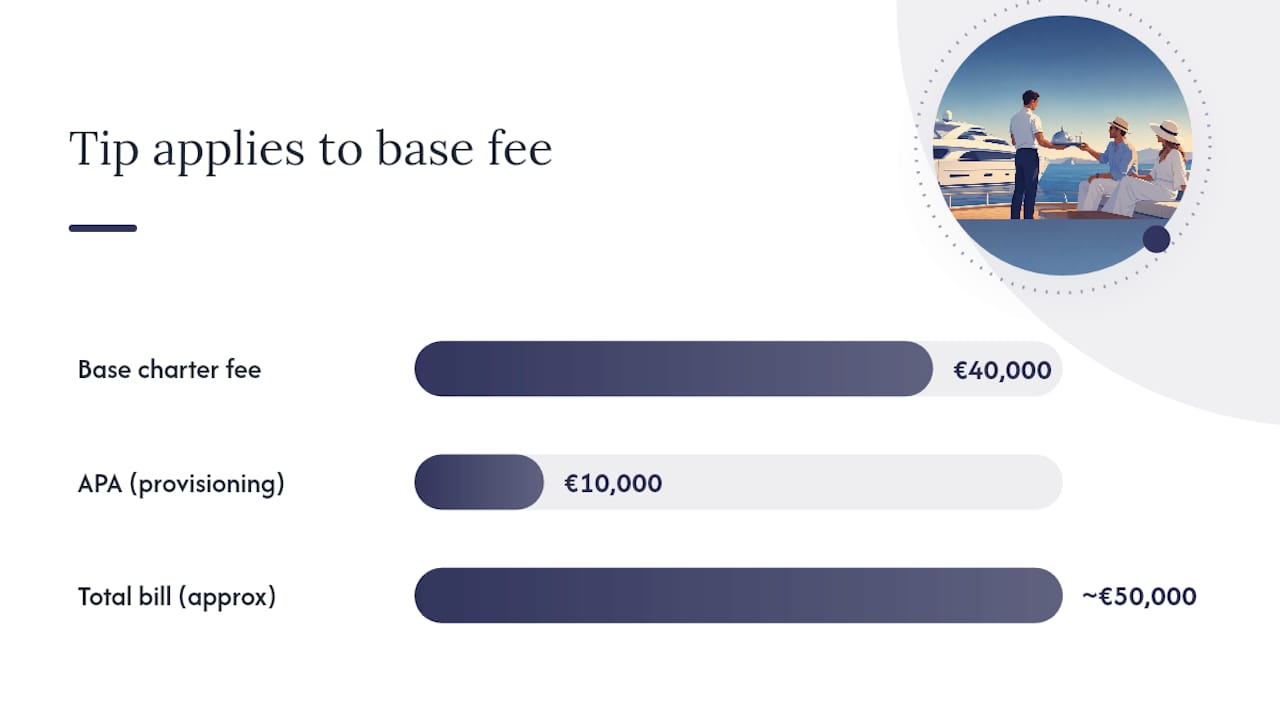
Tip on the base charter fee only. Not the Advance Provisioning Allowance (APA), not VAT, and not fuel surcharges, marina fees, or other extras that show up on the final settlement.
The base charter fee is the price you agreed to for chartering the yacht and crew for the week. It’s your money being spent on your behalf, not the crew’s earnings, so it has no place in the gratuity calculation.
Here’s why the distinction matters in practice:
- A €40,000 base fee with a €10,000 APA might produce a total bill near €50,000. Ten percent of the base fee is €4,000. Ten percent of the full bill would be €5,000, a €1,000 overpayment based on money that was never the crew’s to begin with.
- If your broker tells you gratuity is “included” in an all-inclusive package, get the exact figure and mechanism in writing before you sail. Included doesn’t always mean generous, and you don’t want to double-tip or under-tip because the wording was vague.
- When comparing quotes across yachts, always ask for the base charter fee broken out separately so your tipping math stays clean regardless of how the rest of the invoice is structured.
If you’re weighing an all-inclusive charter against a traditional base-fee-plus-APA structure, this is exactly the kind of detail to confirm before booking, not on the last night.
When and How Should You Hand Over the Gratuity?
Most charterers hand over the tip on the final evening, after the last dinner but before the goodbyes get rushed the next morning. Some prefer the final morning instead, right before disembarking, which avoids the awkwardness of tipping and then spending one more evening aboard. Either works. Pick whichever timing fits your itinerary and stick with it.
Payment methods vary by yacht size and charter value:
- Cash to the captain remains the most common method for standard week-long charters, especially in euros if you’re sailing in Greek or wider Mediterranean waters.
- Broker-held escrow is increasingly common on higher-value charters, letting you transfer the gratuity to the broker ahead of time for distribution after the trip, which spares you from carrying large cash sums onboard.
- Wire transfers suit very large gratuities where carrying cash isn’t practical or legal to move across borders.
Confirm your method with the broker before boarding, not on day one of the charter. Some yachts have specific preferences, and surprises rarely help anyone relax.
Pro Tip: If you’re tipping in cash and crossing EU borders with it, know that cash declaration thresholds sit around €10,000. For anything approaching that figure, wire transfer or broker escrow is the cleaner, legally simpler route.
A sealed envelope with the captain’s name on it, handed over with a short, sincere word of thanks, is all the ceremony this needs. You don’t need a speech. A genuine “thank you for taking care of us” lands better than anything scripted.
Adjusting Your Tip for Service, Yacht Size, and Charter Length
Use these as starting points:
- Below-standard service: 5% to 8%. Reserve this for real problems, not minor annoyances like a rainy afternoon.
- Standard, professional service: around 10%. This covers the vast majority of Mediterranean charters where the crew did their job well and the trip went as planned.
- Exceptional service: 15% or higher. Save this for crews who handled a real crisis smoothly, adapted an itinerary on the fly for your group, or delivered genuinely personalized touches you weren’t expecting, according to industry guidance on when a higher gratuity is warranted.
Yacht size and crew count shift how the percentage feels in practice. A smaller boat with two or three crew makes even a modest percentage go a long way per person; a large yacht with a dozen crew members spreads the same percentage much thinner, which is why absolute euro amounts sometimes matter more than the percentage itself on bigger boats.
If service genuinely disappointed you, the right move isn’t to tip zero and say nothing. Reduce the gratuity to reflect it, and separately raise the specific issue with your broker so it’s on record and can be addressed for future charters.
Sailarmada’s Practical Checklist for Handing Over the Gratuity
After years of coordinating charters and fielding this exact question from first-time guests, here’s the sequence that removes the guesswork:
- Decide your percentage before you board. Base it on your budget, the region, and the service level you expect, then set aside cash or confirm a wire/escrow arrangement with your broker in advance.
- Prepare one labeled envelope for the captain. If one or two crew members clearly went above and beyond, prepare small separate envelopes, but hand those over privately after the main gratuity.
- Confirm the broker’s process ahead of time. Ask directly how and when the gratuity gets distributed if you’re using escrow or wire transfer, so there’s no confusion on the last day.
- Handle service issues through the broker, not through a smaller tip alone. A reduced gratuity sends a signal, but a documented conversation with your broker is what actually improves things next time.
Pro Tip: Ask your broker this one question before you ever step aboard: “How do previous guests on this yacht typically handle the crew gratuity?” It tells you the yacht’s normal pattern and saves you from guessing on the dock.
Understanding who’s actually on your crew and what each role involves makes this whole process feel less like a transaction and more like what it actually is: a thank-you to people who worked hard for your holiday.
Why Getting the Tip Right Matters More Than People Realize
Crew gratuities aren’t a formality tacked onto the invoice. For many crew members, the tip pool makes up a real, sometimes substantial, share of their seasonal income, and it directly reflects how much a guest actually valued their work. A generous, well-timed tip tells a hardworking crew that the long days chasing the perfect anchorage, or the extra effort to reroute around bad weather, were noticed.
Gratuity stays discretionary. Nobody can demand it, and a fair-minded reduction after genuinely poor service is entirely reasonable.
— Sail
Book a Charter Where Gratuity Never Has to Be a Guessing Game
Some yacht charter providers aim to offer transparent pricing in their itineraries, helping clients know the base charter fee upfront to calculate gratuity without untangling APA, VAT, or hidden extras on the last night.
Many charters include skipper support and broker guidance, so clients can ask how gratuity is typically handled on their specific boat before setting sail, providing clarity beyond what is found in forum posts and old broker emails. If you’re planning a Greek sailing week, check pricing and availability on the Greece – Go Private page, where the base fee is listed clearly from the start. Traveling as a larger group? The group sailing holidays page walks through pooled logistics, including how gratuities typically get split when several cabins or families are sharing one boat. It is advisable to reach out before booking to ask how tipping works on your chosen route, which can help remove any awkwardness before departure.
Sources
- How to Tip Yacht Crew: The 2026 Guide for Charterers | VitalCharters
- Yacht Crew Gratuity by Region: How Much to Tip in 2026 | YachtsForKings
FAQ
How much do you tip for a yacht charter?
Between 5% and 15% of the base charter fee, with 10% as the comfortable standard for a week-long Mediterranean charter with good service.
How much should I tip a charter boat captain?
The captain receives the full gratuity and distributes it across the crew through a tip pool, so you tip the same 5% to 15% of the base fee rather than a separate amount just for the captain.
How much to tip for a 4-hour charter?
For short day charters, 10% to 15% of the day rate is typical, or a flat amount that reflects the length and quality of the trip if the day rate is modest.
What is the 10 rule for yachts?
There’s no single official “10 rule,” but 10% of the base charter fee has become the widely used baseline gratuity for standard, professional service on a week-long charter, per MYBA-aligned industry guidance.
Do I tip on the APA or the total charter bill?
No. Tip only on the base charter fee, not on the APA, VAT, or any extras, since the APA covers expenses spent on your behalf rather than crew compensation.