Choose a motor yacht when nonstop speed, long-range hops, and vertical-luxury amenities top your list. Choose a catamaran when social deck space, shallow-water anchoring, and steady, level motion matter more to your group. Both make wonderful charter boats, but they reward different priorities, and the rest of this guide walks through exactly where each one wins.
Pe scurt:
- Catamarans offer more social space, shallow draft, and easier swim access, making them ideal for island-hopping and family groups.
- Motor yachts provide higher speed, greater range, and vertical luxury amenities, suited for longer daily hops and formal service.
- Handling and safety considerations differ, with catamarans featuring twin engines for maneuverability and stability, but rely more on prevention against capsizing.
- Fuel costs are generally lower for sail-assisted catamarans, which can reduce environmental impact compared to faster, engine-dependent motor yachts.
- The choice depends on guest mobility, trip style, and priorities, with catamarans preferred for relaxed, social groupings and motor yachts for speed and extended cruising.
Cuprins
- Motor Yacht or Catamaran: Comparing the Core Differences
- Who Should Book a Motor Yacht, and Who Should Book a Catamaran?
- What Charter Costs and Logistics Should You Budget For?
- How Do Safety and Motion Tradeoffs Compare?
- How Should You Choose: A Checklist and Questions for Your Operator
- How Do Crewing and Handling Differ Between the Two?
- How Do Maintenance Requirements and Costs Compare?
- What Do Resale Value and Depreciation Look Like?
- How Do Fuel Efficiency and Environmental Impact Compare?
- When Do We Recommend a Catamaran or a Motor Yacht?
- How Can We Help You Book the Right Charter?
- FAQ
- Surse
Motor Yacht or Catamaran: Comparing the Core Differences
Every charter decision comes down to how you want your days to feel on the water. Here’s how the two boat types stack up across the factors that actually shape your trip.
Space and layout favor catamarans almost every time. Because they float on two hulls, catamarans put the salon at deck level and spread living space across a wide bridge deck, which means more room to lounge, eat, and socialize without climbing stairs. Motor yachts stack their living space vertically instead, often across two or three decks, giving you a sundeck, a flybridge, and separate formal and casual zones, but less single-level flow. For families or groups who want everyone in one open space, the space and layout advantages of catamarans tend to settle the question quickly.
Motion and comfort split the two boats in an important way. Catamarans resist heeling almost entirely, so you won’t lean into your drink at the dinner table, but their twin-hull design produces a quicker, more linear pitch-and-roll that some guests find triggers seasickness just as easily as a monohull’s slower roll, according to The Boat Galley’s cruising comparison. Motor yachts pitch and roll too, but stabilizers on larger models smooth that motion considerably. If anyone in your group gets queasy, don’t assume “no heeling” means “no seasickness.”
Speed and range generally favor motor yachts for raw point-to-point performance, since their engines push higher cruising speeds regardless of wind. Catamarans can move efficiently under sail and often hold competitive speeds off the wind, but their range depends more on weather cooperation.
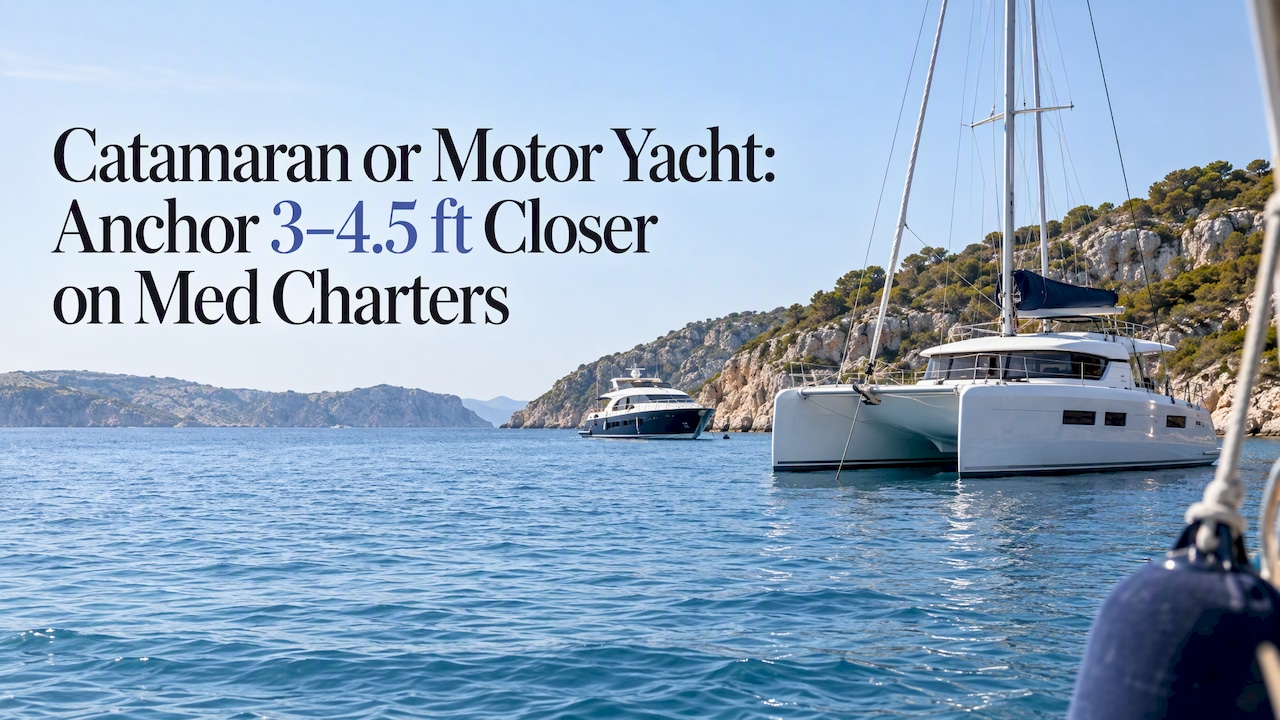
Draft and anchoring tip firmly toward catamarans. A typical 40 to 50 foot cruising catamaran draws roughly 3 to 4.5 feet, according to Catamaran Guru’s monohull comparison, letting you tuck into shallow bays and anchor closer to beaches than most motor yachts can manage. That shallow draft is a major reason groups pick catamarans for island-hopping itineraries.
Maneuvering and redundancy also favor catamarans in close quarters. Twin engines set wide apart give precise low-speed steering and a built-in backup if one engine fails, while motor yachts often run a single larger engine or shaft configuration that handles differently at the dock.
Marina and haulout logistics flip the advantage back to motor yachts. A catamaran’s wide beam limits which marinas can berth it and which shipyards have a travel lift big enough to haul it, often pushing up berthing fees and narrowing service options, per Catamaran Guru.
Running costs and charter pricing differ for structural reasons, not just luxury branding:
- Catamarans often carry a different price bracket than similarly sized motor yachts because of their built-in living volume and strong market demand.
- Motor yachts typically carry higher fuel costs per mile at cruising speed, since displacement and engine size scale up fast.
- Crewed motor yachts frequently add formal service staff, which raises the weekly rate beyond the boat itself.
The takeaway: if shallow anchorages, social space, and steady decks matter most, a catamaran wins. If speed, range, and vertical luxury amenities matter most, a motor yacht wins.
Who Should Book a Motor Yacht, and Who Should Book a Catamaran?
Matching the boat to your group matters more than matching it to a brochure photo. Here’s how to think about it.
- Choose a motor yacht if you want long daily hops, formal crew service, and vertical luxury. Guests who want a private chef, a dedicated cabin crew, and the ability to cover more coastline in a single afternoon tend to gravitate toward motor yachts.
- Choose a catamaran if you’re traveling with a mixed group, families, or anyone who values social space and easy swim access. The low freeboard and swim platforms make getting in and out of the water simple for kids and less mobile guests, and the group-friendly design keeps everyone together rather than scattered across decks.
- Consider passenger mix carefully before booking either. Elderly guests or anyone with mobility concerns often do better on a catamaran’s flatter, single-level layout than navigating a motor yacht’s stairs between decks.
A family of eight splitting into two cabins and spending most days anchored off quiet beaches fits a catamaran yacht itinerary naturally. A couple celebrating an anniversary who wants to cover three coastal towns in a week with a chef on board leans toward a motor yacht. A friend group that wants to swim, paddleboard, and gather for long dinners every night almost always ends up happiest on a catamaran.
What Charter Costs and Logistics Should You Budget For?
Your boat choice shapes your budget long before you step aboard. Weekly charter rates vary by crewing level: bareboat charters (you skipper) cost the least, skippered charters add a professional at the helm, and fully crewed charters add hospitality staff and push the price highest.
Fuel consumption scales with speed and daily mileage. A motor yacht covering long distances at higher cruising speeds burns noticeably more fuel per day than a catamaran, which can rely on sail power to cut engine hours and trim the fuel bill. Catamarans often sit in a different price bracket than similarly sized motor yachts, a gap driven by their built-in living space and steady charter demand rather than by luxury finishes alone, a pattern noted by Yatr’s charter guide.
Marina and haulout logistics also affect your total cost. A catamaran’s wide beam can trigger berth surcharges in marinas that charge by width, and fewer yards can haul a beamy cat for routine maintenance, which can mean longer waits or higher yard fees.
Before you book, bring this checklist to your broker or charter operator:
- Ask whether the quoted rate is bareboat, skippered, or fully crewed.
- Confirm whether fuel is included or billed separately by consumption.
- Ask about marina berth availability for the boat’s specific beam.
- Check whether local taxes or VAT are included in the headline price.
- Request a breakdown of common extras like provisioning, water toys, and transfers.
For a region-specific view of what weekly rates actually look like, our Greece catamaran cost breakdown walks through real budget ranges.
How Do Safety and Motion Tradeoffs Compare?
The biggest safety distinction between the two boat types is philosophical. A catamaran will not self-right if it capsizes, so safety on a cat is entirely prevention-focused: careful sail management, reefing early, and avoiding extreme conditions rather than relying on a righting moment after the fact, as Catamaran Guru points out. Motor yachts don’t carry that same capsize concern, since they aren’t sailing vessels managing wind load the same way.
Motion sickness deserves a second look too. Many people assume a catamaran’s lack of heeling makes it immune to seasickness, but its quicker pitch-and-roll motion can still affect sensitive stomachs just as much as a monohull’s slower roll, according to The Boat Galley. If anyone in your group has a history of motion sickness, it’s worth testing their tolerance on a short day sail before committing to a week aboard.
Twin engines on most catamarans also mean built-in redundancy: if one engine fails, the other gets you home. Motor yachts with single-engine setups don’t have that same backup, which is worth asking about during booking.
Sfat profesional: Set up a bridle on your anchor line overnight to reduce the bridge-deck slapping noise that keeps light sleepers awake on catamarans in choppy anchorages.
How Should You Choose: A Checklist and Questions for Your Operator
Before you commit to either boat type, run through a short prioritization exercise, then come armed with the right questions.
- Rank trip length, guest mix, mobility needs, itinerary style, and budget in order of importance.
- Decide whether speed between stops or anchoring flexibility matters more for your route.
- Match your answers against the dimensions above: social space and shallow draft point to a catamaran, while range and vertical luxury point to a motor yacht.
When you talk to a broker or charter operator, ask these directly:
- What’s the fuel policy: full-to-full, or billed by consumption?
- What’s the boat’s beam, and will it fit comfortably in the marinas on this route?
- How many engine hours does the boat have, and is there a maintenance log?
- What safety equipment and crew credentials come with this charter?
- What are the cancellation and refund terms?
Watch for red flags: no engine-hour log, a vague or evasive fuel policy, or an operator who can’t name specific haulout options for the boat’s size. During a walkthrough, spend your first 20 minutes checking engine compartments, safety gear storage, cabin ventilation, and the condition of running rigging or docking lines. For deeper spec-level guidance, our 2026 catamaran buyer’s guide covers what to inspect in detail.
How Do Crewing and Handling Differ Between the Two?
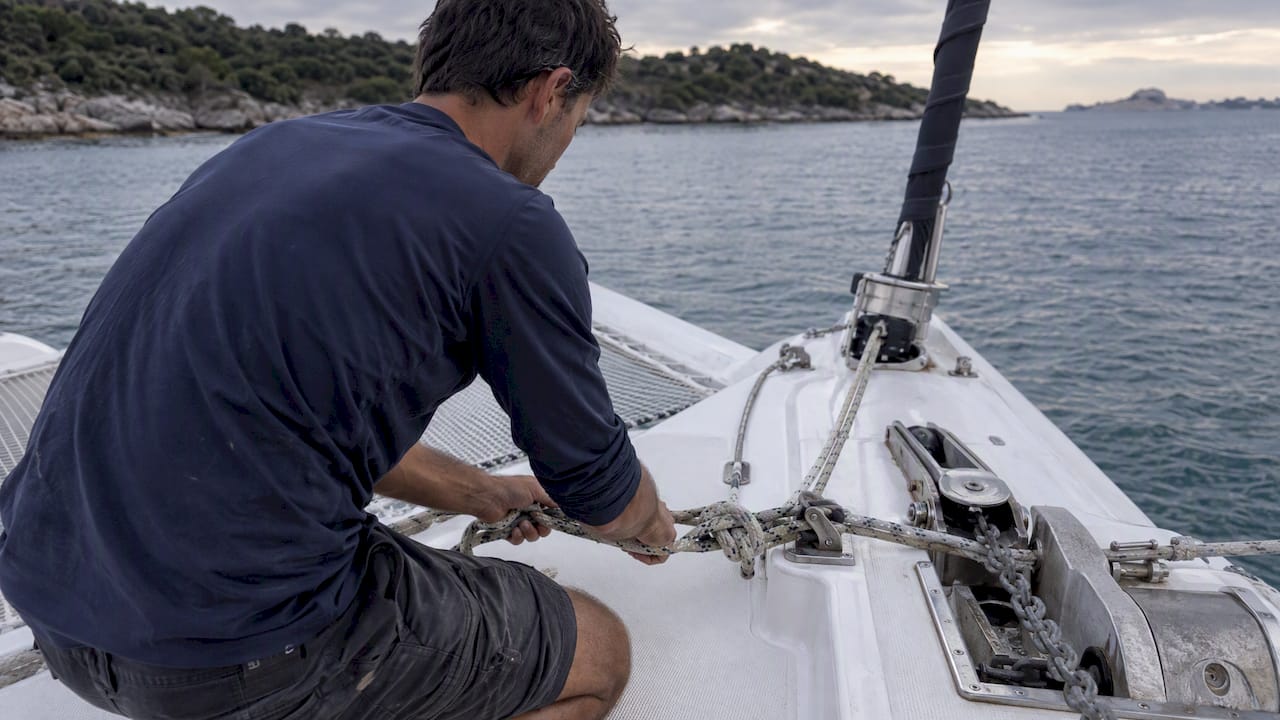
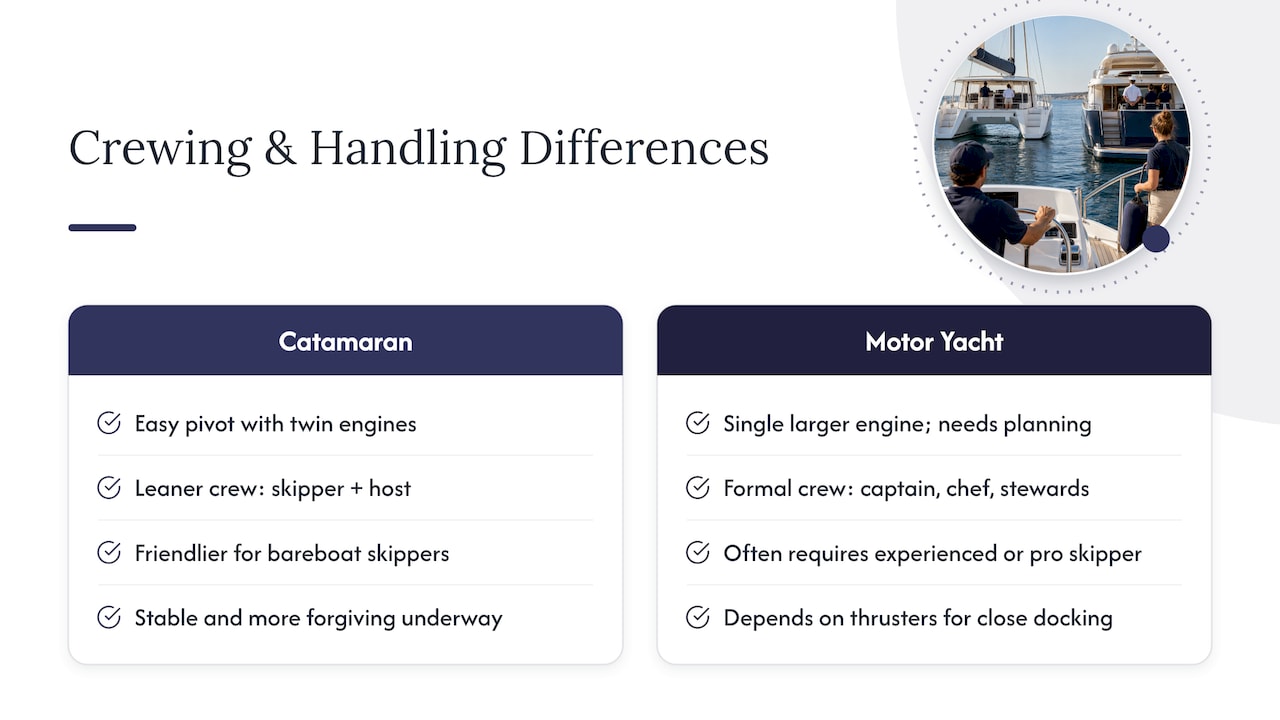
Handling a catamaran at the dock tends to feel more forgiving, since twin engines let a skipper pivot the boat almost in place, nudging one throttle forward and the other in reverse. Motor yachts, often running a single larger engine or shaft, require more planning for close-quarters docking and depend more heavily on thruster assistance where fitted.
Crewed charters also differ in how staff integrate into your day. A motor yacht crew frequently includes a dedicated captain, a chef, and cabin stewards who manage a more formal, service-driven rhythm. A crewed catamaran tends to run leaner, often with a skipper and host who blend more casually into the group’s pace, matching the catamaran’s social, laid-back character.
For bareboat charters, catamaran handling is generally considered more approachable for a less experienced skipper, thanks to that twin-engine maneuverability and the stability underway. Motor yachts, especially larger ones, often call for more experienced hands or a professional skipper regardless of the charter type.
How Do Maintenance Requirements and Costs Compare?
Maintenance costs track closely with complexity and size. Motor yachts typically carry more mechanical systems per square foot of living space: generators, stabilizers, air conditioning, and often more sophisticated electronics, all of which need regular servicing.
Catamarans trade some of that mechanical complexity for structural upkeep tied to their two hulls and wide bridge deck. Because a catamaran’s beam limits which yards can haul it, routine haulout and bottom maintenance can mean longer waits and higher yard fees than a narrower motor yacht faces at the same marina, a constraint Catamaran Guru flags as a real planning factor for owners.
Sail-handling gear on a catamaran, including rigging, sails, and winches, adds its own maintenance line that a pure motor yacht never needs, while a motor yacht’s larger engines and generators add theirs.
What Do Resale Value and Depreciation Look Like?
Resale patterns for both boat types depend heavily on condition, engine hours, and how well maintenance records are kept, the same factors that matter during a charter walkthrough. Catamarans have held strong demand in the charter market in recent years, which can support healthier resale interest, since built-in living volume and shallow draft keep appealing to new buyers entering the space.
Motor yachts depreciate along more familiar lines, where brand reputation, engine condition, and the number of systems needing eventual replacement weigh heavily on long-term value. A boat with a clean engine-hour log and documented servicing history will always hold value better than one without, regardless of hull configuration.
If you’re weighing a purchase rather than a charter, treat engine hours and maintenance documentation as seriously as the hull style itself.
How Do Fuel Efficiency and Environmental Impact Compare?
Catamarans can lean on sail power for a meaningful share of their cruising, cutting engine hours and fuel burn on routes with reasonable wind. Motor yachts run on engine power for every mile, and because they’re heavier and often faster, they typically burn more fuel per mile at cruising speed than a catamaran covering the same distance under sail-assisted power.
That difference adds up over a week-long charter. A catamaran that sails for several hours a day instead of motoring the whole way reduces both fuel costs and exhaust output, while a motor yacht’s appeal rests more on covering distance quickly than on minimizing fuel use.
If environmental impact and fuel costs rank high on your list, a catamaran’s sailing capability gives it a real edge, though the actual savings depend on wind conditions along your specific route.
When Do We Recommend a Catamaran or a Motor Yacht?
Across the routes we curate in the Mediterranean, we see the same pattern play out: families and groups who want to swim, gather, and anchor in quiet coves almost always feel more at home on a catamaran, while guests chasing a tighter, faster itinerary with formal service lean toward a motor yacht. Performance-focused sailors who still want comfort fall somewhere in between, and that’s where a conversation with one of our skippers helps.
Every route we run is guided by professionally trained skippers from CAPETAN.club, so you get a real sailor’s read on which boat fits your group, not just a brochure description. We walk you through layout, guest mix, and itinerary pace before you book, so the boat matches the trip you actually want.
- Sail
How Can We Help You Book the Right Charter?
Itineraries are built around how you want to spend your days on the water, whether that means a catamaran suited to a social, beach-hopping group or a route planned for guests who want to cover more coastline. Expert skippers guide each trip, and both private and group sailing options are available to suit your crew.
| Priority | Cea mai potrivită opțiune | What we offer |
|---|---|---|
| Social space, shallow anchorages | Catamaran | Options for group and private itineraries |
| Flexible dates, custom routes | Either | Skipper-led planning options |
| Mediterranean island-hopping | Catamaran | Sailing holidays with varying prices |
Ready to start planning? Check out Grecia - Go Private for current availability and pricing.
FAQ
Are catamarans better than yachts?
Neither is strictly better: catamarans suit groups wanting social space, shallow anchoring, and steady decks, while motor yachts suit guests prioritizing speed, range, and vertical luxury amenities. The right choice depends on your itinerary and guest mix more than on either boat’s overall quality.
What is the 10% rule for yachts?
This phrase typically refers to a budgeting rule of thumb used in yacht ownership, estimating annual maintenance and running costs at roughly 10% of the boat’s purchase price. Definitions vary by source and boat type, so treat it as a rough planning benchmark rather than a fixed figure for any specific charter or purchase.
What are the disadvantages of catamarans?
Catamarans do not self-right if capsized, so safety relies on prevention rather than recovery, and their wide beam can limit marina berthing options and raise haulout costs. Their quicker pitch-and-roll motion can also trigger seasickness in some guests despite the lack of heeling, according to The Boat Galley.
Can a catamaran be considered a yacht?
Yes, a catamaran is a type of yacht when it’s a recreational vessel used for cruising or chartering, regardless of hull configuration. The term “yacht” describes the vessel’s purpose and size rather than whether it has one hull or two.
How do power catamarans compare to sailing catamarans?
Power catamarans run on engines without sail capability, trading fuel efficiency for guaranteed speed regardless of wind conditions. Sailing catamarans can cut engine hours and fuel costs by sailing part of the route, though their pace depends more on weather.
Surse
- Catamaran vs. Monohull: A Real-World Comparison for Cruisers – The Boat Galley
- Catamaran vs. Monohull: We Changed, Should You? | The Catamaran Gurus