
Expect to pay somewhere between €650 and €1,300 per person per week for a shared Mediterranean sailing holiday, all-in, though a private crewed charter can push well past that. The three biggest levers are boat type (monohull, catamaran or crewed), when and where you sail, and how many people split the fixed costs. Ranges and worked examples below turn that headline number into a real budget you can plan around.
TL;DR:
- A shared week-long Mediterranean sailing holiday costs between €650 and €1,300 per person, depending on boat type, season, and destination.
- Additional expenses such as fuel, marina fees, provisioning, and security deposits can increase the total cost by 40% to 60%.
- Booking outside peak season and choosing destinations like Turkey or Montenegro can reduce base prices by up to 35%.
- Private charters, especially for larger groups, offer better per-person value despite higher upfront costs than shared options.
- Accurately budgeting requires considering all variable costs, securing clear agreements on APA, fuel, and marina fees, and including a contingency of 15–20%.
Table of Contents
- How Much Is a Sailing Holiday? Quick Cost Benchmarks
- What a Base Price Usually Covers, and What You Must Add
- Line-by-Line Cost Breakdown: How Every Charge Adds Up
- How to Build a Realistic Budget and Manage Risk
- Practical Money-Saving Strategies and Booking Tips
- Booking Checklist: What to Ask, Document, and Confirm Before You Pay
- How to Factor In Travel Costs to and from Your Sailing Holiday
- Typical Timing for Booking and Payment Schedules
- Bareboat vs. Crewed Charters: Comparing the Real Costs
- Insurance Costs and Considerations for Sailing Holidays
- SailArmada’s Perspective: Avoiding Hidden Costs
- Get a Transparent Quote for Your Mediterranean Sailing Holiday
- Sources
How Much Is a Sailing Holiday? Quick Cost Benchmarks
Start with the shared options, since that’s how most first-time charterers book. A skippered week on a monohull, shared with a small group, typically runs €650 to €1,200 per person, while a shared catamaran cabin bumps that to €900 to €1,300 per person, reflecting the extra space and stability catamarans offer. Private charters, where your group books the whole boat, change the math entirely: you’re paying a flat weekly rate that gets cheaper per head as your group grows.
Base boat prices vary by size and category. Here’s what mid-market operators typically quote before extras get added:
- 32 to 38ft monohull, bareboat: roughly €2,000 to €3,500 per week
- 40 to 45ft monohull, skippered: roughly €3,000 to €5,500 per week
- 40 to 45ft catamaran: roughly €4,500 to €8,000 per week
- Crewed catamaran or motor yacht, full service: €8,000 and up, often much higher in peak season
Pro Tip: Divide the boat price by your actual headcount, not the boat’s maximum capacity. A “12 person” catamaran that’s cramped at ten will still cost the same whether you fill every berth or not, so a group of eight or nine often gets the better per-person deal without sacrificing comfort.
Season swings these numbers hard. Booking outside July and August can cut the base fee by 15% to 35%, and destinations like Türkiye or Montenegro tend to run cheaper than Croatia, Greece, or the French Riviera at the same time of year.
What a Base Price Usually Covers, and What You Must Add
The number on a charter listing is rarely the number you’ll actually pay. Base prices generally include the yacht itself, a standard equipment inventory, and mandatory insurance. They generally exclude fuel, marina fees, provisioning, the security deposit, crew wages if you’ve booked a crewed boat, and final cleaning.
That gap gets bridged by the Advance Provisioning Allowance, or APA, the industry standard mechanism for covering running costs on plus-expenses charters. Rather than guessing at fuel and dockage costs upfront, you pay a lump sum before departure, typically 25% to 35% of the base charter fee, and the crew or agent settles actual expenses against it, refunding any surplus at the end.
Before you sign anything, ask the operator these questions directly:
- Is the APA collected as a percentage, and what’s the typical reconciliation at the end of a similar trip?
- Does the quote include VAT, port fees, and final cleaning, or are those separate line items?
- What’s the security deposit amount, and is it refundable in cash or held on a card?
- Are skipper and crew gratuities expected on top of listed wages?
Line-by-Line Cost Breakdown: How Every Charge Adds Up
Treat the brochure price as a starting point, not a total. A realistic rule of thumb is that running costs add 40% to 60% on top of the base charter fee once you count fuel, marina nights, provisioning, taxes, and the APA reconciliation. That’s a wide swing, and it’s exactly why so many first-time charterers feel blindsided by the final bill.
Here’s roughly what each category looks like on a typical week-long Mediterranean charter:
| Expense category | Typical weekly range | Notes |
|---|---|---|
| Charter fee (base price) | €2,000–€8,000+ | Varies heavily by boat size and crewed vs. bareboat |
| Fuel | €150–€300 | Depends on engine hours and regional diesel prices |
| Marina/mooring fees | €100–€300 | Fewer marina nights, lower cost |
| Provisioning (food/drink) | €150–€300 per person | Self-provisioning cuts this significantly |
| APA (plus-expenses charters) | 25%–35% of base fee | Covers fuel, marinas, provisioning together |
| Security deposit | €1,500–€5,000+ | Refundable, often held on a credit card |
| Skipper/crew wages | €150–€250 per day (skipper) | Crewed charters add chef and stewardess fees |
| Final cleaning | €100–€250 | Sometimes bundled into the base price |
| Taxes/port fees | €150–€300 | Varies by country and marina |
Now the worked example. A 45ft monohull with a brochure price of €6,000 for the week looks manageable on paper. Add a 30% APA (€1,800), fuel and marina costs (roughly €400 combined), and a final cleaning fee (€150), and you land closer to €9,000 all-in. Split across a group of eight, that’s about €1,125 per person for the week, before flights or personal spending money.
How to Build a Realistic Budget and Manage Risk
A quote without a worksheet is just a guess. Work through it in order:
- Start with the base charter fee for your chosen boat and dates.
- Add the APA estimate, using 25% to 35% of the base fee if the operator runs a plus-expenses model.
- Estimate fuel based on planned engine hours and regional diesel prices.
- Budget marina nights separately if you know you’ll want a few nights docked rather than anchored.
- Set a provisioning figure, roughly €150 to €300 per person for food and drink for the week.
- Confirm the security deposit and insurance so you know what’s held versus what’s spent.
- Add crew wages if applicable, plus any gratuity you plan to leave.
- Layer on a 15% to 20% contingency across the whole total.
That contingency isn’t padding. Fuel prices fluctuate by port, weather can force an extra marina night you didn’t plan for, and provisioning always costs more than the optimistic first estimate. A 15% to 20% buffer absorbs those surprises without derailing your trip.
Pro Tip: Group size changes the math more than almost anything else. A private charter split eight ways often beats a shared skippered cabin on price per person, while still giving you the whole boat and full control over the itinerary. Run both numbers before you assume shared booking is automatically cheaper.
Our budgeting guide for 2026 walks through this worksheet in more depth if you want a printable version.
Practical Money-Saving Strategies and Booking Tips
Small decisions compound into real savings over a week on the water. A few worth locking in before you book:
- Sail shoulder season (May, June, September, October) instead of peak summer for meaningfully lower base fees.
- Self-provision at local supermarkets rather than paying a premium for onboard catering packages. Our shopping guide for a week of sailing covers what to stock and where.
- Get fuel consumption and marina-night expectations in writing before you pay the deposit.
Booking Checklist: What to Ask, Document, and Confirm Before You Pay
Before any money changes hands, confirm the following in writing:
- Exactly what’s included versus excluded in the base price, and the APA policy if one applies.
- Fuel policy (full tank return, or metered by consumption) and expected marina nights.
- Deposit amount, payment method, and refund conditions.
- Skipper and crew wages, whether gratuity is expected on top, and cancellation terms.
Collect the signed contract, the boat’s inventory list, proof of insurance, and the fuel policy in writing.
How to Factor In Travel Costs to and from Your Sailing Holiday
The charter price is only part of the trip. Flights, ferries, and airport transfers to your embarkation marina can add a meaningful chunk to the total, especially if your group is flying in from different cities. Marinas in Greece, Croatia, and Italy often sit an hour or more from the nearest international airport, so factor in a transfer cost per person, not just a flight fare.

Booking flights that land the day before charter start, rather than the same morning, protects you against delays that could cost you a full sailing day if you miss the boat’s departure window. That extra hotel night is a real expense, but it’s cheaper than losing a day of the charter you already paid for.
If your group is scattered across different departure cities, coordinate around a shared arrival window rather than everyone booking independently. It keeps the group together for the transfer and avoids the awkward math of splitting a taxi or shuttle unevenly. Some charter operators can arrange transfers directly, which is worth asking about when you request your quote, since it folds one more variable into a single, predictable line item instead of a scramble on arrival day.
Build a per-person travel line into your worksheet alongside the charter costs. A charter that looks cheaper on paper can end up costing more overall if it’s in a harder-to-reach marina than a slightly pricier option closer to a major airport.
Typical Timing for Booking and Payment Schedules
Most Mediterranean operators follow a similar payment rhythm, and knowing it ahead of time keeps your cash flow predictable. That deposit is typically non-refundable past a certain cancellation window, so check the specific terms before you commit.
The balance of the charter fee is usually due four to eight weeks before departure, with earlier deadlines common for peak-season bookings where operators need firmer cash flow further in advance. The APA, where applicable, is collected separately, often on arrival or a few days before you board, since it’s meant to cover expenses during the trip itself rather than the charter fee.
Booking early, particularly for July and August dates, matters for price as much as availability. Popular boats in Greece and Croatia often fill six to nine months ahead for peak weeks, and last-minute availability tends to skew toward either the priciest boats left unbooked or steep discounts on repositioning trips. If your dates are flexible, watching for those late deals can meaningfully lower your total cost, but don’t count on one being available for your exact group size and preferred destination.
Bareboat vs. Crewed Charters: Comparing the Real Costs
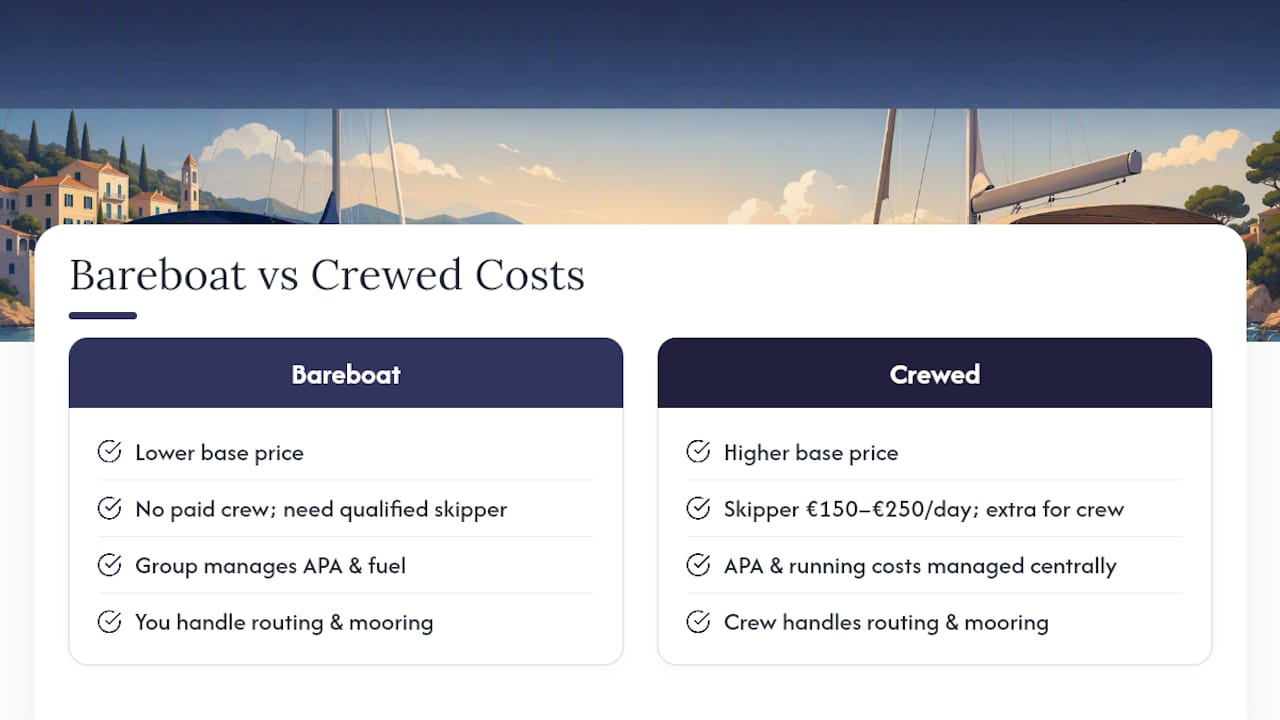
Bareboat charters, where your group sails without a hired skipper, look cheapest on the surface because you’re not paying crew wages. But that comparison only holds if someone in your group holds the sailing qualifications most Mediterranean charter companies require, and it shifts all the routing, mooring, and provisioning decisions onto you.
A skippered or crewed charter costs more upfront, generally an added €150 to €250 per day for a skipper alone, more for a full crew with a chef aboard, but it centralizes the APA and running-cost management. The insight worth sitting with here: sourcing a skipper simplifies your budgeting because APA is managed centrally by someone who knows the local costs, rather than your group guessing at fuel and marina prices in an unfamiliar country.
For a first-time group, that reduced risk is often worth the higher base price. You’re not just paying for someone to sail the boat. You’re paying for someone who already knows which anchorages are calm in a shifting wind and which marina harbormasters overcharge tourists. Our guide to crewed yacht charters breaks down exactly what a full crew adds beyond the skipper.
Bareboat makes more sense for experienced sailors with a qualified skipper in the group, who value the independence and don’t mind managing fuel stops and provisioning themselves.
Insurance Costs and Considerations for Sailing Holidays
Standard hull and liability insurance is almost always bundled into the base charter price, covering the boat itself against major damage. What it doesn’t cover is the security deposit, which is where most charterers get caught off guard.
That deposit, often €1,500 to €5,000 or more depending on boat size, is held against damage or loss during your charter and released after a post-trip inspection. Many operators offer optional damage waiver insurance, typically a flat fee of €100 to €300 for the week, that reduces or eliminates your exposure on that deposit if something goes wrong. It’s worth comparing that flat fee against the deposit amount itself before deciding whether to buy it.
Separately, consider travel insurance that covers trip cancellation, medical emergencies, and delayed or missed flights connecting to your embarkation port. Sailing holidays involve a fixed departure window, and a missed connection can mean losing days of a charter you’ve already paid for. A policy that covers “missed departure” specifically, not just generic trip cancellation, is worth seeking out given how charter schedules work.
SailArmada’s Perspective: Avoiding Hidden Costs
Most cost surprises on a sailing holiday come from vague quotes, not bad luck. We’ve built our booking process around closing that gap: curated routes with skippers who know the anchorages, transparent pricing on private and group charters, and provisioning guidance that helps you set a realistic APA figure before you board rather than after.
Flexibility matters here too. Whether you’re booking a private charter for a family of six or coordinating a larger group split across two boats, the goal is the same: a quote you can trust down to the line item, not one that doubles once fuel and marina nights get added.
— Sail
Get a Transparent Quote for Your Mediterranean Sailing Holiday
Working out fuel estimates, APA percentages, and marina nights on your own takes real time, and a wrong guess costs real money. Sailarmada handles that math for you: every quote for a private or group sailing holiday spells out exactly what’s included before you commit, so you’re comparing a real number against a real number, not a brochure price against a mystery.
Browse sample itineraries and pricing on our yacht holiday page to see how the base price, APA, and extras break down for boats across Greece, Italy, and Croatia. If your group is weighing a monohull against a catamaran, or a shared cabin against booking the whole boat, request a quote directly and we’ll walk you through the real cost difference for your exact group size and dates.