Before you cast off anywhere in Greek waters, three things need to be sorted: valid registration, insurance and radio documents on board, TEPAI paid or a Transit Log filed if your boat qualifies, and a skipper licence Greece actually recognizes. Tenders and fast RIBs sometimes fall under a separate high-speed craft licence, so check that too. The sections below walk through each piece so you can arrive relaxed instead of scrambling at the port police desk.
TL;DR:
- Vessels over 7 meters need to register on the eTEPAI portal and pay the fee before entering Greek waters, with discounts available for annual lump-sum payments.
- All boats must carry registration, insurance, radio licences, and crew lists, and Greek-flagged yachts over 10 meters require a DEKPA document.
- Non-EU licences may require translation or proof of competence, and tender or RIB operation may require a separate high-speed craft licence from the Hellenic Coast Guard.
- Recent regulations have standardized safety and inspection checks across ports, requiring compliant safety gear and seaworthiness certificates to avoid delays.
- Keep all documents accessible onboard, confirm licensing and fees with the operator beforehand, and ensure proper registration and payment to prevent legal or administrative issues.
Table of Contents
- 1. Documentation to carry and port formalities
- 2. TEPAI, Transit Log and fees: who pays and how
- 3. Skipper qualifications and charter rules
- 4. Vessel rules, inspections and recent port-regulation updates
- 5. High-speed craft, tenders and when Greek licensing applies
- 6. A step-by-step compliance checklist for your trip
- 7. What SailArmada clients ask before booking a Greek charter
- 8. Why following the rules protects your holiday
- How SailArmada makes Greek paperwork someone else’s problem
- Official pages and guides to bookmark
- Sources
- FAQ
1. Documentation to carry and port formalities
Greek port authorities and marinas run a fairly consistent checklist, and having everything ready saves you from the least fun part of any sailing holiday: paperwork under a hot sun while your crew waits on the pontoon. Every vessel needs proof of registration or title, a valid insurance certificate, and, where the boat carries VHF equipment, a radio licence along with the operator’s certificate of competence. If your insurance papers are not in Greek or English, bring a certified translation. Port police have seen plenty of documents in German, Italian and Turkish, and they are not always able to accept them on the spot.
You also need a crew and passenger list, which ports use to record who arrived and who departed, particularly relevant on islands where local authorities track vessel movements closely. Greek-flagged private pleasure yachts over 10 meters typically need a DEKPA (a registration and identity card for the vessel), while foreign-flagged boats rely on their home country’s registration documents plus whatever Greece requires for entry, such as the Transit Log described in the next section.
- Registration or title document for the vessel.
- Valid insurance certificate, translated if not already in Greek or English.
- Radio licence and operator certificate, if VHF equipment is fitted.
- Crew and passenger list for port records.
- DEKPA for Greek-flagged pleasure yachts over 10 meters.
Marinas generally want to see originals rather than photocopies, at least on first check-in, though many keep scanned copies on file once you have registered with them once. A folder with everything organized, ideally in a waterproof sleeve, turns a ten-minute formality into a two-minute one.
Pro Tip: Keep a second, digital copy of every document on your phone. Greek marina offices sometimes ask you to send a scan by e-mail rather than hand over paper.
2. TEPAI, Transit Log and fees: who pays and how
TEPAI, officially the Recreational and Daily Tour Cruise Ships Fee, applies to private pleasure boats with an overall length over 7 meters, and it catches a lot of first-time charterers off guard. Payment runs through the eTEPAI application on AADE’s myAADE platform, where you register the vessel and generate an e-Paravolo payment code before entering Greek waters, since the fee is enforced both at entry and monthly during your stay.
- Register the vessel’s details on the eTEPAI portal before departure.
- Generate the payment code and settle the fee for the relevant period.
- Keep the receipt on board, since port police can ask for it during checks.
- If planning an annual stay, pay the lump sum in December or January to access the discount window.
- For non-EU flagged boats over 7 meters, file a Transit Log through gov.gr instead of or alongside TEPAI, depending on your vessel’s status.
A lump-sum annual TEPAI payment carries a discount when settled in December or January, a detail worth planning around if you know you will be cruising Greek waters for most of the season.
Exemptions exist for vessels classified as traditional or those formally immobilized for the season, and the AADE TEPAI FAQs spell out both the exemption categories and the fee bands, which scale with vessel length. Charter operators in Greece frequently pre-clear these obligations for clients, but if you are on a bareboat charter, confirm in writing who is responsible for paying TEPAI and who holds the receipts. Being unable to produce proof of payment at departure is a common, entirely avoidable headache.
3. Skipper qualifications and charter rules
Greece accepts EU and EEA sailing licences without much fuss, which covers a large share of visiting skippers. If you are arriving with a non-EU licence, it generally needs to meet EU competence standards, and marinas or charter companies sometimes ask for a translation or supporting documentation showing what the certificate actually qualifies you to do. This catches out sailors from outside Europe more often than seasoned charterers expect.
Bareboat charters in Greece usually require at least one certified skipper aboard, and operators often want evidence that a co-skipper has genuine sailing experience, not just a certificate gathering dust in a drawer. Marinas commonly check the skipper’s passport alongside the licence itself, so keep both within easy reach rather than buried in a cabin locker.
- EU and EEA licences are accepted without additional paperwork in most cases.
- Non-EU licences may need a certified translation or proof of equivalent competence.
- Bareboat charters typically require a named, qualified skipper plus a capable co-skipper.
- Passport and licence are checked together, so carry both, not just one.
When in doubt, confirm directly with your charter operator or the local port authority before you sail. It is far easier to sort out a licensing question over e-mail two weeks before departure than to argue about it at a fuel dock. If you would rather skip the guesswork entirely, our explainer on Greek boat license rules breaks down exactly which certificates apply to which size of boat.
4. Vessel rules, inspections and recent port-regulation updates
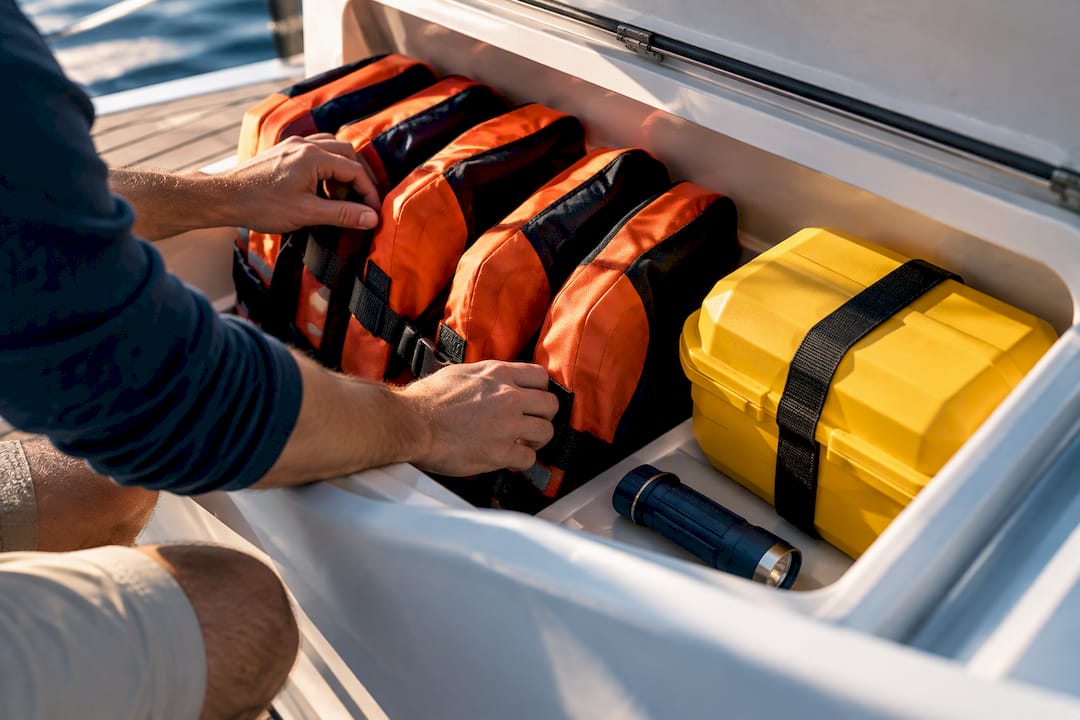
Port police inspections in Greece typically focus on seaworthiness certificates, CE markings on the hull and equipment, and the safety gear you are required to carry, from life jackets to flares to fire extinguishers. Inspectors are not looking to catch you out, but they do expect a boat that matches its paperwork.
The 2025 amendment to General Port Regulation No. 23 updated inspection and documentation requirements specifically for small recreational craft, tightening how consistently these checks are applied across different ports. In practice, this means less variation between islands than sailors experienced in past seasons.
- Seaworthiness certificate and CE markings are checked against the vessel’s actual equipment.
- Life jackets, flares, fire extinguishers and other safety gear must match required counts.
- The 2025 update to General Port Regulation No. 23 standardized small-craft documentation checks across ports.
If an inspector flags something missing, the usual remedy is straightforward: replace or top up the equipment at the nearest chandlery, which most marinas have within walking distance. Non-compliance can hold up your departure until the issue is fixed, so treat the pre-departure safety check as seriously as the paperwork.
Pro Tip: Do a full safety-gear count the night before you leave the marina, not the morning of. Chandleries keep more convenient hours than you’d expect, but not at 7 AM.
5. High-speed craft, tenders and when Greek licensing applies
Here is where a lot of otherwise well-prepared sailors get surprised. The Hellenic Coast Guard’s high-speed craft operator licence is a separate regime from ordinary yacht-skipper certificates, with its own pathways, including no-examination routes for certain professional categories. A standard sailing licence does not automatically cover operating a fast tender or RIB.
If your charter includes a powerful tender for beach runs or watersports, that tender may fall under the high-speed regime depending on its speed and size, meaning the crew member running it needs the right Greek-recognized credential, not just a general skipper certificate.
- Ordinary yacht-skipper certificates do not automatically cover high-speed tender operation.
- Fast RIBs and powerful tenders may trigger the separate Hellenic Coast Guard licensing regime.
- Confirm tender licensing requirements with your charter operator before departure, not after arrival.
The safest approach is to ask your charter company directly which licence covers the tender you will actually use, and to check with the Hellenic Coast Guard in advance if there is any doubt. Our guide to Greek boat licensing covers this distinction in more detail if you want to read ahead.
6. A step-by-step compliance checklist for your trip
Running through this checklist in order removes most of the administrative stress from a Greek sailing holiday.
- Before departure: verify registration, insurance and radio documents, confirm whether TEPAI or a Transit Log applies to your vessel, and check that your skipper licence and any translations are in order.
- Before departure: confirm your insurance policy explicitly covers Greek waters, since some policies exclude specific regions.
- On arrival: present all required documents to the port authority or marina office and pay TEPAI or submit the Transit Log if your vessel qualifies.
- On arrival: keep the stamped receipt or confirmation, since you may need to show it again later in your trip.
- While cruising: keep all paperwork accessible on board, log entries and departures, and cooperate with any port police inspection.
- While cruising: confirm tender or RIB licensing before letting anyone else on board operate it.
- At departure: settle any outstanding fees or fines and keep copies of every receipt in case customs or tax authorities ask later.
Our customs clearance checklist for skippers walks through the arrival formalities in more depth if you want a companion reference for that first day on the water.
7. What SailArmada clients ask before booking a Greek charter
Before booking, ask your operator directly: who handles TEPAI or the Transit Log, does the tender need a separate licence, and what skipper credentials will be checked on arrival. Language barriers and slow marina processing are the two most common friction points travelers mention, especially on the smaller islands.
Clients booking through skippered Greece holidays can arrange for experienced skippers to help handle administrative steps to reduce the paperwork burden.
8. Why following the rules protects your holiday
Compliance in Greek waters is not bureaucracy for its own sake. It is what keeps a fine or a hold-up at the port from swallowing a day of your trip. If you are unsure about a licence, a fee or a tender rule, book with an experienced operator or take a skippered option rather than guessing.
— Sail
How SailArmada makes Greek paperwork someone else’s problem
Sorting registration, TEPAI, Transit Logs and skipper credentials is manageable, but it takes time you would probably rather spend picking your first anchorage. Options exist for skippered and private charters across the Greek islands where administrative tasks such as AADE payments and port procedures can be managed as part of the trip.
- Skippered and private charter options across the Greek islands with local administrative assistance.
- Access to skippers familiar with TEPAI, Transit Log filing and port inspection routines.
- Flexible departure dates and boat choices, including catamarans and monohulls.
Our Greece Go Private packages start from 560 € per week per person, and if you want to understand the licensing side first, our Greek boat license breakdown is a useful next stop before you book.
Official pages and guides to bookmark
For the most current rules straight from the source, these are worth saving before you sail:
- eTEPAI on AADE: the payment portal itself and the authority on current fee bands.
- AADE TEPAI FAQs: exemptions, discounts and calculation details.
- Gov: for non-EU flagged vessels over 7 meters.
- Hellenic Coast Guard high-speed craft licence: the authority on tender and RIB licensing.
- General Port Regulation No. 23 amendment: current small-craft inspection rules.
Sources
- eTEPAI | ΑΑΔΕ
- Frequently Asked Questions for the e-TEPAI
- Gov
- High-speed craft operator licence — Hellenic Coast Guard (MITOS)
- Amendment to General Port Regulation No. 23 (Small craft inspections) — Hellenic Coast Guard edla
FAQ
Do I need a license to sail in Greece?
Yes, most vessels above a certain size require a recognized skipper licence, and EU and EEA licences are accepted without extra steps. Non-EU licences may need a certified translation or additional proof of competence, and tenders or fast RIBs can fall under the separate high-speed craft operator licence from the Hellenic Coast Guard.
What is the most unusual law in Greece?
This falls outside sailing regulations and is not something covered by the official sources used for this guide, so it is not addressed here.
What is law 89 in Greece?
This question refers to a law outside the scope of Greek sailing and charter regulations covered by the sources used for this article, so it is not addressed here.
Is RYA Day Skipper accepted in Greece?
RYA-issued licences from the United Kingdom are generally treated the same as other recognized EU-standard certificates for chartering in Greece, though specific acceptance can depend on the charter operator and vessel type. It is worth confirming directly with your charter company or checking Hellenic Coast Guard documentation before booking if you plan to skipper the boat yourself.
Do I need to pay TEPAI on every trip?
TEPAI applies to private pleasure boats with an overall length over 7 meters, and it is enforced both at entry and monthly during your stay in Greek waters. You can pay through eTEPAI, and a lump-sum annual payment made in December or January carries a 10% discount.