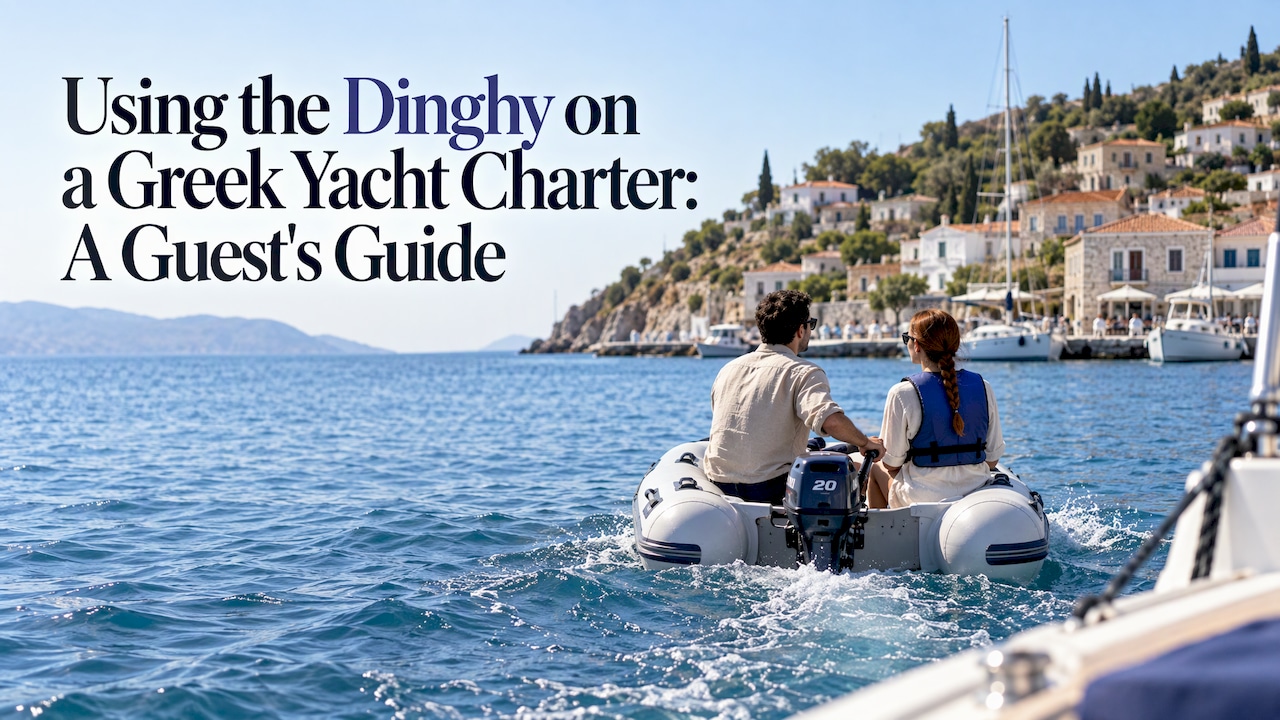
The dinghy is the small inflatable boat that carries you between your anchored yacht and the shore. On a charter in Greece you will use it daily for beach landings, tavernas and swim stops. It is simple to run, but it is a powered boat with its own rules. Keep it slow near swimmers, keep it out of the roped-off bathing zones, and let a sober, qualified person drive. On a skippered holiday that person is usually your skipper, and that’s the easiest way to enjoy it.
This guide covers what the dinghy is, how a day with it works, the Greek rules that apply in 2026, and what to sort out before you step aboard.
TL;DR
- The dinghy (also called the tender) is your shuttle from anchorage to shore. Most Greek stops are at anchor or on a buoy, not at a dock, so you will use it often.
- Greek port rules, amended in 2026, ban moving or anchoring any motorized craft inside the buoyed bathing area. Keep your distance from swimmers and slow down near the coast.
- Treat the driver as a zero-alcohol role. Wear lifejackets, never overload it and check fuel before every trip.
- Outboard fuel, damage and loss are the usual points to settle at the start of a charter, so ask about them at check-in.
- With a skipper on board, you can enjoy the dinghy and leave the local rules, fuel and docking to someone who does this every week.
Table of Contents
- What a dinghy is, and why you’ll use it every day
- Is the dinghy included in a Greek charter?
- Who can drive the dinghy in Greece?
- The 2026 shore rules in plain English
- Alcohol and the dinghy
- How to use the dinghy safely, step by step
- What if something goes wrong?
- Distance and night limits: use common sense
- Perspective: what we’d tell a friend
- Make the dinghy part of the holiday, not a worry
- FAQ
- Sources
What a dinghy is, and why you’ll use it every day
In everyday charter talk, “dinghy” and “tender” mean the same thing: a small boat, usually an inflatable with a small outboard engine, that rides on the back of the yacht or catamaran. It is the family car of a sailing holiday.
Greece is the reason it matters so much. Many of the best spots, such as a quiet cove with a single taverna, have no dock deep enough for a yacht. You drop anchor in clear water, and the dinghy takes you ashore. On a typical sailing day you might use it three times:
- Morning: a run to the bakery or a village market from a bay where you spent the night.
- Midday: a trip to a beach with no road access, or to explore a sea cave a yacht can’t enter.
- Evening: a ride to dinner in a village, and the ride back in the dark.
That last trip is where most of the care is needed. Hold on to it, because we come back to it below.
If you’re deciding between a monohull and a catamaran, the dinghy works the same on both. Catamarans typically carry it on davits (a lifting frame at the stern) or on a rear platform, which makes loading kids and bags easier. Our guide on why groups choose catamarans explains the rest of the difference.
Is the dinghy included in a Greek charter?
The dinghy is a standard part of a charter yacht’s equipment, but the outboard engine, its fuel and any extra charges are set by each booking. They are worth confirming in writing. Price lists for Greek charters vary on whether the outboard is included and whether its fuel is charged separately, so never assume.
Before you sail, get clear answers to these questions:
- Is the outboard included, or charged as an extra for the week?
- How much fuel does it start with, and how is the refill handled at the end?
- What is the dinghy’s passenger limit? The number is printed on the boat or its plate. Your group’s size decides whether you need two trips.
- What equipment comes with it? Oars, a foot pump, a lifejacket for each person, a flashlight and the engine’s safety lanyard.
- What happens if it’s damaged or lost? Ask about the deductible and what it covers.
The last point matters because dinghies are the most-bumped part of a boat. Ropes get caught in propellers, tubes scrape on rocks and a poorly tied dinghy can drift off overnight. Settle the terms on day one, not on the day you hand the boat back. For the wider picture of fuel on charter, see our guide to refueling on charter and what it costs.
Who can drive the dinghy in Greece?
This is where the rules get specific, and it is the question most groups don’t think about until they are standing on the pontoon.
Greece regulates small powered boats under its Port General Regulation (the national rulebook enforced by the coast guard and port police). A July 2026 amendment, published in the Government Gazette, confirms that moving or anchoring any motorized leisure craft inside the buoyed bathing area is prohibited, whether the craft is private or rented. The same amendment says that businesses renting out craft must refuse to rent to anyone without the required qualifications to operate it.
What does that mean for you on a charter?
- The dinghy is not a toy. It is a motorboat, and whoever drives it is the person in charge and responsible for what it does.
- Whether a license is needed depends on engine power and hull type. Small outboards on dinghies are commonly covered by simple rules, but the thresholds differ by hull type and have changed over time. Our guide to when you need a Greek boat license walks through the 30 HP and 3 nautical mile thresholds.
- Age and experience count. Don’t hand the tiller to a teenager because it “looks easy”. Agree beforehand who drives, and keep it to one or two sober, confident people.
On a skippered charter, the simplest answer is the best one: the skipper decides who drives and runs the dinghy when conditions or the shore landing are tricky. For a first-time group, that is a real stress-saver.
The 2026 shore rules in plain English
The rules below come from the amended regulation as summarized in a crew guide on Greek coastal rules and marine parks. They are the ones that affect a dinghy day. Local port authorities can add their own, and marine parks have additional restrictions, so treat this as the baseline.
| Situation | What the guide states for 2026 |
|---|---|
| Inside a buoyed swimming area | No movement or anchoring of any powered craft |
| Distance from bathing buoys | At least 100 m for speedboats |
| Distance from swimmers where there are no buoys | At least 200 m for speedboats |
| Speed near the coast | Maximum 5 knots within 200 m of shore |
| Launching from a beach | Only through a marked channel, or at 3 knots or less with no swimmers within 100 m |
| Launching with swimmers present | 1 knot, with 30 m clearance |
A knot is one nautical mile per hour, roughly a brisk walking pace at 5 knots, so the limit near shore is basically a crawl. That is the point: swimmers in Greece are often hard to see from a low inflatable, and a propeller doesn’t forgive mistakes.
What this looks like in practice
Imagine a busy beach in July with a line of buoys marking the swimming zone. You can’t cut through it, even to reach the sand. Look for the marked channel or find another landing spot, such as a rocky side of the bay or the village quay. Slow down well before the beach, kill the engine when you’re close, and tilt it up if you can before the shallows.
Our guide to Greek sailing regulations explains how port fines work if you get it wrong, and anchoring etiquette in Greece covers the unwritten rules for sharing a bay, including where it’s polite to leave the dinghy.
Alcohol and the dinghy
A taverna dinner with wine is the highlight of a sailing day, and the dinghy ride back is where it gets complicated. The same crew guide says that driving a speedboat or water-sports craft under the influence is prohibited, with testing after an injury accident, and it found no numeric limit for boat operators, so the safe reading is zero for whoever drives the tender.
The easy fix is built into any group plan: choose the designated driver before dinner, not after dessert. If you have a skipper, they handle the ride back. Our guide to alcohol on a Greek yacht charter covers what is allowed on board.
How to use the dinghy safely, step by step
These are the habits that keep a dinghy day relaxed. None of them is complicated.
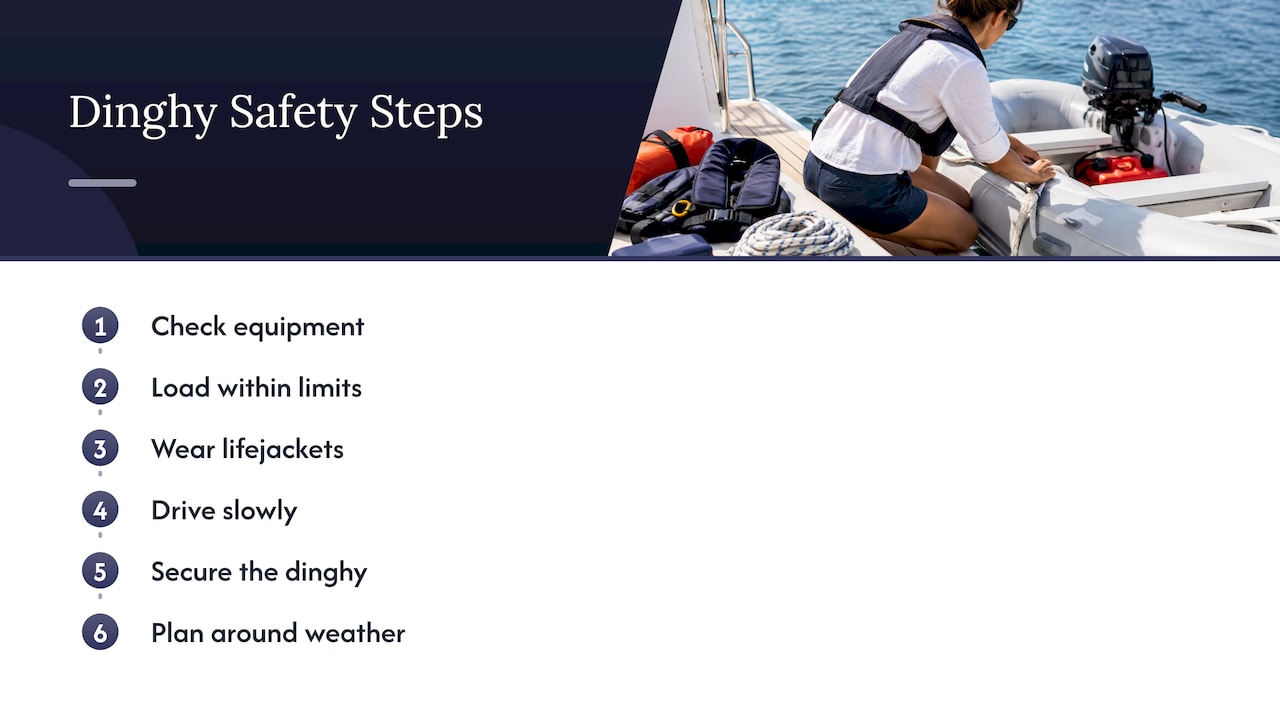
1. Check before you leave the yacht
Look at the fuel level, the engine’s safety lanyard (the cord that clips to the driver and stops the engine if they fall out) and the lifejackets. Make sure the oars are aboard. If the engine fails, oars are how you get home.
2. Load sensibly
Stay under the passenger and weight limit on the boat’s plate. Put heavier items low and central, and sit people evenly. Shopping bags, a few kids and a cooler add up quickly. If it looks heavy, make two trips.
3. Wear lifejackets, especially at night
Everyone wears one, including strong swimmers. Bring a flashlight for the evening run so other boats can see you and you can find your yacht among the anchor lights.
4. Drive slowly and dry
Keep your speed down near swimmers, moored boats and the shore. Approach the landing at a slow, steady pace. Step out one at a time while someone holds the boat.
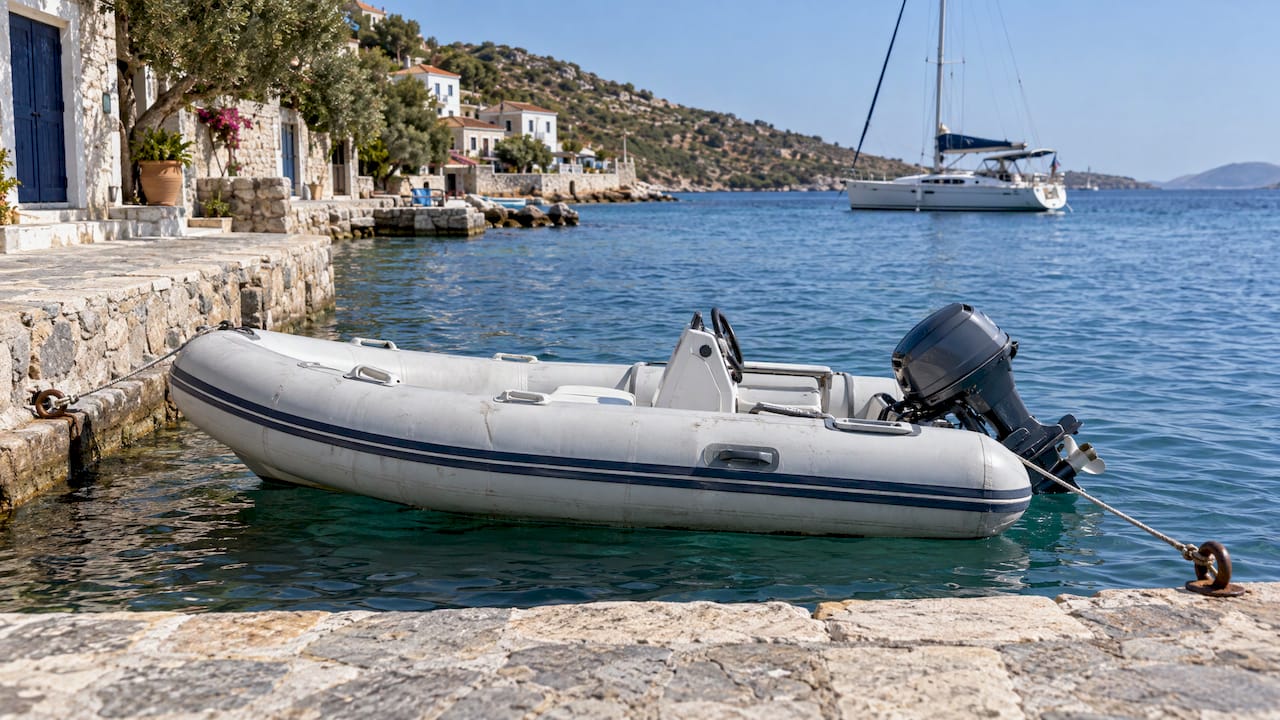
5. Secure it properly
When you land, tie the dinghy with a proper knot to something solid, such as a ring on the quay. When you return to the yacht, tie it alongside with bow and stern lines so it can’t swing and bang the hull. At night, many crews lift it on the davits or tie it very short so it doesn’t drift or get stolen.
6. Plan around weather
A calm morning can turn choppy by afternoon, particularly when the summer northerly wind (the meltemi) builds in the Aegean. A dinghy ride that took five minutes in the morning can be a wet 15 on the way back. Be back before the wind rises, or ask your skipper whether to leave it for another day.
A crew-safety checklist from a skipper’s safety guide for tenders covers the same essentials: plan for weather and tide, wear a lifejacket and kill cord, carry oars, a communication device, a flashlight and a foot pump, don’t overload, check fuel and secure it alongside with bow and stern lines.
What if something goes wrong?
Most dinghy issues are small and fixable:
- Engine won’t start: check the kill cord is attached, the fuel valve is open and the tank has fuel. If it still fails, row, or call the yacht.
- Flat tube: the foot pump is the answer. Pump it before you leave and top it up if the sun warms the air inside.
- Dinghy drifted away: tell your charter base or skipper straight away. Don’t swim after it in open water.
- Damage: note it, take a photo and report it. It is much easier to handle when you flag it on the day.
If anyone is hurt or in danger on the water, call the Hellenic Coast Guard on 112, the European emergency number that works across Greece.
Distance and night limits: use common sense
A dinghy isn’t built for crossing open water. Keep trips short, stay within a few minutes of the yacht, and avoid leaving the anchorage if the wind is up. A simple group rule works well: if you can’t comfortably see the yacht from the shore, don’t go. For night runs, check the yacht’s position before you leave the dock and have a flashlight, because the anchorage looks very different in the dark.
Perspective: what we’d tell a friend
We love the dinghy. It’s what turns a sailing holiday from sitting on a yacht into exploring islands, coves and villages that most visitors never see.
It’s also the piece of the week where groups most often feel unsure: who drives, how fast to go near swimmers, what to do at night. Our routes are curated by experienced, professionally trained skippers from CAPETAN.club, and we think that’s the best way to enjoy it. You get the freedom of a private holiday with a skipper who knows the local rules, the best landings and how to tie up properly, and you get to enjoy the evening in the taverna.
If you’re sailing as a group of friends or with kids, that’s a big part of the appeal: everyone relaxes together, and nobody has to worry about the details.
Sail
Make the dinghy part of the holiday, not a worry
If you want the beaches, the tavernas and the swim stops without managing the shore rules yourself, a skippered holiday is the natural fit. Our Greece Go Private sailing holidays start from €560 per person per week, with a choice of yacht or catamaran, flexible itineraries and custom departure dates. Our skippers are experienced and professionally trained, and you get personal support from actual sailors at every step.
If you’d rather sail with other people, our group sailing holidays give you the same experience with a crew of new friends. Not sure which suits you? Our guide to a private or group sailing holiday will help you choose.
FAQ
Do I need a license to drive the charter dinghy in Greece?
It depends on the engine power and the hull type, and the rules have thresholds that change. Our guide to Greek boat license rules explains them. On a skippered charter, your skipper can drive the dinghy, so nobody in your group needs to worry about it.
Can I take the dinghy into a swimming area?
No. Under the 2026 amendment to the Greek port regulation, moving or anchoring a motorized craft inside the buoyed bathing area is prohibited. Land at a marked channel, a quay or another part of the beach.
Is the outboard fuel included in the charter price?
This varies by booking, so confirm it before you sail and agree how the tank is returned. Our guide to refueling on charter explains how it works and who does it.
Can we drive the dinghy after dinner?
Treat the driver as zero-alcohol. The Greek regulation prohibits operating a speedboat under the influence, and no numeric limit for operators was found in the 2026 crew guide. Pick a sober driver before dinner, or let your skipper take the ride back.
How many people can ride in the dinghy?
The limit is shown on the dinghy’s plate and depends on the boat. Stay under it, include luggage and shopping in your count and make two trips if needed. Everyone should wear a lifejacket.
Sources
- Government Gazette amendment to the Port General Regulation, decision 2131.4/52320/2026
- Coastal rules and marine parks for yacht crew in Greece (2026)
- Essential yacht tender safety for skippers and crew