The Advance Provisioning Allowance (APA) is a prepaid float that covers your charter’s variable running costs, like fuel, food, and marina fees. As a quick rule of thumb, budget 20 to 40% of the base charter fee depending on your yacht type and route. The captain manages this account against receipts, and anything you don’t spend gets refunded after the trip.
TL;DR:
- APA typically accounts for 20 to 40% of the base charter fee, depending on yacht type and itinerary complexity, with high-season routes increasing costs.
- Fuel costs dominate in motor yachts, while provisioning expenses are the largest share on sailing yachts, and both increase with luxury preferences.
- A detailed worksheet from the captain, including projected engine hours and marina estimates, is essential to avoid surprises and verify the APA calculation.
- Refunds for unspent APA usually arrive within a few weeks after disembarkation, and overspending requires settlement before or shortly after the trip.
- Sailarmada advocates for itinerary-specific estimates and detailed planning, reducing guesswork and ensuring the APA reflects actual consumption rather than industry averages.
Table of Contents
- Understanding Apa Yacht Charter Costs: What’s Included and What’s Not
- How APA Is Calculated Across Yacht Types
- When and How You Pay Your APA
- How APA Reconciliation, Refunds, and Top-Ups Actually Work
- Three Sample Apa Yacht Charter Budgets by Yacht Type
- Managing Your APA: A Pre-Booking Checklist
- The SailArmada Approach to APA Planning
- Ready to Plan Your Charter Without the APA Guesswork?
- Sources
Understanding Apa Yacht Charter Costs: What’s Included and What’s Not
Once you know the APA is an advance payment rather than a fixed fee, the next question is obvious: what exactly is it paying for? The captain runs this money as a working account for anything that changes based on where you sail and how you like to eat and drink on board.
Here’s what typically gets charged to APA:
- Fuel for the main engines, tenders, and water toys like jet skis or seabobs
- Provisioning: all food, wine, spirits, and soft drinks you request
- Marina and port fees, which climb fast in high-season hotspots
- Communications, including onboard Wi-Fi top-ups and SIM cards
- Laundry service for linens and guest clothing
- Local transfers, taxis, and pre-booked activities like diving excursions or private tours
None of this touches the base charter fee, which pays for the yacht itself, the crew’s wages, insurance, and the owner’s maintenance costs. Crew gratuity is a separate line entirely and never comes out of APA.
Every one of these items scales with your choices. A group that wants premium champagne and fresh seafood every night burns through provisioning faster than a group happy with local wine and simple grilled fish. A route with three marina stops a week costs more in berthing fees than one built around quiet anchorages. Your preference sheet is where these choices get locked in before you ever step aboard.

How APA Is Calculated Across Yacht Types
Brokers quote APA as a percentage of your base charter fee, and that percentage moves with fuel burn and itinerary intensity, not just yacht size. A sailing yacht that spends most of its week gliding on wind power needs far less fuel money than a motor yacht running generators and engines around the clock.
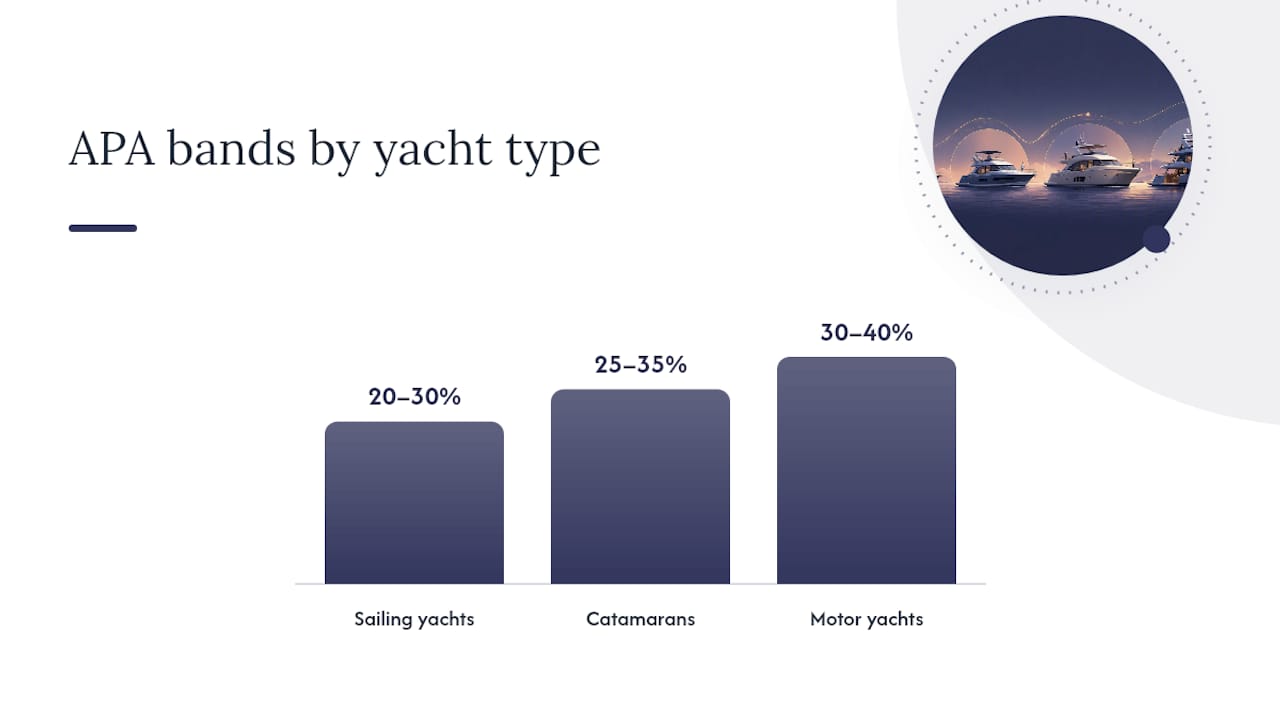
The typical bands break down like this:
- Sailing yachts: roughly roughly 20 to 30% of the base fee
- Catamarans: roughly 25 to 35%, reflecting twin engines and higher guest counts
- Motor yachts: about 30 to 40 percent or more, driven by heavier fuel consumption
A busy high-season itinerary with back-to-back marina stops, or long point-to-point hops between islands, can push any of these bands toward the top edge.
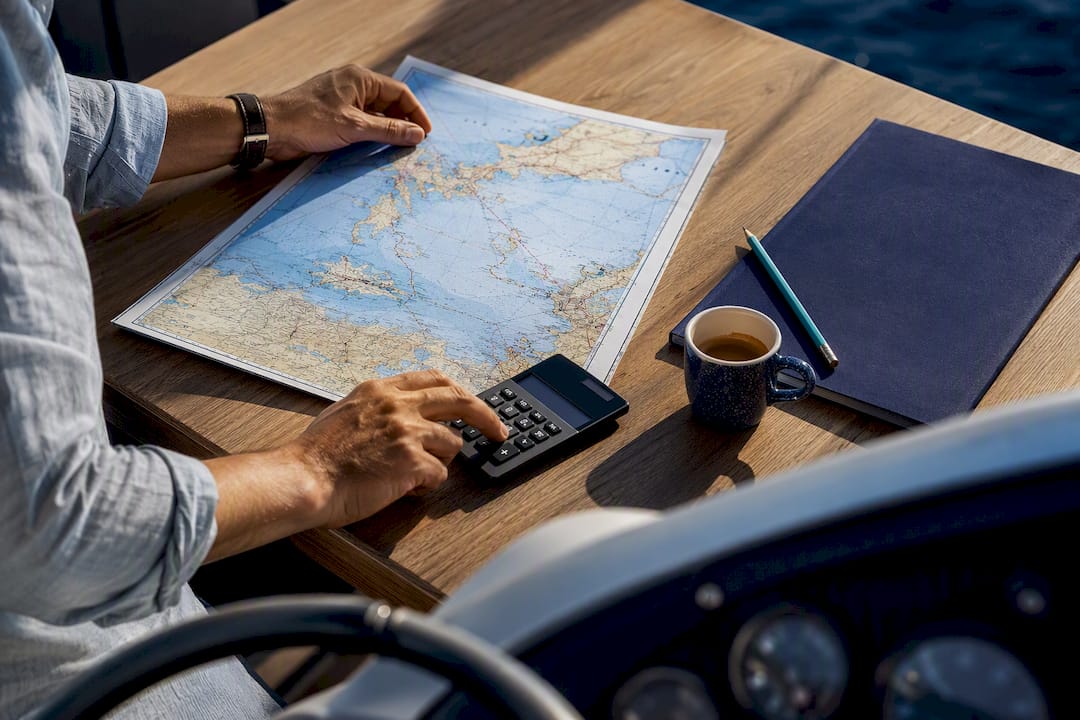
Don’t just accept a flat number. Ask your broker or captain for a fuel worksheet showing projected engine hours multiplied by fuel burn rate and current local prices, plus a marina-night estimate for your specific route. A captain who can produce that breakdown is showing you real math, not a guess pulled from a standard template.
When and How You Pay Your APA
APA payment follows a predictable rhythm tied to your final balance:
- Booking deposit: paid first, typically 30 to 50% of the base fee, to secure the yacht and dates.
- Final balance and APA: both are usually due together, roughly four to six weeks before embarkation, often by bank wire.
- Custody on arrival: the captain holds and administers the account, sometimes through a broker’s ring-fenced client account rather than the yacht owner directly.
Ring-fencing matters because it keeps your APA separate from the owner’s operating funds, so the money is protected and traceable strictly for your charter’s expenses. Refunds for unspent APA typically land back in your account within a few weeks of disembarkation, usually by the same wire method you used to pay.
How APA Reconciliation, Refunds, and Top-Ups Actually Work
The captain keeps a running account throughout your charter, logging every fuel fill, provisioning run, and marina fee against receipts as they happen. On longer charters, a midpoint check is common practice, giving you a rough sense of whether spending is tracking to plan or running hot.
At the end of the week, you get an itemized statement backed by vendor receipts, and the numbers should match what you actually consumed.
- If you underspent, the balance is refunded, commonly within within about one or two weeks, sometimes stretching to 30 depending on the management company.
- If you overspent, whether from extra fuel on a long passage or a bigger bar tab than planned, you settle the difference before or shortly after disembarkation.
- Supplier invoices folded into your APA may carry local VAT, but the APA itself is not a taxable fee. It’s an operational float, not a service charge.
Three Sample Apa Yacht Charter Budgets by Yacht Type
Numbers vary by season, region, and how your group likes to eat and move, but these illustrative splits show how the percentage actually breaks down once it’s spent.
| Yacht Type | Typical APA Band | Fuel Share | Provisioning Share | Notes |
|---|---|---|---|---|
| Sailing yacht | roughly 20 to 30% | Low | Dominant | Wind power keeps fuel costs down; food and drink drive most spending |
| Catamaran | roughly 25 to 35% | Moderate | Balanced with berthing | Twin engines and larger guest counts push both fuel and marina costs up |
| Motor yacht | around 30 to 40% or more | Dominant | Secondary | Engine and generator fuel burn overshadows even generous provisioning budgets |
A motor yacht cruising several hours a day can burn through hundreds of euros in fuel before dinner is even served, which is exactly why fuel dominates its APA. Provisioning alone can run anywhere from modest to a few hundred euros per person per day depending on how particular your group is about wine, seafood, and snacks. Treat these figures as a starting frame for your own conversation with a broker, not a guarantee for your specific week.
Managing Your APA: A Pre-Booking Checklist
Before you wire a cent, request three documents: an itemized APA worksheet, a fuel estimate based on projected engine hours and local prices, and a marina-night list for your exact route.
Once aboard, ask for a midpoint balance update, and use your preference sheet to lock in provisioning standards early so the crew isn’t guessing what “good wine” means to your group.
- Request the APA worksheet before you pay your final balance
- Confirm who holds the account and how refunds are processed
- Set a spending threshold with the captain for anything beyond routine provisioning
- Compare the itemized APA quote against an all-inclusive alternative if you want price certainty over flexibility
Pro Tip: If two brokers quote wildly different APA percentages for a similar yacht and route, ask each one for their fuel and marina worksheet side by side. The gap almost always traces back to itinerary assumptions, not padding.
The SailArmada Approach to APA Planning
Guesswork around APA is the single biggest source of post-charter friction we see, and it’s almost always preventable. Sailarmada builds every quote around a detailed preference sheet and an itinerary-informed APA worksheet, so your fuel, provisioning, and marina estimates reflect your actual route rather than a generic percentage.
Our team liaises directly with captains before you sail, coordinating provisioning standards so nothing gets left to a last-minute guess at the dock. If you’re comparing quotes right now, ask us for a full APA worksheet before you commit. It costs nothing to see the math.
Ready to Plan Your Charter Without the APA Guesswork?
Most charter guides tell you the percentage band and stop there, leaving you to negotiate blind with whoever holds your account. Sailarmada builds the fuel and provisioning math into your quote from the start, so the APA number you see reflects your actual route, not a copy-pasted industry average.
We coordinate directly with captains on itinerary-specific fuel estimates and provisioning plans tied to your preference sheet, and we stay in the loop through reconciliation so refunds don’t get lost in translation. If your group wants extras like a private event or specialty transfer, partners like Alanya’s night disco yacht experience show how those add-ons typically get folded into your onboard spending.
Ready to see real numbers for your route instead of a generic percentage? Request a private sailing quote from Sailarmada and get an itemized breakdown before you book.
Sources
- What Is APA in a Yacht Charter and Where Does Your Money Actually Go? — Frontier Yachting
- What Is APA on a Yacht Charter? 20 to 40%, and You Get the Rest Back — George Yachts