Flotilla sailing safety procedures are the standardized practices that keep every boat and crew member safe during group sailing adventures. Sailing in a flotilla, the recognized industry term for a coordinated fleet of yachts traveling together, adds layers of complexity that solo sailing never demands. You are responsible not just for your own vessel but for your coordination with every other boat in the group. USCG-approved life jackets, fire extinguishers, VHF radios, and practiced emergency drills are the non-negotiable foundation of any safe flotilla week. Get these right, and your sailing holiday stays exactly what it should be: breathtaking, free, and full of great memories.
What are the mandatory pre-departure safety checks for flotilla sailing?
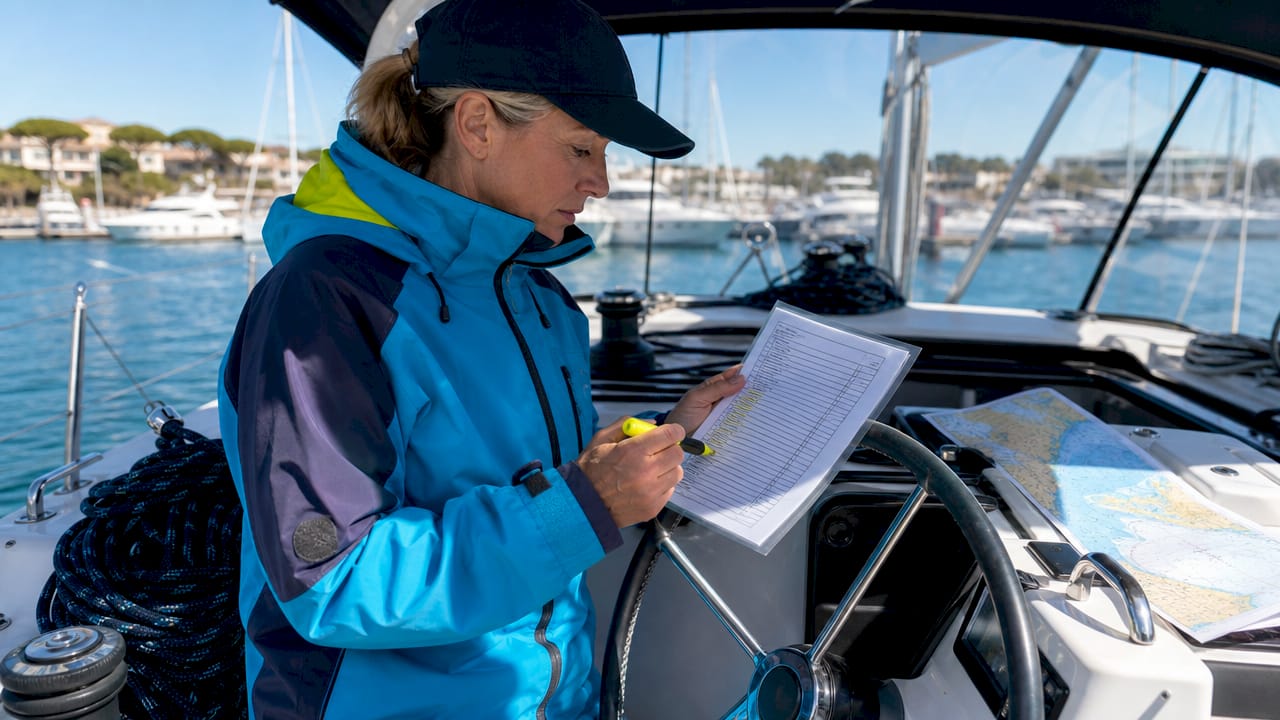
Every safe flotilla day starts before you leave the dock. Skippers must complete a formal pre-departure checklist every morning, covering fuel levels, engine systems, life-saving equipment, and fire suppression gear. Skipping even one item creates a gap that can escalate fast once you are out on open water.
Here is the full sequence to run through each morning:
- Fuel level. Check that you have enough for the planned passage plus a reserve. Running dry mid-crossing in a flotilla puts every boat behind you at risk.
- Engine cut-off switch (ECOS). Attach the kill cord to your wrist or life jacket and test the function. Neglecting engine kill-cord tests is one of the most common and most dangerous oversights on recreational boats.
- Life jacket inspection. Check inflation mechanisms and confirm each jacket meets a minimum 150N buoyancy rating. A jacket that fails to inflate in cold water is worse than useless because it creates false confidence.
- Fire extinguisher check. Verify pressure gauges are in the green zone and that you carry a minimum of two extinguishers on boats under 15 meters. Check that mounts are secure and accessible.
- Navigation lights. Test all running lights the evening before departure and again at dawn. Poor visibility conditions can arrive without warning in the Mediterranean.
- Bilge pump and through-hulls. Confirm the bilge pump operates and that all through-hull fittings are closed and sealed.
Pro Tip: Laminate your checklist and keep it at the helm. A physical list takes 90 seconds to run through and removes the risk of memory lapses on busy mornings.
How should crews practice emergency drills and man overboard (MOB) procedures?
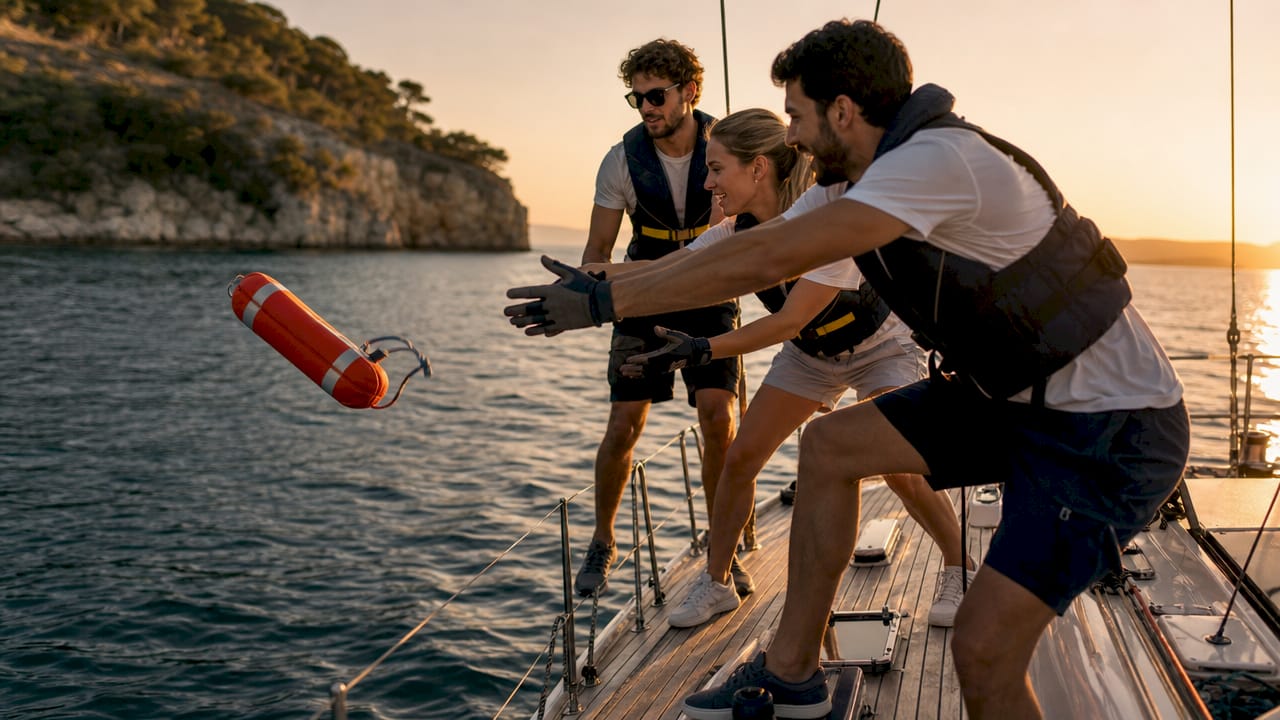
MOB drills are the single most important training exercise a flotilla crew can practice. All passengers must know how to perform MOB maneuvers, including pointing continuously at the casualty, pressing the GPS MOB button, and deploying a life ring immediately. Conduct your first drill at the start of the sailing week, before you leave the marina.
The MOB sequence breaks down into four clear steps:
- Shout “Man overboard” and point. One crew member keeps eyes and a pointed arm locked on the person in the water. Never lose visual contact, even for a second.
- Press the GPS MOB button. This marks the exact position on your chartplotter. Position data becomes critical if visibility drops or the casualty drifts.
- Deploy the life ring and throw rope. Get flotation to the casualty as fast as possible. 75% of recreational boating fatalities are drowning, which means speed of response is the single biggest variable you can control.
- Alert the flotilla on VHF Channel 16. Every other boat needs to know immediately. A second vessel can approach from a different angle while you maneuver, cutting recovery time significantly.
Pro Tip: Run a timed MOB drill using a fender as the “casualty.” Aim to have flotation in the water within 30 seconds. If your crew cannot hit that mark, run the drill again.
Coordinating MOB response across multiple boats in a flotilla requires pre-agreed roles. Assign one boat as the primary recovery vessel and others as spotters before you leave port.
What communication and coordination protocols ensure safety within a flotilla?
Clear communication is what separates a well-run flotilla from a chaotic one. Experienced skippers confirm that safe flotilla sailing depends on communication skills, clear delegation, and crew familiarity with emergency equipment. These are not soft extras. They are the backbone of group sailing risk management.
Every boat in the flotilla needs these communication structures in place:
- Designate a second-in-command. Your co-skipper takes over if you are incapacitated. Brief them on the passage plan, emergency contacts, and equipment locations before departure.
- Assign mooring roles. Decide before arrival who handles bow lines, stern lines, and fender placement. Confusion during docking causes most preventable damage in flotilla sailing.
- Use VHF Channel 16 as the primary emergency channel. Switch to an agreed working channel (typically Channel 72 in European waters) for routine flotilla coordination. VHF radios with DSC capability send your exact GPS position with a single button press during a distress call.
- Establish a daily passage briefing. The lead skipper shares the day’s route, waypoints, weather forecast, and any hazards at a set time each morning. Every crew member on every boat should hear this briefing.
- Agree on visual signals. Hand signals for “slow down,” “stop,” and “all clear” keep communication flowing when radio traffic is heavy or distances are short.
- Share emergency contacts. Every skipper carries the local coast guard frequency, the marina’s contact number, and the flotilla lead’s cell number.
Knowing how to select the right sailing crew for your group directly affects how well these communication protocols hold up under pressure.
What are the best practices for docking, anchoring, and raft-up safety?
Improper docking is the chief cause of physical damage in flotilla sailing. The good news is that most docking damage is entirely preventable with the right technique and a calm, deliberate approach.
Anchoring for stability
Use two anchors, bow and stern, whenever you plan to stay in one position for an extended time. This two-anchor technique locks the boat in place and stops it from swinging in wind shifts. Swinging boats collide with neighbors, and in a crowded anchorage that can mean serious hull damage.
Raft-up safety
Raft-ups, where multiple boats tie alongside each other, are one of the great social joys of flotilla sailing. They also carry real risk if done carelessly. Follow this approach:
| Raft-up element | Best practice |
|---|---|
| Fender count | Minimum three large fenders per side, positioned at beam height |
| Line pattern | Use the “X” pattern to connect boats, crossing bow and stern lines for maximum stability |
| Approach speed | Slow to near-idle before contact; use hand signals to coordinate final approach |
| Anchor support | The outermost boat drops a stern anchor to prevent the whole raft from drifting |
| Crew coordination | Assign one person per boat to handle lines during the connection sequence |
Pro Tip: In windy conditions, raft up with the bow of all boats pointing into the wind. This reduces the load on your lines and keeps the raft stable through the night.
Always communicate your docking plan with the lead crew before entering a tight marina. In popular Mediterranean ports like those in Croatia or Greece, berths fill fast and maneuvering space shrinks quickly. A pre-agreed plan prevents the kind of rushed decisions that cause bumps and scrapes.
Which onboard safety equipment and boating safety measures are non-negotiable?
Every flotilla boat needs a core set of safety gear before it leaves the dock. Meeting USCG and international maritime standards is the baseline, not the ceiling.
Mandatory equipment:
- Life jackets (PFDs). One per person, USCG-approved, with a minimum 150N buoyancy rating for offshore use. Wearing USCG-approved life jackets consistently saves lives, and every crew member should put one on before leaving the marina in rough conditions.
- Flares. Carry a full set of current, in-date flares. Expired flares are illegal and unreliable.
- Fire extinguishers. Two minimum for boats under 15 meters, mounted in accessible locations.
- First aid kit. Stocked for offshore use, including seasickness medication, wound care, and any crew-specific prescriptions.
Strongly recommended gear:
- EPIRB (Emergency Position Indicating Radio Beacon). Automatically transmits your position to rescue services if the boat sinks. This is the piece of kit that saves lives when everything else has failed.
- Personal locator beacons (PLBs). One per crew member for offshore passages. A PLB works even if the boat is gone.
- Ditch bag. A grab bag with water, rations, a handheld VHF, a mirror, and a PLB. Pack it before every offshore leg.
- Backup battery charger. Dead electronics end communication. A portable power bank keeps your handheld VHF and phone alive.
Behavioral rules that matter:
Alcohol use is a leading factor in fatal boating incidents, and marine law enforcement treats it seriously. A strict no-alcohol-while-underway policy is the single most effective behavioral rule a flotilla can enforce. Save the sundowners for the anchorage.
Filing a float plan with a trusted shore contact before every passage gives rescue services a starting point if you go missing. Include your route, expected arrival time, and the number of people on board. It takes five minutes and can save your life. For a broader look at water safety gear when you are off the boat exploring, a snorkel equipment guide is worth reading before any Mediterranean stop.
Key Takeaways
Safe flotilla sailing requires daily pre-departure checks, practiced MOB drills, clear VHF communication protocols, proper anchoring technique, and USCG-compliant safety gear on every vessel.
| Point | Details |
|---|---|
| Pre-departure checks | Run a formal checklist every morning covering fuel, ECOS, life jackets, and fire extinguishers. |
| MOB drills | Practice the full sequence at the start of each sailing week and assign recovery roles across boats. |
| Communication structure | Use VHF Channel 16 for emergencies, hold daily passage briefings, and designate a second-in-command on every boat. |
| Docking and raft-up | Deploy three large fenders per side, use the X-pattern for lines, and approach at near-idle speed. |
| Behavioral safety | Enforce a no-alcohol-while-underway rule and file a float plan before every offshore passage. |
What I have learned after years of watching flotillas set sail
The skippers who run the smoothest flotillas are not always the most technically gifted sailors. They are the ones who invest time in their crew before the first line is cast off. I have seen experienced sailors struggle in flotilla settings because they treated safety briefings as a formality rather than a foundation. The crew that laughs through a MOB drill on day one is the crew that responds calmly when something actually goes wrong on day four.
The piece of advice I give every skipper preparing for a flotilla week: do not wait for an emergency to find out who on your boat is calm under pressure. Run the drills. Assign the roles. Have the uncomfortable conversation about alcohol before you leave the marina. These conversations feel awkward for about 90 seconds and then everyone moves on. Skipping them can cost you far more.
The technical gear matters enormously. But the safety tips that actually make a difference on a real flotilla are almost always about people, not equipment. Who is watching the horizon? Who knows where the flares are? Who has the lead skipper’s number saved in their phone? Get those answers sorted before you leave port, and your flotilla week becomes what it was always meant to be: pure, sun-soaked freedom on the water.
— Sail
Planning a flotilla holiday with safety built in from the start
Sailarmada designs every group sailing holiday around the kind of preparation this article describes. The experienced skippers who lead Sailarmada flotillas across Greece, Croatia, Italy, and beyond hold daily briefings, carry full safety equipment on every vessel, and know their MOB protocols cold.
If you want a group sailing holiday where the safety groundwork is already done for you, Sailarmada’s curated flotilla itineraries are worth a look. Every route is planned with weather windows, safe anchorages, and marina contacts built into the schedule. You bring the crew and the sense of adventure. Sailarmada handles the coordination that keeps everyone safe and smiling. Browse the full range of sailing holiday options and find the flotilla that fits your group.
FAQ
What are the most important flotilla sailing safety procedures?
The most critical procedures are daily pre-departure equipment checks, practiced MOB drills, VHF radio communication protocols, and a strict no-alcohol-while-underway policy. These four elements cover the majority of preventable incidents in group sailing.
How often should a flotilla crew practice MOB drills?
Run a full MOB drill at the start of every sailing week, before leaving the marina. Assign specific roles to each crew member so the response is automatic if a real emergency occurs.
What safety equipment is required on every flotilla boat?
Every boat needs USCG-approved life jackets, in-date flares, at least two fire extinguishers for vessels under 15 meters, a VHF radio with DSC, and a first aid kit. EPIRBs and personal locator beacons are strongly recommended for offshore passages.
Why is a float plan important for flotilla sailing?
A float plan gives shore contacts and rescue services your route, expected arrival time, and crew count. If you go overdue, that information gives rescuers a precise starting point rather than an open ocean to search.
How do you safely raft up multiple boats in a flotilla?
Approach at near-idle speed, deploy a minimum of three large fenders per side, and use the X-pattern to connect bow and stern lines between boats. The outermost boat should drop a stern anchor to keep the entire raft stable overnight.