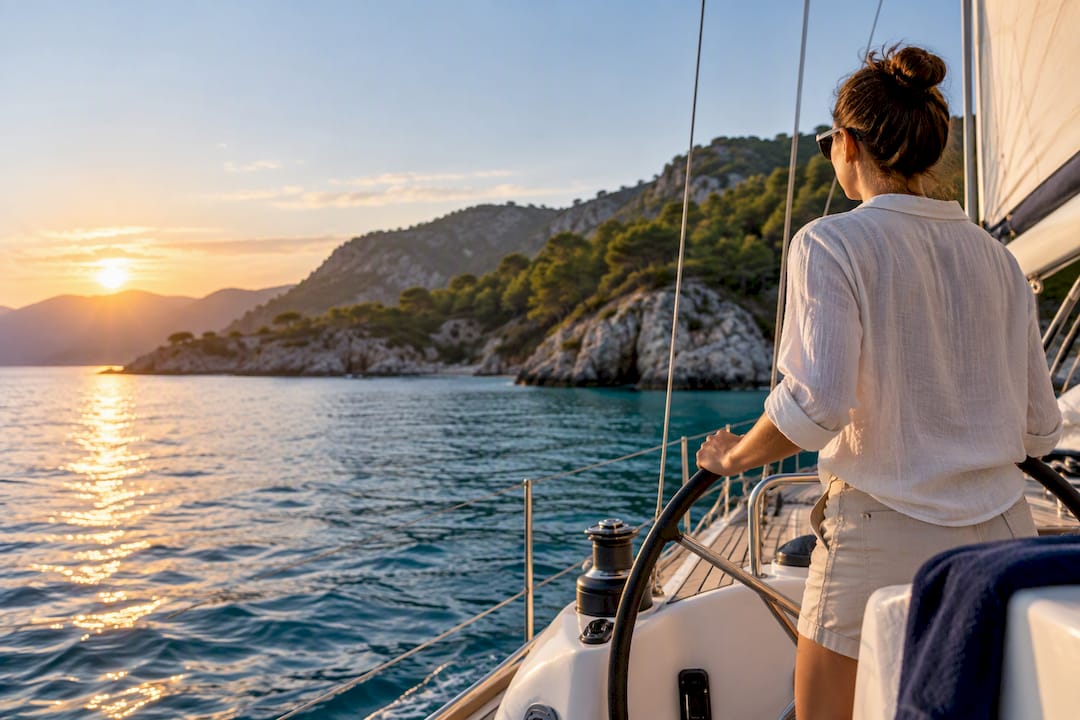
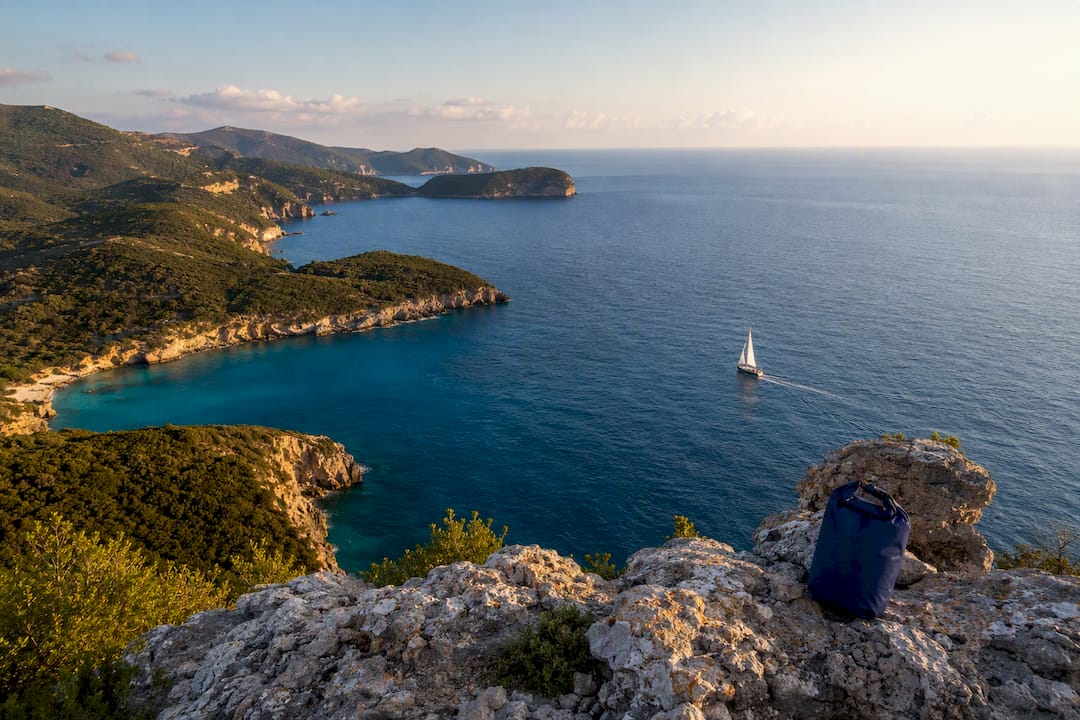
If you want one route that delivers the Ionian’s best coves, easiest sailing, and least stress, start at Lefkada and sail the classic loop: covering about 120 to 140 nautical miles over seven days, with daily legs generally under 25 nautical miles. Got 10 to 14 days instead? Base out of Corfu and stretch north into Paxos and Antipaxos before dropping south to join the same loop.
Pe scurt:
- Starting the classic Lefkada loop covers 120 to 140 nautical miles in seven days with daily legs under 25 miles and avoids strenuous passages.
- Extending to a 14-day itinerary involves adding the north Ionian, with routes involving Corfu, Paxos, Antipaxos, and optional southern extensions, spreading about 200 to 220 NM over nearly twice the time.
- For smooth logistics, plan provisioning outside peak hours, arrive at popular ports between 11:00 and 13:00, and consider one rest day per week to avoid burnout.
- The dominant summer wind is the Maistros, a northwest wind building into 10 to 18 knots by afternoon, shaping departure times and anchoring strategies.
- Using experienced local skippers through services like Sailarmada can simplify route planning, real-time adjustments, and regulatory navigation in Greek waters.
Cuprins
- What Does a 7-Day Ionian Sailing Itinerary Actually Look Like?
- How Do You Extend This Into a 10 to 14 Day Grand Tour?
- Should You Start From Corfu Instead of Lefkada?
- What Do You Need to Handle for Base Logistics and Provisioning?
- When Is the Best Time to Sail the Ionian, and What Winds Should You Expect?
- How Sailarmada Simplifies an Ionian Sailing Trip
- What Permits and Regulations Apply to Sailing the Ionian?
- What Cultural Customs Should Sailors Respect in the Ionian?
- Where Can You Find Reliable Route Guides and Charts for the Ionian?
- An Honest Editorial Take on Ionian Route Planning
- Book an Ionian Sailing Trip Without Building It Yourself
- Surse
What Does a 7-Day Ionian Sailing Itinerary Actually Look Like?
The reason the Lefkada loop dominates every serious Ionian sailing itinerary conversation is simple: it packs Meganisi, Kalamos, Ithaca, and Kefalonia into a week without a single grueling passage. You will sail past turquoise coves, dock in candy-colored harbor towns, and still be back at the base with a full day to spare for a slow breakfast before handover.
Here is the day-by-day breakdown.
- Day 1: Lefkada (Nidri) to Meganisi. Check in, provision, and cast off for a short 8 to 12 NM hop to Meganisi. Aim for Vathy or the tiny hamlet of Spilia. Vathy has a working quay where stern-to mooring is common; Spilia is quieter and better suited to anchoring if you want your own patch of water for the night.
- Day 2: Meganisi to Kalamos or Kastos. Distances run 6 to 16 NM depending on which bay you pick. These two islands get skipped by most flotillas, which is exactly the appeal. Stop for a swim-stop lunch in one of the sheltered coves, then push on to whichever island’s harbor feels calmer for the night.
- Day 3: Kalamos to Ithaca. This is your longest early leg, 17 to 25 NM depending on whether you choose Vathi or Kioni. Both harbors get busy by afternoon in July and August, so plan your arrival window accordingly. If the quay is full, anchoring off and dinghying in works fine in both spots.
- Day 4: Ithaca to Fiskardo. A manageable 12 to 15 NM run to Kefalonia’s prettiest harbor town. Fiskardo’s berths fill quickly in peak season, so arriving before midday matters more here than almost anywhere else on the loop. If the quay is packed, anchor just outside the harbor mouth and tender in for dinner.
- Day 5: Fiskardo to Asos, Sami, or Sivota. This is your flex day, 18 to 25 NM, and the destination should depend on what the wind is doing that morning. Asos rewards you with a dramatic fortress backdrop; Sami offers easier provisioning; Sivota gives you a sheltered fallback if a blow is forecast.
- Day 6: Relax or reposition. Treat this as a rest day in Sivota or Vasiliki, or make a short 10 to 20 NM hop to a quieter bay if you are craving one more anchorage before heading back.
- Day 7: Return to Lefkada. A final 10 to 15 NM run back to base. Aim to arrive early enough to handle fuel, cleaning, and handover without rushing, and use the extra hour to restock forgotten provisions before your evening flight or next leg.
Sfat profesional: Build one deliberately “boring” day into the middle of the week. Crews who sail hard every single day burn out by day five, and the smaller islands like Kalamos reward you precisely because you are not rushing through them.
How Do You Extend This Into a 10 to 14 Day Grand Tour?
Doubling your time on the water does not mean doubling your ports; it means adding the north Ionian while preserving the sheltered rhythm of the classic loop. A well-sequenced 14-day route looks like this:
- Corfu to Paxos: a full-day passage, often around 35 nautical miles depending on your exact start and end points, so plan an early departure.
- Paxos to Antipaxos: a short hop, ideal for a beach-and-swim afternoon before continuing south.
- Antipaxos to Lefkada: a longer repositioning leg that connects the north to the classic loop.
- Lefkada through Meganisi, Ithaca, and Kefalonia: essentially the 7-day route described above, run at a slower pace.
- Kefalonia to Zakynthos and back: an optional southern extension for the final days, adding another distinct island character to the trip.
Total distance across a route like this lands around 200 to 220 nautical miles, noticeably more than the 7-day loop’s 120 to 140 NM footprint, but spread across nearly double the days. The math works in your favor: more distance, but far less daily pressure.
The single hardest planning decision is whether to run this as a one-way trip (fly into Corfu, out of a southern base) or a round-trip loop back to your starting point. One-way routes let you cover more ground without backtracking, but they usually cost more in one-way charter fees and require more careful flight timing. A round-trip loop costs less and simplifies logistics, at the price of a day or two spent retracing water you have already sailed.
Whichever you choose, build in at least one full rest day per week. A 14-day Ionian tour with zero downtime is a marathon disguised as a vacation, and that is not what the Ionian is for.
Should You Start From Corfu Instead of Lefkada?
Corfu makes sense as your base if you have more than a week, want direct flight connections, or simply prefer the north Ionian’s slightly wilder character over the polished marina towns further south. A sample 5 to 7 day Corfu loop looks like this:
- Corfu Town to Paxos: a longer opening leg, often the biggest single-day distance of the whole trip.
- Paxos to Antipaxos: a short 3 to 5 NM transfer, perfect for an easy second day built around swimming and snorkeling.
- Antipaxos back toward Corfu’s southern anchorages or Gaios: a moderate return leg with several sheltered bay options along the way.
This route suits travelers chasing beach days and short hops over deep cultural exploration. It is a fundamentally different feel from the Lefkada loop’s tighter island cluster. Wind direction matters here too: starting north means you are more exposed to open Adriatic swell on the Corfu to Paxos leg, while starting south from Lefkada keeps you sheltered by island chains almost the entire week. If comfort and predictability matter more to your crew than raw distance, Lefkada wins. If you want a slightly rawer sailing experience with fewer boats around, Corfu delivers that instead.
What Do You Need to Handle for Base Logistics and Provisioning?
Choosing your charter base shapes the whole trip before you even leave the dock. Lefkada and Nidri sit at the geographic center of the classic loop, which means minimal empty-leg sailing and the easiest check-in logistics of any Ionian base. Preveza, just across the strait, offers similar positioning with sometimes better airport access. Corfu suits the north Ionian grand tour but adds a longer opening passage if you are heading south. Kefalonia works well as a secondary base for one-way itineraries but sees less charter fleet availability than Lefkada.
Provisioning follows a predictable rhythm on every base:
- Stock up before 11:00 or after 17:00. Local supermarkets in Nidri, Preveza, and Gaios get slammed with charter crews mid-morning; shopping outside that window saves real time.
- Buy perishables for two to three days at a stretch, then top up at smaller island shops along the way rather than trying to load a week’s worth of fresh produce on day one.
- Confirm your check-in window with the charter base, since most Ionian operators run Saturday-to-Saturday handovers with a fixed afternoon boarding time.
Berthing strategy deserves its own rule: arriving between 11:00 and 13:00 at popular ports like Fiskardo, Vathi, and Sivota is the single most effective habit for actually getting a berth in July and August. Arrive at 16:00 and you are anchoring outside the harbor or motoring on to a backup port instead.
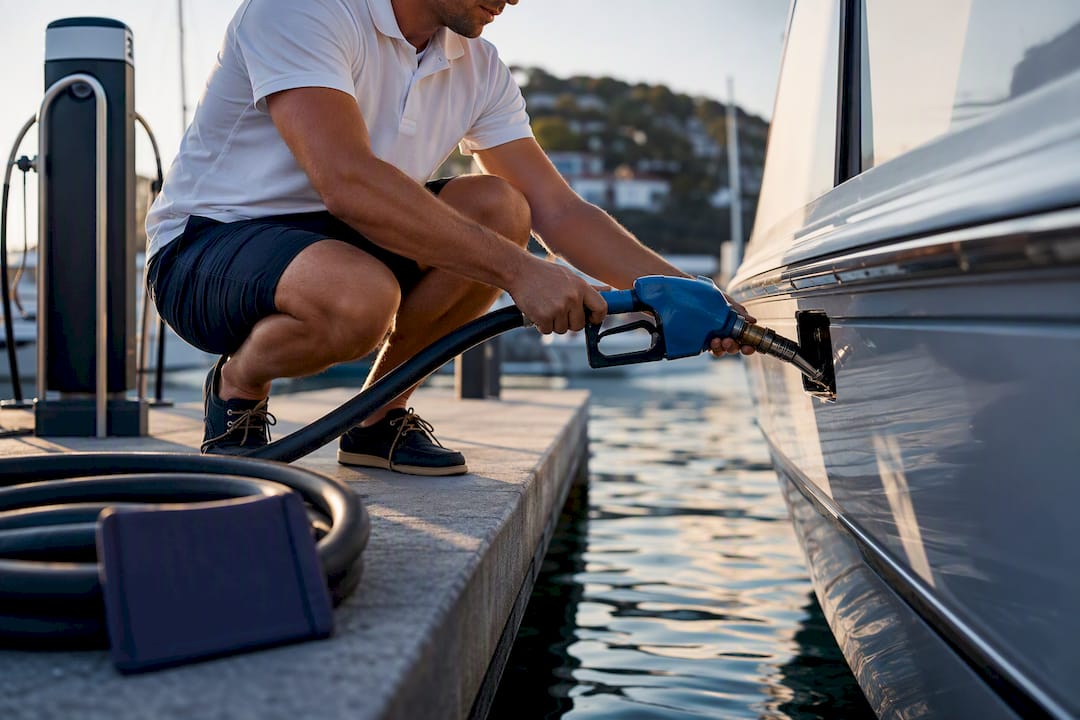
Fuel budgeting is straightforward once you know your usage pattern. A motor-heavy week (light wind, lots of engine hours between anchorages) on a mid-size sailing yacht typically burns noticeably more diesel than a sail-heavy week where you are actually using the Maistros. Budget on the higher end if your crew is not confident under sail, and always ask your charter base for a rough liters-per-hour figure for your specific boat before you leave the dock.
Sfat profesional: Call the harbormaster or marina directly on VHF or by phone an hour before arrival during peak season. A five-minute call can save you an hour of circling a full harbor looking for space.
When Is the Best Time to Sail the Ionian, and What Winds Should You Expect?
The Ionian sailing season runs roughly late April through early October, but not every month inside that window sails the same. June and the first two weeks of September consistently deliver the best combination of warm water, reliable wind, and anchorages that are not packed three boats deep.
Wind pattern to know: a Ionian’s dominant summer wind is the Maistros, a north-westerly that stays light in the morning and builds through the afternoon, typically settling into the 10 to 18 knot range. Mornings are for making distance; afternoons are for slowing down and enjoying whatever anchorage you have already reached.
That pattern should shape your whole daily rhythm: leave early, sail your longer leg before noon, and treat the afternoon breeze as your cue to already be anchored rather than still hunting for a spot. Build in simple safety rules too. Skip exposed approaches when wind exceeds 20 knots or swell tops one meter, and always have a named backup port in mind before you leave the morning anchorage. Check the forecast the evening before departure, again at 06:00, and confirm conditions with the local port authority or VHF once you are close to your destination.
How Sailarmada Simplifies an Ionian Sailing Trip
Building this itinerary yourself is entirely doable, but a lot of the friction, port-timing guesswork, provisioning runs, fuel math, disappears when someone who sails these waters every season handles it for you. Sailarmada curates private and group charters across the Ionian with experienced skippers who already know which Fiskardo mooring spots open up at 10:30 and which Kalamos anchorage holds best in a Maistros blow.
Beyond route knowledge, Sailarmada’s skippers adjust the day-by-day plan in real time for wind, crowding, or a crew that just wants an extra swim stop. If you would rather sail this itinerary than build it, Sailarmada’s private sailing option is the natural next step.
What Permits and Regulations Apply to Sailing the Ionian?
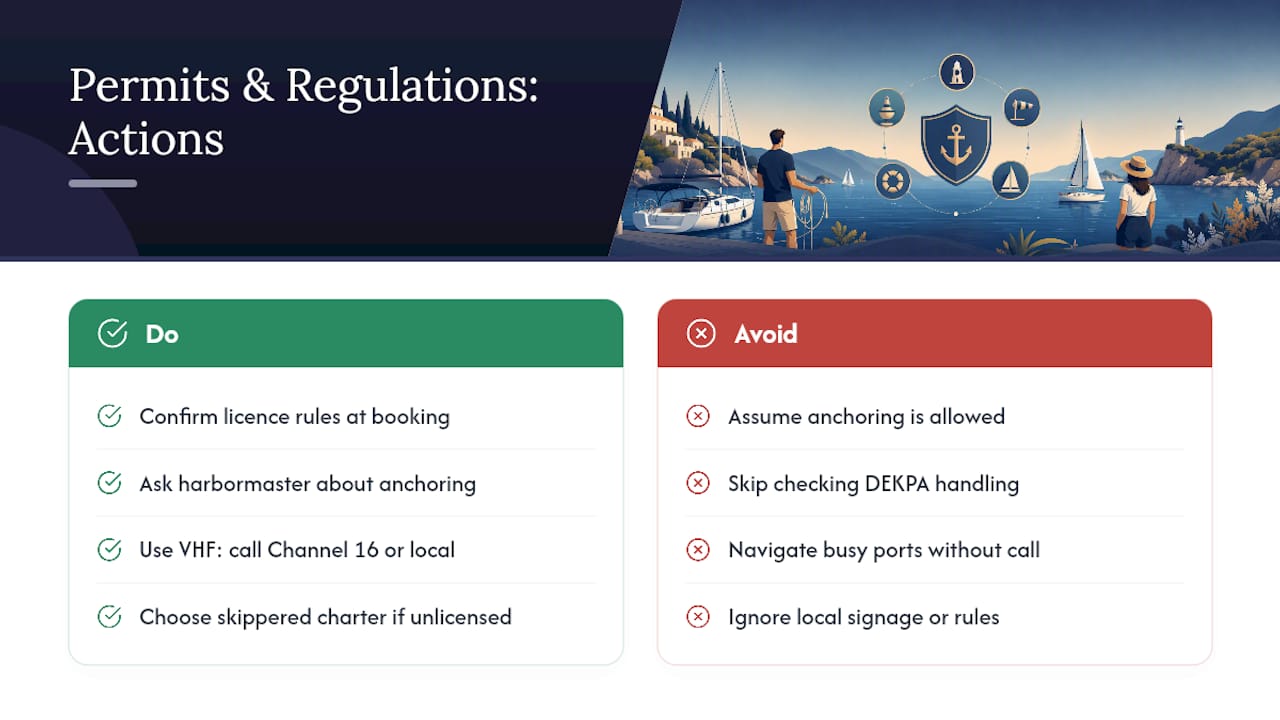
Bareboat charter in Greek waters generally requires at least one crew member holding a recognized sailing qualification, along with prior sailing experience the charter company can verify during booking. Charter companies typically handle the DEKPA (the Greek transit log) on your behalf as part of check-in, so you rarely deal with the paperwork directly, but you should confirm this with your specific charter base before departure.
Anchoring rules vary by bay. Some popular anchorages restrict overnight mooring during peak months, and certain marine park zones around the Ionian islands limit anchoring entirely to protect seagrass and reef areas. Check local signage and, when in doubt, ask the harbormaster rather than guessing.
If nobody aboard holds a qualifying license, a skippered charter is the straightforward solution, and it also removes the burden of navigating unfamiliar approaches at night or in poor visibility. Skippered boats are legally operated by the professional skipper, sidestepping the licensing question for the rest of the crew entirely.
One more practical note: VHF radio use in Greek waters follows international maritime protocol, and most harbormasters expect a call on Channel 16 or a published local working channel before you attempt to enter a busy port. Keep the process simple: confirm your qualification requirements with your charter company at booking, and treat local anchoring restrictions as fixed rules, not suggestions.
What Cultural Customs Should Sailors Respect in the Ionian?
Greek harbor towns run on a rhythm that rewards patience over urgency. Most tavernas do not open for dinner until 19:00 or later, and locals eat noticeably later than most visiting sailors expect, often past 21:00. Plan your evening meal around that clock rather than fighting it.
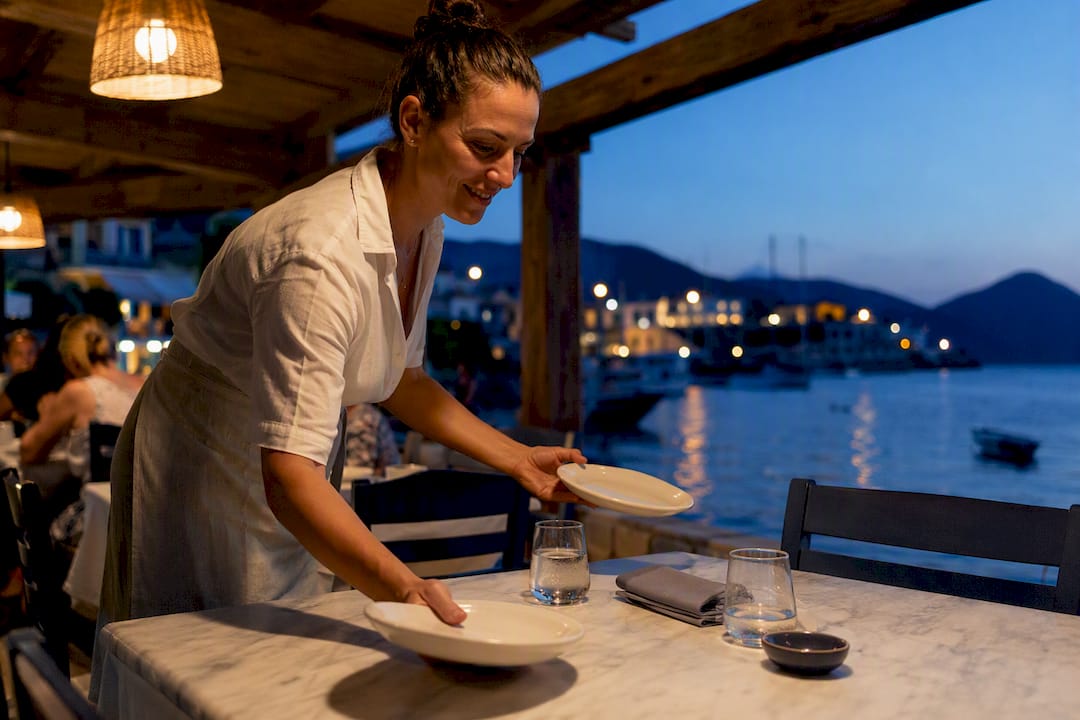
Stern-to mooring in small harbors is a shared, informal system. Neighboring boats will often help you tie up, and returning that favor to the next arrival is simply how it works. A friendly wave or a few words of thanks go a long way in these tight-knit harbor communities.
Quiet hours matter more than a visiting sailor might assume. Running a generator or blasting music late into the night in a small anchorage like Kastos or Kalamos is a fast way to earn dirty looks from neighboring boats and shoreside residents alike. Keep noise down after 22:00, especially in the smaller, quieter bays that do not see heavy tourist traffic.
Tipping in tavernas runs 5 to 10% for good service, though it is never mandatory. Basic Greek phrases, “kalimera” for good morning, “efharisto” for thank you, are appreciated even in the most tourist-heavy harbor towns. Small gestures like these tend to open doors, sometimes literally, when a shop owner decides to stay open an extra ten minutes for a sailor who made the effort.
Where Can You Find Reliable Route Guides and Charts for the Ionian?
For real-time chart detail on anchorages, hazards, and holding ground, OpenSeaMap’s nautical layers are worth bookmarking before departure. For structured day-by-day route plans covering both the 7-day and 14-day versions of this trip, Sail Greece Guide’s Ionian itineraries fill in the gaps. Cross-check both against your charter base’s own briefing, which usually reflects the most current local conditions.
An Honest Editorial Take on Ionian Route Planning
Most Ionian guides oversell distance and undersell timing. The conventional wisdom treats an itinerary as a list of islands to check off, when the real variable that determines whether your week feels relaxed or frantic is arrival time at port, not miles sailed. A crew that covers 15 NM but leaves at 11:00 and arrives at a crowded harbor at 16:00 will have a worse day than a crew that covers 22 NM but leaves at 08:00.
The most overrated piece of advice in this category is “see everything.” Skipping Zakynthos or Corfu to spend an extra night in Kalamos is not a compromise, it is often the better decision. The smaller, less-photographed islands consistently deliver a calmer, more genuine version of the Ionian than the harbors every flotilla stops at.
If you take one thing from this article, prioritize your morning departure time over your destination choice. Everything else, the port you pick, the anchorage you settle into, sorts itself out once you are moving early.
- Sail
Book an Ionian Sailing Trip Without Building It Yourself
Reading this itinerary is one thing. Actually executing arrival timing, fuel budgeting, and provisioning runs across seven days with a full crew is another. Sailarmada exists for exactly that gap, giving you the Lefkada loop or the Corfu grand tour without spending your evenings on chart plotting and berth-availability guesswork.
Every charter typically comes with a skipper who already knows local approaches, crowd patterns, and anchorage conditions. Whether you want a private family charter or a curated group sailing itinerary, the route customization and local knowledge come built in, not bolted on after booking. If this 7-day loop or the 14-day grand tour sounds like your trip, the next step is simple: check available dates and yacht options on Sailarmada’s private sailing page and get a route built around your crew’s pace, not a generic template.
Surse
- The Classic Ionian Loop from Lefkada: Meganisi, Ithaca, Kefalonia
- Ionian Islands sailing itinerary: 7-day route guide 2026 – Sailing Click
- Sailing the Ionian guide – The Vanabond Tales
- Ionian Sea Sailing Guide: Top Routes and Tips
Recomandate
- Vacanțe cu vele și căpitan în Grecia pentru familii
- Skipper a testat itinerariul de navigație în Ciclade cu planuri gata de făcut zi de zi
- Itinerarii de navigație de 7 până la 10 zile în Dodecanez pentru echipaje cu niveluri mixte de experiență
- Idei pentru un tur al insulelor din Marea Mediterană: trasee în Grecia + opțiuni de iahturi