Good Mediterranean sailing etiquette comes down to three core habits: follow the skipper’s lead, respect your neighbors on the water, and leave every anchorage cleaner than you found it. Two quick examples to set the tone:
- Onboard behavior: When you step aboard, remove your shoes before crossing the deck, greet the captain first, and wait for the safety briefing to finish before asking about the itinerary. Simple, but it signals respect immediately.
- On-water courtesy: When two sailboats converge, the vessel on port tack gives way to the one on starboard tack, per COLREGs and US Sailing navigation rules. The stand-on vessel holds course; the give-way vessel alters early and decisively.
These aren’t arbitrary rules. They exist because a 40-foot yacht in a crowded Greek anchorage or a Croatian marina is a shared space where safety, comfort, and local goodwill all depend on everyone playing by the same playbook. Sailarmada’s skipper briefings cover every one of these customs before departure, so guests arrive informed and confident.
Principalele concluzii
Respectful Mediterranean sailing etiquette covers everything from pre-charter communication and onboard behavior to navigation rules, tipping customs, and environmental responsibility.
| Punct | Detalii |
|---|---|
| Communicate before boarding | Share dietary needs, medical info, and arrival times with the skipper before departure to prevent friction. |
| Împachetați numai genți moi | Hard suitcases damage interiors and won’t fit in cabins; use a duffel or dry bag instead. |
| Follow the five navigation rules | Port gives way to starboard, give-way alters early, overtaking keeps clear, and power yields to sail in most cases. |
| Respect quiet hours | Keep noise down after 10 PM in anchorages and marinas; check local rules on arrival. |
| Tip an appropriate gratuity on crewed charters, varying by country and service quality | Cash at the end of the trip is the norm in Greece, Croatia, and Italy; coordinate as a group. |
| Sailarmada’s briefings cover it all | Every Sailarmada booking includes safety, navigation, cultural, and environmental guidance from experienced skippers. |
Cuprins
- What should you do before boarding a Mediterranean charter?
- How to make a great first impression when stepping aboard
- Daily onboard behavior that keeps everyone happy
- How do anchoring and marina etiquette work in the Mediterranean?
- What are the basic navigation rules every charter guest should know?
- How should you treat crew, and what’s the right tip for a Mediterranean charter?
- Five common etiquette mistakes and how to fix them
- How Sailarmada prepares guests for a respectful charter experience
- Ready to sail the Mediterranean the right way?
- Surse
What should you do before boarding a Mediterranean charter?
The best Mediterranean sailing etiquette starts well before you set foot on the dock. Most friction on multi-guest charters traces back to information that nobody shared ahead of time, and pre-boarding communication is one of the simplest ways to prevent social friction on the water.
Send your skipper or charter manager the following before departure:
- Dietary restrictions and allergies — be specific (“shellfish allergy, carries an EpiPen”) rather than vague (“eats everything mostly”).
- Medical needs — seasickness medication, prescription drugs, or any condition the crew should know about in an emergency.
- Arrival time and port of embarkation — confirm the exact marina, berth number, and your ETA so the crew can prepare.
- Activity preferences — snorkeling, coastal hikes, nightlife, or a mix? Sharing this upfront lets the skipper plan the route.
- Passenger count and ages — especially relevant for families with young children or guests with mobility considerations.
Packing matters more than most first-timers expect. Soft duffel bags or roll-top dry bags are the standard on Mediterranean yachts because hard suitcases damage cabin walls and eat up storage space. For clothing, long-sleeve sun shirts offer UV protection on deck, while loose breathable fabrics keep you comfortable during daytime sailing; a light collared shirt or sundress works well for evenings ashore. Non-marking rubber-soled shoes (or bare feet) are the rule on deck. Pack a modest cover-up for visiting churches or traditional villages in southern Italy or Greece, where shorts and swimwear are unwelcome ashore.
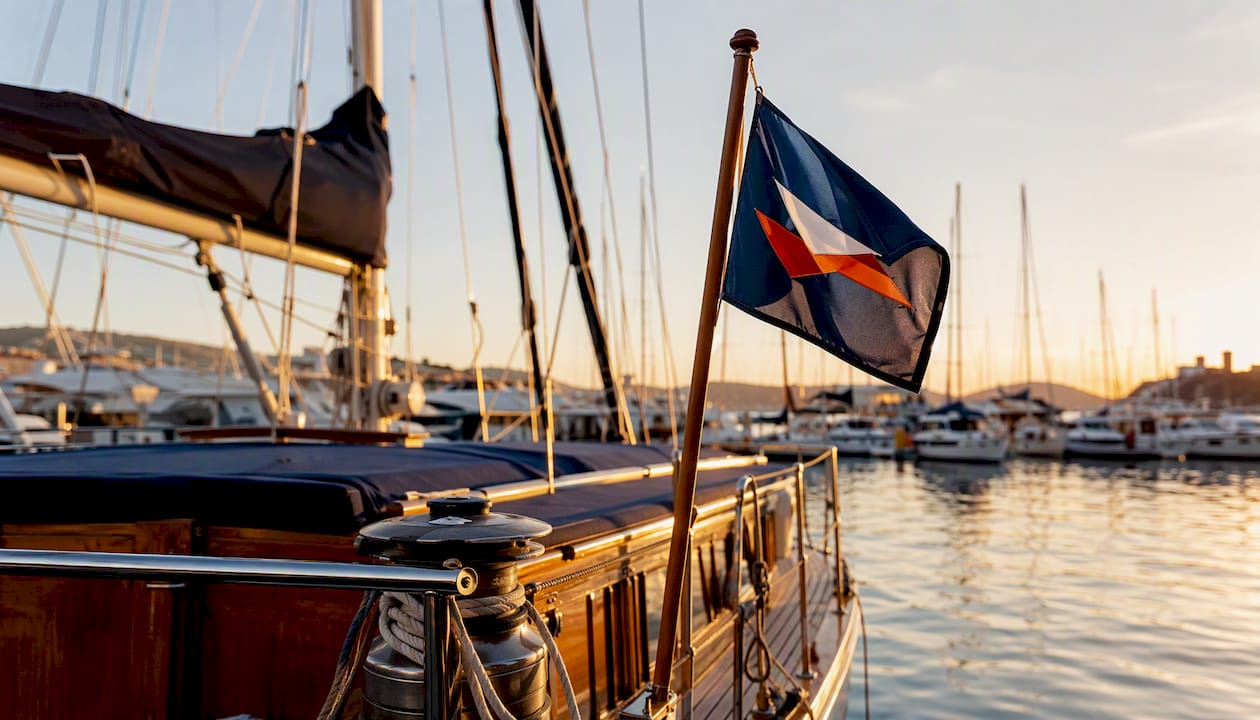
Before departure, confirm your berth reservation with the marina, check whether a courtesy flag is required for the country you’re entering, and ask the skipper what time they prefer the safety briefing. Flying the correct courtesy flag and respecting local anchoring restrictions are two of the most visible signs that a crew knows Mediterranean customs.
Sfat profesional: Label any shared medications or allergy-specific food items with your name and a brief note before you pack them. It takes two minutes and prevents the kind of confusion that can turn a galley into a guessing game on day one.
How to make a great first impression when stepping aboard
Boarding a yacht is its own small ceremony, and getting it right sets the tone for the whole trip. The skipper is the vessel’s legal authority, so greet them first, by name if you know it, with a firm handshake and a genuine “Thanks for having us.” Crew members come next, in whatever order they’re introduced.
The moment you cross the lifelines:
- Remove your shoes and stow them in the designated rack or bag near the companionway. Ask if you’re unsure where.
- Introduce yourself briefly — first name, where you’re from, and one line about your sailing experience. Nobody needs your full biography, but a quick intro helps the crew calibrate how much hand-holding to offer.
- Ask where to stow your bag before you start exploring. Cabins on a 40-foot sailboat are tight, and dropping gear in the wrong spot creates immediate friction.
When the safety briefing starts, stop whatever you’re doing and listen. This isn’t a formality. The skipper will cover life jacket locations, flare procedures, man-overboard protocol, and the heads (toilet) system. Ask clarifying questions afterward, not during. A good question to ask: “Is there anything specific about this boat’s layout I should know before we get underway?” It shows you’re engaged without interrupting the flow.
A few short scripts that work well:
- “Hi, I’m [name]. Really excited to be here. Where would you like me to put my bag?”
- “Just a heads-up — I mentioned it in the booking notes, but I’m vegetarian. Happy to help with provisioning if that’s useful.”
- “Should I wait on deck or is there somewhere specific you’d like guests during departure?”
These lines are small, but they signal that you’re a guest who makes the crew’s job easier, not harder.
Daily onboard behavior that keeps everyone happy
Life aboard a Mediterranean yacht is genuinely wonderful, and a few shared habits keep it that way for everyone. The boat is a small, shared home, and the etiquette that governs it reflects that reality.
Shared spaces and cleanliness:
- Keep personal items in your cabin or designated storage. The cockpit and saloon are communal.
- Rinse saltwater gear before bringing it below. Wet towels and dripping wetsuits left in the cabin are a quick way to create mold and resentment.
- Wash up after yourself in the galley. On a charter with a cook, stay out of the galley unless invited.
- Ask before using the last of any shared provisions.
Water conservation is non-negotiable on a yacht. Freshwater tanks are finite, and refilling mid-passage is often inconvenient. Keep showers under two minutes, turn off the tap while brushing teeth, and use the marina showers when you’re in port. It’s one of those habits that experienced sailors follow automatically and first-timers often overlook.
Noise is the most common source of tension in anchorages. Daytime music at a reasonable volume in the cockpit is generally fine. After 10 PM in a marina or anchorage, keep it down. Good sailing etiquette means keeping noise low in anchorages and marinas, and local rules in some Greek and Croatian marinas enforce quiet hours formally. If you’re not sure of the local curfew, ask the marina staff when you arrive.
Privacy aboard is real even in tight quarters. Knock before entering someone’s cabin. Don’t assume that because a door is ajar, you’re welcome. Respect that crew members have their own sleeping areas, which are off-limits to guests unless explicitly invited.
On environmental responsibility: never throw anything overboard, including food scraps, in protected bays. Sort recyclables when the marina provides bins. And if your skipper asks you to avoid a particular patch of seabed, it’s almost certainly to protect Posidonia seagrass, a protected marine habitat across much of the Mediterranean. Using designated moorings instead of anchoring on Posidonia beds is both a local rule and a shared etiquette expectation among experienced skippers.

How do anchoring and marina etiquette work in the Mediterranean?
Mediterranean anchorages fill fast, especially in July and August along the Amalfi Coast, the Dalmatian islands, and the Greek Cyclades. Arriving early, typically before noon, gives you the best choice of position and avoids the awkward dance of squeezing into a crowded bay.
At anchor:
- Judge swing room carefully. Your boat will swing on its anchor chain as the wind shifts, and so will every other boat nearby. A good rule of thumb: allow at least one full boat length of clear water on each side, more in open roadsteads.
- If a bay is nearly full, ask the nearest boat before dropping your hook. A simple hail of “Mind if we anchor here?” goes a long way.
- Arrive early at popular anchorages and be ready for stern-to mooring — it’s the standard throughout the Mediterranean, from the French Riviera to Turkey.
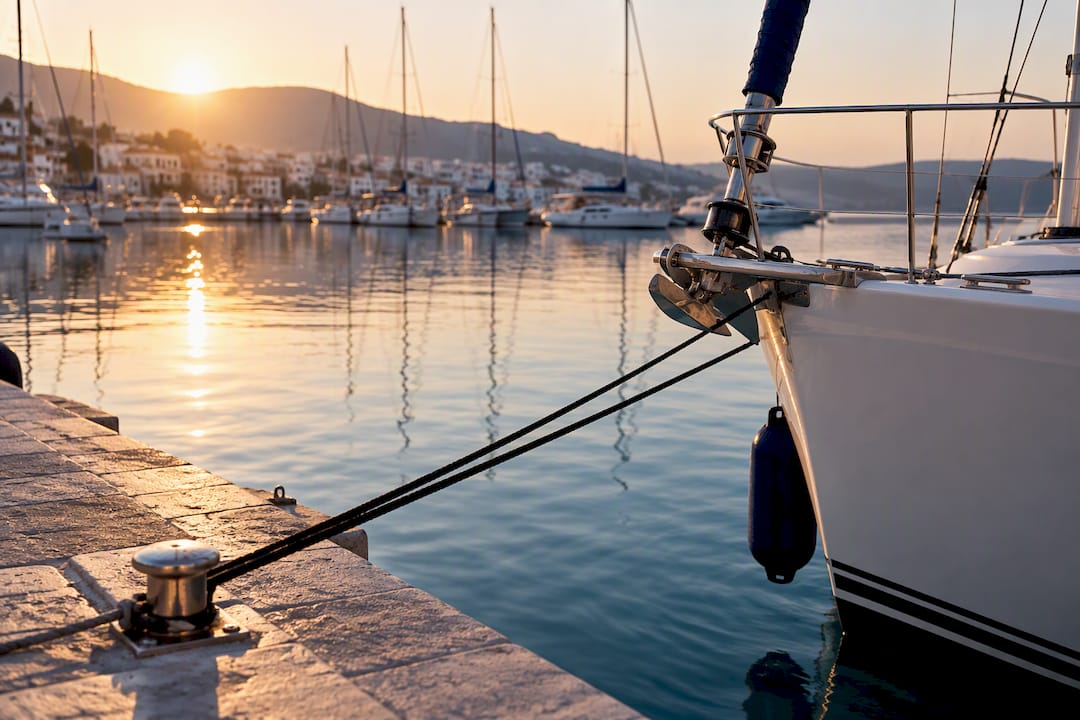
Mediterranean mooring (stern-to) means backing your boat into a berth with the stern tied to the dock and the bow held by an anchor or a lazy line. As a guest, your job during this maneuver is to stay out of the way unless the crew asks for help. Stand clear of lines, keep children away from the stern, and be ready to step off quickly with a line if asked.
Dinghy and tender etiquette:
- Use oars or a low throttle when approaching other boats. A wake from a dinghy engine can rock a neighboring vessel and spill drinks, or worse.
- Secure your dinghy properly at night so it doesn’t bang against the hull of another boat.
- Never tie your dinghy to another vessel’s stern without asking first.
Preparing lines and fenders in advance and approaching slowly are the two behaviors marina staff and neighboring crews notice most. They mark the difference between a crew that knows what it’s doing and one that’s about to cause a problem.
Sfat profesional: When approaching a full anchorage, hail the nearest boat on VHF Channel 72 (the common working channel in the Med) or simply call across the water. Most skippers are happy to advise on depth and holding ground, and the exchange builds goodwill immediately.
What are the basic navigation rules every charter guest should know?
You don’t need a captain’s license to understand the five navigation rules that govern most situations on the water. US Sailing summarizes these clearly, and knowing them helps you understand why the skipper makes the moves they do.
-
Port tack gives way to starboard tack. If your boom is on the starboard side, you’re on port tack and you give way. Example: Two sailboats converging on opposite tacks — the port-tack boat bears away and passes behind the starboard-tack vessel.
-
Stand-on vs. give-way. The stand-on vessel holds course and speed; the give-way vessel alters course early and clearly. Example: You’re the stand-on boat. The other skipper isn’t moving. Hold your course a moment longer, then take action yourself — your safety matters more than being technically right.
-
Windward gives way to leeward. On the same tack, the boat closer to the wind gives way to the one further downwind. Example: You’re sailing close-hauled; a boat on a broad reach is to leeward. You alter course to avoid them.
-
Overtaking gives way. If you’re catching up to another vessel from behind, you’re the overtaking vessel and you keep clear. Example: You’re running downwind faster than the boat ahead. Bear away to pass well to their side, not close across their stern.
-
Power gives way to sail (with exceptions). Recreational powerboats generally give way to sailboats under sail. But large commercial vessels, ferries, and ships constrained by their draft do not. Example: A ferry crossing the Adriatic has limited maneuverability. Give it a wide berth regardless of your technical right of way.
Good etiquette on the water means making early, decisive maneuvers so other skippers aren’t left guessing. A last-second course change is more dangerous than a slow, obvious one made well in advance. Keep fenders inboard until you’re actually approaching a berth, and avoid dragging lines in the water where they can foul a propeller.
Sfat profesional: When in doubt near large commercial traffic, call the vessel on VHF Channel 16 and state your position and intentions. Most commercial captains appreciate the communication and will confirm whether they’ve seen you.
How should you treat crew, and what’s the right tip for a Mediterranean charter?
The skipper is not your tour guide or your employee. They are the vessel’s legal authority, and their safety decisions are final. If the skipper says the weather is too rough to reach a particular island today, that’s not a negotiation. Respecting that authority is the single most important piece of crew etiquette on any charter.
Do and don’t list for guest-crew relations:
- Do thank the crew at the end of each day. It costs nothing and matters more than most guests realize.
- Do ask before entering any crew-only area, including the helm station when underway unless invited.
- Don’t interrupt the skipper during a maneuver, docking, or any moment of concentrated navigation.
- Don’t offer unsolicited advice on how to sail the boat, even if you have experience.
- Do let the crew know immediately if something feels unsafe or if a guest is unwell.
Tipping on Mediterranean charters follows a general convention rather than a fixed rule. In Greece and Croatia, cash tips handed directly to the skipper at the end of the trip are the norm. In Italy, a tip split between skipper and any additional crew is appreciated.
If you’re traveling as a group, coordinate the tip before the last day so one person handles it cleanly. A handwritten thank-you note alongside the tip is a genuinely appreciated touch, especially on longer charters. Small local gifts, a bottle of wine from a port you visited together, or a good review on the charter platform are all meaningful signals of appreciation.
Five common etiquette mistakes and how to fix them
These scenarios come up on Mediterranean charters more often than you’d think. Each one is easy to avoid once you know what’s actually at stake.
-
Photography without consent. A guest photographs a neighboring boat’s sunbathing occupants and posts the image online. The consequence: real offense, potential legal exposure in some EU jurisdictions, and a soured anchorage atmosphere. Fix: Ask before pointing a camera at anyone on another vessel. A simple wave and a thumbs-up question is all it takes.
-
Ignoring crew instructions during a maneuver. A guest stays in the cockpit during a stern-to approach despite being asked to move forward. The consequence: they’re in the way of a line, and the maneuver becomes dangerous. Fix: When the crew says move, move immediately and ask questions afterward.
-
Late-night loud music in an anchorage. A group plays amplified music past midnight in a quiet bay in Croatia. The consequence: neighboring boats bang on the hull, the marina authority is called, and the group faces a fine. Fix: After 10 PM in any anchorage or marina, switch to acoustic or use headphones. Check local quiet-hour rules when you arrive.
-
Improper waste disposal. A guest tosses a plastic bag overboard in a protected bay near a Posidonia seagrass zone. The consequence: environmental damage, potential fines under local marine protection law, and embarrassment for the whole crew. Fix: All waste goes in the onboard bin. Sort recyclables and dispose of everything at the marina.
-
Hard suitcases in the cabin. A guest arrives with a large hard-shell rolling suitcase. The consequence: it won’t fit in the cabin, scratches the interior, and blocks the companionway. Fix: Use soft bags instead of hard suitcases — a duffel or dry bag that can be squashed under a bunk is the right call every time.
A brief note on cultural variation: in southern Italian ports and some Greek island towns, modest dress ashore is genuinely expected. Swimwear in a village square or a church entrance will draw stares and, in some cases, a polite refusal of entry. Pack a light sarong or a pair of linen trousers and use them when you step off the boat.
How Sailarmada prepares guests for a respectful charter experience
Sailarmada’s approach to Mediterranean sailing is built around one idea: a well-briefed guest has a better trip. Every booking includes a skipper-led briefing that covers the following before the lines are cast off:
- Safety briefing: life jacket locations, flare use, man-overboard procedure, and emergency contacts.
- Navigation hazards: local traffic patterns, ferry routes, shallow areas, and restricted zones specific to the destination.
- Local rules: marina quiet hours, anchoring restrictions, courtesy flag requirements, and protected marine areas.
- Environmental guidance: Posidonia seagrass zones, waste disposal procedures, and no-discharge areas.
- Cultural notes: dress codes for shore visits, local customs, and recommended behavior in traditional fishing villages.
On booking, guests receive suggested packing lists, destination-specific cuisine and cultural guides, and the option to submit dietary accommodations in advance. Sailarmada’s itinerarii mediteraneene îngrijite are designed by skippers who know these waters well, from the Ionian islands of Greece to the Dalmatian coast of Croatia and the waters around Sardinia. The routes balance sailing time with shore exploration, so guests spend less time figuring out logistics and more time actually enjoying the trip.
For groups and families, Sailarmada also offers opțiuni personalizate de vacanță pe iaht that include add-ons like local guides, chef services, and early-boarding arrangements, all of which reduce the kind of friction that etiquette missteps tend to create.
Why etiquette is the difference between a good trip and a great one
Here’s what I’ve come to believe after watching countless Mediterranean charters unfold: the guests who have the best experiences are almost never the most experienced sailors. They’re the ones who show up curious, communicate clearly, and treat the boat and the crew with genuine respect.
Etiquette on the water isn’t about following rules for their own sake. It’s about creating the conditions where everyone, guests, crew, and neighbors in the anchorage, can relax and enjoy something genuinely special. A skipper who feels respected makes better decisions. A crew that isn’t managing avoidable friction has more energy to show you the hidden cove that isn’t on any tourist map. And when you leave an anchorage cleaner than you found it, you’re contributing to the culture that makes Mediterranean sailing worth doing in the first place.
The Mediterranean rewards guests who arrive prepared. Everything else, the crystal-clear water, the gorgeous sunsets, the fresh seafood in a tiny harbor taverna, follows naturally from that.
Ready to sail the Mediterranean the right way?
Knowing the etiquette is one thing. Having an experienced skipper beside you to navigate it in real time is another. Sailarmada’s vacanțe de navigație individuale și în grup include full pre-departure briefings, skipper-led routes across Greece, Croatia, Italy, and Sardinia, and cultural guidance built into every itinerary. You get the freedom of open water with the confidence of knowing exactly what to do when you get there.
Whether you’re planning a group adventure or a family escape, Sailarmada handles the logistics so you can focus on the experience. Browse available dates and destinations at Sailarmada and book the charter that fits your crew.
Surse
These resources are worth bookmarking before your trip:
- Five Basic Navigation Rules for Sailing Situations – US Sailing
- Boat etiquette explained: How to conduct yourself properly underway
- Sailing yacht etiquette & marina rules: An in-depth guide
- What to Know Before Sailing the Mediterranean Sea: A Complete Guide for New Sailors – Urban Splatter
- The Dos and Don’ts: A Guide to Sailing Etiquette – The Nautal Blog | All the information about boat rental