
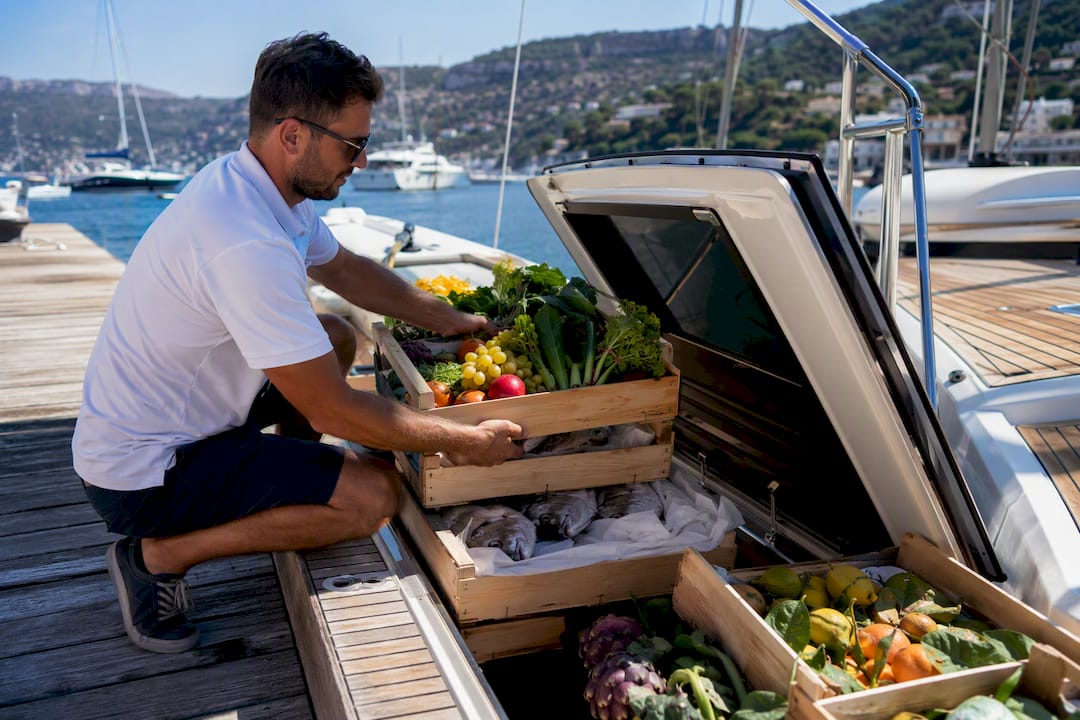
The yacht provisioning process is the planning, purchasing, packing, and delivery of food, drinks, and supplies to a boat before guests step aboard, and the whole job comes down to five moves: plan around guest preferences, buy the bulk of your list at the base port, pack and label everything for the marine environment, get it delivered and stowed before boarding, then top up locally as the trip unfolds. On crewed charters, the APA (Advanced Provisioning Allowance) covers this and the crew executes it. On private charters or bareboats, that job falls to you or a hired provisioning company like Balacus Markets.
Your next move is simple:
- Send guests a preference sheet today.
- Confirm the boat name and handover time with the marina.
- Book your Day 1 supermarket run or a pre-provision delivery for arrival morning.
Pro Tip: Print two copies of the preference sheet, one for the supplier and one taped inside a galley cabinet. It settles arguments about who wanted the oat milk faster than any group chat.
Key Takeaways
The yacht provisioning process works best as a hybrid system: bulk-buy essentials at the base port, then top up fresh goods locally throughout the charter.
| Point | Details |
|---|---|
| Send the preference sheet early | Capture guest counts, allergies, and brand preferences at least two weeks out. |
| Bulk-buy at base port | Cover 80-90% of your list on Day 1 to save on markups from island shops. |
| Confirm the APA upfront | Know what percentage covers provisioning and how unspent funds get returned. |
| Inspect every delivery | Check freshness, log damage, and require a signed checklist from the supplier. |
| Use a hybrid strategy with SailArmada | Pair base-port bulk shopping with daily local top-ups, guidance SailArmada builds into its Mediterranean charter planning. |
Table of Contents
- Charter vs Private Provisioning: Who’s Actually Responsible?
- How Do You Plan a Yacht Provisioning Timeline?
- What Should a Yacht Provisioning Checklist Include?
- How Do You Brief a Yacht Provisioning Company?
- How Much Does Yacht Provisioning Cost, and What Is the APA?
- Mediterranean vs Remote Provisioning: What Changes?
- How Should You Pack and Inspect Provisions Onboard?
- What Belongs on a Delivery and Marina Logistics Checklist?
- Who Handles What Onboard During the Charter?
- Why a Hybrid Provisioning Strategy Works Best
- How Do You Handle Last-Minute Provisioning Changes?
- What Legal and Customs Rules Affect Yacht Provisioning?
- How Do You Manage Waste and Sustainability While Provisioning?
- Coordinating With Crew for Ongoing Inventory Management
- Common Provisioning Mistakes Worth Avoiding
- Let SailArmada Handle the Details for You
- Sources
Charter vs Private Provisioning: Who’s Actually Responsible?
On a crewed charter, provisioning is the crew’s job, funded through the APA you pay ahead of the trip. The chef builds menus, the stewardess orders groceries, and you approve the preference sheet. On a private or bareboat charter, there’s no crew safety net. You’re either doing the shopping yourself or hiring a provisioning company to do it for you.
Typical roles break down like this:
- Owner or provisioning manager: sets the budget, approves the preference sheet, signs off on deliveries.
- Chef: plans menus, orders specialty and perishable items, checks quality on arrival.
- Chief stewardess: manages inventory, stowage, and daily fridge organization.
- Hostess: handles meal service and runs mid-week local top-ups.
- Provisioning company or marina contact: sources, packs, and delivers to the boat before boarding.
Pro Tip: At handover, walk through the inventory list out loud with whoever provisioned the boat. It’s the fastest way to catch duplicate purchases, like two crews both buying six cases of water.
How Do You Plan a Yacht Provisioning Timeline?
Good provisioning follows a rhythm, not a scramble, informed by tips for eating healthy on holiday that help with balanced provisioning lists. Fourteen days out, you should have guest counts and dietary restrictions locked. A week before, order anything nonperishable or specialty, think aged cheeses, specific spirits, or gluten-free pasta that a small island market won’t stock. Two to three days out, lock in fresh goods with your supplier. On Day 0 or Day 1, execute the bulk run or receive your pre-provision delivery.
Your preference sheet should capture:
- Guest count and any children’s needs
- Dietary restrictions and allergies (be specific, not just “vegetarian”)
- Favorite brands and drink preferences
- Planned restaurant nights (so you don’t over-buy dinner ingredients)
- Medical items or special requests
Before the trip starts, run through a quick decision checklist: pre-provision or shop yourself, fridge and freezer capacity, water and ice needs, and a waste plan for the week. Share your documentation early with any supplier, this means charter company name, boat name, berth number, and arrival time, so nothing gets held up at the marina gate.
Pro Tip: Book your fresh goods order the moment you land on a delivery date. Fishmongers and bakeries in popular ports get fully booked during peak season.
What Should a Yacht Provisioning Checklist Include?
A sample list built for 6 guests over 7 days gives you a baseline to scale up or down. Multiply per person, per day, and adjust for how many meals you’ll eat ashore.
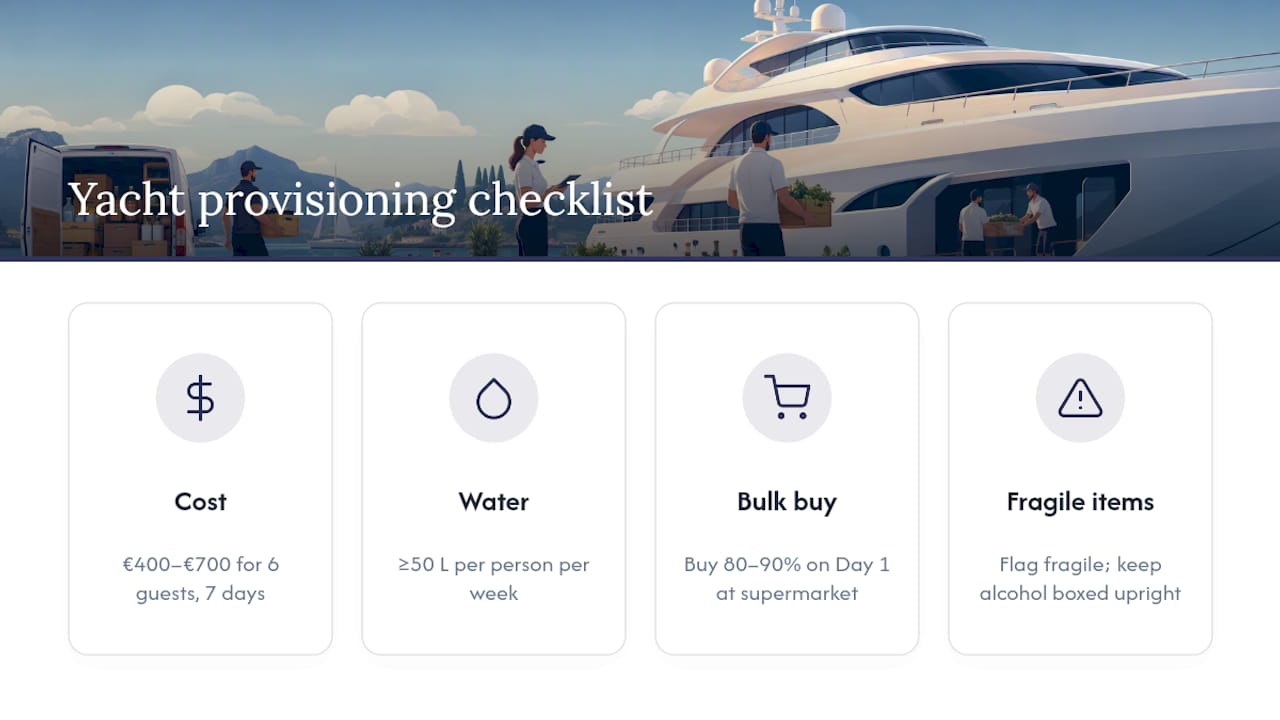
Published industry checklists put grocery costs for this exact scenario at €400 to €700, with water alone recommended at 50 or more liters per person, per week in warm climates.
Buying 80% to 90% of your list on Day 1 at a large supermarket near the base port is almost always cheaper than buying piecemeal at island shops, where markups on basics can be steep. A regionally known provisioner such as Balacus Markets can handle this bulk order and deliver straight to the boat, which saves you the awkward taxi-with-twelve-grocery-bags routine. Flag fragile items (eggs, glass jars) and temperature-sensitive goods (frozen fish, dairy) separately when you brief any supplier, and keep alcohol boxed and upright during transport.
How Do You Brief a Yacht Provisioning Company?
A clear brief is the difference between a smooth delivery and a dockside argument over missing items. Give your supplier the exact arrival time, boat name, berth number, your full preference sheet, allergy list, storage constraints, and a direct delivery contact.
Most established provisioning companies now offer:
- Full online ordering with item-level customization
- Chef-specific requests for special ingredients
- Temperature-controlled packing and clear labeling
- Direct delivery to the marina at an agreed window
Reputable suppliers need only the charter company name, boat name, and arrival dates to schedule delivery, which makes remote planning far easier than it used to be.
Expect either a flat service fee or a percentage markup on your grocery total. Ask for a line-item invoice up front so you know exactly what you’re paying for versus what you’re paying extra.
- Confirm the brief a week before arrival.
- Request photo confirmation of perishables before they leave the warehouse.
- Get a signed delivery checklist when goods hit the boat.
Pro Tip: Never accept a delivery without checking it against your original order line by line. Missing items are far easier to fix at the dock than after you’ve left the marina.
How Much Does Yacht Provisioning Cost, and What Is the APA?
The APA is money you pay in advance, on top of the charter fee, specifically to cover food, drink, fuel, and dockage during the trip. The crew spends from this fund and returns whatever’s left unspent at the end. Some charter guides use around 35% of the base charter price as a rough planning figure, though this varies by yacht size, itinerary, and how heavily guests drink or dine out.
A rough example for a one-week charter:
- Groceries and bar stock: €400 to €700 baseline, more for premium spirits or specialty items
- Restaurant nights: budget separately per person, per meal
- Service fee or markup: typically a percentage on top of the grocery total
- Water, ice, and fuel: a few hundred euros depending on usage
- Contingency: 10% buffer for the unexpected
Pro Tip: Pre-approve high-cost items like top-shelf spirits or rare wines before the crew buys them, and require receipts for everything. It keeps the end-of-trip APA settlement honest and fast.
Mediterranean vs Remote Provisioning: What Changes?
The Mediterranean rewards a light-touch strategy: provision the essentials at base, then top up daily at local markets and bakeries as you island-hop. Remote cruising grounds demand the opposite, heavy up-front buying, because resupply options thin out fast once you’re away from a major port.
Before you sail, check island type, supermarket access, and how seasonal tourism affects stock and pricing. Marina chandleries often mark up basics heavily, so treat them as a backup, not a plan.
- Use local markets for daily fresh produce wherever the route allows.
- Favor canned and UHT goods for longer open-water passages.
- Calculate bottled water needs before you leave, not after you run out.
Pro Tip: Keep a short list of trusted local suppliers, including operators like Balacus Markets in some Greek ports, and register your delivery details before you arrive.
How Should You Pack and Inspect Provisions Onboard?
Professional provisioning follows a staged process: source from specialist suppliers, inspect for quality, pack with temperature control, then deliver within an agreed window. Seafood goes in sealed bags, glass items get wrapped and cushioned, and every box gets labeled by storage zone before it leaves the supplier’s warehouse.
On delivery, check freshness, inspect for breakage, and log anything damaged immediately rather than discovering it mid-week.
- Free up 30 to 40% of fridge space by keeping non-perishables in dry storage.
- Layer items by how often they’re accessed, frequently used goods near the front.
- Use ice blocks mid-trip to ease the load on compressors during hot weather.
Pro Tip: Keep a simple inventory board, paper or a shared phone note, and have the delivering supplier initial the onboard checklist before they leave.
What Belongs on a Delivery and Marina Logistics Checklist?
Confirm these details with your supplier well before delivery day: boat name, charter company, berth number, a direct contact name and phone number, your preferred delivery window, and any customs or bonded-store notes for specialty items.
- Verify marina security gate rules and supplier vehicle access in advance.
- Ask about protocols for late-night or early-morning arrivals.
- Confirm who signs for goods and whether the supplier carries delivery insurance.
Specialty items, duty-free alcohol, imported cheeses, certain meats, sometimes require extra paperwork depending on the country’s customs rules, so check with your supplier or the marina office rather than assuming it’s straightforward.
Who Handles What Onboard During the Charter?
Once you’re underway, the workflow splits cleanly by role. The chef executes the menu and manages perishables day to day. The chief steward or stewardess tracks inventory and stowage. The hostess handles meal service and runs mid-week top-ups for bread, fish, or produce. The provisioning manager or owner keeps an eye on budget and guest preferences throughout.
- Run a quick morning inventory check before planning the day’s meals.
- Hold a short meal-planning meeting so nobody duplicates a fish market run.
- Assign waste separation so recycling and food waste don’t pile up in one bin.
For bareboat charters especially, consider hiring a hostess if the trip is provisioning-heavy or guests would rather relax than shop.
Why a Hybrid Provisioning Strategy Works Best
Bulk-buying everything at base port saves money but sacrifices freshness by day five. Buying everything locally day-by-day costs more and eats into your time on the water. The hybrid approach, heavy base-port shopping plus intentional daily top-ups, balances both without overcomplicating the logistics.
- Buy pantry staples, drinks, and bulk goods at the base port.
- Schedule short morning stops for fresh bread, fish, or produce.
- Keep contingency funds aside for rare finds or a spontaneous seafood dinner.
Pro Tip: Designate one person to manage the central kitty, all receipts, one settlement at the end. It’s far less friction than splitting every small purchase.
How Do You Handle Last-Minute Provisioning Changes?
Plans change. A guest cancels a flight, someone announces a shellfish allergy the morning of boarding, or a supplier’s delivery truck breaks down two hours before handover. The provisioning process needs built-in slack for exactly this.
Keep a running list of nearby backup suppliers, a supermarket, a smaller grocer, even a gas station convenience store for emergency basics, so you’re never fully dependent on one delivery. If a guest reports a new allergy late, don’t guess. Call the supplier directly, ask what’s already been packed, and adjust before the boat leaves the dock rather than trying to work around it mid-week.
Build a small contingency budget specifically for this, separate from your general provisioning fund. A spare €100 to €150 covers a taxi run to a supermarket or a rush order for a forgotten item without derailing your whole budget.
If your delivery is delayed past the planned departure window, confirm with the marina how much flexibility you actually have. Some berths have strict turnaround schedules for the next charter; others are more relaxed. Knowing this ahead of time means you’re not negotiating under pressure.
Keep phone numbers for at least two provisioning contacts on file, not just one. If your primary supplier can’t fulfill a last-minute add, a backup contact who already has your boat details on file can often turn around a smaller order same-day. This single habit resolves more provisioning emergencies than any checklist item on this page.
What Legal and Customs Rules Affect Yacht Provisioning?
Import restrictions and quarantine rules vary significantly by country, and they change depending on what you’re bringing aboard and where you’re sailing. Fresh meat, dairy, and certain produce often face tighter restrictions when crossing borders between countries or regions with different agricultural rules, even within the same sea.
Duty-free alcohol purchases typically come with limits tied to the number of guests and the length of the charter, and going over those limits at customs can mean fines or confiscation. If your itinerary crosses an international border mid-charter, check what’s permitted to carry across before you provision heavily on either side.
Quarantine rules matter most for anyone importing specialty food items from outside the region, cured meats, unpasteurized cheeses, or certain seafood products carried in personal luggage rather than sourced locally. Rules here are set by each country’s customs and agriculture authorities, not by charter companies or provisioning suppliers, so when in doubt, verify directly with the relevant port authority or your charter broker rather than relying on general guidance from a supplier.
Bonded stores, tax-free provisioning available to yachts crossing into international waters, follow their own separate paperwork requirements. If your charter itinerary includes this option, your provisioning company or marina agent should walk you through what documentation is needed before delivery, since rules differ by jurisdiction and can change with little notice.
How Do You Manage Waste and Sustainability While Provisioning?
Waste management starts before you even leave the dock. Buying in bulk at the base port cuts down on packaging waste compared to a dozen small daily purchases, and it’s one of the simplest sustainability wins available to anyone managing a provisioning list.
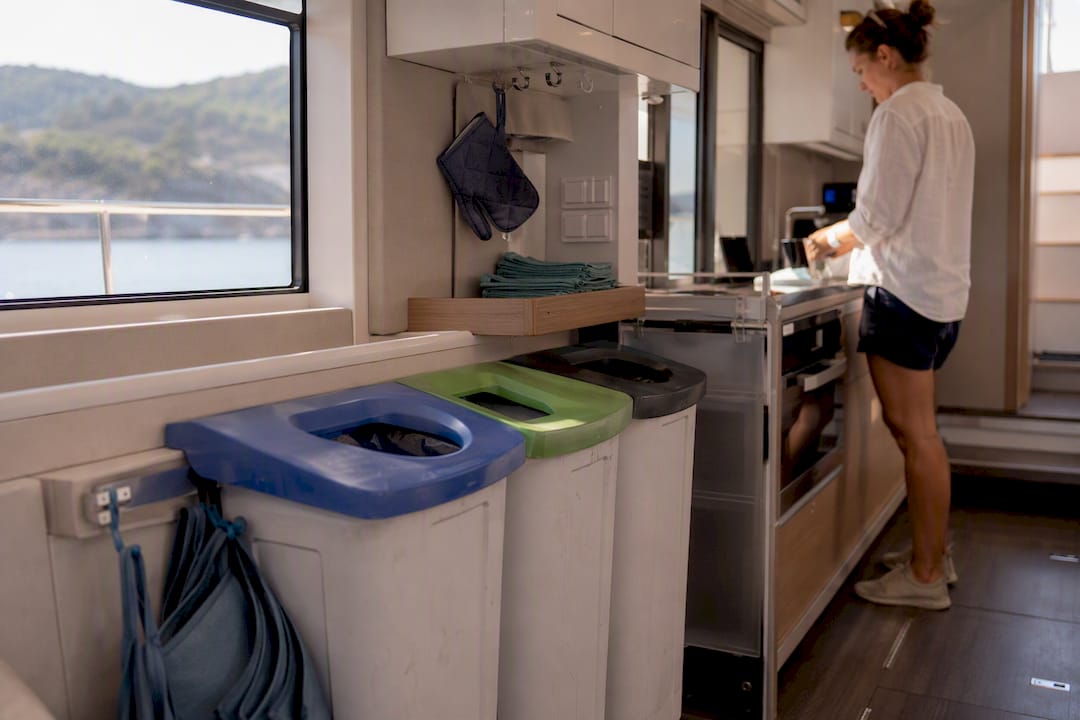
Separate recycling from food waste from day one, and confirm with the marina what disposal options exist before you set sail, since not every anchorage or small island has reliable waste collection. Fresh markets, especially in the Mediterranean, often generate less plastic packaging than supermarket runs, which is one more reason the hybrid provisioning approach pays off environmentally as well as financially.
Reduce single-use plastics where you can. Reusable water containers refilled from large jugs cut down dramatically on plastic bottle waste over a week-long charter, and many guests appreciate the gesture once it’s explained. Composting food scraps isn’t always practical onboard, but portioning meals accurately, guided by an honest headcount and preference sheet, reduces the amount of spoiled or uneaten food that ends up in the trash by the end of the week.
Ask your provisioning supplier directly about their packaging practices. Some now offer reduced-plastic packing on request, using paper or reusable crates instead of shrink-wrap, particularly for base-port bulk orders.
Coordinating With Crew for Ongoing Inventory Management
Provisioning doesn’t end at delivery. It continues every day of the charter as guests eat, drink, and use supplies faster than expected in some categories and slower in others. Clear coordination with the crew prevents both waste and unpleasant surprises on day five.
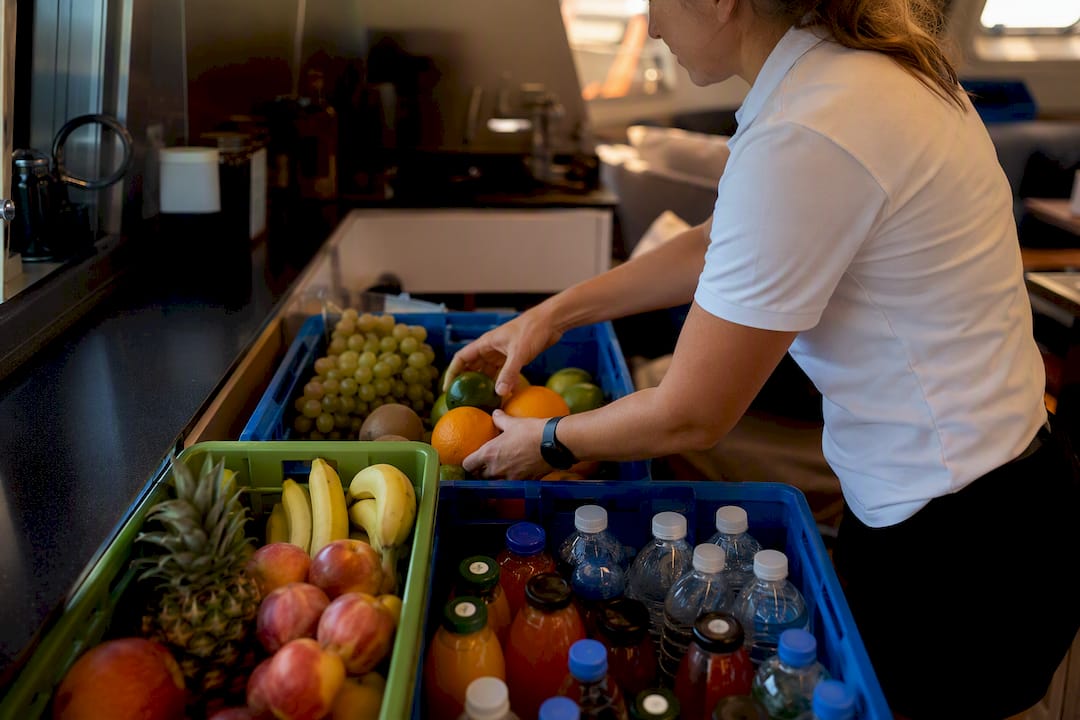
A quick daily inventory check, five minutes at most, run jointly between the chef and chief steward or stewardess, keeps everyone aligned on what’s running low. Share this information at a short meal-planning meeting so decisions about upcoming top-ups happen before a shortage becomes urgent, not after.
Communication matters more than paperwork here. A shared note or a simple inventory board works better than a complicated spreadsheet nobody checks mid-trip. The goal is visibility, not bureaucracy. If the hostess is handling mid-week top-ups, she needs to know exactly what’s been used and what’s still in reserve before heading to a local market.
For provisioning managers not physically onboard, staying in touch with the crew through a quick daily or every-other-day check-in message keeps you informed without micromanaging. This also gives you the chance to approve any unexpected purchases before they hit the APA settlement at the end of the trip, avoiding awkward conversations during checkout.
Common Provisioning Mistakes Worth Avoiding
Underestimating water, ignoring fridge capacity, skipping allergy logs, over-relying on island shops, and not requiring supplier receipts. Fix each with a checklist step, and always run a short debrief after the charter to note what to change next time.
Let SailArmada Handle the Details for You
SailArmada builds itinerary-aware sailing holidays across the Mediterranean, and that means provisioning advice comes baked into your trip planning rather than bolted on as an afterthought.
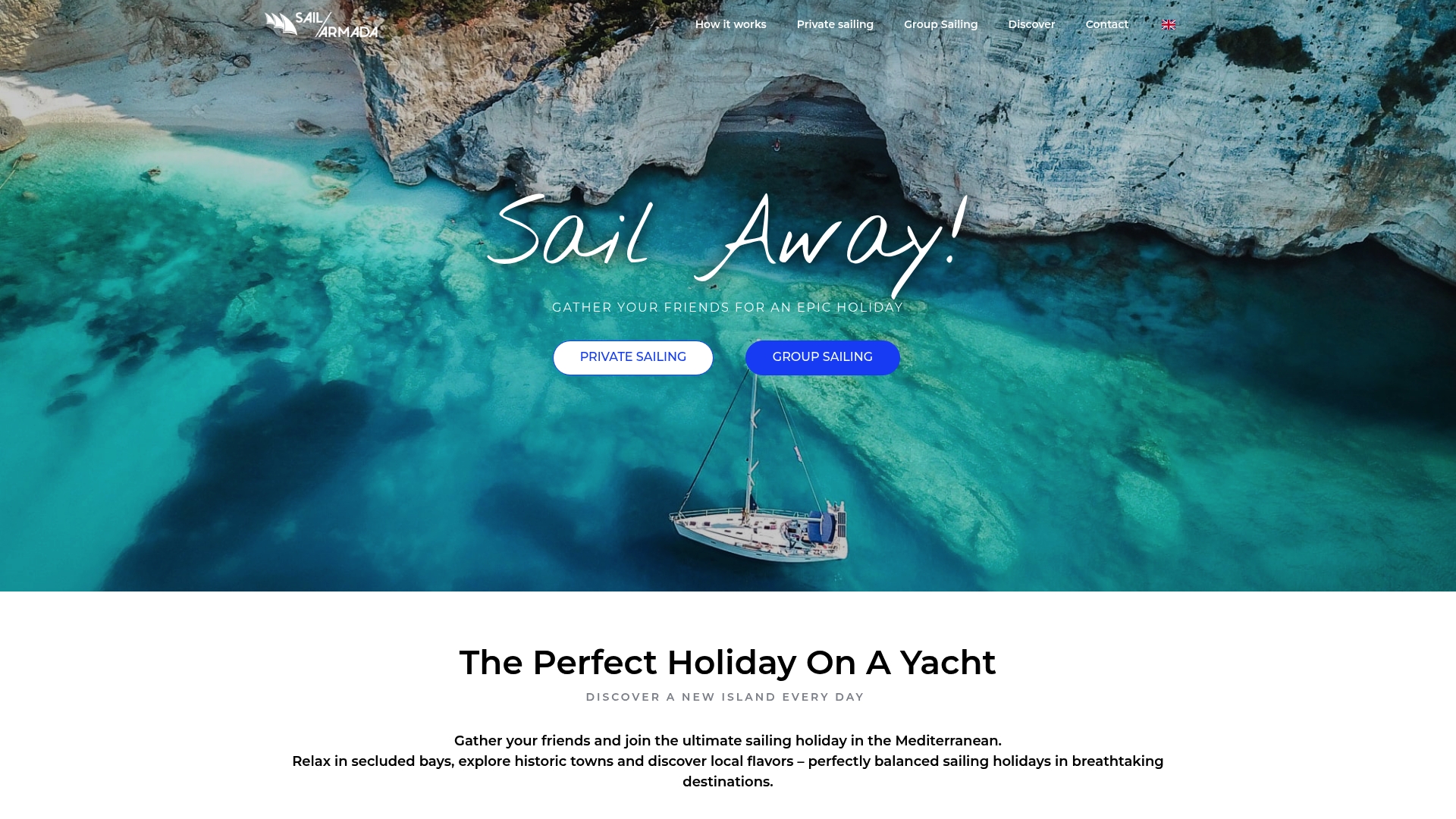
If you’re already deep into planning a group or family charter and provisioning feels like one more thing on a long list, our team can walk you through which ports suit a bulk shop, which islands are better for daily fresh top-ups, and where a hostess might save your group more stress than she costs. Check out our Shopping for a Week of Sailing resource for a practical head start, then browse private or group sailing holidays to see available dates and start a conversation about your itinerary. Getting the provisioning plan right before you book means fewer surprises once you’re actually on the water.
Sources
- Provisioning a Yacht for a Week: Complete Checklist & Costs | GetBoat Blog
- Yacht Charter Provisioning Guide | NauticEd Sailing Blog
- How Yacht Provisioning Works | Gourmet Deliveries
- Charter Yacht Provisioning Guide 2025 | YATCO
- Taking care of your marine refrigeration systems | Yachting Pages