You book what sounds like a dream trip, get the charter company on the phone, and suddenly the conversation is full of words like “APA,” “starboard,” and “jibing.” It feels like everyone speaks a different language. Understanding industry terminology in sailing holidays is not just nice to have. It directly affects the quality of your booking experience, your safety onboard, and how much you actually enjoy the trip. This guide breaks down the most important sailing vacation terms in plain English, so you arrive at the marina feeling confident, not confused.
Table of Contents
- Key Takeaways
- Industry terminology in sailing holidays: charter types first
- Directional and maneuvering terms you need to know
- Boat parts and equipment explained
- Weather and navigation language for your trip
- Daily sailing etiquette and operational terms
- My honest take on learning sailing language
- Ready to put your new sailing knowledge to work?
- FAQ
Key Takeaways
| Point | Details |
|---|---|
| Know your charter type | Understanding bareboat, skippered, crewed, and flotilla formats helps you pick the right fit and avoid surprise costs. |
| Learn directional terms first | Port, starboard, bow, and stern are the four most critical words for your safety and communication onboard. |
| Study briefing materials early | Reading boat documents before you board dramatically reduces stress and confusion during the technical walkthrough. |
| Weather terms matter for planning | Words like windward, leeward, and gust show up in daily forecasts and affect where your skipper chooses to sail. |
| Etiquette terms improve your experience | Knowing mooring customs, fender use, and tipping norms makes daily life onboard smoother and more enjoyable. |
Industry terminology in sailing holidays: charter types first
The first place you will encounter four yacht charter formats is when you start browsing boats online. The terminology here is genuinely consequential because each format comes with different costs, responsibilities, and experiences.
Bareboat charter means you rent the boat without a skipper or crew. You are the captain. This requires a sailing license and real experience. It is the most affordable format but also the most demanding.
Skippered charter means a professional skipper comes with the boat and handles all the sailing. You relax and enjoy the ride. Skipper fees run €180 to €320 per day, and that cost is typically added on top of the base boat price. One practical thing many first-timers miss: the skipper sleeps in the smallest cabin onboard, which reduces the total number of guest berths available to your group.
Fully crewed charter includes a skipper plus additional crew such as a cook, hostess, or deckhand. This is the most luxurious option, with costs starting around €25,000 per week. It is the closest experience to staying at a private floating resort.
Flotilla charter is a format many newcomers discover and love. You sail your own boat as part of a small convoy, typically 5 to 12 boats guided by a lead boat, with a shared route and social evenings at anchor. Flotilla costs generally run €1,200 to €1,800 per person per week. It balances independence with safety, making it a popular choice for beginners. You can explore the flotilla sailing in the Mediterranean guide for a detailed breakdown of how this works for families and groups.
Here are three other yacht vacation terminology terms you will hear when booking any of these formats:
- APA (Advance Provisioning Allowance): A deposit, typically 25 to 35% of the charter fee, held to cover fuel, marina fees, and food provisioning during the trip. Unspent funds are returned.
- Skipper: The licensed captain of the vessel, responsible for all navigation decisions and safety onboard.
- Preference sheet: A form you fill out before a crewed charter so the crew can prepare meals, stock drinks, and plan activities based on your tastes.
| Charter type | License needed | Crew included | Approximate cost |
|---|---|---|---|
| Bareboat | Yes | None | Lowest |
| Skippered | No | Skipper only | Mid-range |
| Fully crewed | No | Skipper + crew | Highest |
| Flotilla | Basic or none | Lead boat support | Budget-friendly |
Pro Tip: When comparing charter types, always ask whether the skipper fee is included in the quote or added separately. A boat that looks affordable can quickly become much more expensive once the skipper, APA, and marina fees are added.
Directional and maneuvering terms you need to know
Here is the good news about sailing jargon: new sailors typically learn around 40 of the 50 most common terms within just two to three days on the water. The key is to focus on the directional vocabulary first, because those are the words your skipper will shout and expect you to respond to immediately.
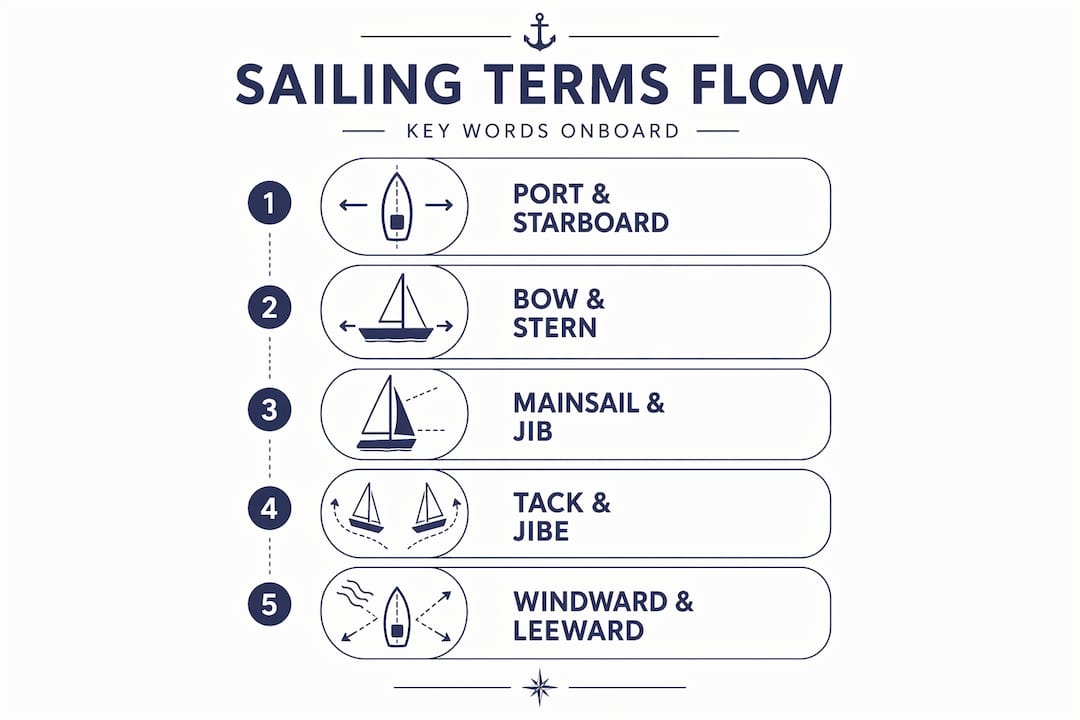
Port is the left side of the boat when you are facing the bow. Starboard is the right side. Bow is the front of the boat. Stern is the back. These four terms are not just nautical color. They are safety vocabulary. If a skipper calls “move to starboard!” and you hesitate, it creates a real risk.
The two most important maneuvering terms are tacking and jibing. Tacking turns the bow through the wind and is the standard way to sail upwind. It is a relatively gentle maneuver. Jibing turns the stern through the wind and is used when sailing downwind. The critical difference is that during a jibe, the boom swings across forcefully, which can seriously injure anyone standing in its path. Experienced skippers always warn the crew before a jibe.
Here is a quick-reference list of common onboard commands and what they mean:
- “Ready to tack?” The skipper is asking if everyone is set before turning upwind.
- “Helm’s alee!” The turn has begun. Duck the boom.
- “Ease the sheet!” Let out (loosen) the sail line to reduce tension.
- “Trim the sail!” Adjust the sail for better efficiency in the current wind.
- “All hands on deck!” Everyone should come topside immediately.
Pro Tip: Before you leave the marina on your first day, ask your skipper to walk you through these commands at the dock. Practicing on dry land, before the wind picks up, makes a genuine difference when things move fast out at sea.
Boat parts and equipment explained
Your pre-departure safety briefing will cover a lot of ground quickly. Knowing the key equipment terminology in advance means you spend less time mentally translating and more time absorbing what actually matters for your safety.
The main sail parts you will interact with are the mainsail (the large triangular sail attached to the mast), the jib (the smaller sail at the bow), and the boom (the horizontal pole that extends from the mast at roughly head height and holds the bottom of the mainsail). Familiarity with terms like mainsail, jib, boom, and halyard makes safety briefings far more useful. The halyard is the line used to raise and lower the sails.
Below deck, you will hear references to the hull (the body of the boat), the keel (the weighted fin underneath the hull that provides stability), the hatch (a watertight door in the deck), and lines (the general term for ropes on a boat). Sailors never call them ropes. Always lines.
Anchoring terminology deserves its own attention. Here is the sequence you will typically hear:
- Anchor: The weighted device that holds the boat to the seabed.
- Rode: The complete anchor line, including chain and rope.
- Scope: The ratio of how much rode is out versus the depth of the water. A typical scope ratio is 5:1, meaning five meters of rode for every one meter of depth. In rough conditions, you let out more.
- Dragging: When the anchor loses grip and the boat starts to drift. This is something the skipper monitors carefully, especially overnight.
Reviewing technical briefing documents before you board is one of the most effective things you can do to reduce stress during your first sailing holiday. Many charter companies send these in advance, and most guests never read them. Read them.
Weather and navigation language for your trip
Sailors live and breathe weather data. Your skipper will reference wind conditions constantly, and understanding the basic vocabulary helps you follow along and make better decisions about your daily plans.
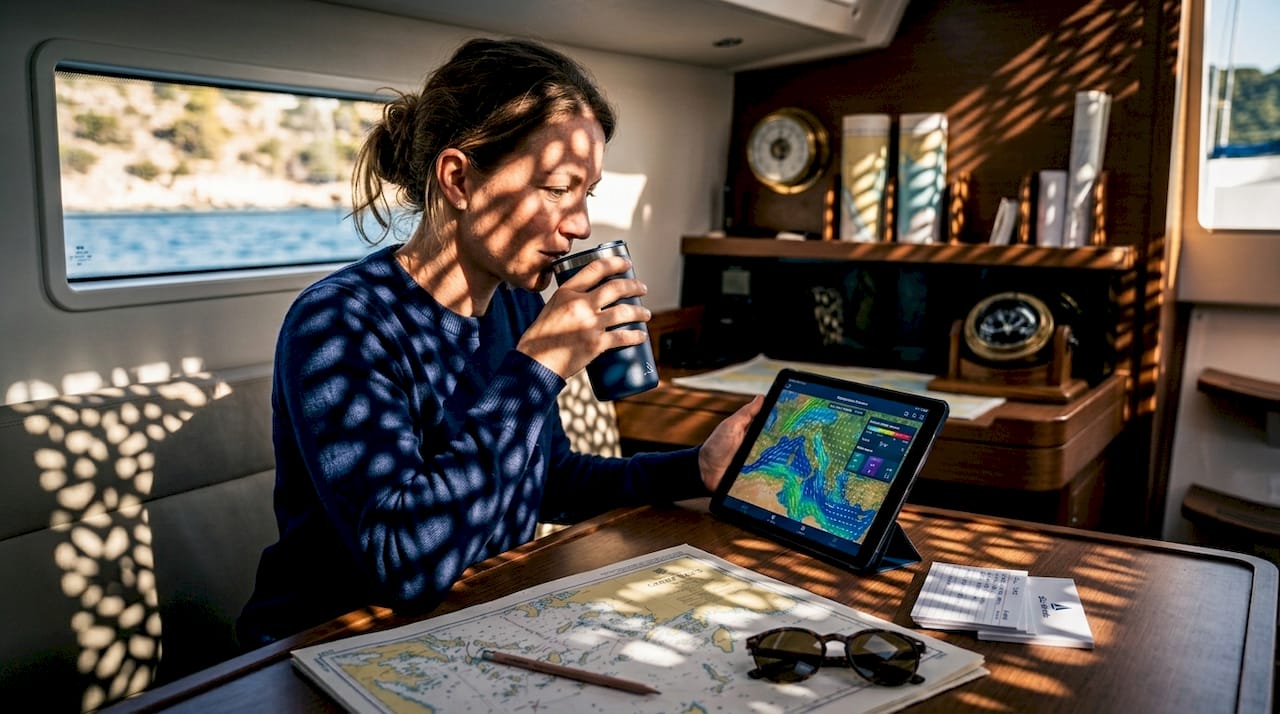
Windward means the side of the boat facing into the wind. Leeward (pronounced “loo-ward”) is the sheltered side facing away from the wind. Secluded anchorages are often described as “leeward” because they offer protection from the prevailing breeze. A gust is a short burst of stronger wind, while a squall is a fast-moving storm with intense wind and rain, usually brief but serious.
Sailors rely on multiple weather sources including VHF radio and online weather services for accurate forecasting. The VHF radio is the vessel’s communication system, and channel 16 is the internationally monitored distress and calling channel. Every boat keeps a permanent listen on channel 16. A heading is the direction the boat is pointed, while a course is the intended path from one point to another.
Here are the tools and terms worth knowing before you go:
- PredictWind: One of the most widely used sailing weather apps, popular across Mediterranean destinations.
- Beaufort scale: A numerical scale from 0 to 12 rating wind force. Your skipper will often describe conditions using Beaufort numbers.
- Waypoint: A specific GPS coordinate used in navigation planning.
- Knots: The unit of speed at sea. One knot equals roughly 1.15 miles per hour.
Pro Tip: Download a weather app like PredictWind before your trip and spend a few minutes each morning checking the forecast alongside your skipper. It is a great way to learn the language in context and to understand why the day’s route might change.
Daily sailing etiquette and operational terms
Beyond the safety vocabulary, there is a whole set of operational and social terms that come up every single day of your sailing holiday. Knowing them makes you a genuinely better guest and a more relaxed traveler.
Mooring refers to securing your boat to a fixed point, whether a buoy, a dock, or a wall. Dock lines are the ropes used to tie the boat to the marina. Stern-to (also called “Med mooring”) means reversing into a berth so the boat’s back faces the dock. It is the default parking style in Mediterranean marinas and something you will witness or participate in daily.
Fenders are the inflatable bumpers hung along the hull’s side to protect the boat from bumping against docks or other boats. You will often hear the skipper ask someone to “put out the fenders” as you approach a marina. It is one of the easiest ways for guests to actively help the crew.
A few social and etiquette terms worth knowing:
- “Pipe down”: Keep the noise down. Sound carries across water and quiet hours at marinas are taken seriously.
- Sundowner: The informal drink shared at anchor as the sun sets. Possibly the best part of any sailing day.
- Watch: A scheduled time period during which specific crew members are on duty for navigation.
Standard tipping etiquette for crewed charters runs 10 to 15% of the charter fee, given in cash to the skipper for distribution to the whole crew. On a skippered charter, tipping the skipper directly at the end of the week is both expected and appreciated. It is a simple custom that reflects how much you valued their expertise and company.
Pro Tip: On a crewed charter, filling out the preference sheet thoroughly before your trip is genuinely appreciated by the crew. The more specific you are about dietary needs, favorite drinks, and activity interests, the more tailored your experience will be.
My honest take on learning sailing language
I’ve talked to hundreds of people planning their first sailing holiday, and the pattern is almost always the same. They feel slightly overwhelmed before the trip, then completely at ease by day two or three. The terminology that seemed intimidating on a website becomes obvious in context, once you’re on the boat and someone is pointing at the actual thing while they say the word.
What I’ve learned is that you don’t need to memorize a full sailing glossary for beginners before you book. You need to know enough to ask good questions. When a charter company mentions APA, you should be able to ask how much it typically runs on their boats. When they offer a skippered option, you should know to ask whether that affects the cabin count for your group.
The vocabulary that genuinely reduces stress is the safety vocabulary. Port, starboard, jibing, fenders, channel 16. Those terms matter fast, and learning them before you board means your brain is free to enjoy the crystal-clear water and gorgeous sunsets instead of catching up on the basics. The rest of the sailing terminology guide builds naturally over the course of the trip, and honestly, that gradual discovery is part of what makes sailing holidays so memorable.
— Sail
Ready to put your new sailing knowledge to work?
Now that you have a solid grasp of sailing vacation terms and charter formats, you are in a much stronger position to plan a trip that actually matches what you are looking for.
At Sailarmada, we work with families and groups of all experience levels across Greece, Croatia, Italy, and beyond. Whether you want a fully crewed catamaran in the Ionian Sea or a skippered sailing week in Sardinia, our team speaks your language and helps you match the right charter type to your group’s needs. Explore your options through our private yacht charter guide or check out our group sailing holiday options to see what fits best. A genuinely unforgettable trip starts with a single, well-informed conversation.
FAQ
What does “bareboat charter” mean in sailing?
A bareboat charter means you rent the yacht without a skipper or crew. You need a valid sailing license and sufficient experience to legally take the helm.
What is an APA on a sailing holiday?
APA stands for Advance Provisioning Allowance, a prepaid fund covering fuel, marina fees, and provisions. Any amount you don’t use gets refunded at the end of the trip.
What is the difference between tacking and jibing?
Tacking turns the bow through the wind and is used for sailing upwind. Jibing turns the stern through the wind and carries more risk because the boom swings fast and forcefully.
What does “stern-to” mean at a marina?
Stern-to means reversing your boat into a berth so the back faces the dock, which is the standard mooring style in Mediterranean marinas.
How much should you tip on a crewed sailing charter?
Standard gratuity runs 10 to 15% of the charter fee, paid in cash to the skipper at the end of the week for distribution among the crew.