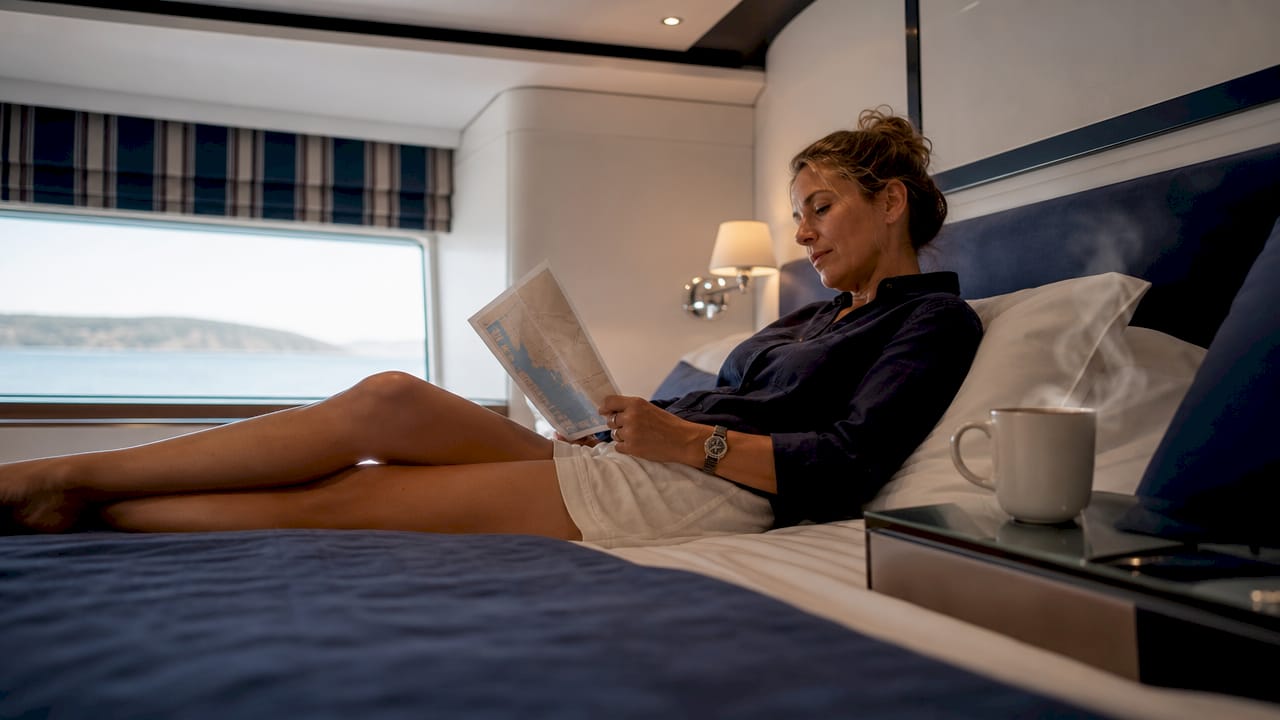
Types of yacht accommodation range from compact cabins to lavish suites, and knowing the difference can make or break your sailing holiday. Whether you’re planning a week in Greece, Croatia, or the Turquoise Coast of Turkey, the cabin you sleep in shapes your entire experience on the water. Yacht accommodations, known in the industry as guest quarters or staterooms, come in several distinct categories, each designed for a different comfort level and travel style. This guide breaks down every option so you can book with confidence and wake up to crystal clear water every morning.
1. What are the main types of yacht cabins and suites?
Yacht cabins come in three main categories: basic cabins, staterooms, and suites, each offering a different level of space and luxury. Understanding these distinctions saves you from booking the wrong option for your group.
Basic cabins are the entry point for onboard sleeping arrangements. They offer a private berth, minimal storage, and often a shared bathroom. They work well for budget travelers or anyone who plans to spend most of their time on deck.
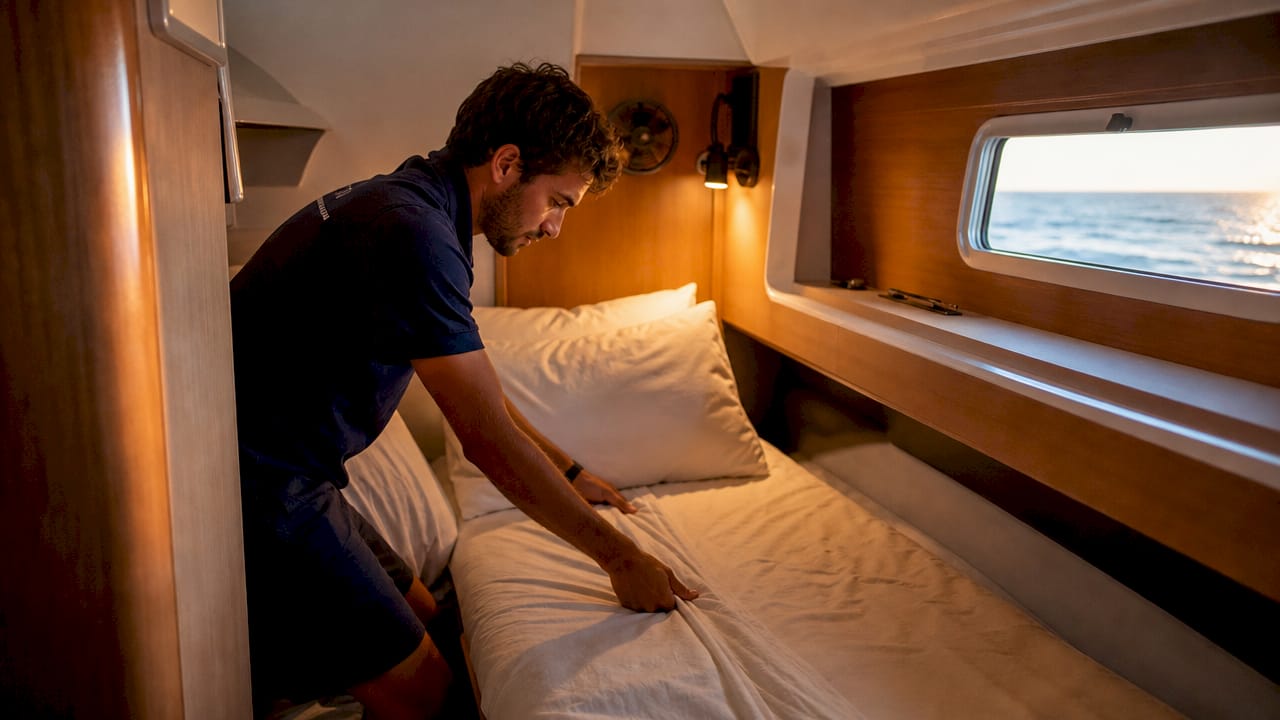
Staterooms sit a step above basic cabins. They are larger, better equipped, and almost always include a private en suite bathroom. You get more storage, better lighting, and a real bed rather than a narrow berth. On a Mediterranean sailing holiday, a stateroom is the most common choice for couples and solo travelers who want comfort without paying suite prices.
Suites are the most luxurious accommodations on any yacht. They typically feature a king or queen bed, a full private bathroom with a shower, premium linens, and sometimes a private seating area. On larger motor yachts, the master suite often occupies the best position on the vessel, whether that is the main deck or the upper deck with panoramic views.
Key features to look for in each category:
- Basic cabin: Single or double berth, shared or private head (bathroom), limited storage, often forward or aft position
- Stateroom: Double or queen bed, private en suite bathroom, built-in storage, climate control on newer vessels
- Suite: King or queen bed, full private bathroom, premium finishes, sometimes a private deck or lounge area
Pro Tip: Ask the charter broker specifically whether the stateroom has a standing headroom. Some mid-range yachts label a cabin a “stateroom” even when you cannot stand upright, which matters a lot after a week at sea.
2. How does yacht type affect your accommodation options?
Motor yachts typically feature multiple decks with diverse cabin arrangements, while sailing yachts prioritize streamlined layouts with fewer cabins due to design constraints. The vessel itself determines what sleeping arrangements are even possible.
Here is a quick comparison to help you choose:
| Yacht type | Typical cabin count | Privacy level | Space per cabin | Best for |
|---|---|---|---|---|
| Motor yacht | 4–8+ | High | Large | Luxury groups, families |
| Sailing yacht | 2–5 | Medium | Compact | Couples, small groups |
| Catamaran | 4–6 | Very high | Spacious | Families, social groups |
| Gulet | 4–10 | Medium | Medium | Large groups, slow travel |
Catamarans provide greater stability and space, often featuring multiple cabins with en suite bathrooms and generous common areas. That stability is a real advantage if anyone in your group gets seasick on a monohull sailing yacht.
Sailing yachts have a narrower hull, so cabins tend to be smaller and more intimate. That is not necessarily a drawback. Many travelers love the cozy feel and the authentic sailing experience that comes with it. You can learn more about how yacht type shapes comfort before you commit to a vessel.
Gulets, the traditional wooden motor-sailing vessels popular in Turkey and Croatia, offer some of the most generous cabin sizes relative to their price. They are a fantastic middle ground between a sailing yacht and a full motor yacht.
Pro Tip: If your group includes light sleepers, a catamaran is your best bet. Each cabin sits in a separate hull, so noise from the engine room or neighboring cabins travels far less than on a monohull.
3. What onboard sleeping arrangements and cabin layouts can guests expect?
Cabin layouts vary widely across yachts: single, double, and twin bed configurations each suit different traveler types, and the cabin’s position on the vessel affects both comfort and noise levels.
The three main cabin positions are forward, midship, and aft.
Forward cabins sit at the bow of the boat. They often have a V-shaped berth that can convert to a double bed. The forward position means more motion at sea, which some travelers love and others find disruptive at night.
Midship cabins are the most stable sleeping position on any vessel. They sit closest to the waterline and experience the least rocking. On larger yachts, midship cabins are often the most desirable and priced accordingly.
Aft cabins sit at the stern. They are typically quieter than forward cabins and often have easier access to the swim platform and cockpit. On catamarans, aft cabins in each hull are among the most popular options for couples. You can read more about catamaran cabin allocation to understand how groups divide these spaces.
Bathroom arrangements matter just as much as bed type. Here is a breakdown of what you will typically find:
- Private en suite: Each cabin has its own toilet and shower, the gold standard for privacy
- Shared head: Two or three cabins share one bathroom, common on smaller sailing yachts
- Day head: A separate bathroom for daytime use, available to all guests, found on larger vessels
Pros and cons by layout for different traveler needs:
- Forward double cabin: Great for couples who want privacy, less ideal for rough sea conditions
- Twin cabin: Perfect for friends or siblings sharing, less romantic but very practical
- Master suite midship: Best comfort and stability, usually the most expensive cabin on the boat
- Aft cabin: Easy deck access, good ventilation, popular for families with young children
4. Which factors should travelers consider when selecting yacht accommodation?
Matching accommodation type with itinerary length, group size, and budget produces the most satisfying charter experience. Getting this alignment right before you book prevents a lot of frustration on the water.
Budget is the most obvious factor. Basic cabins on a sailing yacht cost significantly less than a master suite on a motor yacht. But the gap narrows when you factor in what is included. A stateroom on a well-maintained catamaran often delivers better value than a cramped cabin on an older motor yacht at a similar price point.
Privacy is a prime consideration for families and couples, and it directly shapes which cabin layout makes sense. A family with two children will want at least two separate cabins with a shared bathroom between them. A couple celebrating an anniversary will prioritize a master suite with a private bathroom, even if it means a shorter itinerary to stay within budget.
Group size determines how many cabins you need and which vessel types are even viable. A group of eight adults needs at least four double cabins, which rules out most monohull sailing yachts and points toward a catamaran or gulet. Sailarmada specializes in matching groups to the right vessel, whether you are booking a private sailing holiday or joining a group charter.
Key questions to ask before booking:
- How many people are sharing each cabin, and are they comfortable with that?
- Does every cabin have a private bathroom, or is sharing acceptable?
- How long is the charter? Longer trips demand more storage and comfort.
- What is the itinerary? Rougher sailing routes favor midship cabins and catamarans.
Pro Tip: Book 6–12 months in advance for Mediterranean summer charters to secure your preferred cabin layout. The best cabins on the most popular vessels go first, and waiting until spring for a july departure often means settling for whatever is left.
Key takeaways
Choosing the right yacht accommodation comes down to matching cabin type, vessel layout, and group needs before you book, not after you board.
| Point | Details |
|---|---|
| Three core cabin types | Basic cabins, staterooms, and suites each offer distinct comfort levels and price points. |
| Vessel type determines layout | Catamarans offer the most space and privacy; sailing yachts are compact but authentic. |
| Cabin position affects comfort | Midship cabins provide the smoothest ride; forward cabins suit couples who want privacy. |
| Book early for peak season | Securing preferred layouts in the Mediterranean requires booking 6–12 months ahead. |
| Match accommodation to group needs | Privacy, group size, and itinerary length should all drive your cabin selection. |
My honest take on picking the right yacht cabin
After years of helping travelers plan sailing holidays across Greece, Croatia, and Turkey, the single biggest mistake I see is treating cabin selection as an afterthought. People spend hours choosing a destination and an itinerary, then pick whatever cabin is left. That is backwards.
The cabin is where you sleep, store your clothes, and decompress after a full day of swimming and exploring. A poor fit ruins the whole trip. A forward cabin on a sailing yacht in choppy Aegean waters is a very different experience from a midship stateroom on a catamaran in the calm waters of the Ionian Sea.
One thing most guides skip entirely is the Advance Provisioning Allowance, or APA. The APA covers fuel, food, and port fees on Mediterranean charters and is managed separately by the captain. It is a real budget line item, often 20–30% of the base charter fee, and it affects how much you can realistically spend on upgrading your cabin. Factor it in early.
My honest recommendation: if you are traveling as a couple, prioritize a private en suite bathroom over cabin size. If you are traveling as a family or a group of friends, prioritize a catamaran for the separate hull cabins and the social deck space. And if this is a once-in-a-lifetime trip, go for the master suite. You will not regret waking up to a sea view from a real bed.
— Sail
Planning your sailing holiday with Sailarmada
Sailarmada curates private yacht charters across Greece, Croatia, Italy, and Turkey, matching every group to the right vessel and cabin configuration from the start. Whether you want a cozy stateroom on a sailing yacht or a spacious suite on a catamaran, the team knows which boats deliver on their promises.
Every Sailarmada charter comes with a skipper who knows the local waters, so you spend less time worrying about logistics and more time enjoying secluded bays and gorgeous sunsets. Browse sailing destinations and yacht options to find the accommodation style that fits your group, your budget, and the adventure you have in mind.
FAQ
What is the difference between a cabin and a stateroom on a yacht?
A cabin is a basic private sleeping space, while a stateroom is larger and typically includes a private en suite bathroom and better amenities. Staterooms are the most common accommodation type on charter yachts used for Mediterranean holidays.
How many cabins does a typical charter yacht have?
Most charter yachts offer between 2 and 6 cabins, depending on vessel type. Catamarans and gulets tend to have more cabins than monohull sailing yachts of a similar length.
Are all yacht cabins private?
Most charter yachts offer fully private cabins, but bathroom arrangements vary. Some smaller sailing yachts have shared bathrooms between two cabins, while catamarans and motor yachts more commonly provide private en suite facilities.
Which type of yacht has the best accommodation for families?
Catamarans are the top choice for families because they offer separate hull cabins, greater stability, and spacious common areas. The family sailing holiday experience on a catamaran is noticeably more comfortable than on a monohull for groups with children.
When should I book a yacht charter to get the best cabin?
Book 6–12 months in advance for Mediterranean summer charters to secure your preferred cabin layout and vessel type. Peak season demand, especially in july and august, fills the best yachts quickly.