The quickest practical way of getting to Lefkas is flying into Aktion/Preveza (PVK) and transferring 20 to 30 minutes by car or taxi, since Lefkada connects to the mainland by a floating bridge rather than a car ferry. Driving from Athens takes roughly 3.5 to 4.5 hours, Thessaloniki closer to 4.5 or more, and seasonal boats link nearby islands to Nidri and Vasiliki. Rent a car once you land. This island rewards wandering.
TL;DR:
- Flying into Aktion/Preveza is the quickest way to reach Lefkada, with seasonal flights from April to October and transfers costing around €60 to €80.
- Driving from Athens takes about 3.5 to 4.5 hours, but delays often occur at the floating bridge, especially during peak summer weekends.
- Seasonal boat routes connect Lefkada to nearby islands like Kefalonia and Ithaca, typically operating from June to September with limited winter schedules.
- Booking rental cars and transfers early, especially during July and August, helps avoid high prices and availability issues.
- Public buses are available but less frequent outside peak months, so advanced planning is essential for connecting with ferries or flights.
Table of Contents
- Flying to the region: Aktion/Preveza and alternative airports
- Driving routes: highways, journey times, tolls, and the bridge
- Buses and coaches: KTEL schedules and coach routes to Lefkas
- Ferries and local boat links: which islands connect and port details
- On-island logistics: car hire, taxis, transfers, and bridge practicalities
- Best time to travel and practical tips to avoid common hassles
- Public bus routes and intercity coach times worth knowing
- Weather, holidays, and other disruptions to plan around
- Alternative ways in: cycling and motorbiking routes to Lefkas
- Seasonal shifts in transportation you should plan around
- Coordinating your arrival with a sailing departure
- The most overrated and underrated parts of getting to Lefkas
- Sources
Flying to the region: Aktion/Preveza and alternative airports
Aktion National Airport, better known by its code PVK, sits about a 20–30 minute drive from Lefkada town and is by far the most convenient way in. Seasonal charters and a handful of scheduled routes run mainly from April through October, which lines up neatly with when most travelers actually want to be on the island. Outside that window, flight options thin out fast.
If you’re traveling in winter, or PVK simply doesn’t have a route from your city, flying into Athens or Thessaloniki and connecting overland works fine. From Athens, expect a drive or coach journey of approximately 4 to 5 hours; from Thessaloniki, the drive takes about 4.5 hours. Neither is as smooth as landing at PVK, but both are workable with a bit of planning.
Pro Tip: Book a car hire or private transfer before you land during July and August. Same-day availability at PVK dries up fast in peak weeks.
Once you’re through arrivals, you’ve got two main options:
- Taxi: fares from PVK to Lefkada town typically run €60 to €80 depending on season and exact destination.
- Car hire: available directly at the airport, and worth arranging in advance if you want a specific vehicle class.
Aktion National Airport’s seasonal flight schedule means late bookers sometimes find only Athens or Thessaloniki connections left, so lock in your PVK flight early if that’s your plan.
Driving routes: highways, journey times, tolls, and the bridge
If you’re road-tripping in from Athens, the Ionia Odos motorway is the route to take, and it typically gets you to Lefkada in 3.5 to 4.5 hours, traffic and toll stops factored in. Coming from Thessaloniki or the northwest, you’ll pick up the Egnatia Odos before heading south, and the trip stretches past 4.5 hours. Travelers approaching from the Peloponnese usually cross via Rio-Antirrio before joining the same coastal roads north.
The last stretch of any drive is the part people remember: Lefkada connects to the mainland by a floating, swing bridge at Agios Ioannis, and it rotates hourly during the daytime season to let boats through. That means:
- Short delays are normal, not a sign anything’s gone wrong.
- Weekend afternoons in peak summer see the longest queues.
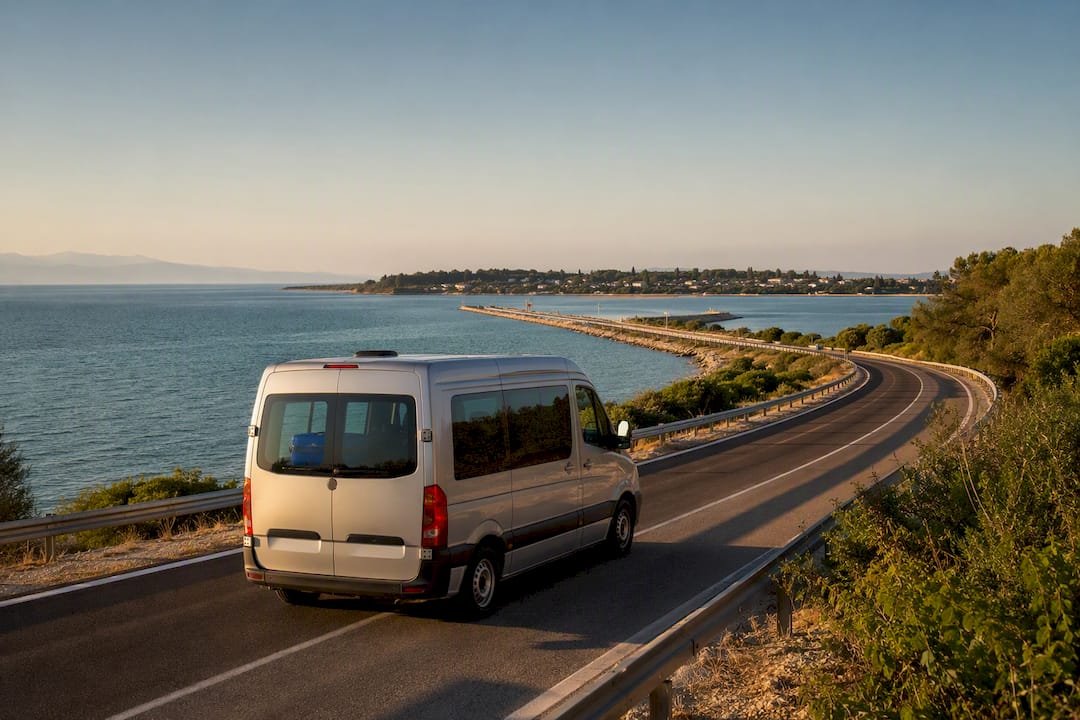
- Campervans and larger vehicles should build in extra buffer time near rotation windows.
Pro Tip: If you’re on a one-way car rental, confirm the drop-off location and fee before you book. One-way hires between the mainland and Lefkada often carry a premium, and prebooking a private minibus can work out cheaper per person for groups.
Buses and coaches: KTEL schedules and coach routes to Lefkas
KTEL Lefkadas runs the coach network connecting Lefkada to the mainland, and it’s a solid budget option if you’re not driving.
- From Athens, journeys run roughly 4 to 5 hours, with frequency shifting depending on the season.
- From Thessaloniki, expect a noticeably longer ride, and fewer daily departures than the Athens route.
- From Igoumenitsa, useful if you’re arriving by ferry from Italy, connections exist but run less frequently, so check timing carefully before committing to that leg.
Coaches typically arrive and depart from a central station in Lefkada town, and luggage space is limited compared to a car, so pack accordingly. If you’re timing a bus around a flight, build in a wide margin. KTEL timetables shift with the seasons, and the schedule that worked in July won’t necessarily hold in October. Buy tickets ahead during peak weeks rather than assuming walk-up seats will be available.
Ferries and local boat links: which islands connect and port details
No car ferry crosses to Lefkada, since the bridge handles vehicle access, but seasonal passenger boats connect the island to several neighbors. Kefalonia and Ithaca run summer routes to Vasiliki, with crossings from Kefalonia often landing around 1 to 1.5 hours depending on the exact route. Nidri, meanwhile, runs frequent short hops to Meganissi, which makes it an easy add-on day trip rather than a full logistics puzzle.
Here’s where you’ll actually land, depending on where you’re coming from:
- Vasiliki: the main arrival point for boats from Kefalonia and Ithaca.
- Nidri: hub for Meganissi crossings and smaller charter and day-boat traffic.
- Lefkada Town: occasional seasonal connections, though less frequent than the other two.
These schedules are seasonal, often shrinking sharply outside June through September, so confirm sailing times close to your travel date rather than trusting a listing from months earlier.
On-island logistics: car hire, taxis, transfers, and bridge practicalities
Once you’ve landed, actually getting to your accommodation is its own small project, and it pays off to plan the last leg before you touch down. Car hire is available at PVK, in Lefkada town, and in Nidri, though one-way drop-offs between locations sometimes carry an extra fee.
Taxis are everywhere but informal about pricing, so ask the fare before you get in, not after. From PVK to Lefkada town, expect something in the €60 to €80 range, shifting with season and exact drop-off point. Prebooked transfers cost more upfront but remove the guesswork, which matters if you’re arriving late or traveling with a group.
- Rent at the airport if you want flexibility for day trips to western beaches.
- Rent in town if you’re staying centrally and only need a car occasionally.
- Prebook a transfer if you’re arriving with a tight embarkation window for a boat.
Pro Tip: If you roll up to the bridge mid-rotation, don’t panic. Wait it out or, if you’ve got flexibility, time your arrival around the hourly cycle so you’re not sitting there during the busiest weekend slot.
Best time to travel and practical tips to avoid common hassles
Late May through June, and September into mid-October, give you the most reliable combination of good weather and manageable crowds. Travel guides consistently point to these shoulder-season windows as the sweet spot for anyone who wants Lefkada without the July and August crush.
Peak season brings its own friction: bridge rotations back up longer, KTEL timetables get tighter with demand, and transfer prices climb. Prebooking taxis, car hire, and any boat transfers well ahead sidesteps most of that.
- Aim for late May, June, or September through mid-October if your schedule allows it.
- Prebook transfers and car hire at least a few weeks out during July and August.
- Pack proper footwear if you’re planning to reach western beaches like Egremni or Porto Katsiki, since access there often means steep steps or a boat rather than a simple drive-up parking lot.
Locals and guides also flag that a rental car is close to essential if you want to reach mountain villages or the western coast, since bus service there runs thin even in peak season.
Public bus routes and intercity coach times worth knowing
Beyond the Athens and Thessaloniki lines, KTEL Lefkadas also handles smaller intercity connections that many travelers overlook when planning. Coaches from Igoumenitsa exist for anyone arriving via ferry from Italy or Corfu, though these run on a lighter schedule than the Athens route and deserve a specific check rather than an assumption.
Local buses on the island itself are a separate network from the intercity coaches, and they connect Lefkada town to Nidri, Vasiliki, and smaller villages, but frequency drops sharply outside peak months. If your plan involves reaching a beach or village by public bus rather than car, cross-reference the current timetable before you build your day around it, since a schedule that runs six times a day in August might run twice a day in April.
Buying tickets in advance matters more for the long-haul intercity routes than for local hops, where you can typically pay onboard. If you’re connecting a coach with a flight, give yourself a wide buffer. Coach arrival times in Lefkada town aren’t always precise to the minute, and missing a tight connection because a bus ran 20 minutes late is an easy, avoidable mistake.
Weather, holidays, and other disruptions to plan around
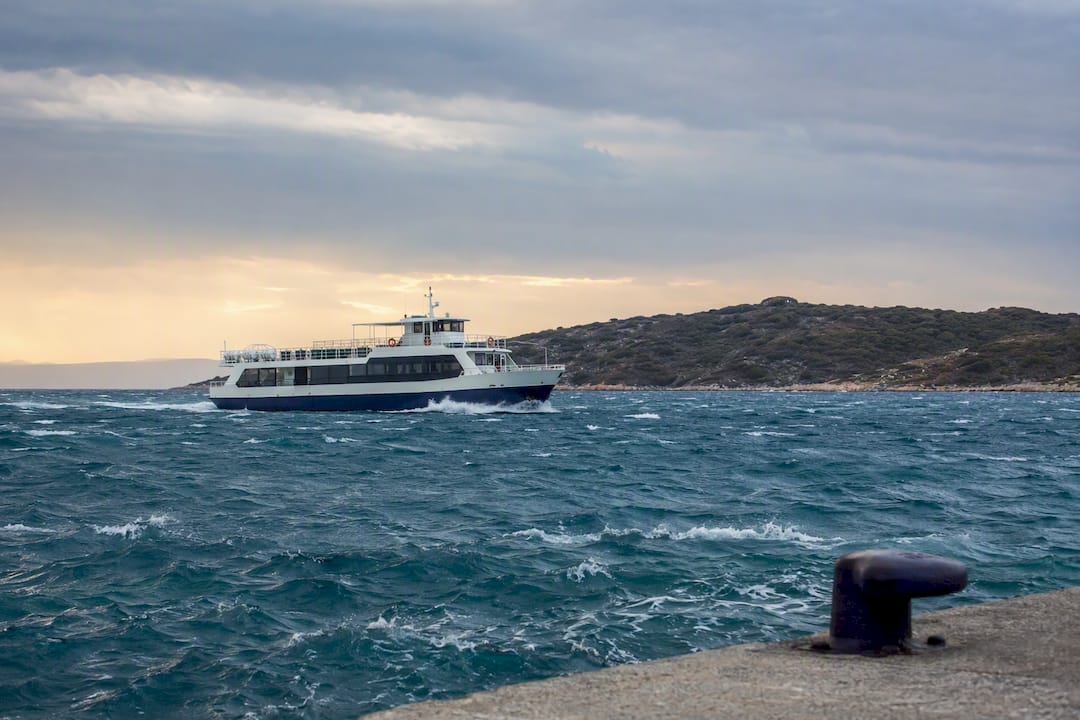
Strong winds occasionally affect ferry crossings to Vasiliki and Nidri, particularly in shoulder months when the Ionian can turn choppy with little warning. If your itinerary depends on a boat connection, build in a spare day rather than scheduling a same-day onward flight right after a ferry arrival.
Greek public holidays also reshape transportation patterns. Coach frequency on KTEL routes often drops around major holidays, and road traffic on the Athens approach can spike heavily around Easter and the mid-August Assumption holiday, both of which are peak domestic travel periods. If your trip lands near either date, expect longer drive times and book transfers earlier than you normally would.
The bridge itself is a smaller but real variable. Rotation delays lengthen during high-traffic weekends, and while they’re rarely more than a short wait, arriving at the tail end of a queue after a long drive is a frustrating way to end a travel day. Checking a live traffic app before your final approach, and avoiding late Friday or Sunday afternoon arrivals in July and August, sidesteps most of that friction. None of these disruptions are severe enough to derail a trip, but they’re exactly the kind of detail that separates a smooth arrival from a stressful one.
Alternative ways in: cycling and motorbiking routes to Lefkas
Cycling onto Lefkada is possible via the same bridge that carries cars, and it’s a genuinely appealing option if you’re already touring the mainland by bike. The approach roads through Preveza are manageable, though summer heat and traffic near the bridge make early morning crossings the smarter call.
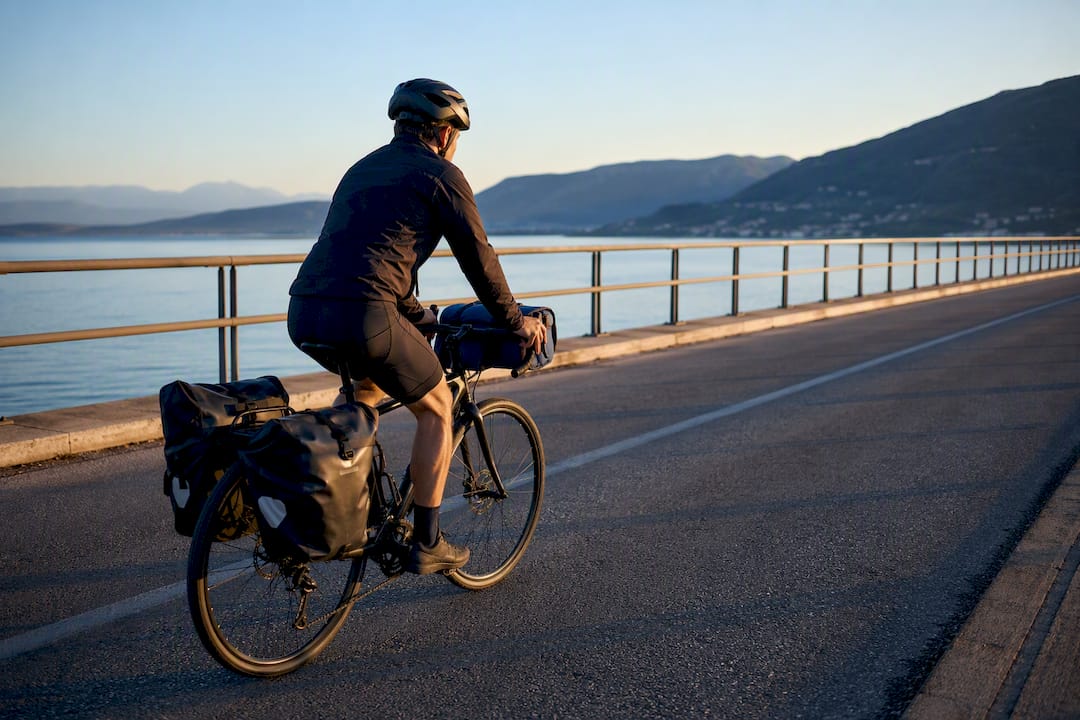
Motorbikes and scooters are a popular choice once you’re actually on the island, less so as a way of arriving from Athens or Thessaloniki given the distance involved. Riders coming from within a reasonable range, say from Preveza or nearby coastal towns, find the roads onto Lefkada straightforward, with the bridge crossing itself posing no special challenge for two wheels.
Where cycling and motorbiking genuinely shine is in exploring once you’ve arrived, particularly along the calmer eastern coast road linking Lefkada town to Nidri. The western side, with its steep descents to beaches like Egremni, is a tougher ask on two wheels and better suited to a car or a boat transfer. If you’re set on arriving by bike from any real distance, treat it as a multi-day approach rather than a single push, and pair it with the same shoulder season timing that makes everything else on this island easier.
Seasonal shifts in transportation you should plan around
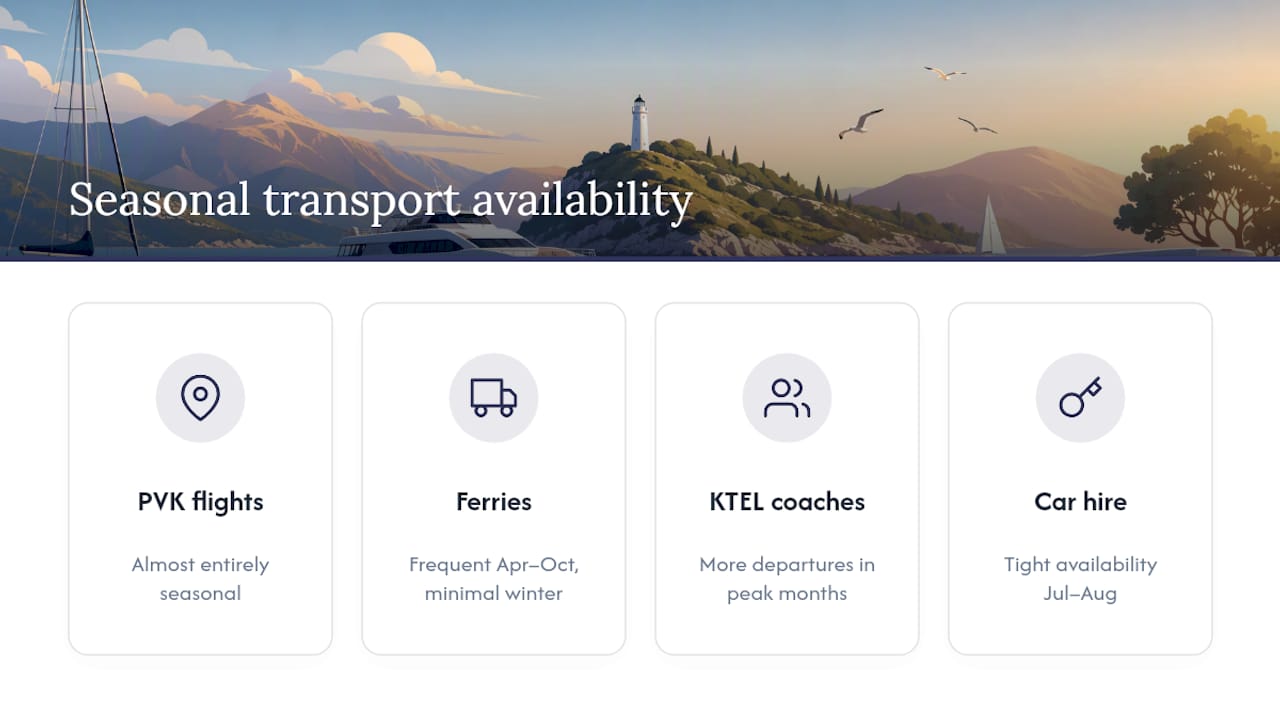
Transportation on and off Lefkada isn’t a static system. It expands and contracts hard between April and October. PVK’s flight schedule is almost entirely seasonal, meaning the airport option that works beautifully in July may not exist at all in January. Ferry routes to Vasiliki and Nidri follow the same pattern, running frequently in summer and dropping to minimal or no service in winter months.
KTEL coach frequency also flexes, with more daily departures in peak months and a thinner schedule once the crowds leave. Car hire availability tightens in July and August specifically, which is the single biggest reason to book that piece early rather than assuming you’ll sort it on arrival.
The practical takeaway is that Lefkada in August and Lefkada in November are close to two different logistics puzzles. If you’re planning outside the core season, verify every mode of transport you’re relying on individually. Don’t assume that because ferries ran last month, they’re still running this month.
Coordinating your arrival with a sailing departure
Landing at PVK doesn’t have to mean settling into an inland stay first. If you’re joining a yacht charter, timing your transfer to arrive close to marina check-in avoids a late afternoon scramble and skips an unnecessary overnight stay before boarding. Arrival logistics can be arranged to align PVK transfers with embarkation windows at Nidri or Vasiliki, allowing guests to move from plane to deck with minimal downtime.
For groups landing together, a prebooked transfer beats a scramble for taxis at the curb, especially with gear and luggage involved, making private transfers and boat tours a seamless option for onward travel. A few things worth having sorted before you land:
- Passport or ID matching your booking name
- Confirmation of your marina and check-in window
- A transfer booked to arrive within that window, not just “sometime that day”
If your trip centers on the water rather than a fixed address, exploring Lefkada by boat from Nidri or Vasiliki often makes more sense than committing to one inland base, particularly if your route follows the broader Ionian sailing loop around the island’s neighbors.
The most overrated and underrated parts of getting to Lefkas
Most travel advice treats the flight or drive as the hard part and the arrival as an afterthought. That’s backward. The PVK to town transfer, the bridge rotation, and the taxi fare negotiation—these small handoffs cause more actual stress than the multi-hour drive from Athens ever does, because people don’t plan for them.
The conventional advice to “just drive from Athens, it’s easy” undersells how much traffic and toll stops can stretch that 3.5 hour estimate on a bad Friday. Meanwhile, the advice that gets skipped entirely, agree your taxi fare before you get in, prebook transfers in August, check the bridge schedule if you’re on a tight connection, is the stuff that actually determines whether your first two hours on the island feel smooth or chaotic.
If you’re coordinating a sailing departure on top of all this, the priority shifts again. Getting to Lefkada matters less than getting to the right marina at the right hour. That’s the piece worth obsessing over, not the highway.
— Sail
Ready to turn that arrival into the start of something better? Sailarmada’s private sailing holidays around Lefkada and the Ionian pair naturally with a well-timed PVK transfer, so your trip starts on deck, not stuck in an airport queue.
Sources
- Aktiοn National Airport — Wikipedia
- Lefkada — Wikivoyage
- Getting to Lefkada — Lefkada Trails
- Lefkada
- Lefkada — Discover Greece