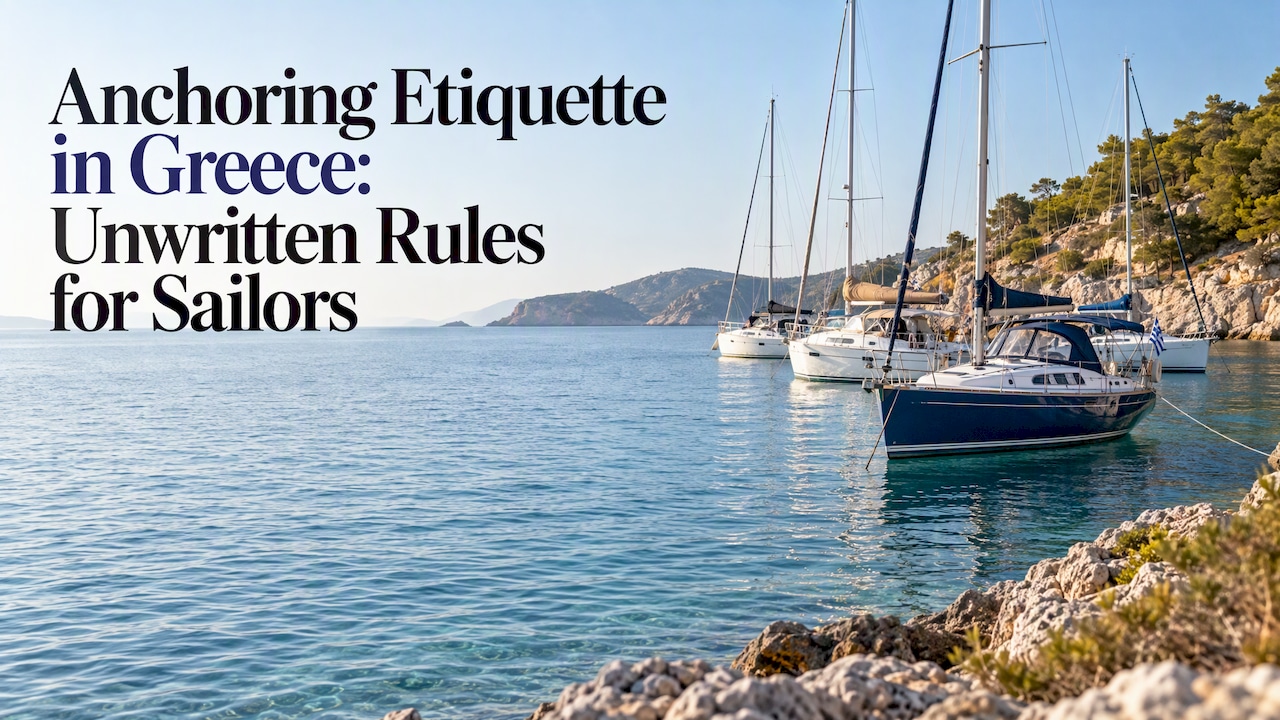
Anchoring etiquette in Greece comes down to five habits: arrive slowly, give every boat room to swing, leave the swimmers and the beach alone, put out enough chain for the wind you will really get, and obey the local rules of the harbor master. Nobody hands you a rulebook when you drop the hook in a gorgeous bay, but everyone around you is watching. Here is how to be the boat that gets friendly waves instead of raised eyebrows.
TL;DR
- Anchoring is traditionally first come, first served: the boat that arrived first sets the pattern, and you fit around it, never squeeze into it.
- Keep your swing circle clear of other boats and well away from swimmers and shore access. Use a 5:1 scope as an overnight target and expect more when the Meltemi blows.
- Rules change by place: marine parks such as Alonissos and Zakynthos limit or ban anchoring in some zones, and the port authority’s word always wins.
- Watch for dragging from the first minute and again after dark. Calm at sunset in a Greek bay often does not last.
- Not ready to skipper? Join a skippered week and learn the routine from sailors who do it daily.
Table of Contents
- Why anchoring manners matter more in Greece
- Rule one: first come, first served
- Give everyone room to swing
- Stern-to, bow-to and lines ashore
- How to pick a spot and set the anchor
- Respect swimmers, beaches and shore access
- Greek rules that change from bay to bay
- Overnight at anchor: the Meltemi test
- If the anchor drags
- Our perspective
- Join a Greek sailing week and learn it on the water
- FAQ
- Sources
Why anchoring manners matter more in Greece
Greece has thousands of islands and a coastline full of small bays, but the best ones are famous, and in July and August the famous ones fill by late afternoon. Add the fact that many boats here anchor stern-to or with a line ashore, and a bay that looks huge on the chart can turn into a puzzle of anchors, chains and lines.
That is why etiquette is practical, not just polite. A boat that anchors too close, too fast or too late in the day puts everybody’s night at risk, including its own. If you want the broader picture of how sailors behave on and off the boat, our Mediterranean sailing etiquette examples cover marinas, tavernas and shared quays. This article stays at anchor.
Rule one: first come, first served
There is no law that decides who gets the best spot in an anchorage. As BoatUS puts it, anchoring is traditionally first come, first served, so a boat already settled has the stronger claim and you work around it.
In practice that means:
- Circle first, drop second. Motor slowly through the bay, look at where boats are lying, which way they point and how much chain they seem to be using. Then pick your spot.
- Anchor behind, not in front. The boat ahead of you cannot see you. If you drop upwind of someone and drag, you are the problem. Anchoring downwind of a settled boat is the safer courtesy.
- Do not squeeze in. Athens Sailing Academy’s advice is simple: keep a good distance from nearby boats and do not squeeze into a full anchorage. If the bay is full, move on to your plan B.
- Ask when in doubt. A friendly wave and a shout of “Is there room if I go there?” works in every language and wins you a neighbor instead of an enemy.
That last point connects to the plan B. Professional seamanship guidance from the Shipowners’ Club says a safe anchorage needs suitable depth and enough room for vessels to swing, and it recommends identifying an alternative anchorage in advance. In August, that is gold. Pick your second bay before you leave the first.
Give everyone room to swing
A boat at anchor does not stay still. It pivots around its anchor as the wind shifts, and the circle it draws is bigger than most newcomers imagine. As a worked example, two 12 m boats each lying to 5:1 scope in 5 m of water swing on a circle of about 37 m radius, so their anchors should be roughly 75 m apart. Overlapping circles are only fine as long as both boats swing the same way, and in a shifting breeze they will not.
A few habits make this easy:
- Estimate your own radius: depth plus your freeboard, times your scope, plus your boat length.
- Look at what the others are doing. A catamaran swings differently from a monohull, and big boats swing slowly and in a wider arc.
- Remember that boats on all-chain and boats on rope and chain behave differently, so do not assume your neighbor swings like you.
- If you must anchor closer than you like, tell the neighboring crew and set an anchor alarm.
Stern-to, bow-to and lines ashore
Greek bays often invite a different style: drop the anchor, reverse towards the shore, and tie the stern to a rock or tree. Etiquette here is about space and sequence.
- Check the order of boats. If a boat is already stern-to, line up with it. Do not anchor bow-to in a row of stern-to boats, it ruins the pattern.
- Keep your chain tidy. Lay your anchor so that it does not cross a neighbor’s. If you do cross, sort it out before sunset, not at 2 a.m.
- Take the windward line first. When there is a crosswind, the guide at Greek Waters recommends tying the windward line ashore first, then putting pressure on the anchor.
- Do not run lines across swim paths. A line at head height over the water is a hazard for swimmers and dinghies.
When the goal is a quayside rather than a bay, the same stern-to logic applies on a pier. If you are aiming at a taverna dock, our guide to Greek tavernas you can reach by boat shows where to tie up and eat.
How to pick a spot and set the anchor
The polite anchor is also the one that holds. Before you drop, think about these four things.
Depth, bottom and wind
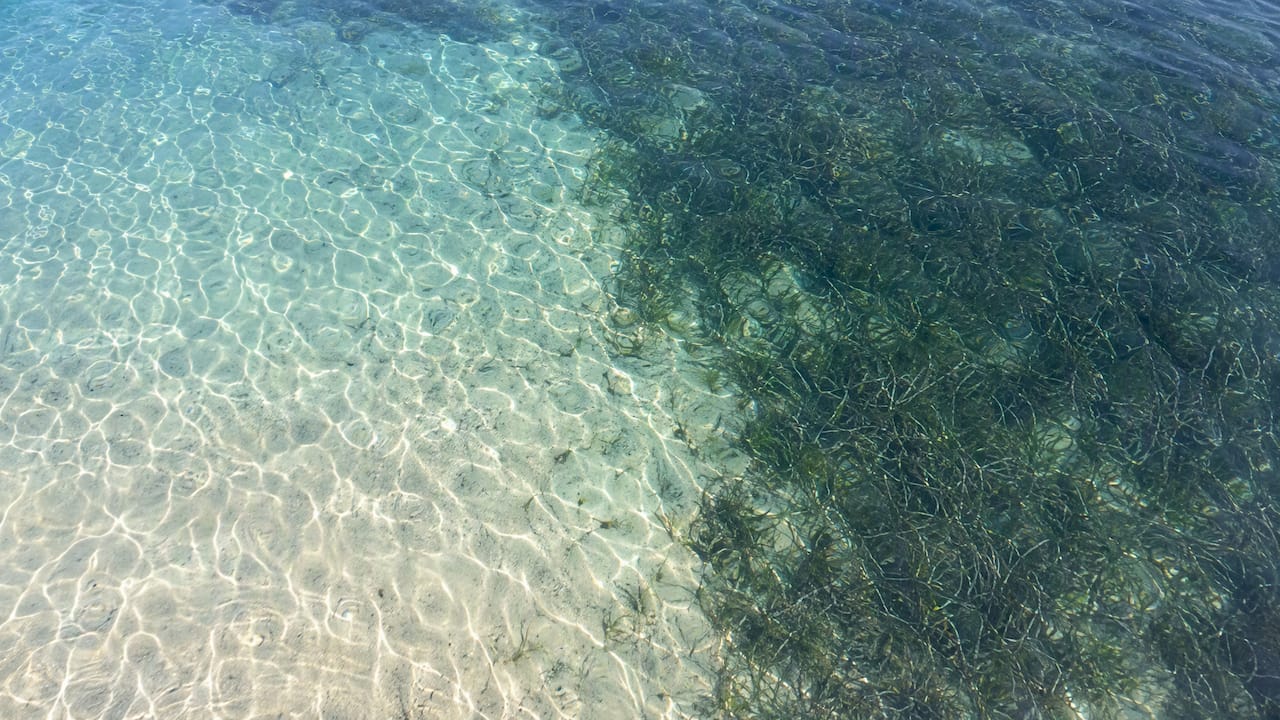
The Athens Sailing Academy guide suggests an ideal depth of around 3 to 10 metres, with mud and clay, or clay and sand, generally holding best. The same source warns that dense seagrass or algae can stop an anchor from holding as it should. In clear Greek water you can usually see the bottom: aim for a sandy patch, not a dark carpet of weed.
The approach
Come in slowly, bow into the wind or current, and stop where you want the anchor to land. One practical tip from the local sailing safety advice is to keep speed low, under 4 knots in bays, though in a crowded bay you will want to be much slower than that. Lower the anchor, do not throw it, and back down gently while paying out chain.
The scope
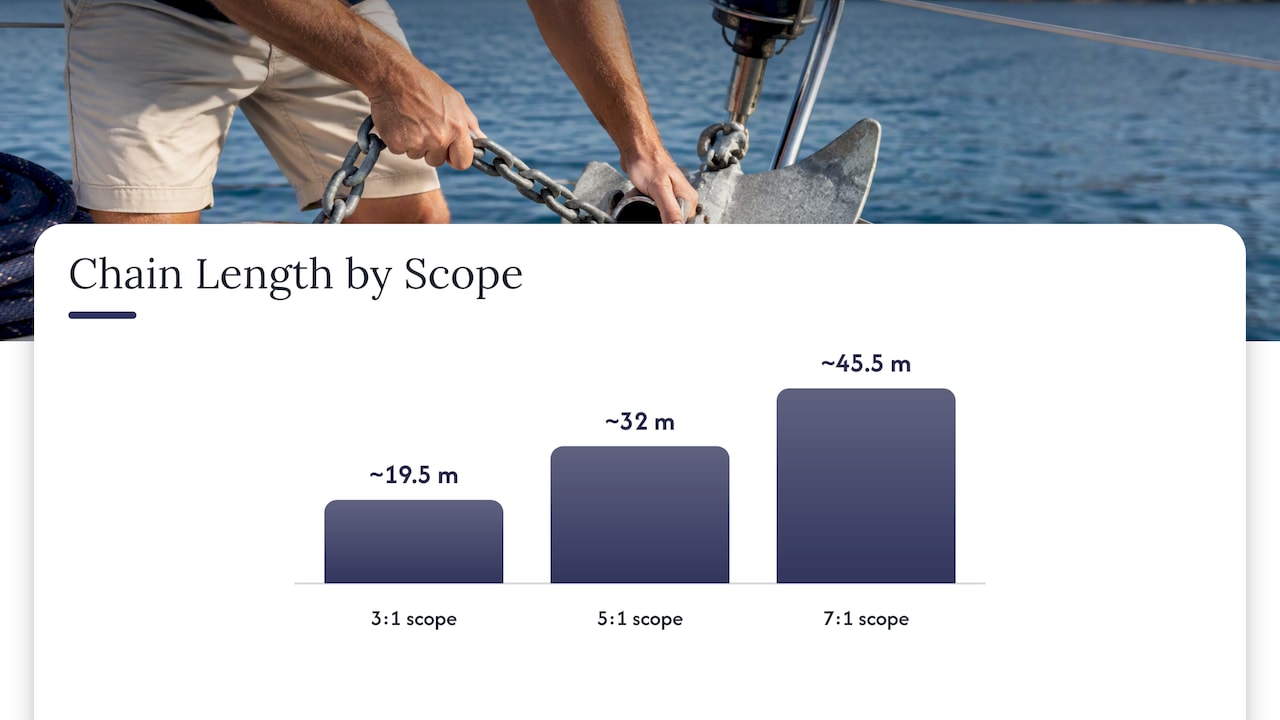
How much chain is enough? Mooring Solution’s guidance says that in calm conditions 3:1 may be the minimum, 5:1 is a better overnight target, and stronger winds may call for closer to 7:1. Scope means the length of chain out compared with the depth of water, measured from the bow. In 5 m of water with 1.5 m of freeboard, a 5:1 scope is about 32 m of chain.
Let out more only if you have the room. Longer scope means a bigger circle, so recheck your neighbors.
The check
In clear water, swim over the anchor and look at it. It takes two minutes and it is the most reliable test you have. Then pick two fixed objects on shore, line them up, and see whether they move. If they do, you are dragging.
Respect swimmers, beaches and shore access
The golden rule of every Greek bay: the water near the beach belongs to the people in it. Keep your anchor well outside the swimming zone and run your tender slowly and at low speed when you cross it.
There is also an official yardstick. A 2026 Greek regulation for rental powerboats (carboats) prohibits circulation within 100 metres of the outer edge of swimming buoys and within 200 metres of the usual point swimmers reach where there are no buoys. It applies to that boat category, not to every sailing yacht, but it shows how seriously Greek authorities take swimmer safety. Treat it as a good benchmark for your own dinghy and your own boat.
A few more manners near the shore:
- Leave the taverna jetty and fishing boat landings free. Those quays are somebody’s livelihood.
- Do not anchor across a channel or a boat ramp.
- Keep your music down after dark. Sound carries across still water, and the next boat is only 80 m away.
- Run the generator and watermaker at sensible hours.
- Take your rubbish with you, and keep grey water to a minimum in small bays.
Greek rules that change from bay to bay
Etiquette is unwritten. Regulation is not, and in Greece it changes with the location. Skippers should know that recreational vessels are required to follow all orders from the Port Authority about anchoring, mooring and restricted zones, as set out in General Port Regulation No. 20. If a coast guard officer or port police tells you to move, you move.
Some examples worth knowing before you plan a route:
| Place | What applies | Where to check |
|---|---|---|
| Alonissos National Marine Park | Rules vary by zone. At Piperi, approaching within 3 nautical miles is prohibited except for vessels engaged in permitted activities. | Alonissos Marine Park zones |
| Zakynthos Marine Park, Zone B | From 1 May to 31 October, vessels may enter at up to 6 knots, but anchoring is prohibited. Entry zones C and Iα also have a 6-knot limit. | Zakynthos anchorage guide |
| Navagio Beach, Zakynthos | Access has been restricted in recent seasons, including a ban on approaching or anchoring within 50 meters of the shoreline. | To Vima report |
The Navagio rules have been extended season by season, so confirm the current position with the local port authority before you go. The same goes for the marine parks: ask at your last port or check the park’s official page.
For the paperwork side of a charter in Greece, see our guides to Greek sailing regulations and port fines, yacht check-in and when you need a boat license.
Overnight at anchor: the Meltemi test
The most important etiquette rule at night is not to be the boat that drags. Two sailing sources, Athens Sailing Academy and Mooring Solution, stress that a calm bay at sunset can be misleading: gusts coming down from hills and changing wind patterns, such as the Meltemi, can make an anchorage unsuitable overnight.
So before dinner, ask yourself:
- Holding: did the anchor dig in properly, and have you checked it?
- Scope: is it right for tonight’s forecast, not just this afternoon’s breeze?
- Swinging room: if the wind turns 180 degrees at 3 a.m., do you still clear everyone?
- Exposure: is the bay open to the direction the forecast wind comes from?
- Plan B: if you need to leave in the dark, can you do it safely?
For the Meltemi itself, read our guide to sailing the Meltemi in Greece, and for the routine that lets a crew actually rest, our five step checklist for sleeping at anchor is worth bookmarking.
If the anchor drags
Dragging happens to everyone eventually, and the polite response is to act fast and tell your neighbors.
- Notice early. Changing bearings to fixed objects on shore is the oldest and most reliable sign. Set a GPS anchor alarm too, and check at regular intervals in the first hour.
- Wake the crew. Do not try to sort it out alone. One person at the helm, one at the bow.
- Mark the position. Safety guidance on dragging anchors advises noting the position where the anchor was dropped so that you know how far you have moved.
- Start the engine before you need it. Motor up to the anchor, take the strain off, and recover it.
- Warn nearby boats. A shout or horn is better than a collision.
- Re-anchor with more scope or in a different spot. If it still drags, change the bay. Do not repeat the same mistake in a crowded anchorage.
If you drift into somebody’s boat, stay calm, exchange details, and call the coast guard if there is damage or danger.
Our perspective
After many weeks of guiding crews through the Greek islands, we see the same thing every summer: the problems are rarely about the anchor. They are about arriving late, rushing the approach, and picking the bay everybody else picked. The skippers on our routes from CAPETAN.club plan around that. They choose a calm second option, they get to the bay early enough to pick a patch of sand, and they brief the whole crew on the anchor drill before anyone jumps in for a swim.
We also think etiquette is part of the holiday. A quiet evening, a friendly wave to the boat next door and a swim at dawn in an empty bay is what people remember. If you are new to anchoring, a week with a skipper is the quickest way to learn the rhythm, and you can ask all the questions you like.
— Sail
Join a Greek sailing week and learn it on the water
If you would rather practice with an experienced skipper than read about it, our Greece private week is a good place to start. Greece – Go Private starts from 560 € per week per person, with a skipper who handles the anchor drill, bay choice and Meltemi planning while you swim, cook and relax. Prefer company? Take a look at our group sailing holidays, or browse the Greece destination page for routes and ideas.
FAQ
Who has priority when anchoring in a crowded bay?
There is no legal priority rule, but the custom is first come, first served. The boat that anchored first is entitled to its space, so newcomers should find a spot that leaves everyone enough room to swing. If you doubt you fit, ask the neighbors or go to another bay.
How far from other boats should I anchor in Greece?
Far enough that your swing circles do not overlap. As a rule of thumb, add up each boat’s radius, which is its scope times the depth plus its length, and keep your anchors at least that far apart. In a Meltemi, allow even more.
How much chain should I let out?
In calm conditions 3:1 may be the minimum, 5:1 is a better target overnight, and up to 7:1 may be needed in stronger wind. Measure the depth from the bow, not from the sounder. Check by swimming over the anchor when the water is clear.
Can I anchor anywhere in Greece?
No. Marine parks such as Alonissos and Zakynthos have zones where anchoring is restricted or banned, and port authorities can order you to move. Check the official park page or ask at the nearest port before you plan a night in a protected area.
Should I anchor at night in a bay that looks calm?
Only after checking the forecast and the shape of the bay. Local gusts from the hills or a shift in wind can turn a calm sunset anchorage into a rough night. Have a plan B and keep an anchor alarm on.
Sources
- Athens Sailing Academy: guide to anchoring stern-to in Mediterranean style
- Mooring Solution: best anchorages in Greece
- The Shipowners’ Club: guidance on anchoring
- BoatUS: anchoring etiquette
- Safety Anchor Alarm: how far apart should boats anchor
- SAFETY4SEA: dos and don’ts when dragging anchor
- Greek Government Gazette 2026: carboat regulation
- General Port Regulation No. 20
- Alonissos National Marine Park: zones A and B
- To Vima: Navagio Beach access curbs
- Sail Greece Guide: Zakynthos anchorages