The VAT on a Greek yacht charter depends on one question: who runs the boat? A bareboat charter, where you take the yacht and the owner steps back, is generally treated as a lease of a means of transport and taxed at the standard 24%. A crewed charter is treated as a transport service and can qualify for a reduced rate. Below we explain the difference, which costs sit outside VAT, and how the security deposit works, so your quote makes sense before you pay anything.
TL;DR
- Bareboat: Greek law treats it as a lease of a means of transport, which generally means the standard 24% rate.
- Crewed: it counts as a transport service and can get a reduced rate. Greece’s standard rate is 24%, with reduced charter rates from 5.2 percent upward, depending on the yacht’s certification.
- Cruising tax (TEPADAH) is a separate obligation from VAT, so a good invoice lists the two on separate lines.
- Security deposit is not VAT and not a fee. It is a refundable guarantee, usually between €1,000 and €5,000 for a Greek charter.
- Before you pay, ask for a quote that shows whether VAT is included, at what rate, and what is excluded.
Table of Contents
- Why the answer is never a single number
- Bareboat versus crewed: the line that decides your VAT
- What is not VAT, and still lands on your bill
- The security deposit: how it works
- How to read a Greek charter quote line by line
- Our view on VAT and Greek charters
- Practical steps before you pay
- Ready to plan a Greek sailing week?
- FAQ
- Sources
Why the answer is never a single number
Search for the VAT on a yacht charter in Greece and you will find 24%, 13%, 6.5% and 5.2%, often on the same page. They are not contradicting each other. They apply to different kinds of charter.
Greece has a standard VAT rate of 24%. On top of that sit special treatments for charters, and which one applies depends on the type of contract, the length of the charter and, for crewed yachts, the certification of the boat. That is why a friend who chartered a crewed motor yacht can quote a very different percentage from the one on your bareboat catamaran quote.
Two more things make it confusing. First, the rules have changed in recent years, with temporary reductions and later extensions. Second, many articles are written for superyacht clients, with 35 meter boats and professional crew. If you are a group of friends or a family booking a sailing week, that is not your world, so read those figures as context and not as your bill.
Bareboat versus crewed: the line that decides your VAT
Greek tax lawyers describe the split clearly. According to an analysis by a Greek tax law practice, a bareboat charter, where the owner is separated from the vessel, qualifies as a lease of a means of transport. A crewed time charter is a transport service. Those two labels carry different VAT treatment.
In practice, that gives you this picture:
| Charter type | How Greek VAT law sees it | What to expect |
|---|---|---|
| Bareboat (you skipper, or hire a skipper separately) | Lease of a means of transport | Standard rate of 24% in most scenarios |
| Crewed charter, commercial, over 48 hours | Transport service | Reduced statutory rate, commonly quoted as 13%, with lower effective rates for certified yachts |
| Short or static charters | Treated as standard in most sources | Expect 24% unless your operator documents otherwise |
Treat the table as orientation, not a tax ruling. The rates have moved over time. A Greek fiscal representation firm explains that from 1 April 2021 the government reduced the tax base for crewed yachts from 24% to 13% through semi-annual ministerial decisions. If the rate matters to your budget, ask the operator which rate applies to your specific dates and boat.
What about a boat with a skipper?
This is the grey zone for most holiday sailors. Hiring a skipper for a bareboat yacht is common, and it feels like a crewed charter. Whether the tax authorities see it that way depends on the contract and on who is in command, so do not assume the reduced rate applies just because someone else steers. Ask the company to confirm in writing how your charter is classified and which VAT rate is on the invoice. A reputable operator will answer that in one email.
Where the 5.2% and 6.5% figures come from
You will see very low effective rates quoted for crewed yachts. Industry sources describe these as the result of a reduction structure tied to certification and time in international waters, with rates as low as 5.2% or 6.5%. The point for you: they apply to specific, certified crewed vessels, not to every boat in a marina. If someone quotes you 5.2% on a bareboat catamaran, ask them to show you why.
What is not VAT, and still lands on your bill
A cheaper looking quote often just leaves things out. Before you compare two offers, line up what each one includes.
Cruising tax (TEPADAH)
For commercial crewed charters, Greece applies a cruising tax known as TEPADAH. It is calculated pro rata on the yacht’s length, gross tonnage and the days spent cruising in Greek waters, and it is required to issue the charter license. It is separate from VAT. People mix the two up all the time, so ask the broker or operator to show them as two lines on your final invoice.
Marina and mooring fees
These are paid at the quay, usually by the boat, and they vary by size and season. A weekly itinerary that sleeps in marinas every night costs more than one that anchors in bays. We cover that in detail in our guide to marina fees in Greece, including how they are calculated.
Fuel, final cleaning, linen and extras
Fuel for the engine and the dinghy, final cleaning, bed linen, a second paddleboard and the transit log are the usual suspects. Some are bundled and some are optional. The question to ask is simple: “What is excluded from this price?”
Tips
Tipping is not tax and not mandatory, but it belongs in your budget if you have a crew. Our note on tipping on yacht charters explains why we suggest calculating it on the base fee only.
The security deposit: how it works
Many readers who land on this topic also ask about the security deposit, because it is the other big number on a charter quote.
The deposit is not a cost. It is money held against damage to the boat or missing equipment, and you get it back if the yacht returns in good order. According to an insurance provider, the charter company’s policy insures the hull and carries the compulsory third-party liability, and you as the charterer are personally liable only up to the deposit, typically €1,000 to €5,000. The same page says an optional deposit insurance, also called a damage waiver, refunds the deposit if the yacht is damaged, and costs 2 to 15% of the deposit per charter.
What to check:
- The amount, and whether it differs by boat size. Larger catamarans usually carry higher deposits.
- How you pay it: card hold, bank transfer, or cash. Ask when it is released after return.
- What is excluded from cover. Typical exclusions include negligence and damage to sails or the dinghy engine, but the exact list is in your contract, so read it.
- Whether a waiver is offered, what it costs, and what it does not cover.
No VAT is charged on a refundable deposit as such, but if part of it is kept to cover damage, ask how that is invoiced.
How to read a Greek charter quote line by line
A quote you can trust looks boring. Here is what we would want to see:
- The base charter fee for your dates, with the VAT rate stated and whether the price is shown with or without VAT.
- The classification of the charter: bareboat, skippered or crewed.
- A separate line for any cruising tax, if it applies to your type of charter.
- A clear list of mandatory extras (cleaning, linen, transit log) and optional ones (skipper, hostess, watersports).
- The security deposit amount and the waiver option.
- Payment schedule and cancellation terms.
If a quote arrives as a single number, ask for the breakdown. Comparing two single numbers tells you nothing.
A worked example of why the comparison fails
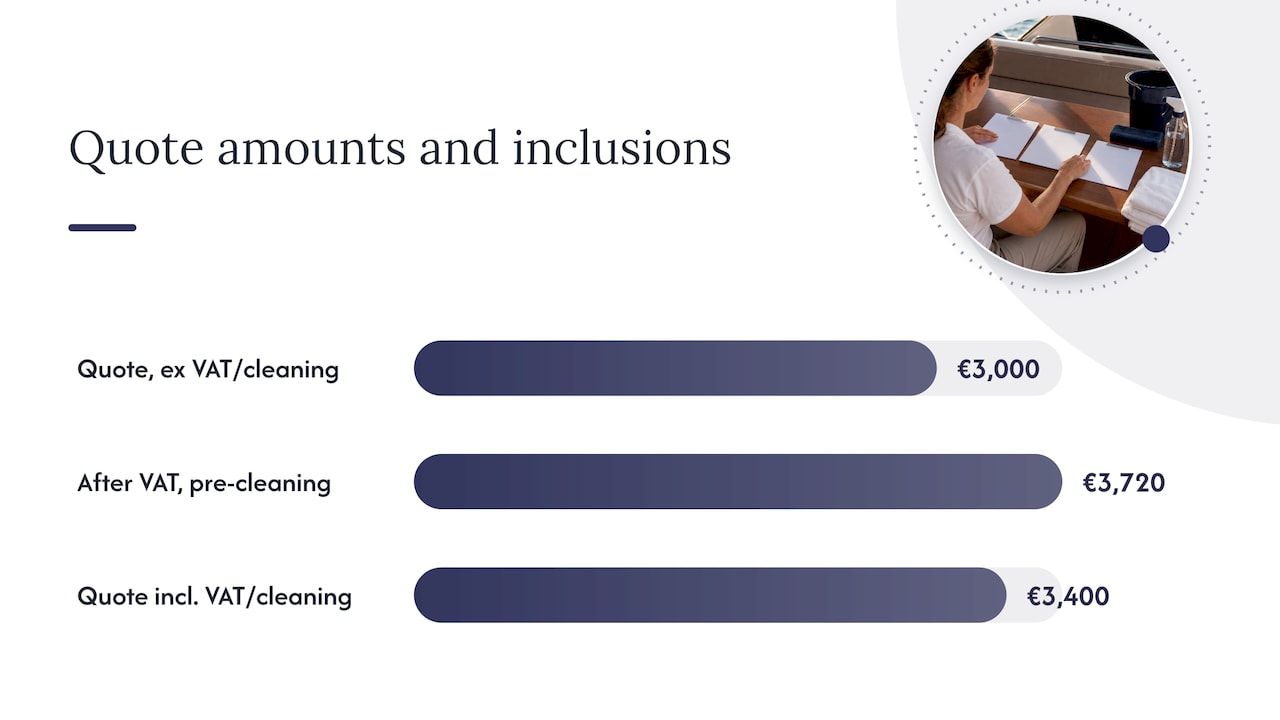
Imagine two quotes for the same week on similar boats. One says 3,000 and the other says 3,400. The cheaper one excludes VAT and cleaning, and the pricier one includes both. Once you add 24% VAT to the first, it overtakes the second before you even count cleaning. The numbers here are only an illustration, not a real quote, but the pattern is the one we see readers fall into most often. Always compare the all-in total with the same inclusions.
Our view on VAT and Greek charters
We plan sailing weeks for groups of friends and families, and the questions we hear most are not about tax law. They are about whether the price on the screen is the price at the end. Here is how we think about it.
First, tax is a reason to be precise, not a reason to worry. The rules differ between bareboat and crewed, and a clean quote tells you where you stand. We publish our private-week prices per person, with the starting figures visible on each offer page, because transparent pricing is part of how we work.
Second, the cheapest headline is rarely the cheapest holiday. The extras around a boat, from marina nights to fuel, can move the total more than the VAT line does. That is why we build itineraries with you, balancing nights at anchor and nights in port, instead of selling a week as a fixed box.
Third, ask a real person. Our team are sailors, and our routes are curated by skippers from CAPETAN.club, so if you want to know what a week on a given boat includes, you can ask someone who has been on that boat. For anything that depends on your own tax situation, such as a company booking, check with your accountant.
— Sail
Practical steps before you pay
- Decide the format first. Do you want to skipper yourself, hire a skipper, or have a full crew? Our explainer on bareboat charters helps you decide how hands-on you want to be.
- Ask for the VAT rate in writing, and whether the quoted price includes it.
- Ask for the full list of extras, and which of them are paid on arrival.
- Get the deposit terms and the release date after return.
- Check your own paperwork. Skippers should know the local rules. We summarize them in our guide to sailing regulations in Greece.
- Keep the invoice. If you are booking through a company, your accountant will want a proper VAT invoice.
For groups splitting the cost
VAT looks smaller when you divide it by eight people, but only if everyone sees the same numbers. Agree on one person to pay the operator, share the invoice with the group, and settle the deposit and the extras kitty before you leave. A shared spreadsheet saves more arguments than any discount.
Ready to plan a Greek sailing week?
If you would like a clear price for a private week among the Greek islands, take a look at our Greece Go Private offer, which starts from 560 € per week per person. You choose the boat, the dates and the pace, and our team of sailors helps with everything from the route to what is included. Prefer to travel in company? Browse our group sailing holidays and join a crew for the week. Want inspiration on where to go first? Our Greece destination page is a good starting point.
FAQ
What is the VAT rate on a yacht charter in Greece?
The standard Greek rate is 24%, and reduced charter rates exist for crewed yachts. Bareboat charters are classified as a lease of a means of transport, which in most scenarios means 24%. Because the rules have been adjusted several times, ask your operator to confirm the rate for your dates in writing.
Is cruising tax the same as VAT?
No. TEPADAH is a separate cruising tax for commercial crewed charters, calculated on the yacht’s length, tonnage and days in Greek waters. VAT is charged on the charter fee. A clear invoice shows both on separate lines.
How much is a yacht charter security deposit in Greece?
It is usually between €1,000 and €5,000, depending on the boat. It is a refundable guarantee against damage, not a fee. Ask when it is released after return and whether a damage waiver is offered.
Can I pay less VAT if someone skippers the boat for me?
Not automatically. A reduced rate depends on how the charter is classified and, for crewed yachts, on the yacht’s certification. Hiring a skipper for a bareboat yacht does not by itself change that, so get the classification confirmed in writing before you book.
Sources
- Charter of vessels and VAT implications, TaxLaw
- VAT in Greece, SOS Yachting
- Yacht Charter in Greece: Common Misunderstandings and Questions, Megayacht News
- E-charter permission, Stephenson Harwood
- Do You Need Insurance to Charter a Yacht in Greece?, Digicare