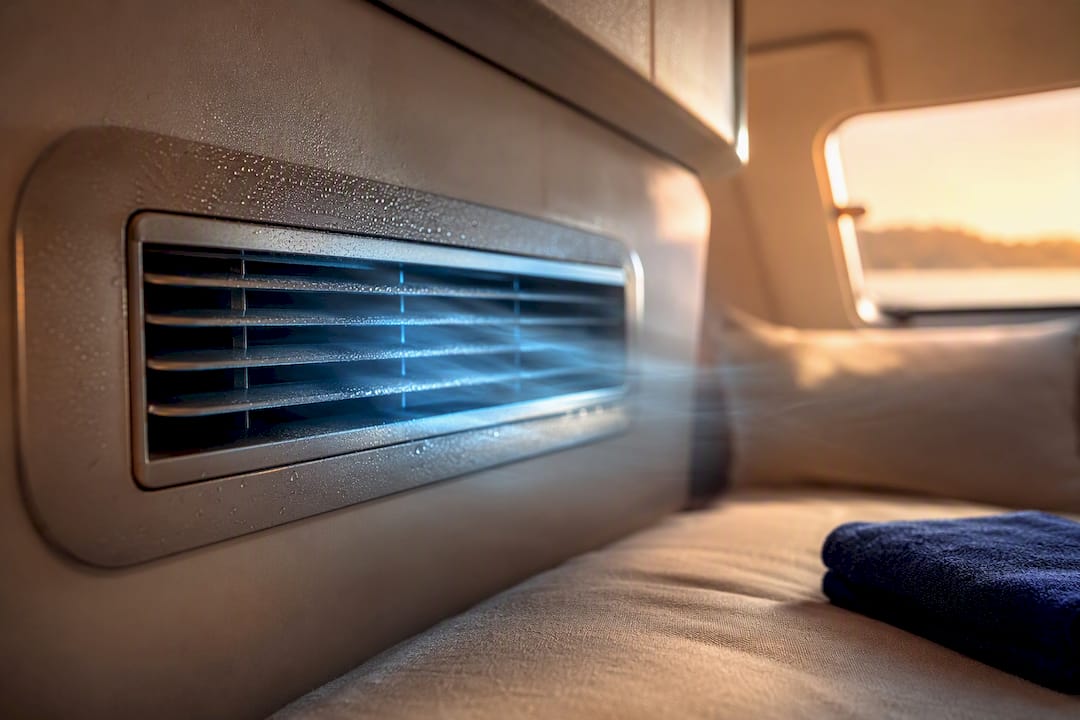
Most charter yachts over 45 feet offer air conditioning, but “having A/C” and “running it whenever you want” are two very different promises. Smaller sailing yachts often limit it to overnight hours because of generator capacity, while gulets and catamarans vary widely by class and price. If cool cabins around the clock matter to your trip, the fix is simple: get the exact hours written into your charter agreement before you sign, not assumed from a brochure photo.
TL;DR:
- Smaller yachts under 50 feet typically have scheduled A/C hours with limited generator capacity, often not providing 24/7 cooling.
- Larger vessels over 80 feet generally feature chilled-water systems that support continuous cooling without excessive fuel use.
- Confirm the specific air conditioning system type, hours included, and whether shore power is available before booking.
- Generator capacity and startup surges limit the number of A/C units that can run simultaneously, impacting daytime comfort.
- Proper maintenance and strategic use of A/C, such as pre-cooling and closing hatches, improve efficiency and onboard comfort.
Table of Contents
- How Common Is Air Conditioning on Yachts by Type and Size?
- What Types of Marine A/C Systems Will You Actually Find Onboard?
- How Do Generators and Shore Power Limit A/C Run Time?
- How Does A/C Affect Comfort, Noise, and Daily Life Onboard?
- What Does A/C Actually Cost on a Charter Bill?
- What Should You Ask Before Booking to Secure the A/C You Need?
- How Do You Prevent and Fix Common Yacht A/C Problems?
- How Can You Use A/C More Efficiently Onboard?
- Does Weather or Sea Conditions Change How Well A/C Performs?
- Is Yacht Air Conditioning Safe for Air Quality and Mold Prevention?
- The SailArmada Take on Getting A/C Right
- Ready to Book a Charter With A/C You Can Count On?
- Sources
How Common Is Air Conditioning on Yachts by Type and Size?
Availability tracks almost perfectly with vessel size, and once you know the thresholds, choosing a boat gets a lot easier.
Small sailing yachts under 50 feet typically carry self-contained reverse-cycle units that cool a cabin or two well but strain when every unit runs at once. On these boats, A/C is usually scheduled around generator hours rather than left on continuously. Move into the 50 to 80 foot range, common for larger catamarans and monohulls, and you’ll find split systems serving multiple cabins independently, with meaningfully more flexible run times.
Above 80 feet, chilled-water systems become the norm, and that’s where genuinely 24/7 cooling starts to feel standard rather than exceptional. Gulets sit slightly outside this size logic: a standard gulet often includes around five hours of A/C a day, while deluxe gulets can offer extended hours depending on price tier.
- Under 50 feet: self-contained units, scheduled hours, generator dependent
- 50 to 80 feet: split systems, broader coverage, still generator limited on passage days
- 80 feet and up: chilled-water systems, near-continuous cooling standard
- Gulets: hours tied directly to class and nightly rate, not just length
The pattern comes down to physics as much as budget. Bigger hulls hold bigger generators, better insulation, and more battery reserve, so the boat can afford to run A/C without burning through fuel every hour. If continuous cooling is non-negotiable for your group, choose the vessel class first and let price follow, not the other way around. Yacht type shapes onboard comfort more than almost any other single decision you’ll make while booking.
What Types of Marine A/C Systems Will You Actually Find Onboard?
You don’t need an engineering degree to interpret a broker’s spec sheet, but knowing three system names will save you a lot of guesswork.
Self-contained (direct expansion) units are the workhorses of small and mid-size charter boats. Each unit cools one zone, usually a single cabin, and they’re the type most likely to be scheduled around generator hours rather than left running.
Split systems separate the noisy compressor from the indoor air handler, which means quieter cabins and the ability to cool several spaces independently. These show up on larger catamarans and monohulls up to roughly 80 feet, and they’re a meaningful upgrade in comfort over a single self-contained unit trying to serve a whole boat.
Chilled-water systems circulate cooled water through the vessel to multiple air handlers from one central plant. They’re efficient at scale and standard on yachts over 80 feet, which is a major reason larger charters can offer round-the-clock cooling without the fuel penalty smaller boats face.
- Self-contained: best up to ~50 feet, common on entry to mid-tier charters
- Split systems: ideal up to ~80 feet, quieter and zone-flexible
- Chilled-water: typical above ~80 feet, built for continuous use
Pro Tip: Ask the broker which system type is onboard, not just “does it have A/C.” A split system on a 65-foot catamaran behaves very differently from a single self-contained unit trying to cool the same boat.
As a rough sizing cue, cabins generally need somewhere in the neighborhood of 5,000 to 8,000 BTU each, while open saloons need considerably more given their volume and glass area. Installation costs for these systems range from a few thousand dollars for a basic self-contained retrofit to well over $100,000 for a full chilled-water build on a large yacht, which explains why bigger boats treat A/C as a built-in feature rather than an add-on.
How Do Generators and Shore Power Limit A/C Run Time?
Three power sources keep a yacht’s A/C running, and each one comes with a ceiling.
Shore power, available when docked at a marina, is essentially unlimited and lets you run every unit onboard without a second thought. Generator power, used at anchor, is where most charter limits come from: a single generator serves lighting, refrigeration, water makers, and A/C simultaneously, so it has to be sized carefully. Battery and solar setups can run small loads like fans and lighting for hours, but they rarely have the capacity to start an A/C compressor’s initial surge, let alone sustain it overnight.
That surge matters more than most guests realize. A 16,000 BTU unit draws roughly 2,400 watts once running, but startup current can hit three to four times that briefly. Sizing rules of thumb generally call for 1,500 to 2,000 watts of generator capacity per 12,000 BTU of cooling, which is exactly why boats can’t just run every cabin’s unit at full blast the moment someone feels warm.
- Shore power: unrestricted, available at marinas and port stops
- Generator power: the main constraint at anchor, sized to specific loads
- Battery/solar: supplements small loads, rarely covers A/C compressors
This is why many charters schedule A/C for overnight hours, add fuel surcharges for extended daytime use, or restrict simultaneous units. If your itinerary allows for it, ask your operator about building in a port night or two, since docking with shore power access is the simplest way to guarantee a cool, quiet night without stressing the generator.
How Does A/C Affect Comfort, Noise, and Daily Life Onboard?
Cooling and quiet don’t always arrive together, and understanding the trade-off helps you set realistic expectations before day one.
Generators and A/C compressors both produce noise, and on smaller boats where the generator sits close to sleeping cabins, that hum is noticeable at night. Larger yachts with better sound insulation and generators mounted further from living spaces minimize this considerably, which is one more reason vessel class affects comfort as much as the cooling system itself.
Humidity is the other half of the equation. A/C doesn’t just cool air, it pulls moisture out of it, so cabins running A/C regularly feel noticeably drier and more comfortable than saloons or open decks relying on natural airflow. Most charter guests settle into a rhythm: run A/C for an hour before bed to drop cabin temperature, sleep through the coolest overnight hours, then rely on shade, breeze, and swimming during the day when the boat is underway or anchored in a sheltered bay.
- Smaller boats: more generator noise near cabins, shorter A/C windows
- Larger yachts: better insulation, generators positioned away from sleeping areas
- Common guest pattern: pre-sleep cooling, overnight run, daytime natural ventilation
Cabin layout plays a role too. Compact cabins on smaller boats cool faster and hold temperature better than large open saloons, which lose cool air through hatches and companionways. Cabin configuration is worth reviewing alongside A/C specs when you’re comparing charter options.
What Does A/C Actually Cost on a Charter Bill?
A/C rarely shows up as its own line item, but it shapes your final bill in three predictable ways.
- Included in the base charter price. Many operators bundle a set number of A/C hours, often overnight plus limited daytime use, into the quoted rate.
- Billed through the Advance Provisioning Allowance (APA). Fuel burned running the generator for extended A/C use gets pulled from this fund alongside food, drinks, and dockage, so heavy use can shrink what’s left for the trip’s other expenses.
- Charged as a separate surcharge. Some operators, particularly on smaller or budget vessels, add a flat daily fee for extended or 24/7 A/C access.
The cost logic traces straight back to installation. A basic four-unit system with its own generator on a 50-foot boat can run $35,000 or more in equipment plus installation labor, while a full chilled-water build on an 80-footer can exceed $100,000. Operators who’ve made that investment tend to include generous A/C hours because the infrastructure already supports it; operators running leaner setups pass the fuel cost back to guests instead.
Before you pay a deposit, ask directly whether A/C is included in the quoted price or drawn from the APA, and request a cap on any daily surcharge in writing. Comparing quoted prices against what’s actually included is worth doing before you commit, and understanding typical charter pricing structures makes that comparison a lot easier.
What Should You Ask Before Booking to Secure the A/C You Need?
The single most effective thing you can do is treat A/C hours as a contract term, not a verbal assurance.
Before you pay anything, ask your broker or operator these questions directly: How many A/C hours are included daily, and are they scheduled or flexible? Is shore power available on the planned itinerary, and how many port nights are built in? Does extended daytime use trigger a fuel surcharge, and is there a cap? What happens if the generator or a unit fails mid-charter?
- Confirm the system type (self-contained, split, or chilled-water) and vessel size
- Ask for specific included hours in writing, not “as needed” language
- Check whether the itinerary includes port nights with shore power access
- Request a surcharge cap for any extra A/C use beyond included hours
- Add a special condition to the charter agreement specifying agreed hours
A short contract clause covering this might read: “A/C available nightly from 10:00 PM to 8:00 AM and during daytime hours subject to safe generator operation, with any additional use billed at a capped daily rate.” Brokers generally accept this kind of specific language without pushback, and documenting agreed hours in the charter agreement is standard practice on well-run charters.
Pro Tip: If you’re traveling with young children or anyone medically sensitive to heat, note that explicitly as a special condition. Operators take it more seriously than a general comfort preference.
How Do You Prevent and Fix Common Yacht A/C Problems?
Marine A/C fails differently than the units at home, mostly because seawater does the cooling.
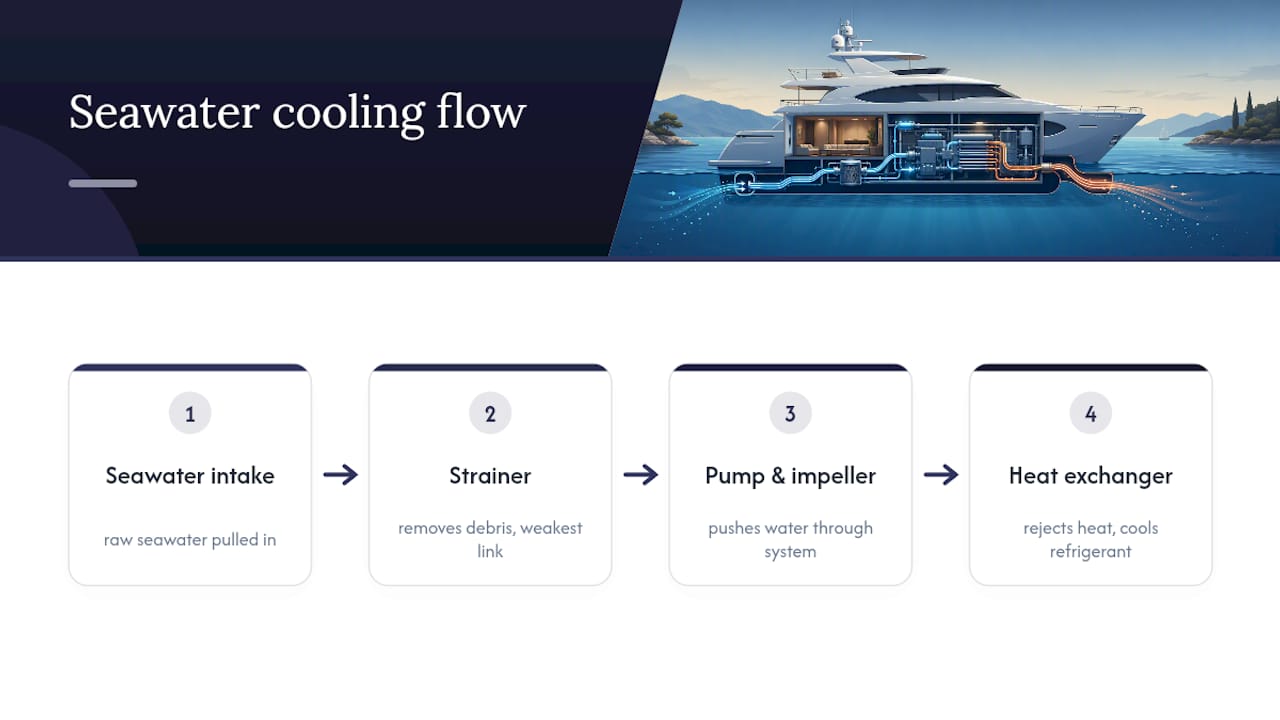
Every marine A/C system pulls raw seawater through a strainer to cool the refrigerant, and that strainer is the weakest link. A clogged strainer or worn pump impeller can trigger a high-temperature shutdown within minutes, which is why well-maintained charter fleets carry spare impellers, strainers, and zinc anodes as a matter of course rather than an afterthought.
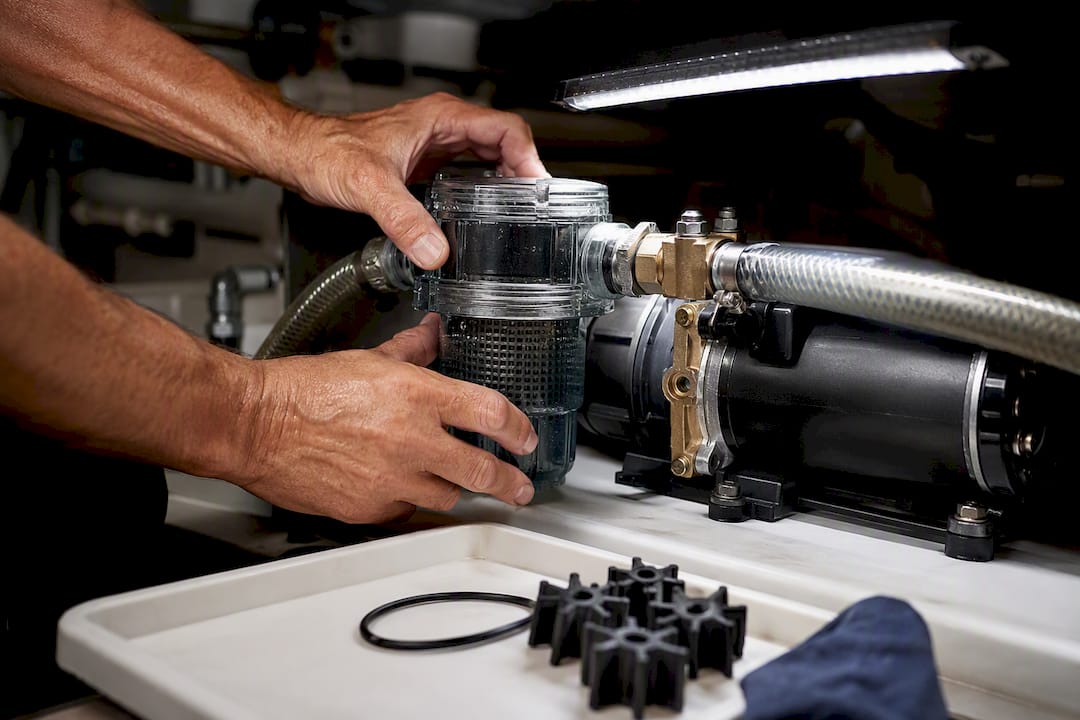
Salt buildup is the other recurring headache. Salt crystallizes inside water lines and on heat exchangers over a season of use, gradually reducing cooling efficiency even when everything looks fine on the surface. Crews on maintained charter yachts flush systems periodically and inspect filters between charters specifically to catch this before a guest ever notices warm air coming from a vent.
If you notice weak airflow or a warm cabin mid-charter, tell the crew immediately rather than waiting. A quick filter clean or strainer clear often resolves the issue within the hour, but a delayed report can mean a full day of discomfort that a five-minute fix would have solved. This is one area where booking with an established operator pays off: crews familiar with a specific boat’s system spot early warning signs, like a slightly warmer discharge or a faint hum change, that a less experienced team might miss entirely.
How Can You Use A/C More Efficiently Onboard?
Running A/C smarter, not harder, keeps both fuel costs and generator strain in check.
Closing hatches, blinds, and curtains during the hottest midday hours keeps solar heat from building up in cabins before you even switch the system on, which means less work for the compressor later. Pre-cooling a cabin for 30 to 45 minutes before bed, rather than running A/C all evening, uses noticeably less generator fuel while still delivering a comfortably cool room at sleep time.
Running fewer units at once, rather than every cabin’s A/C simultaneously, also respects the generator’s real capacity rather than pushing it toward that startup surge repeatedly. On boats with split systems, closing off unused cabins and focusing cooling capacity on occupied ones is a simple way to stretch generator hours further without asking the crew for extra fuel.
Timing matters too. Scheduling extended A/C use for hours when the boat is docked on shore power, rather than at anchor on generator, avoids fuel costs entirely and lets you run the system as long as you like. If your itinerary includes a marina stop, that’s the natural window to leave A/C running while you’re out exploring ashore, since shore power carries none of the generator’s load limits.
Does Weather or Sea Conditions Change How Well A/C Performs?
Marine A/C works harder in some conditions than others, and knowing why helps you set expectations for peak summer sailing.
Seawater temperature directly affects cooling efficiency, since these systems reject heat into the sea rather than the air. In warmer Mediterranean waters during peak summer months, that heat exchange is less efficient than in cooler spring or autumn water, meaning the same unit delivers slightly less cooling power on the hottest days of the year, exactly when you want it most.
Anchorage choice matters just as much as the calendar. A boat anchored in a shaded, breezy bay needs far less mechanical cooling than one sitting in full sun with no natural airflow, since the hull and deck absorb less heat to begin with. Humidity swings with weather systems too, and a humid spell makes cabins feel warmer even when the thermometer reading doesn’t change much, which is part of why A/C output can feel inconsistent from one day to the next despite the system running exactly the same way.
Wind plays a role as well. A steady breeze through open hatches during daytime sailing often makes mechanical cooling almost unnecessary, letting crews save generator hours for the still, hot nights when natural airflow disappears and A/C becomes the only real option for comfortable sleep.
Is Yacht Air Conditioning Safe for Air Quality and Mold Prevention?
A/C systems that aren’t maintained can create the exact problem they’re supposed to solve.
Cabins that stay closed and cool for days without fresh air exchange can develop musty smells or, in worse cases, mold growth around vents and damp surfaces, particularly in humid Mediterranean summers. Cabin size and airflow, covered in more detail here, influence how quickly moisture builds up in a space that’s cooled but never ventilated.
Regular filter cleaning matters for more than efficiency. A dirty filter recirculates dust, salt residue, and moisture back into the cabin air rather than filtering it out, which can aggravate allergies or general respiratory discomfort over a week-long charter. Crews on well-run boats clean filters between guest turnovers specifically to prevent this buildup.
The simplest guest-level fix is airing out cabins during the day. Opening hatches and doors for even an hour while you’re up on deck or ashore lets moisture escape and interrupts the damp, closed conditions mold needs to take hold. If you notice a musty smell or visible spotting around a vent, flag it to the crew immediately rather than living with it, since it’s a maintenance issue, not something that resolves on its own. For anyone with asthma or sensitivity to mold, mentioning it as a booking preference lets the operator prioritize a well-ventilated, well-maintained boat for your specific dates.
The SailArmada Take on Getting A/C Right
Guests almost always ask the wrong first question. They ask “does the boat have A/C?” when the question that actually protects their trip is “how many hours, and is it written down?” Every operator will say yes to the first question, because technically it’s true on almost every boat over 45 feet. Far fewer will commit to specifics until you ask directly.
Sailarmada confirms A/C system type, generator capacity, and included hours with every operator before a yacht makes it onto a shortlist, because a beautiful boat with a two-hour nightly A/C window is a different product than the same boat advertised generically. When your priorities call for it, we steer recommendations toward vessels with split or chilled-water systems, and we build port nights into itineraries specifically to give shore power access when continuous cooling matters to your group.
If A/C hours are a dealbreaker for your trip, say so when you request a quote. We’ll put it in the confirmation in writing, the same way we’d document any other special condition.
— Sail
Ready to Book a Charter With A/C You Can Count On?
If everything above tells you one thing, it’s that A/C availability shouldn’t be a surprise you discover on day one of your trip. Sailarmada is the alternative to guessing from a brochure: we confirm system type, generator capacity, and included hours with every operator before a yacht ever gets recommended to you, so the comfort you’re picturing matches what actually happens onboard.
Whether you’re planning a private family charter or coordinating a larger group booking, we build A/C requirements into the quote itself rather than leaving it as an assumption. That’s especially useful for groups with young kids, hot-season Mediterranean routes, or anyone who simply sleeps better cool. If comfort priorities like this matter to your group, personalizing your yacht holiday around them is part of how we curate every charter. And travelers weighing broader comfort factors for a group trip might also find value in advice on optimizing travel comfort for luxury small groups.
Ready to see which yachts fit your comfort needs? Request a private sailing quote and tell us your A/C priorities up front, we’ll confirm the details before you ever see a contract.
Sources
- Everything you need to know about boat heating and air-conditioning
- Boat AC Systems: A Complete Guide to Marine Air Conditioning
- 3 Things You Need to Know About Air Conditioning on Gulet Charter Boats – Goolets