
Yes, most people feel less seasick on a catamaran than on a monohull, mainly because twin hulls cut roll and produce steadier, more predictable motion. That said, a catamaran is not a magic fix. Short, beam-on chop or a powered catamaran running fast through a turn can still stir up nausea. The two moves that matter most: pick a calmer route or season, and take your medication on schedule, ideally before symptoms begin, to ensure best effectiveness.
TL;DR:
- Choosing calmer routes, sailing during better seasons, and taking medication before symptoms onset significantly reduce seasickness risks on a catamaran.
- Catamarans offer about 50 to 60 percent less roll compared to monohulls, but unpredictable motion in beam seas or at high speed can still cause discomfort.
- Visual cues like keeping the horizon in view and staying on deck near the center help your brain anticipate motion, lowering nausea.
- Most first-time sailors experience symptoms only during the first two days, with adaptation typically occurring within three days in sheltered waters.
- Proper planning, route selection, and proactive medication use are more important than hull type in preventing seasickness.
Table of Contents
- How Catamaran Motion Differs From a Monohull
- Why Do You Get Seasick on a Boat in the First Place?
- What Actually Prevents Seasickness on a Catamaran
- Choosing Routes and Timing That Lower Your Risk
- When a Catamaran Can Actually Make Things Worse
- We ask every guest about past seasickness before matching them to a boat and route, because the right pairing prevents most problems before they start. Skippers plan calmer headings when conditions allow, run an onboard briefing covering motion, medication timing, and where to sit if anyone feels off, and know the emergency steps if symptoms escalate beyond the ordinary. It’s a routine part of planning every charter, not an afterthought.
- The Real Lesson: Stop Debating the Boat, Start Planning the Route
- Book a Calmer Catamaran Holiday With Sailarmada
- Sources
- FAQ
How Catamaran Motion Differs From a Monohull
A monohull sailboat leans into the wind, rolls with the swell, and often keeps a steady heel that some people find soothing and others find seasickness-inducing within the first hour. A catamaran sits on two hulls spread wide apart, which changes the physics of how the boat reacts to waves. That width resists rolling the way a single hull cannot, and it shows up immediately once you step aboard.
A recent stability analysis of a passenger catamaran found catamarans deliver higher transverse stability than comparable monohull designs across many load conditions, meeting international intact stability standards with room to spare. Practically, that translates to a boat that stays flatter at anchor and in moderate seas. Some charter guides estimate catamarans reduce roll by roughly 50 to 60 percent compared with a similarly sized monohull in the same conditions.
Here’s the part most articles skip: the amount of motion isn’t the whole story. Your inner ear and eyes care more about whether that motion is predictable than about how big it is.
- Slow, rhythmic rolling that your body can anticipate is easier to tolerate than short, sharp jerks.
- A catamaran’s flatter ride tends to produce fewer of those sudden, unpredictable jolts.
- The Atlantic’s reporting on motion-sickness science points to visual-vestibular mismatch, not motion volume alone, as the real trigger.
- A catamaran in calm-to-moderate seas gives your brain a motion pattern it can predict and adjust to faster.
None of this means a catamaran eliminates motion. It means the motion you do feel is usually gentler and more rhythmic, which is exactly the kind your body handles best.
Why Do You Get Seasick on a Boat in the First Place?
Seasickness starts with a disagreement between your senses. Your inner ear detects the boat rolling and pitching, but your eyes, especially if you’re below deck or staring at a phone, tell your brain that everything is still. That mismatch is what triggers nausea, sweating, and the general misery of feeling seasick on a catamaran or any vessel.
Certain motion frequencies provoke this more than others. Slow, rolling swells around 0.2 Hz are notorious for causing symptoms, which is part of why a jerky, choppy sea feels worse than a long, lazy one even at similar wave heights. Add a stuffy cabin, engine fumes, or a dim interior with no horizon in sight, and the conflict gets worse fast.
Symptoms usually build over the first hour or two of exposure: a vague unease, then clammy skin, yawning, and finally nausea if nothing changes. First-time sailors and anyone prone to migraines or anxiety tend to be more susceptible, though plenty of experienced sailors get caught out on the wrong day too.
What Actually Prevents Seasickness on a Catamaran
Most seasickness on a charter is manageable with the right prep, and the fixes are less about willpower and more about timing.
- The night before: get real sleep, skip the late-night drinks, and eat something light rather than a heavy, greasy dinner. Alcohol and exhaustion both lower your tolerance for motion.
- Medication timing: take an over-the-counter option like meclizine or a scopolamine patch 30 to 120 minutes before boarding, not once you already feel off. Waiting until symptoms start makes most medications far less effective. Drowsiness is the main side effect worth checking with a pharmacist or doctor before your trip, especially if you’re mixing it with other medication.
- Once you’re moving: stay on deck, keep the horizon in view, and post yourself near the center of the boat where motion is least exaggerated. Skip your phone and any close-up reading.
- Avoid the obvious triggers: strong diesel fumes, cooking smells belowdecks, and a crowded, closed-in cabin all make the visual-vestibular mismatch worse.
- Try non-drug backups: ginger candies or ginger tea, acupressure wristbands, and slow, deliberate breathing all have loyal followings among charter guests and skippers alike.
Pro Tip: Ask to take the helm or help watch for the next mark on the chart. Active tasks like steering give your vestibular system something to anticipate, which turns passive, confusing motion into motion you’re controlling. It’s one of the most underrated tricks on a boat.
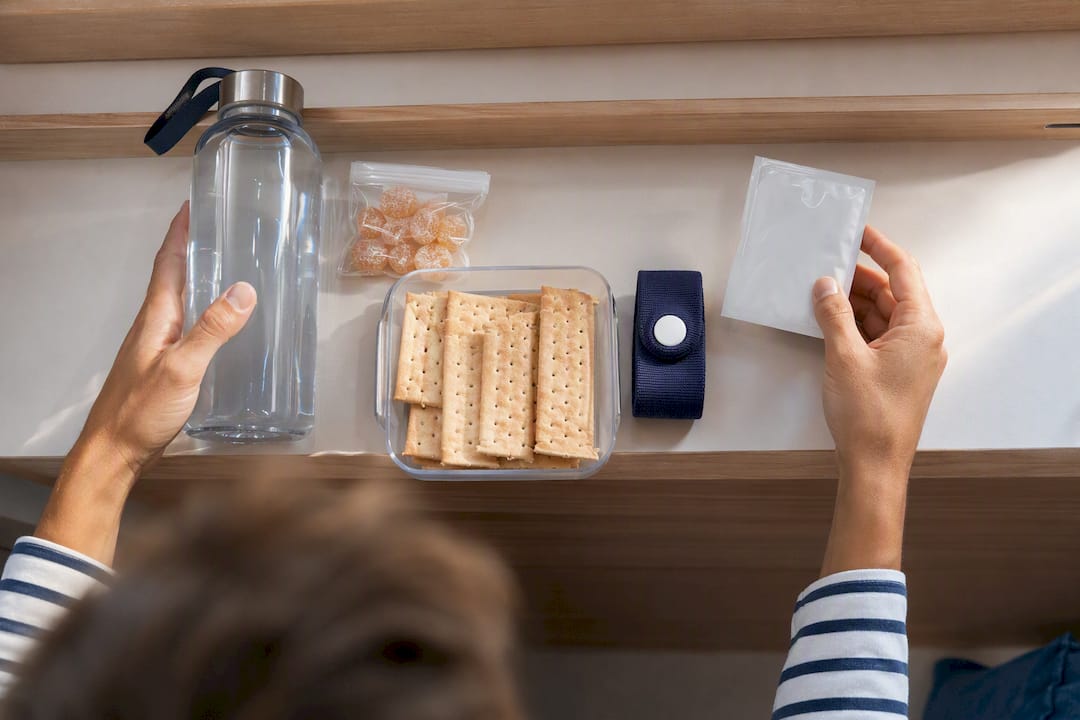
Pack light but pack smart: your seasickness medication, ginger candies, an acupressure band if you use one, a refillable water bottle, and a few plain snacks like crackers. Anyone with a prescription patch should bring it applied and ready before boarding, not stashed in a suitcase for later.
Choosing Routes and Timing That Lower Your Risk
The boat matters less than most people think. Where and when you sail matters more.
- Favor sheltered island chains with short hops of a few hours, followed by an overnight anchorage, over long open-water passages.
- Steer clear of known high-wind windows. In the Aegean, the Meltemi can push sustained winds well past a moderate breeze, turning a pleasant afternoon into a bouncy one fast.
- Ask your skipper early for a heading that keeps the wind aft or on the quarter rather than beam-on, since side-on chop is one of the roughest motions to sit through.
- Accept the trade-off: a calmer route sometimes means a longer sail or a different anchorage than the fastest option. Most seasickness-prone guests find that trade worth making.
Adaptation happens faster than most first-timers expect. On typical Mediterranean charters with short passages and sheltered stops, most people adjust within a couple of days, and roughly 25 to 30 percent of first-time sailors feel symptoms on day one, a number that drops to a small minority by day three. If you’re booking, browsing island-hopping routes built around short hops is a smart first move, and checking a guide to picking calmer sailing dates helps you dodge the worst weeks before you even book.
When a Catamaran Can Actually Make Things Worse
A catamaran’s stability advantage isn’t universal. Short, choppy beam seas, where waves hit the side of the boat in rapid, irregular bursts, can produce a quick, jerky motion that’s genuinely harder on the inner ear than a monohull’s slower, more familiar roll.
Powered catamarans add another wrinkle. Hydrodynamic testing on powered catamarans found real stability concerns at speed and during turns, meaning a fast motor-cat cornering hard can behave less predictably than a displacement sailing catamaran moving at a gentle pace. Older or smaller catamarans with cramped, poorly ventilated interiors and few windows can also trap the exact conditions, stale air, no horizon, that trigger symptoms indoors.
If you start feeling off in any of these situations, the fix is usually simple: ask the skipper to slow down, change heading to reduce the beam-on angle, or head to open deck where you can see the horizon again.
We ask every guest about past seasickness before matching them to a boat and route, because the right pairing prevents most problems before they start. Skippers plan calmer headings when conditions allow, run an onboard briefing covering motion, medication timing, and where to sit if anyone feels off, and know the emergency steps if symptoms escalate beyond the ordinary. It’s a routine part of planning every charter, not an afterthought.
The Real Lesson: Stop Debating the Boat, Start Planning the Route
The catamaran versus monohull debate gets more attention than it deserves. Yes, catamarans generally offer steadier, more forgiving motion, and the stability research backs that up. But treating the hull design as the whole answer misses where most seasickness actually gets decided: the route, the season, and how well you prepare before you ever step aboard.
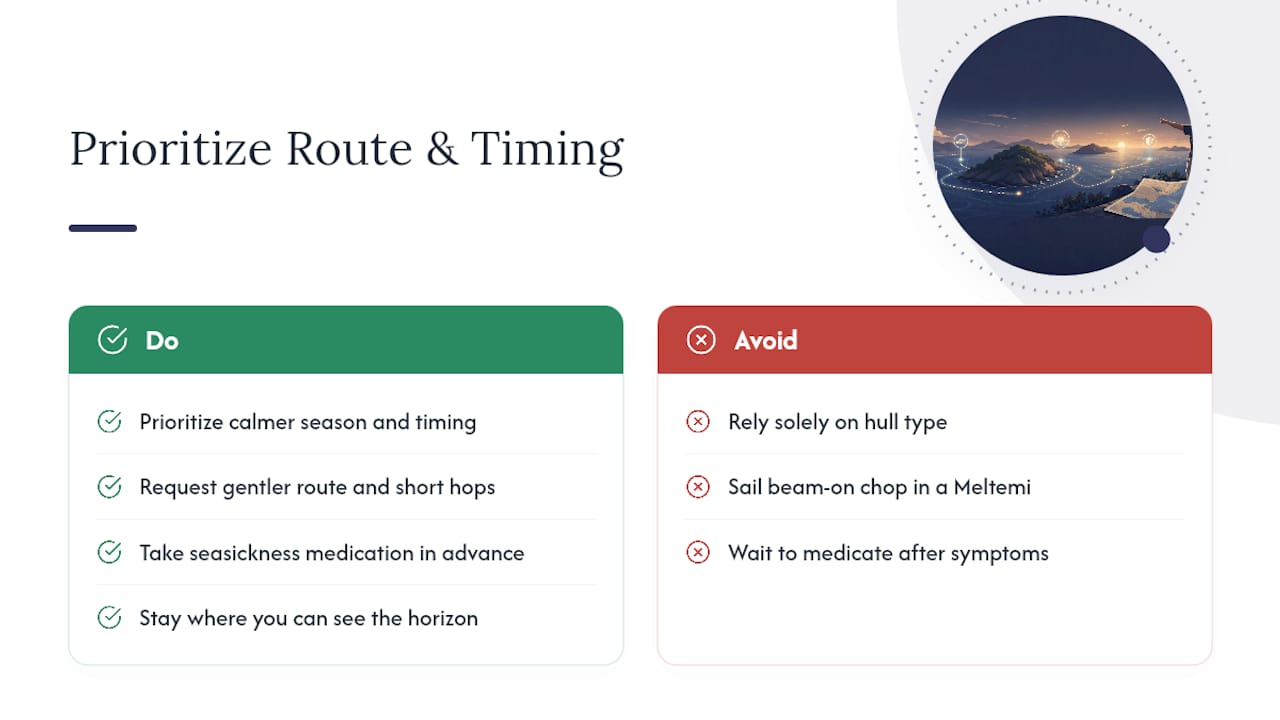
Conventional advice leans hard on “just pick a catamaran” as if that settles it. It doesn’t. A catamaran punching through beam-on chop in a stiff Meltemi will beat up a sensitive stomach just as fast as any monohull, sometimes faster given how a powered cat handles turns at speed. What actually moves the needle is boring, practical stuff: sail during calmer weeks, request short hops with early anchorages, take your medication in advance of any symptoms, and stay where you can see the horizon.
If you only have room to prioritize one thing before your next charter, make it timing, not boat type. Book the calmer season, ask for the gentler route, and let the hull design work as a bonus, not a substitute for planning.
— Sail
Book a Calmer Catamaran Holiday With Sailarmada
Sailarmada builds private and group catamaran charters around real route planning, not just boat selection, pairing you with experienced skippers who know which passages stay calm and which ones don’t.

When you book, tell us upfront if seasickness is a concern. We’ll factor it into your itinerary, favor shorter hops with early anchorages, and brief your skipper on keeping headings that avoid the roughest beam-on angles. It costs nothing to ask, and it changes how your whole week goes. Browse private sailing options and mention your seasickness history when you request a quote so we can match you with the right boat, route, and skipper from day one.
Sources
Naval-architecture stability data, skipper-tested prevention tips, and motion-sickness science each cover a different piece of this topic: the physics, the practical fixes, and the biology behind why they work.
- Seasickness on a Yacht: Prevention Guide | Boat Tomorrow
- Intact stability analysis of a passenger catamaran vessel (2024) | GJETA – DOI
- Hydrodynamic stability of powered catamarans (JMSE, 2024)
- The mysterious science of motion sickness | The Atlantic (2015)
FAQ
Do you get less seasick on a catamaran?
Most people do, thanks to a catamaran’s higher transverse stability and reduced roll, though beam-on chop or fast powered-catamaran turns can still cause symptoms.
What are the downsides of catamarans?
Beyond seasickness in certain sea states, catamarans can be pricier to charter, less nimble in tight marinas, and some older models have poor interior ventilation and limited horizon views below deck.
Are catamarans safe for ocean crossing?
Displacement sailing catamarans generally show strong intact stability in published naval-architecture research, though powered catamarans face separate hydrodynamic stability concerns at speed that don’t apply to slower sailing cats.
Where do you get less seasick on a boat?
Staying on deck near the centerline, keeping the horizon in view, and getting fresh air all reduce symptoms far more than staying below in a closed cabin.
How long does it take to adjust to catamaran motion?
Most first-time sailors adapt within 24 to 48 hours on typical sheltered Mediterranean charters, with symptom rates dropping from roughly 25 to 30 percent on day one to under 5 percent by day three.