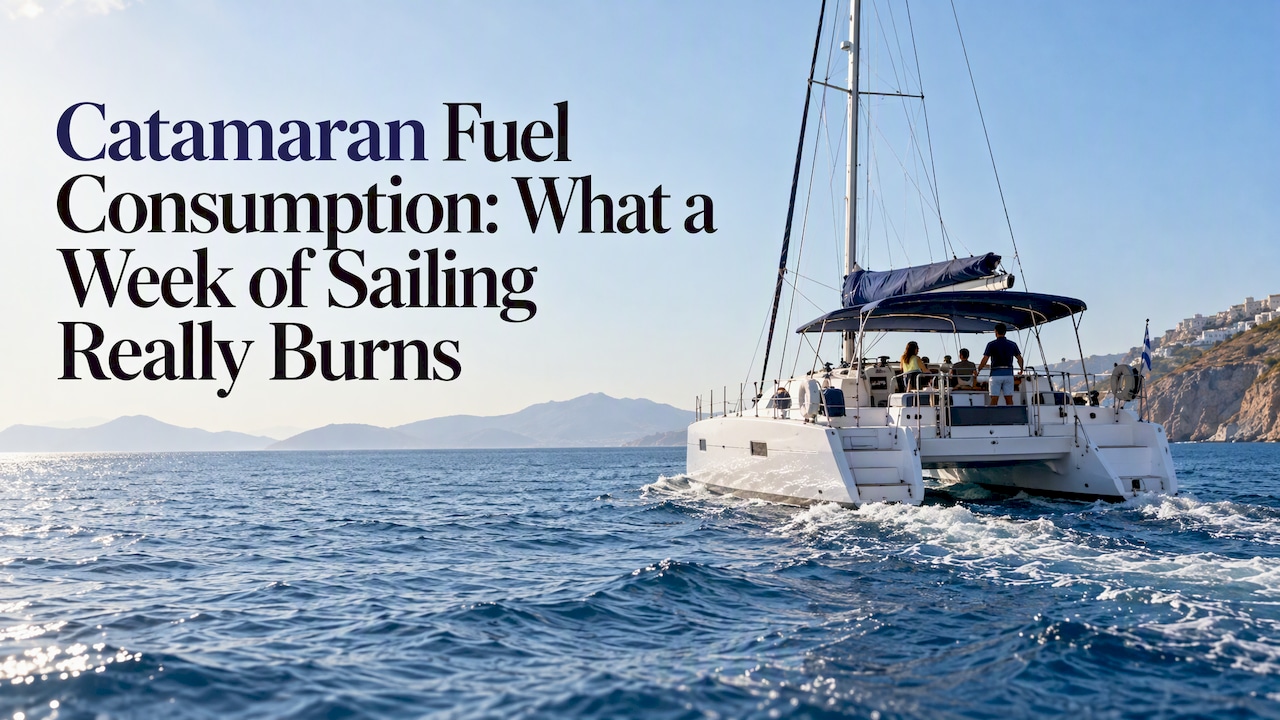
A sailing catamaran under one engine typically burns about 1.2 to 4.0 liters of diesel per hour, and roughly double that with both engines running, according to owner-reported data. Over a normal week of island hopping in Greece, where the wind does most of the work, that adds up to a fuel bill that is small next to the charter fee. Here is how to estimate it for your own trip, what changes the number, and which questions to ask before you book.
TL;DR
- Expect roughly 1.2 to 4.0 liters per hour per engine on a sailing catamaran, and about twice that if both engines run.
- Hours under engine matter far more than the boat’s size. A week with plenty of wind can cost a fraction of a windless one.
- On a week-long Mediterranean charter, a sailing catamaran’s fuel typically lands around €400 to €800, per our own fuel guide.
- Marine diesel in Athens and Piraeus has recently averaged €1.45 to €1.75 per liter, so a few liters saved is real money but never the main budget line.
- Before booking, ask for the expected liters per hour and how fuel is settled at the end of the week.
Table of Contents
- Do catamarans have engines, and when do they use them?
- How much fuel does a sailing catamaran use per hour?
- What changes the number
- How to estimate your own fuel use
- Fuel on a catamaran holiday in Greece
- Planning range and a safe reserve
- Ten habits that cut fuel use
- Our perspective: fuel is a small line on a well-planned week
- Sail a Greek week with a skipper who knows the numbers
- FAQ
- Sources
Do catamarans have engines, and when do they use them?
Yes. Sailing catamarans typically carry twin diesel engines, one in each hull. That gives you excellent maneuverability in tight harbors and a backup if one engine fails. Many boats can also run happily on a single engine to save fuel.
In practice, the engines are tools for the edges of the day. Sailing catamarans generally use the auxiliary engines only when necessary, for example in ports and marinas or in an emergency. On a Greek charter that usually means:
- Leaving and entering the marina or a crowded town quay.
- Setting and retrieving the anchor in a busy bay.
- Motoring through the calm patches that sometimes settle over the Aegean or Ionian mornings.
- Making a longer hop when you need to reach a specific island by a specific time.
If you picture a cat as a floating motorboat, reset that image. A sailing holiday is mostly sails up, engines off, and the sound of water along the hulls.
How much fuel does a sailing catamaran use per hour?
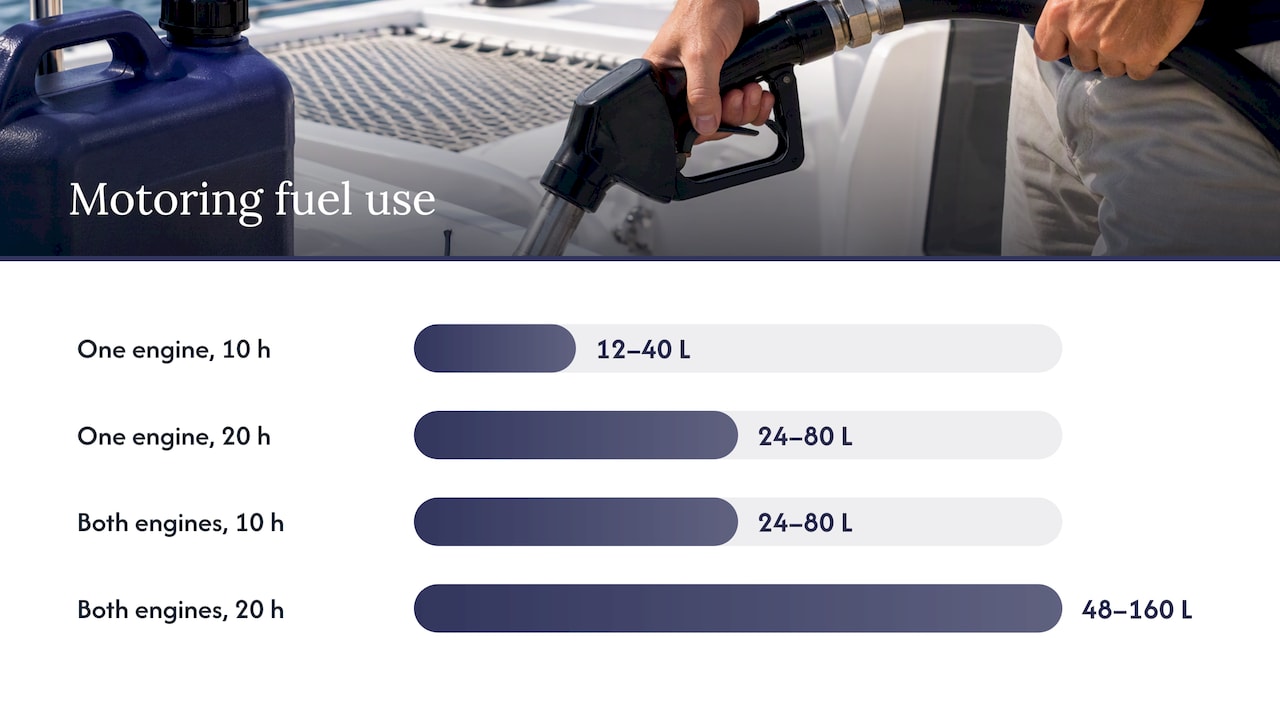
The most useful figures come from owners who log what they actually burn. Their range for a sailing catamaran under a single engine is 1.2 to 4.0 liters per hour, doubling when both engines are engaged. Where you land in that range depends on boat length, weight and how hard you push the throttle.
Here is how that looks as a simple guide for a typical charter catamaran:
| Engine setup | Typical burn per hour | 10 hours of motoring | 20 hours of motoring |
|---|---|---|---|
| One engine, gentle cruise | about 1.2 to 4.0 L | about 12 to 40 L | about 24 to 80 L |
| Both engines, same speed range | about 2.4 to 8.0 L | about 24 to 80 L | about 48 to 160 L |
The table is our own arithmetic on the owner range above, not a manufacturer’s figure. Your boat’s real number depends on its engines, so ask the skipper or base what it burns at cruising revs.
Two more things help put this in context. First, catamarans are generally more fuel efficient than comparable monohulls thanks to low drag, low weight and narrow hulls. Second, power catamarans are a different animal. They rely entirely on engines, and range follows the throttle: one Lagoon Power 44 is quoted at 1,300 nautical miles at 8 knots, dropping to 450 nautical miles at 18 knots. Same hulls, wildly different fuel story. If you are weighing a motor boat against a sailing cat for your group, our comparison of a catamaran versus a motor yacht covers the trade-offs beyond fuel.
What changes the number
Fuel use is not a fixed property of the boat. It is shaped by a handful of things you can mostly control.
Speed
This is the big one. Fuel use rises geometrically at higher speeds, and slowing down almost always saves fuel. A Greek marine association makes the same point for planing boats: once on the plane, consumption climbs with the square of speed and more. Sailing cats are displacement boats, so the curve is different, but the lesson holds. Dropping a knot or two off your motoring speed can save a surprising amount of diesel and costs you very little time on a short island hop.
Weather and sea state
Headwinds and short, steep waves make the engines work harder. The Aegean’s summer northerly, the meltemi, can push consumption up if you are motoring into it. The good news is that the same wind is often what lets you sail the other way for free.
Load
Weight counts. A boat full of people, water, provisions, toys and a dinghy with an outboard sits deeper and needs more power for the same speed. Total vessel weight is one of the main factors owners track, along with weather and engine RPM.
Engine revs and one engine or two
Every engine has a sweet spot. Running on one engine saves fuel, but there is a catch. One yacht builder points out that propellers are optimized for specific cruising speeds, so a single engine at the wrong revs can cause wear. The sensible approach is to follow your skipper’s advice on what is best for that particular boat.
Hull and technology
Narrow, low-drag hulls help, and so does newer propulsion. Hybrid systems are an emerging option: one manufacturer reports that its E-Drive tested on Balance catamarans offers 46 to 68 percent better power generation efficiency than a traditional diesel generator. That is a manufacturer’s own figure, and most charter fleets in Greece still run conventional diesel, so treat it as a look at where things are heading.
How to estimate your own fuel use
You do not need a formula with horsepower in it. A charter is simple enough for a three-step estimate.
- Guess your engine hours. Count the days and the likely motoring per day. A relaxed Greek week might include 2 to 3 hours of motoring on a typical day, mostly in and out of harbors, and more if the wind drops.
- Multiply by liters per hour. Use the skipper’s figure for the boat. If you have none, use the owner range above for one engine, and double it if both will run.
- Multiply by the price per liter. Marine diesel in Athens and Piraeus has averaged €1.45 to €1.75 per liter in 2025 to 2026. Another price index puts marina pump diesel at €1.65 to €1.85, and more at small island fuel docks. Use the higher end if your route is remote.
If you are the one keeping the log, the method owners use is just as simple. Skippers estimate usage by recording fuel added at each fill-up, engine hours and nautical miles per trip. After a couple of days of that, your estimate stops being a guess.
A worked example
Say your group runs one engine at about 3 liters per hour for 20 hours over the week, and uses both engines for brief maneuvers that add up to 4 hours at 6 liters per hour.
- Cruising: 20 hours x 3 L = 60 L
- Maneuvering: 4 hours x 6 L = 24 L
- Total: 84 liters
- At €1.45 to €1.75 per liter: roughly €122 to €147 for the week
That is our own illustration with assumed numbers, not a quote. A windless week with 40 hours of motoring on both engines would be several times that. Our own fuel guide cites a real crewed catamaran charter in peak-summer Greece that used roughly 970 liters for the week, which shows how far the top end can stretch when engines run a lot. Both pictures are true, and the difference is wind and itinerary.
Fuel on a catamaran holiday in Greece
Greece rewards sailors who plan around the wind. Distances between islands are often short, and the summer breezes in the Aegean are reliable enough that many days are mostly sailing. The Ionian is gentler and typically has more days when the engines come on in the afternoon lull. For ideas on how far each day’s hop might be, see our Greek island-hopping routes and the Greece destination page.
A few local factors to keep in mind:
- Island fuel is dearer. Small-island docks often charge more than mainland marinas, so a fill-up before a remote leg can save money.
- Fuel is usually settled at the end. On many charters the boat is handed over with a full tank and you pay for what you burn, or the cost comes from a pooled allowance. Ask which system your booking uses. Our guide explains how fuel gets paid from the advance provisioning allowance.
- Ask for two numbers. The expected liters per hour and the local price per liter on your route tell you almost everything you need.
- Marina fees are the other moving part. If you want the full picture of what a Greek week costs on top of the charter itself, read our marina fees guide and our catamaran charter cost breakdown.
If you are also driving to the departure marina, the same budgeting logic applies on the road. A guide to estimating fuel use on the road shows how ranges and driving style change consumption on land, much like speed and load do on the water.
Planning range and a safe reserve
On a sailing catamaran you rarely worry about range in the way a motor yacht owner does, but your skipper still plans for it. Experienced skippers keep a reserve for windless stretches or to reach port before a forecast gale, and on long offshore passages some carry extra fuel in containers. That is skipper territory, not something guests need to manage, and it is one of the reasons a good skipper checks the tank before every leg.
The trade-off is worth knowing: a power cat gets its range from the throttle, while a sailing cat swaps speed and schedule certainty for a near-empty fuel log. If your week depends on being at a specific island on a specific evening, say so when you plan the route. If you can let the wind decide, the fuel bill takes care of itself.
Ten habits that cut fuel use
- Sail whenever there is enough wind to make 4 to 5 knots, even if the engine would be faster.
- Plan the longer legs for the morning, when the breeze is often steadier.
- Use one engine on calm, flat stretches if your skipper agrees it suits the boat.
- Slow down by a knot or two when you motor.
- Keep the boat light: do not haul more water, ice and gear than you need.
- Choose routes with shorter hops between islands.
- Let the skipper check the sails and trim, since good trim means less engine.
- Avoid motoring straight into a strong meltemi when a day in the bay is just as good.
- Use the engines for charging only when needed, and not for long idling at anchor.
- Ask the skipper to log engine hours daily so nothing surprises you at handover.
Our perspective: fuel is a small line on a well-planned week
We see the fuel question a lot, and here is how we think about it. For most groups on a sailing catamaran, fuel is one of the smaller costs, and the more useful question is how many hours you want to spend under sail versus under engine. Our routes are curated by experienced, professionally trained skippers from CAPETAN.club, so the itinerary balances short legs, good anchorages and the wind of the day. Your skipper knows the boat’s real consumption and will tell you plainly when a calm forecast makes motoring the sensible call.
We also like pricing to be clear. Our private weeks are published per person, and we would rather you ask about fuel up front than be surprised at the end. If a figure is unclear, ask us. You will be talking to actual sailors, not a call script.
— Sail
Sail a Greek week with a skipper who knows the numbers
If you want the freedom of your own boat without doing the sums alone, our Greece private sailing week starts from 560 € per week per person. You pick the catamaran or sailing boat, we shape the route around your group, and an experienced skipper handles the engines, the weather and the fuel log.
Prefer company on board? Browse our group sailing holidays or compare with the wider Mediterranean private yacht rental guide.
FAQ
Do catamaran boats have engines?
Yes. Most sailing catamarans have two diesel engines, one in each hull, which helps with maneuvering and gives you a backup. They are mainly used in marinas, in light wind and in emergencies.
How much fuel does a catamaran use per hour?
Owners report about 1.2 to 4.0 liters per hour for a sailing catamaran on a single engine, and about double with both running. Speed, load and sea state move the number up or down. Ask your skipper for the exact figure for your boat.
How much does fuel cost for a week-long catamaran charter in Greece?
It depends on how much you motor. As a rough guide, our fuel guide puts a sailing catamaran week in the Mediterranean at roughly €400 to €800, while a windy week with mostly sailing can cost much less. Diesel in Athens and Piraeus has recently averaged €1.45 to €1.75 per liter.
Is running one engine really better?
It usually saves fuel, and many catamarans can cruise on one engine. However, propellers are tuned for particular speeds, so one engine at the wrong revs can add wear. Follow your skipper’s advice for the boat you are on.
Sources
- Sailing Catamaran Fuel Consumption Data From Owners
- Catamaran With Motor? 8 Types Explained
- Catamarans Guide: The ABCs of Multihull Boats, Boat Trader
- Power Catamaran vs Sailing Catamaran: How to Choose
- Οι εξωλέμβιες μηχανές και η κατανάλωση, Σωματείο Ελλήνων
- Catamaran Sailing Techniques: Powered Sailing, Interparus
- Integrel Solutions: E-Drive Performance, Power Generation
- Yacht Cost in Athens: Annual Ownership Expenses
- Greece Sailing Price Index 2026
- Viatori Cruising: Fuel Consumption
- Desert guy with catamaran questions, Cruisers Forum
- Koliko goriva porabi avtodom