
Choosing a catamaran is defined by one decision above all others: matching your boat to your mission on the water. Whether you’re planning weekend escapes in the Mediterranean, a full liveaboard lifestyle, or group charters with friends and family, the right catamaran selection process starts with clarity about how you’ll actually use the boat. Size, layout, brand philosophy, and budget all flow from that single starting point. Get the mission right first, and every other decision becomes much easier.
How to choose a catamaran size and layout
The most important factor in catamaran selection is size, and size is determined by how you plan to use the boat. Cruising purpose drives size: a 30–40 ft catamaran suits weekend leisure sailing and couples or small families; a 45–55 ft model fits extended cruising or liveaboard life; and 50 ft and above works best for larger groups or anyone who loves entertaining at anchor.
Cabin count matters just as much as overall length. A four-cabin layout gives each couple their own private space, which is exactly what you want on a two-week sailing holiday in Greece or Croatia. A two-cabin layout is lighter, faster, and easier to handle solo or as a couple. If you’re chartering with a group, check out catamaran cabin options before you commit to a specific model.

Draft is another factor that catches buyers off guard. A shallower draft, typically under 4 ft on most production catamarans, lets you anchor in gorgeous, crystal-clear bays that monohulls simply cannot reach. That freedom to tuck into secluded coves is one of the biggest reasons groups and families fall in love with catamarans in the first place.
| Size Range | Best Use Case | Typical Cabins |
|---|---|---|
| 30–40 ft | Weekend sailing, couples, small families | 2–3 cabins |
| 45–55 ft | Extended cruising, liveaboard, flotillas | 4 cabins |
| 50 ft and above | Large groups, charter fleets, entertaining | 4–6 cabins |
- Beam (width) affects stability and interior space but also marina fees in some ports.
- Bridgedeck height affects comfort in waves. More on this in the evaluation section.
- Cockpit size and layout determine how social your time at anchor actually feels.
Pro Tip: Before you look at a single listing, write down the maximum number of people you’ll ever have on board at once. That number alone will eliminate most of the wrong boats immediately.
What does a catamaran actually cost to own?
Purchase price is only the beginning of the financial picture. Annual ownership costs include insurance at 1–2% of vessel value, maintenance at 10–15% of vessel value, and docking fees ranging from $1,000 to $5,000 per month depending on location. That means a $300,000 catamaran could cost you $45,000 or more per year before you ever leave the dock.
International buyers face additional costs that are easy to underestimate. Delivery fees run $5,000 to $30,000 depending on distance, and import taxes can add 10–20% to the purchase price. Buying a boat built in Europe and sailing it in the Caribbean, for example, triggers real financial consequences that need to be in your budget from day one.
Deferred maintenance is the silent killer of catamaran ownership enjoyment. Skipping routine upkeep to save money in year one almost always leads to larger repair bills and lower resale value down the road. Budget honestly from the start and you’ll enjoy the boat far more.
| Cost Category | Estimated Annual Amount |
|---|---|
| Insurance | 1–2% of vessel value |
| Maintenance | 10–15% of vessel value |
| Docking / Marina Fees | $12,000–$60,000 per year |
| Delivery (one-time) | $5,000–$30,000 |
| Import Taxes (if applicable) | 10–20% of purchase price |
- New catamarans from brands like Leopard, Lagoon, and Fountaine Pajot typically start around $300,000 for entry-level models.
- Pre-owned catamarans in good condition can be found from $100,000 upward, depending on age and brand.
- Refit costs on older boats can quickly close the gap between new and used purchase prices.
Pro Tip: Build a detailed first-year ownership scenario before you sign anything. Include purchase price, delivery, import fees, insurance, marina costs, and a realistic maintenance reserve. That full picture changes the math on new versus pre-owned more than most buyers expect.
New vs. pre-owned: which catamaran is right for you?
Brand choice and ownership type are two decisions that feed directly into each other. Different brands embody distinct design philosophies, and a mismatch between brand philosophy and your cruising style causes real frustration offshore. Lagoon catamarans, for example, prioritize interior volume and comfort, making them popular for charter and family cruising. Outremer and Gunboat lean toward performance sailing, with lighter builds and faster passages in mind. Leopard sits comfortably in between, offering solid build quality and strong resale value across a wide range of cruising uses.
New boats offer warranty coverage and a known configuration, which means fewer surprises in year one. You choose your layout, your electronics package, and your sail plan from the factory. The tradeoff is a higher purchase price and sometimes a long wait for delivery from builders like Fountaine Pajot or Leopard.
Pre-owned catamarans offer a lower entry price, but first-year costs on pre-owned boats often erode those savings quickly. Hidden maintenance issues, outdated electronics, and worn sails add up fast. The key is knowing exactly what you’re buying before you commit.
Here is what to verify before purchasing any pre-owned catamaran:
- Full maintenance and repair history, including engine hours and service records.
- Rigging age and condition, including standing and running rigging.
- Sail inventory condition, including mainsail, jib, and any furling systems.
- Engine and generator service history, including impeller and belt replacements.
- Osmotic blistering on the hulls, which is a common and costly repair on older fiberglass boats.
- Electrical system condition, including battery bank age and solar or wind generation capacity.
- Safety equipment certification dates, including life raft, flares, and EPIRB.
Evaluating ownership scenarios with a scorecard that compares new versus pre-owned across risk tolerance, timeline, and maintenance comfort is one of the most practical tools available to first-time buyers. It removes emotion from the decision and puts the numbers front and center.
How do you properly evaluate a catamaran before buying?
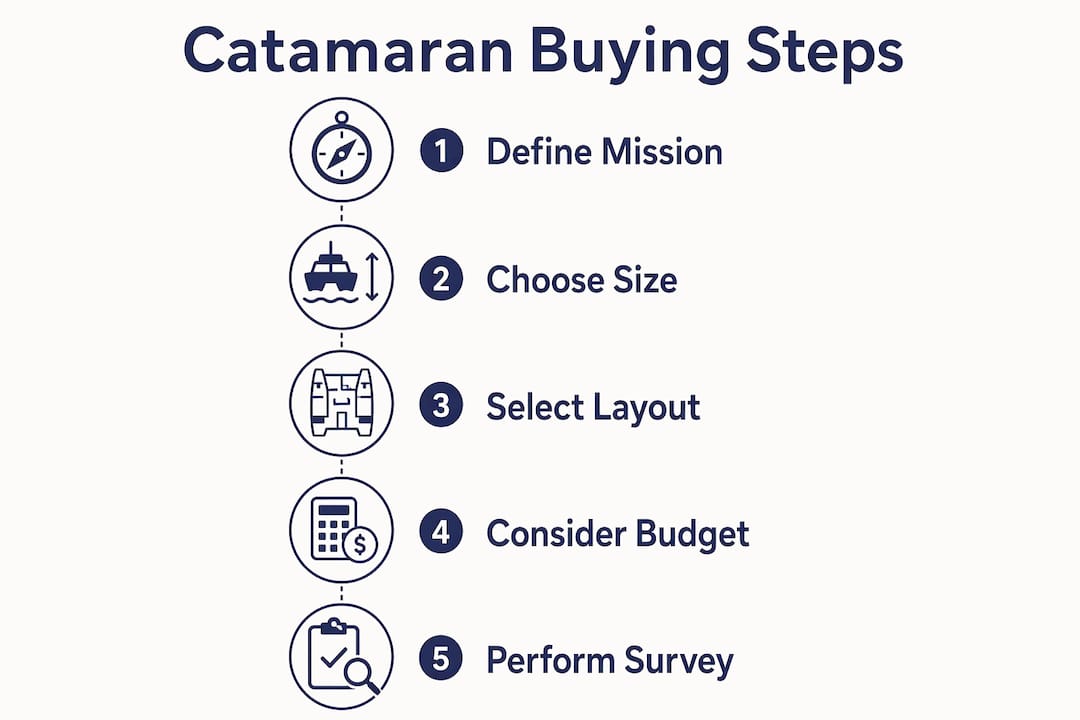
A proper catamaran evaluation follows a clear sequence. Skipping any step increases the risk of an expensive mistake. Here is the step-by-step process that experienced buyers use:
- Define your mission in writing. Mission clarity before selection simplifies the entire buying process and eliminates features you will never use.
- Shortlist models that match your size and budget criteria. Use the size table above as your starting filter.
- Commission a catamaran-specific marine survey. Catamaran-specific surveys are non-negotiable. A surveyor without multihull experience will miss bridge-deck stress fractures and osmotic blistering issues that are unique to this type of boat.
- Conduct a thorough sea trial. A good sea trial tests sailing performance, engine behavior, sail handling systems, noise levels at anchor, and maneuverability in tight spaces.
- Test bridge-deck clearance specifically. Insufficient bridge-deck clearance causes persistent pounding in waves, and it is extremely difficult and expensive to retrofit. This is one of the most undervalued checks in a sea trial.
- Review the survey report and negotiate accordingly. Use findings to adjust the purchase price or require repairs before closing.
| Evaluation Step | What to Check |
|---|---|
| Marine Survey | Hull integrity, osmotic blistering, rigging, electrics |
| Engine Test | Start behavior, temperature, hours, smoke |
| Sail Trial | Upwind and downwind performance, furling systems |
| Bridge-Deck Check | Clearance height, pounding in chop |
| Noise Assessment | Generator, engine, and wave noise at anchor |
Common mistakes buyers make at this stage include ignoring the maintenance history, underestimating how different a catamaran handles compared to a monohull, and choosing a layout that looks great at the dock but feels awkward at sea. Walk through the boat as if you’re living on it for two weeks. Open every locker. Sit in the cockpit at sunset. Cook a meal in the galley. The boat that feels right in real life is the one worth buying.
Pro Tip: Always bring a multihull-experienced surveyor, not just any marine surveyor. The structural issues unique to catamarans require specialized knowledge that a monohull-focused inspector simply does not have.
Key takeaways
Choosing the right catamaran requires defining your mission first, then matching size, brand, and budget to that mission before ever stepping aboard for a sea trial.
| Point | Details |
|---|---|
| Mission defines everything | Write down your cruising purpose before comparing any models or brands. |
| Size follows group size | Match boat length and cabin count to your maximum crew and comfort needs. |
| Budget the full picture | Add insurance, maintenance, docking, and delivery to your purchase price from day one. |
| Brand philosophy matters | Choose a brand whose design priorities align with your actual sailing style. |
| Survey and sea trial are non-negotiable | Always use a multihull-experienced surveyor and test bridge-deck clearance on the water. |
What i’ve learned about choosing a catamaran
After years of helping sailors and groups find the right boat for Mediterranean adventures, one pattern stands out clearly: most buyers spend too long comparing specifications and not enough time defining their mission. I’ve seen people fall in love with a gorgeous 55 ft Lagoon because of the saloon views, only to realize six months later that they mostly sail with two people and the boat is simply too much to manage.
The buyers who get it right are the ones who compare catamaran vs. sailing boat options early, think honestly about how often they’ll actually have a full crew, and then work backward to the right size. They also take the sea trial seriously. Not as a formality, but as a real test. They push the boat upwind in a chop, they listen for noise at anchor, and they check whether the cockpit layout actually works for the way they like to socialize on the water.
My honest advice: spend one week on a chartered catamaran in your target size range before you buy anything. You will learn more about what you actually want from seven days of living on the boat than from months of reading spec sheets. The freedom, the space, the way a catamaran sits still at anchor in a crystal-clear bay. That experience will tell you everything you need to know.
— Sail
Ready to experience a catamaran before you buy?
Sailarmada makes it easy to get real time on the water before committing to a purchase. Our curated private and group sailing holidays across Greece, Croatia, Italy, and beyond put you on board the exact type of catamaran you’re considering, with an experienced skipper who knows the boat inside and out. It’s the smartest research you can do, and it happens to be a breathtaking adventure at the same time.
Whether you’re a first-time buyer wanting to test a 45 ft cruising catamaran in the Aegean, or a group looking to compare layouts across a sailing week, Sailarmada has the right boat and the right route waiting for you. Explore our sailing holiday options and find your perfect match on the water.
FAQ
What size catamaran is best for a family of four?
A 40–45 ft catamaran with three or four cabins suits most families of four comfortably, offering enough space for privacy and storage without being difficult to handle.
How much does it cost to maintain a catamaran annually?
Annual maintenance runs 10–15% of the vessel’s value, plus insurance at 1–2% and docking fees that can reach $5,000 per month in premium marinas.
Should i buy a new or pre-owned catamaran?
New catamarans offer warranty coverage and predictable setup, while pre-owned boats cost less upfront but often carry hidden repair costs that can erode those savings in the first year.
What is bridge-deck clearance and why does it matter?
Bridge-deck clearance is the height between the water surface and the underside of the main deck connecting the two hulls. Low clearance causes uncomfortable pounding in waves and is very expensive to correct after purchase.
Do i need a specialized surveyor for a catamaran?
A catamaran-specific marine surveyor is required for any serious pre-purchase inspection. General marine surveyors often miss multihull-specific issues like bridge-deck stress fractures and osmotic blistering in the hulls.