
The Mediterranean’s most rewarding islands come down to a tight shortlist: Santorini, Crete, Mykonos, Rhodes, Mallorca, Ibiza, Formentera, Sicily, Sardinia, Corsica, Hvar, Korčula, Malta and Gozo, Zakynthos, Elba, the Aeolian Islands, Folegandros, and Ischia. Each earns its place for a different reason, and together they cover every travel style from wild nightlife to secluded coves to ancient ruins.
Here’s the quick-scan shortlist to get you oriented:
- Santorini (Greece) — iconic caldera views and unforgettable sunsets from Oia
- Crete (Greece) — the Mediterranean’s most complete island: beaches, gorges, Minoan history
- Mykonos (Greece) — vibrant nightlife, whitewashed windmills, and crystal-clear waters
- Rhodes (Greece) — a UNESCO-listed medieval old town inside a living, breathing city
- Mallorca (Spain) — dramatic mountains, turquoise coves, and a thriving food scene
- Ibiza (Spain) — world-famous clubs plus surprisingly quiet northern villages
- Formentera (Spain) — the Balearics’ best-kept secret: flat, car-free, and impossibly blue
- Sicily (Italy) — volcanic drama, Greek temples, and some of the best food in Europe
- Sardinia (Italy) — Caribbean-grade beaches without the Caribbean price tag
- Corsica (France) — rugged mountains plunging into turquoise sea; France’s wild island
- Hvar (Croatia) — lavender fields, Venetian architecture, and a buzzing harbor
- Korčula (Croatia) — quieter than Hvar, with a medieval old town and excellent local wine
- Malta and Gozo — 7,000 years of history packed into two small, sun-drenched islands
- Zakynthos (Greece) — home to the famous Shipwreck Beach and loggerhead sea turtles
- Elba (Italy) — Napoleon’s island exile turned outdoor paradise, just off the Tuscan coast
- Aeolian Islands (Italy) — seven volcanic islands including active Stromboli
- Folegandros (Greece) — a quieter Cycladic gem for travelers who’ve outgrown Mykonos
- Ischia (Italy) — Italy’s thermal island, with hot springs, lush gardens, and a castle on a rock
These aren’t just popular picks. They’re curated for range: you get history, beaches, sailing, food, nightlife, and off-the-beaten-path serenity all in one list. The rest of this guide breaks each one down so you can figure out exactly which islands belong on your trip.
Key Takeaways
The must-see Mediterranean islands reward travelers most when they match the island to their travel style, travel in shoulder season, and consider sailing as the best way to connect multiple stops.
| Point | Details |
|---|---|
| Shoulder season wins | May through June and September through October offer the best balance of weather, crowds, and price on almost every island. |
| Hub-and-spoke routing | Pair one large hub island (Crete, Sicily, Mallorca) with one or two smaller neighbors to maximize variety without exhausting logistics. |
| Sailing unlocks the best stops | Anchorages, hidden coves, and early-morning port arrivals are only accessible by boat, making a sailing itinerary the richest way to island-hop. |
| Match island to travel style | Beaches: Sardinia or Formentera. History: Rhodes, Malta, or Crete. Quiet authenticity: Folegandros or Korčula. Nightlife: Mykonos or Ibiza. |
| Book early for peak season | Accommodations and ferries for July and August on smaller islands fill up three to four months in advance; shoulder-season travelers have far more flexibility. |
Table of Contents
- The best Mediterranean islands, one by one: your complete travel snapshot
- How to choose the right Mediterranean island for your trip
- The best sailing routes through the Mediterranean’s must-see islands
- When to go and what to budget for Mediterranean island travel
- Getting to the Mediterranean: transport, visas, and health for U.S. travelers
- Our perspective: why sailing changes how you experience these islands
- Sources
The best Mediterranean islands, one by one: your complete travel snapshot
Travel guides consistently organize islands by travel style — Sicily for food, Sardinia for beaches, Crete for history — and that’s exactly how the entries below are framed. Each island gets the details you actually need: what makes it special, who it’s best for, when to go, how to get there, and how long to stay.
1. Santorini, Greece
Santorini’s caldera is one of the most dramatic landscapes on earth. The island sits inside the rim of an ancient volcanic eruption, and the views from Oia or Fira across the flooded crater are genuinely unlike anything else in the Mediterranean.
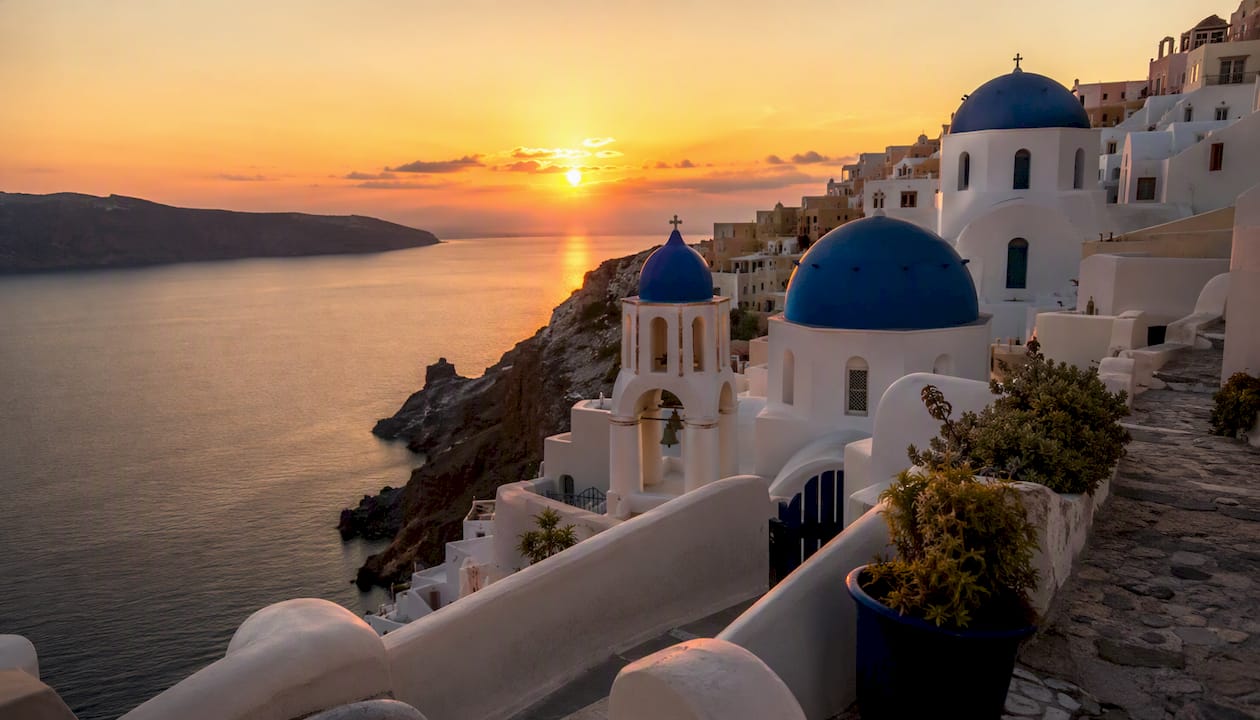
Top highlights: Oia sunset, caldera boat tours, the ancient site of Akrotiri (a Bronze Age city buried by volcanic ash)
Best for: Couples, photography, luxury travel
Best time: May, June, or September (July and August are extremely crowded and hot)
How to get there: Fly into Santorini International Airport (JTR) from Athens or direct from major European cities; ferries from Piraeus take 5–8 hours
Suggested stay: 3–4 nights
2. Crete, Greece
Crete is the Mediterranean’s most self-contained island. You could spend two weeks here and still not see everything: the Minoan palace at Knossos, the Samaria Gorge hike, the pink-sand beach at Elafonisi, and the Venetian harbor at Chania are all on the same island. That harbor, developed during Venetian occupation, is one of the most memorable port arrivals in the entire sea.
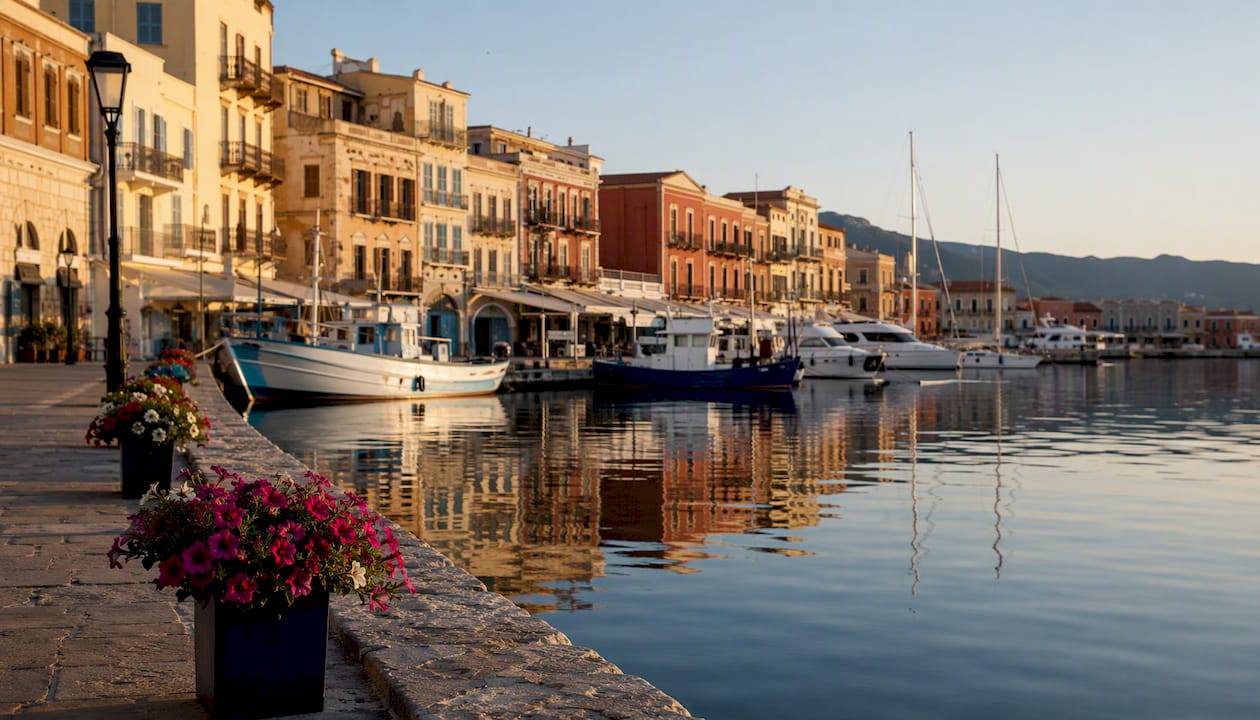
Top highlights: Knossos Palace, Samaria Gorge, Chania’s Venetian harbor
Best for: History lovers, hikers, families, food travelers
Best time: April through June, September through October
How to get there: Two international airports (Heraklion/HER and Chania/CHQ); ferries from Piraeus (8–9 hours overnight)
Suggested stay: 5–7 nights minimum
3. Mykonos, Greece
Mykonos runs on two speeds: party and paradise. The harbor town (Chora) is all whitewashed walls, bougainvillea, and boutiques by day, then transforms into one of the Mediterranean’s most electric nightlife scenes after dark. The beaches, especially Paradise and Super Paradise, are legendary.
Top highlights: Little Venice waterfront, Windmills of Mykonos, Delos day trip (a UNESCO-listed ancient sanctuary)
Best for: Nightlife, beach clubs, solo travelers, LGBTQ+ travelers
Best time: June and September (July and August are peak and pricey)
How to get there: Mykonos Island National Airport (JMK); ferries from Piraeus (2.5–5 hours depending on speed)
Suggested stay: 3–4 nights
4. Rhodes, Greece
Rhodes has one of the best-preserved medieval old towns in Europe, listed as a UNESCO World Heritage Site. The Knights’ Street, the Palace of the Grand Master, and the ancient city of Lindos make this island a genuine history lover’s dream. The beaches on the west coast are calm and family-friendly; the east coast is wilder.
Top highlights: Rhodes Old Town (UNESCO), Lindos Acropolis, Valley of the Butterflies
Best for: History, families, beach variety
Best time: May, June, September
How to get there: Rhodes International Airport (RHO); ferries from Piraeus (12–18 hours) or fast ferries from nearby Kos
Suggested stay: 4–5 nights
5. Mallorca, Spain
Mallorca is the Balearics’ biggest island, and it earns its reputation. The Serra de Tramuntana mountain range along the northwest coast is a UNESCO World Heritage landscape, with dramatic cliffs dropping into turquoise coves. Palma’s cathedral, La Seu, is one of the most striking Gothic buildings in Spain.
Top highlights: Serra de Tramuntana (UNESCO), Palma Cathedral, Cala Mondragó natural park
Best for: Cycling, sailing, families, food and wine
Best time: May, June, September, October
How to get there: Palma de Mallorca Airport (PMI) is one of Europe’s busiest; ferries from Barcelona, Valencia, and Ibiza
Suggested stay: 5–7 nights
6. Ibiza, Spain
Ibiza’s reputation for nightlife is real, but the island has a quieter side that most visitors miss. The north, around San Juan and Santa Gertrudis, is full of organic farms, art galleries, and sleepy villages. The UNESCO-listed Dalt Vila (the old walled town) is worth an afternoon even if clubs aren’t your thing.
Top highlights: Dalt Vila (UNESCO), Es Vedrà rock formation, Cala d’Hort beach
Best for: Nightlife, beach clubs, culture seekers willing to explore beyond the south
Best time: May, June, September (July and August are peak season and very expensive)
How to get there: Ibiza Airport (IBZ); ferries from Barcelona, Valencia, and Mallorca
Suggested stay: 3–5 nights
7. Formentera, Spain
Formentera is what Ibiza was 40 years ago: flat, quiet, and stunningly beautiful. The water at Ses Illetes beach is so clear and shallow that it genuinely looks Caribbean. Experienced travelers consistently name Formentera among their favorites precisely because it resists the mass-tourism machine. There are no airports here, which keeps the crowds manageable.
Top highlights: Ses Illetes beach, Trucador Peninsula, La Mola lighthouse
Best for: Beach lovers, couples, travelers seeking quiet and authenticity
Best time: May, June, September
How to get there: Ferry from Ibiza (30–40 minutes); no direct flights
Suggested stay: 2–3 nights (often combined with Ibiza)
8. Sicily, Italy
Sicily is the Mediterranean’s most complex island. Greek temples at Agrigento and Selinunte, Arab-Norman architecture in Palermo, active volcanoes on Etna and Stromboli, and a food culture that draws serious travelers from around the world. It’s an island that rewards slow travel.
Top highlights: Valley of the Temples (Agrigento, UNESCO), Mount Etna, Palermo street food markets
Best for: Food lovers, history, culture, families
Best time: April through June, September through October
How to get there: Palermo (PMO) and Catania (CTA) airports; ferries from Naples, Genoa, and Civitavecchia
Suggested stay: 7–10 nights (it’s large)
9. Sardinia, Italy
Sardinia’s beaches are the benchmark against which other Mediterranean beaches are measured. The Costa Smeralda in the north has water that shifts from turquoise to deep blue in a matter of meters. But Sardinia also has a fierce, ancient culture: the nuraghi (Bronze Age stone towers) scattered across the island are unlike anything else in Europe.
Top highlights: Costa Smeralda, La Maddalena Archipelago, Nuraghe Su Nuraxi (UNESCO)
Best for: Beaches, sailing, outdoor adventure, culture
Best time: June, September (August is peak and very crowded on the Costa Smeralda)
How to get there: Airports at Cagliari (CAG), Olbia (OLB), and Alghero (AHO); ferries from Genoa, Civitavecchia, and Livorno
Suggested stay: 5–7 nights
10. Corsica, France
Corsica feels like two islands in one. The coastline is Mediterranean: warm, clear, and gorgeous. The interior is almost Alpine: granite peaks, chestnut forests, and the famous GR20 hiking trail. It’s a French island with a fiercely Corsican identity, and the food reflects both.
Top highlights: Bonifacio cliffs, Scandola Nature Reserve (UNESCO), GR20 trail
Best for: Hikers, sailors, nature lovers, independent travelers
Best time: May, June, September
How to get there: Airports at Ajaccio (AJA) and Bastia (BIA); ferries from Marseille, Nice, Toulon, and Livorno
Suggested stay: 5–7 nights
11. Hvar, Croatia
Hvar is Croatia’s most glamorous island, and it earns the label. The harbor at Hvar Town is lined with yachts and outdoor restaurants, the hilltop fortress looks down over the Pakleni Islands, and the lavender fields in the interior bloom beautifully in June. It’s lively without being overwhelming, at least outside of peak August.
Top highlights: Hvar Town fortress, Pakleni Islands by boat, lavender fields
Best for: Sailing, nightlife, couples, foodies
Best time: June, early September
How to get there: Ferry from Split (1 hour to Stari Grad); catamaran from Split to Hvar Town
Suggested stay: 3–4 nights
12. Korčula, Croatia
Korčula is often called “Little Dubrovnik,” and the comparison is fair: the old town sits on a small peninsula, its medieval towers rising straight from the sea. It’s quieter than Hvar, the local wine (Pošip and Grk) is excellent, and the island is a natural fit for a sailing itinerary along the Dalmatian coast.
Top highlights: Korčula Old Town, Marco Polo’s alleged birthplace, Lumbarda vineyards
Best for: History, wine, sailing, travelers wanting fewer crowds
Best time: June, September
How to get there: Ferry from Split or Dubrovnik; catamaran from Split
Suggested stay: 2–3 nights
13. Malta and Gozo
Malta packs an extraordinary amount of history into a very small space. The Megalithic Temples of Malta are among the oldest freestanding structures on earth, listed as a UNESCO World Heritage Site. Valletta, the capital, is a Baroque masterpiece. Gozo, the smaller sister island, is greener, quieter, and home to the Azure Window’s famous replacement dive site. For deeper local planning, Your Malta Story is a solid resource for island-specific experiences and hidden gems.
Top highlights: Valletta (UNESCO capital), Megalithic Temples, Blue Lagoon (Comino)
Best for: History, diving, couples, cultural travelers
Best time: April through June, October
How to get there: Malta International Airport (MLA); ferries from Sicily (Pozzallo or Catania)
Suggested stay: 4–5 nights for Malta; add 1–2 nights for Gozo
14. Zakynthos, Greece
Zakynthos is famous for one image: the rusting shipwreck on Navagio Beach, surrounded by white cliffs and electric-blue water. But the island is also a protected nesting ground for loggerhead sea turtles (Caretta caretta) at Laganas Bay, which gives it a conservation angle that sets it apart from most Greek islands.
Top highlights: Navagio (Shipwreck) Beach, Blue Caves, Laganas turtle nesting beach
Best for: Beach lovers, nature travelers, photographers
Best time: May, June, September
How to get there: Zakynthos National Airport (ZTH); ferry from Kyllini on the Peloponnese
Suggested stay: 3–4 nights
15. Elba, Italy
Napoleon spent his first exile here, and you can understand why he was reluctant to leave. Elba is lush, hilly, and ringed with excellent beaches. It’s just a short ferry ride from the Tuscan coast, which makes it an easy add-on to a mainland Italy trip. The snorkeling around the Tuscan Archipelago National Park is some of the best in Italy.
Top highlights: Napoleon’s Villa dei Mulini, Portoferraio harbor, Tuscan Archipelago snorkeling
Best for: Families, history, beach lovers, sailors
Best time: June, September
How to get there: Ferry from Piombino (1 hour); small airport at Marina di Campo (EBA) with limited seasonal flights
Suggested stay: 3–4 nights
16. Aeolian Islands, Italy
Seven volcanic islands north of Sicily, and each one is different. Lipari is the largest and most accessible. Stromboli erupts almost continuously, and watching it glow at night from a boat is one of the most memorable experiences in the Mediterranean. Panarea is tiny, chic, and car-free. The Aeolian Islands are listed as a UNESCO World Heritage Site for their volcanic geomorphology and ongoing geological activity.
Top highlights: Stromboli night eruption, Lipari Archaeological Museum, Panarea’s thermal springs
Best for: Sailing, volcanic tourism, adventure, geology enthusiasts
Best time: May through June, September
How to get there: Hydrofoil or ferry from Milazzo (Sicily) or Naples; small airstrip on Lipari (LIP) with limited connections
Suggested stay: 3–5 nights across multiple islands
17. Folegandros, Greece
Folegandros is the Cyclades without the crowds. The Chora perches dramatically on a cliff above the sea, the hiking trails are excellent, and the island has no cruise ship port, which keeps the atmosphere genuinely local. Experienced travelers who’ve visited 40 or more Mediterranean islands name Folegandros as a standout for exactly this reason.
Top highlights: Chora clifftop village, Chrysospilia cave, Agali Beach
Best for: Travelers seeking quiet, authenticity, and Cycladic beauty without the Santorini crowds
Best time: June, September
How to get there: Ferry from Piraeus (6–8 hours) or from Santorini (1.5–2 hours)
Suggested stay: 2–3 nights
18. Ischia, Italy
Ischia is Italy’s thermal island. The volcanic activity that shaped it also created a network of natural hot springs, and soaking in the Poseidon Thermal Gardens while looking out over the Tyrrhenian Sea is a genuinely restorative experience. The Aragonese Castle, connected to the main island by a stone bridge, is one of the most dramatic fortresses in southern Italy.
Top highlights: Poseidon Thermal Gardens, Aragonese Castle, Maronti Beach
Best for: Wellness travelers, couples, families, history lovers
Best time: May, June, September, October
How to get there: Ferry or hydrofoil from Naples (45 minutes to 1.5 hours)
Suggested stay: 3–4 nights
Quick-scan comparison
How to choose the right Mediterranean island for your trip
Your first filter is time. If you have fewer than five days, pick one island and commit. Trying to island-hop across the Mediterranean in a long weekend means spending most of your trip on ferries or in airports. For a week or more, a hub-and-spoke approach works beautifully: one larger island as your base, with 1–2 day trips or short overnight stays to nearby smaller islands.
Here’s a simple decision checklist to work through before you book:
- Trip length. Under 5 days: one island only. 7–10 days: one hub plus one or two smaller neighbors. Two weeks or more: a proper multi-island itinerary or a sailing route.
- Travel style. Beach and relaxation? Sardinia, Formentera, or Zakynthos. History and culture? Crete, Rhodes, Malta, or Sicily. Nightlife? Mykonos or Ibiza. Outdoor adventure? Corsica or the Aeolian Islands. Sailing and exploration? The Dalmatian coast, the Cyclades, or the Balearics.
- Who you’re traveling with. Families with kids do well on Crete, Mallorca, or Elba. Couples tend to love Santorini, Corsica, or Ischia. Groups of friends often gravitate toward Hvar, Ibiza, or Mykonos.
- Budget and crowd tolerance. Santorini and Mykonos in July and August are expensive and packed. Folegandros, Korčula, and Gozo offer comparable beauty at a fraction of the price and crowd level.
- Transport constraints. Some islands (Formentera, Folegandros, the Aeolian Islands) have no airports or very limited air connections. If you’re short on time, prioritize islands with direct or one-stop flights from the US.
Red flags to watch for:
- Avoid Santorini and Mykonos in late July and August if you dislike crowds. The caldera path in Oia can feel like a theme park queue.
- Formentera has no airport, so factor in the Ibiza ferry connection when planning tight itineraries.
- The Aeolian Islands have limited accommodation, especially on Panarea and Stromboli. Book well in advance for summer.
- Sicily is large. Trying to see Palermo, Agrigento, and Catania in three days means you’ll see nothing properly.
Pro Tip: Pair one well-connected hub island with one smaller neighbor to get the best of both worlds. Sicily plus the Aeolian Islands, Mallorca plus Formentera, or Crete plus a smaller Cretan islet all work brilliantly. You get the infrastructure and variety of the big island with the serenity and authenticity of the small one, and you only need one main flight.
The best sailing routes through the Mediterranean’s must-see islands
From a sailing perspective, the Mediterranean’s best island clusters are the Cyclades, the Dalmatian coast, the Balearics, and the Tyrrhenian triangle of Elba, Ischia, and the Aeolian Islands. Each offers a different rhythm on the water, and each rewards the kind of slow, port-to-port exploration that a yacht makes possible. Experienced skippers recommend choosing a base marina with solid provisioning and medical access — Piraeus, Split, Palma, or Cagliari — and planning one or two overnight anchor stays per island to balance sailing time with genuine shore exploration.
Port arrivals matter more than most travelers realize. Arriving at a historic harbor like Chania or Kotor by sea adds a layer of cultural depth that no airport transfer can replicate. And the timing of that arrival makes a real difference: early morning or late afternoon, when day-trip crowds are absent, gives you a completely different and far more tranquil experience of these places.
Here are four sample sailing itineraries that cover the top islands:
Route 1: Cyclades loop (7–10 days, base: Piraeus or Syros)
A classic Greek island-hopping route that hits the Cyclades’ greatest hits while leaving room to breathe.
- Day 1–2: Sail from Piraeus to Syros or Paros (overnight anchor or marina)
- Day 3–4: Santorini (2 nights; anchor in the caldera or use Vlychada marina)
- Day 5: Folegandros (1 night; anchor off Agali Beach)
- Day 6–7: Mykonos (2 nights; Mykonos Town marina or anchor off Ornos)
- Day 8–9: Delos day sail, then return to Piraeus
On-water rhythm: roughly 3–5 hours of sailing per day, leaving afternoons free for shore time. The caldera anchorage at Santorini is dramatic but can be rolly; Vlychada marina is calmer and less crowded.
Route 2: Dalmatian coast (7–10 days, base: Split)
Croatia’s coastline is one of the most beautiful sailing grounds in the world, and Hvar and Korčula are the highlights.
- Day 1: Split (base port; explore Diocletian’s Palace)
- Day 2–3: Hvar Town (2 nights; ACI marina or anchor off Pakleni Islands)
- Day 4–5: Korčula (2 nights; town marina)
- Day 6: Vis Island (1 night; anchor in Stiniva cove)
- Day 7–8: Brač (1 night) then return to Split
Vis is a former Yugoslav military island that only opened to tourism in 1989, and its seclusion shows. Stiniva cove, accessible only by sea or a steep hike, is one of the most beautiful anchorages on the Dalmatian coast.
Route 3: Balearics day-sail (7 days, base: Palma, Mallorca)
The Balearics are compact enough for a relaxed week of sailing with short passages between islands.
- Day 1–2: Palma, Mallorca (base; explore the cathedral and old town)
- Day 3: Sail to Cabrera (protected national park; anchor overnight)
- Day 4–5: Ibiza (2 nights; Ibiza Town marina or anchor off Es Vedrà)
- Day 6: Formentera (1 night; anchor at Ses Illetes)
- Day 7: Return to Palma
Passages between islands are short (2–4 hours), which makes this route ideal for groups new to sailing or families with children. The anchorage at Ses Illetes in Formentera is one of the most beautiful in the western Mediterranean.
Route 4: Tyrrhenian triangle (7–10 days, base: Naples or Civitavecchia)
This route links three of Italy’s most distinctive island experiences: Elba’s outdoor beauty, Ischia’s thermal springs, and the Aeolian Islands’ volcanic drama.
- Day 1–2: Naples (base; day trip to Pompeii)
- Day 3–4: Ischia (2 nights; Casamicciola marina or anchor off Maronti Beach)
- Day 5: Sail south to Stromboli (anchor overnight; watch the eruption from the water)
- Day 6–7: Lipari and Panarea (2 nights across both islands)
- Day 8–9: Elba (2 nights; Portoferraio marina)
- Day 10: Return to Civitavecchia or Livorno
Stromboli’s overnight anchorage is one of the most memorable experiences in Mediterranean sailing. The volcano erupts roughly every 20 minutes, and watching it glow against a dark sky from the cockpit of a yacht is something you won’t forget.
Pro Tip: The Mediterranean sailing season runs from late April through October, with the sweet spot in May, June, and September. July and August bring reliable wind but also peak marina prices and crowds. US travelers don’t need a visa for Schengen countries (Greece, Italy, Spain, France, Croatia) for stays under 90 days, but always check current entry requirements before you travel. For Croatia, note that it joined the Schengen Area in January 2023. A private yacht charter gives you the flexibility to adjust your itinerary based on weather and wind, which is something no ferry schedule can offer.
For more detailed island-hopping route ideas and yacht options, Sailarmada has put together practical guides covering Greek routes, Dalmatian passages, and beyond.
When to go and what to budget for Mediterranean island travel
The short answer: shoulder season wins. May through June and September through October give you warm weather, swimmable sea temperatures, and dramatically fewer crowds than July and August. High season delivers guaranteed sunshine and the most vibrant atmosphere, but at a real cost in both price and congestion.
The Mediterranean has over 3,000 islands, which is exactly why a curated shortlist matters. Not all of them follow the same seasonal patterns, and knowing the differences can save you a trip.
Seasonality by island group:
Rough daily budget tiers (per person, excluding flights):
- Budget ($80–$130/day): Guesthouse or hostel, local tavernas, public ferries, self-catering. Works well on Crete, Sicily, Malta, and Corsica.
- Mid-range ($150–$280/day): Boutique hotel or apartment, restaurant meals, occasional fast ferry or short flight. Comfortable on most islands including Mallorca, Hvar, and Rhodes.
- Luxury ($350+/day): Cliffside resort or private villa, fine dining, private transfers, yacht day charters. Santorini, Mykonos, and the Costa Smeralda in Sardinia sit firmly in this tier in peak season.
Pro Tip: Book ferries and accommodations for July and August at least three to four months in advance, especially on smaller islands with limited beds (Folegandros, Panarea, Formentera). Shoulder-season travelers can often book two to three weeks out and still find good options at significantly lower prices. For sailing holidays specifically, understanding the Mediterranean sailing seasons in detail will help you pick the window that matches your priorities.
Getting to the Mediterranean: transport, visas, and health for U.S. travelers
Most U.S. travelers fly into a major hub city first, then connect by regional flight or ferry. The main gateway airports are Athens (ATH), Rome Fiumicino (FCO), Barcelona (BCN), and Palma de Mallorca (PMI). From any of these, you’re within a short flight or ferry ride of most islands on this list.
Transport options by island cluster:
- Greek islands: Fly into Athens (ATH), then connect by domestic flight (Olympic Air, Sky Express) or ferry from Piraeus. Fast ferries reach Mykonos in 2.5 hours; overnight ferries to Crete and Rhodes are comfortable and cost-effective.
- Italian islands: Rome (FCO) or Naples (NAP) for Ischia and the Aeolian Islands; Pisa (PSA) or Livorno for Elba; Palermo (PMO) or Catania (CTA) for Sicily; Cagliari (CAG) or Olbia (OLB) for Sardinia.
- Balearics: Barcelona (BCN) or Valencia (VLC) for Mallorca, Ibiza, and Formentera. Palma (PMI) has direct seasonal flights from many US cities via European hubs.
- Dalmatian coast: Split (SPU) or Dubrovnik (DBV) for Hvar, Korčula, and the Croatian islands. Both airports have good connections from major European hubs.
- Malta: Direct flights into Malta International Airport (MLA) from major European cities; ferry from Pozzallo or Catania in Sicily.
- Corsica: Fly into Ajaccio (AJA) or Bastia (BIA) via Paris, Nice, or Rome; ferry from Nice, Marseille, or Livorno.
Visa basics for U.S. passport holders:
- Greece, Italy, Spain, France, and Croatia are all Schengen Area members. U.S. citizens can visit for up to 90 days within any 180-day period without a visa.
- Malta is also in the Schengen Area.
- The EU’s ETIAS (European Travel Information and Authorization System) is expected to launch for US travelers; check the latest status before you travel, as the timeline has shifted.
- Always carry your passport (not just a driver’s license) and keep a digital copy stored separately.
Health and insurance:
- No specific vaccinations are required for Mediterranean island travel, but the CDC recommends being up to date on routine vaccines. Hepatitis A is worth considering for food-focused destinations like Sicily and Crete.
- Travel insurance with medical evacuation coverage is strongly recommended, especially for remote islands like the Aeolians or Folegandros where hospital access is limited.
- European pharmacies (farmacia in Italy, farmakio in Greece) are well-stocked and pharmacists can advise on minor ailments without a doctor’s appointment.
Luggage and small-island practicalities:
- Soft-sided bags or duffel bags are far easier than hard-shell suitcases on ferries, small boats, and cobblestone streets.
- Many small islands have limited or no ATMs; carry some cash (euros for Eurozone countries, euros also for Croatia since it adopted the euro in January 2023).
- For guided sailing tours and group charters, packing light is not just a suggestion. Most yacht cabins have limited storage, and a compact bag makes life on board significantly more comfortable.
Our perspective: why sailing changes how you experience these islands
There’s a version of Mediterranean island travel that most people know: fly in, check into a hotel, take a day trip, fly out. It’s fine. But it misses something fundamental about what these islands actually are.
Every island on this list was shaped by the sea. The Venetian harbors, the ancient trading ports, the volcanic anchorages, the hidden coves accessible only by water: these places make the most sense when you arrive by boat. Sailing from Hvar to Korčula at dawn, with the Dalmatian coast turning pink in the early light, is a different experience from taking the car ferry. Anchoring off Stromboli and watching the volcano erupt at midnight is not something you can replicate from a hotel room.
Sailarmada curates private and group sailing holidays across exactly these routes: the Cyclades, the Dalmatian coast, the Balearics, Sardinia, and the Tyrrhenian islands. The itineraries are built around the kind of port-level detail that makes a sailing trip genuinely memorable: where to anchor for the best morning light, which harbors to reach before the day-trip crowds arrive, which local tavernas are worth the dinghy ride ashore.
If you’re weighing whether a sailing holiday is right for your group or family, private yacht charters genuinely transform how you travel as a group. The flexibility, the privacy, and the access to places that ferries and tour buses simply can’t reach make it a fundamentally different kind of trip.
Sources
- Must-see ports on a Mediterranean cruise — and those to skip
- Best Mediterranean islands
- Best Mediterranean islands to visit by cruise
- I’ve Been To 40 Mediterranean Islands: These Are My 5 Favorites – Travel Off Path
- UNESCO World Heritage Centre