

Aim to arrive at the charter base well ahead of official check-in and plan your first cast-off within daylight hours. For multi-yacht groups, use a single lead-boat schedule with 30–60 minute staggered cast-offs. Charter check-in is often scheduled in the late afternoon, though operators will often get you aboard earlier when the yacht is ready. A full handover typically runs 45 minutes or more, so arriving early is not just nice to have — it is the single biggest thing you can do to protect your first sunset at anchor.
Four timing rules that apply to almost every charter departure:
- Arrive at the base by 2–3 PM even when official check-in is 5 PM; this gives you time for paperwork, provisioning, and a relaxed technical briefing.
- Budget 45–60 minutes for the handover (longer if you skipped digital pre-check-in).
- Add a 30-minute provisioning buffer after boarding before you cast off.
- Set a hard daylight cut-off for your first cast-off — sailing into an unfamiliar anchorage after dark is avoidable with good planning.
Principalele concluzii
Arriving 2–3 hours before official check-in and completing paperwork, provisioning, and the technical handover before cast-off is the single most reliable way to guarantee an on-time departure for any group charter.
| Punct | Detalii |
|---|---|
| Arrive early, always | Reach the charter base 2–3 hours before the official 5 PM check-in to allow time for paperwork and handover. |
| Budget 45–60 min for handover | The system-by-system technical briefing takes 45 minutes or more; digital pre-check-in shortens the total. |
| Stagger flotilla cast-offs | Lead boat departs first; each additional yacht follows 30–60 minutes later to avoid congestion. |
| Pre-order provisioning | Stage groceries at the dock 48 hours ahead so boarding is clean and cast-off is not delayed by a supermarket run. |
| Sailarmada handles the coordination | Sailarmada’s curated itineraries and on-the-ground partners manage transfers, staging, and multi-yacht scheduling for groups. |
Cuprins
- How to coordinate yacht departures: ready-to-use timeline templates
- Who does what on departure day?
- How should you handle airport transfers and luggage?
- How do you keep a flotilla on schedule?
- What communication tools and scripts should your group use?
- What’s your plan B for delays and no-shows?
- What does a departure actually cost beyond the charter fee?
- Step-by-step boarding: what happens at the dock?
- Sailarmada’s take on stress-free departures
- Sailarmada takes the logistics off your plate
- Surse
How to coordinate yacht departures: ready-to-use timeline templates
Three copy-ready schedules cover the most common scenarios. Adapt them to your destination and group size.
Digital pre-check-in can cut the paperwork and briefing window to roughly one hour total, which is a genuine gift when you have a long first leg ahead. For international arrivals with uncertain flight times, the smartest move is always to plan an overnight in the marina and cast off fresh in the morning. A well-designed itinerary built around realistic first-leg distances removes the pressure to rush that first departure.
Who does what on departure day?
Clear roles prevent the classic “I thought you had the passports” moment at the dock.

Charter base: Processes paperwork, collects the security deposit hold, confirms fuel level, and assigns the base technician for your handover.
Base technician: Walks you through every system on the yacht — engine, navigation instruments, safety gear, heads, and VHF. This is the 45-minute briefing you cannot skip.
Skipper: Asks final questions about local conditions, confirms the VHF working channel with the base, and runs the crew safety briefing before lines are cast.
Group leader: Holds all passports and sailing licenses, signs the charter agreement, and confirms the passenger list matches the crew declaration.
Invitați: Arrive with soft bags only, provisions pre-ordered or pre-staged, and cabin assignments already decided. Pre-assigning cabins before you arrive saves 20 minutes of dock-side negotiation.
A quick ownership table for the items most likely to cause delays:
| Articolul | Who Confirms | Deadline |
|---|---|---|
| Crew list / passports | Group leader | Night before departure |
| Security deposit hold | Group leader | At base office on arrival |
| Provisioning order | Group leader or designated guest | 48 hours before departure |
| Transfer confirmations | Group leader + transfer provider | 24 hours before departure |
| Insurance / sailing license | Skipper or group leader | At booking, re-confirmed on arrival |
How should you handle airport transfers and luggage?
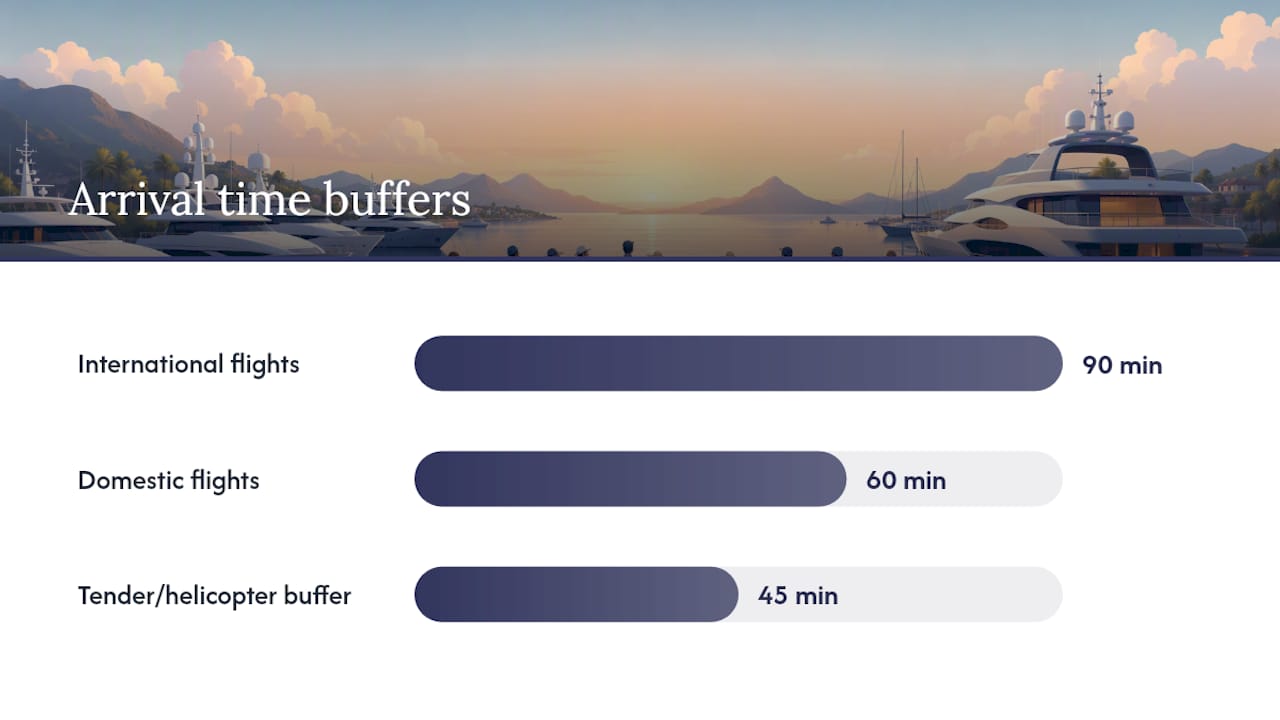
Getting everyone from the airport to the dock without chaos takes a bit of choreography, but it is very doable. Professional transfer coordination — whether by car, tender, or helicopter for remote island berths — meaningfully cuts guest fatigue and luggage-handling delays on arrival day.
- Book transfers at the same time as the charter. Last-minute transfers in peak season are expensive and unreliable.
- Build in a 90-minute buffer for international flights and 60 minutes for domestic, beyond the scheduled arrival time.
- Assign one contact person per vehicle who has the driver’s number and the base address saved offline.
- Use soft duffel bags only. Hard-shell suitcases do not fit in lockers and slow boarding considerably.
- Stage luggage at the base office rather than carrying it straight onto the yacht before handover is complete.
- Pre-order provisioning for delivery to the dock. Grocery runs after a long flight are a morale killer; pre-arrival staging keeps your on-water time intact.
For island or remote berths requiring a tender or helicopter transfer, add at least 45 minutes to your base arrival estimate and confirm the tender schedule with the marina the day before.
Sfat profesional: Share the driver’s WhatsApp number and the marina’s GPS coordinates (not just the address) in your group chat the night before. Marinas in Greece and Croatia often have multiple entrances, and a confused taxi driver costs you an hour.
How do you keep a flotilla on schedule?
Multi-yacht departures are where good planning really pays off. The lead boat sets the rhythm for everyone else, so staggered cast-offs and shared communications are the backbone of any successful flotilla departure.
A reliable lead-boat pattern: the lead boat confirms its cast-off time with the base, then each additional yacht departs 30–60 minutes later. This prevents congestion at the marina exit and gives the base technician time to complete each handover properly.
Common flotilla mistakes to avoid:
- Letting every skipper set their own departure time independently.
- Skipping a shared weather brief before the first boat leaves.
- Failing to agree on a rendezvous point and arrival window for the first anchorage.
Assign one communications lead across all yachts — typically the lead skipper — who holds the shared VHF channel, the group WhatsApp, and the base’s emergency number. Synchronized provisioning deadlines (all orders placed 48 hours out) and a joint safety-signal protocol agreed before departure keep the whole group moving together.
Sfat profesional: Choose a first-night anchorage that is easy to reach in 3–4 hours of sailing. A short, stress-free first leg lets everyone settle in, and you can push further on day two when the group has its sea legs.
What communication tools and scripts should your group use?
Keep it simple: two channels, two templates, and one schedule.
- Group SMS or WhatsApp for guest-level logistics (transfer times, meeting points, packing reminders).
- Radio VHF (agreed channel, typically 16 for emergencies and a working channel for inter-yacht chat) for skipper-to-skipper coordination once underway.
- One group leader manages both channels and escalates to the charter base or local agent when needed.
Day-before confirmation message (copy and adapt):
Day-of arrival check-in message:
Pre-load the charter base number, the local agent’s number, and each skipper’s cell into your phone before you leave home. Roaming surprises on arrival day are avoidable.
What’s your plan B for delays and no-shows?
Every departure plan needs a short playbook for the three most common disruptions.
Late flight: Wait up to 90 minutes past the scheduled transfer window before reassigning the vehicle. If the delay pushes arrival past 7 PM, plan an overnight in the marina and notify the base immediately so they can adjust the handover schedule.
Medical no-show: The group leader contacts the charter base to update the crew declaration. Depending on the charter agreement, a replacement crew member may need to be added formally. Do not cast off with an undeclared crew change.
Severe weather: The base or lead skipper makes the call to delay cast-off. Never override a skipper’s weather judgment to stick to a timeline. Have a fallback anchorage or marina identified within two hours of the base for the first night.
Sfat profesional: Ask your charter base for the name and number of their local agent before departure day. When something goes sideways, the local agent is faster to reach and more empowered to solve problems than a central reservations line.
- Confirm the base’s 24-hour emergency contact at check-in.
- Keep a written list of fallback marinas along your first leg.
- Build a 24-hour “float day” into multi-week itineraries for weather delays.
What does a departure actually cost beyond the charter fee?
Departure logistics carry real costs that catch first-time organizers off guard. Budget for these line items:
- Airport transfers: Varies widely by region and group size; private minibus transfers in Greece or Croatia typically run higher per person than shared shuttles.
- Early check-in fee: Available at many bases for arrivals around 1–2 PM; confirm the fee at booking rather than on arrival.
- Late cleaning or turnaround surcharge: Charged when the previous charter runs late and your handover is delayed.
- Tender or helicopter transfer: Required for some island berths; costs vary by distance and provider.
- Provisioning delivery fee: Many bases or local agents charge a small fee to stage pre-ordered groceries on the dock.
For a realistic sense of what a full yacht holiday costs, factor transfer and provisioning fees into your per-person budget from the start. Booking transfers and early check-in at the same time as the charter almost always saves money compared to arranging them separately on arrival. For budget-conscious groups, bundling group boat logistics early is one of the most consistent ways to reduce per-person costs.
Step-by-step boarding: what happens at the dock?
Here is the exact sequence from car park to open water, with realistic time estimates for each step.
Speed the process by delegating one person to handle all paperwork signing, keeping everyone else off the dock until boarding is confirmed, and having provisioners meet the boat at the dock rather than carrying bags of groceries through the office. The procesul de rezervare pentru grupuri works best when the organizer has pre-submitted the crew list and sailing licenses digitally, so the office step is a quick confirmation rather than a data-entry session.
Sailarmada’s take on stress-free departures
The single thing that separates a chaotic departure from a smooth one is not luck — it is the quality of the coordination that happened in the 72 hours before anyone set foot on the dock. Groups that pre-submit crew documents, pre-order provisioning, and confirm transfers in writing arrive relaxed and ready. Groups that leave those tasks to arrival day spend their first afternoon in an office rather than on the water.
Sailarmada has coordinated departures for groups across Greece, Croatia, Italy, and beyond, and the pattern is consistent: curated itineraries with realistic first-leg distances, on-the-ground partners who know the local marinas, and a clear communication plan handed to the group leader before departure day. That combination removes the friction that turns a gorgeous first afternoon into a stressful scramble.
Sailarmada takes the logistics off your plate
Coordinating a group sailing departure is genuinely fun when someone else has already handled the hard parts. Sailarmada builds transfer coordination, provisioning staging, multi-yacht scheduling support, and curated Itinerarii mediteraneene de navigație pentru grupuri into every booking, so your group arrives at the dock with a plan already in place.
Indiferent dacă organizezi un private yacht charter for your group or joining a flotilla sailing week, Sailarmada’s local partners and experienced skippers make sure the first cast-off happens on time and the first anchorage is worth every minute of the journey. Ready to plan your departure? Browse Sailarmada’s sailing holidays and get your group on the water.
Surse
- Yacht Charter Check-In: What to Expect & How to Prepare | Floatist
- Charterm
- Check-In Time For Yacht Charter | SailChecker
- Airport Pick-Up & Drop Off Service | Yacht Management