
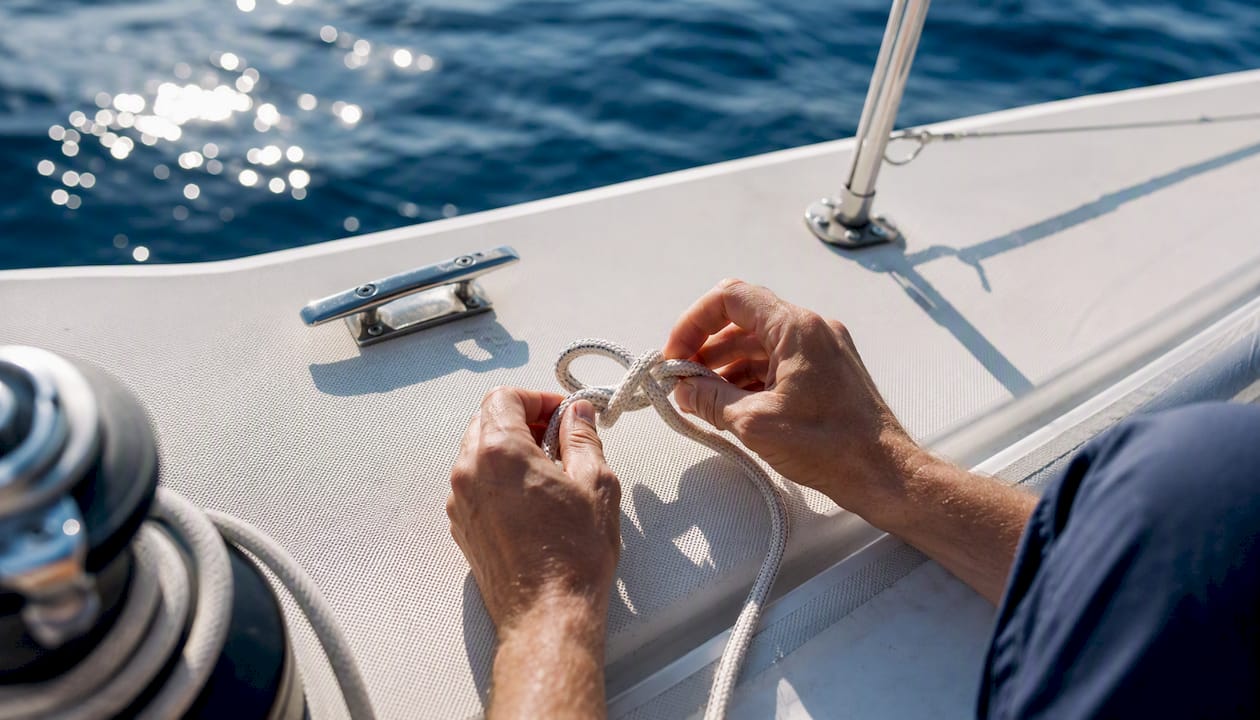
Before you step aboard a sailboat in Greece, there are a handful of words you genuinely need to know. Not because they sound cool, but because they keep you safe and useful. The short list: bow (front), pupa (back), port (left), la tribord (right), cârmă (the steering wheel or tiller), boom (the horizontal pole attached to the mast), vela mare și braț (your two main sails), tack și gybe (the two ways to turn), sheet și drezină (the lines that control sails), and man overboard și MAYDAY (the two emergency calls that can save a life). Position words like port and starboard are fixed to the boat, not to you, so they mean the same thing no matter which way you’re facing. That’s exactly why sailors use them instead of “left” and “right.”
Two things to memorize before your first sail:
- Port = left side of the boat (both “port” and “left” have four letters — that’s the classic mnemonic)
- Om căzut peste bord = shout it immediately if anyone falls in, then point and keep pointing at the person in the water
Principalele concluzii
Mastering the core sailing vocabulary before you board, especially position words, safety calls, and basic commands, is the single most effective way to stay safe and confident on a charter in Greece.
| Punct | Detalii |
|---|---|
| Port and starboard are fixed | Port = left, starboard = right, always relative to the bow — memorize these before anything else. |
| Safety calls save lives | “Man overboard” and “MAYDAY” on VHF Channel 16 are the two emergency phrases every guest must know. |
| Three knots cover most situations | Learn the cleat hitch, bowline, and figure-eight before departure — practice until each takes under 60 seconds. |
| Commands need fast responses | “Ready about,” “ease sheets,” and “gybe-oh” require immediate action; know the response before you hear the call. |
| Sailarmada offers guided practice | Skippered charters in Greece include day-one orientation and real drills, the fastest way to turn vocabulary into instinct. |
Cuprins
- The must-know sailing terms for beginners, grouped and easy to scan
- Boat parts you should recognize on deck
- Lines, sails, and controls — what they do and the commands tied to them
- Points of sail and basic maneuvers — how the boat moves relative to the wind
- Three essential knots every beginner should learn
- Common commands you’ll hear on deck and how to respond
- Safety words and what to do if something goes wrong
- How to practice these terms safely on a sailing holiday in Greece
- Sailing terms in action — real examples from the dock to the open water
- Navigation basics — buoys, bearings, and marks
- Weather terms every sailor should understand before heading out
- Sail trim and adjustment — the terms that make the boat go faster
- What skippers actually wish beginners knew before stepping aboard
- Ready to practice these skills on the water in Greece?
- Surse
The must-know sailing terms for beginners, grouped and easy to scan
Think of this as your personal cheat sheet. These are the core sailing terms grouped so they stick together naturally.
Direction and position
- Arc (rhymes with “cow”) — the front of the boat. “Move to the bow” means walk forward.
- Stern — the back of the boat. The skipper might say “stay aft” meaning stay toward the stern.
- Port — the left side when you’re facing the bow. Always. Red navigation light.
- Tribord — the right side when you’re facing the bow. Always. Green navigation light.
- Forward / aft — forward means toward the bow; aft means toward the stern.
- Windward — the side the wind is coming from. Stand here and you feel the breeze full in your face.
- Suflet (pronounced “loo-erd”) — the sheltered side, away from the wind. Waves and spray tend to come over the leeward rail when heeling.
Sails and rigging
- Mainsail (say “main-sul”) — the large sail attached to the mast and boom. It’s the engine of the boat.
- Jib / Genoa — the sail at the front, attached to the forestay. A genoa is simply a larger jib that overlaps the mast.
- Boom — the horizontal pole at the base of the mainsail. Watch your head around this one.
- Mast — the tall vertical pole that holds the sails up.
- Halyard (say “hal-yerd”) — the line used to hoist (raise) a sail.
- Sheet — the line used to control the angle of a sail. Pulling in the sheet tightens the sail; easing it lets the sail out.
Sfat profesional: Pair each term with a physical action the first time you hear it. When the skipper says “ease the sheet,” watch what happens to the sail. That visual lock-in beats any flashcard.
Boat parts you should recognize on deck
Knowing what’s what before you step aboard means you can follow instructions without freezing up. Here’s a quick visual tour of a typical charter sailboat.
- Hull — the body of the boat, everything below the deck. It keeps you floating.
- Deck — the flat surface you walk on. Keep three points of contact when moving around.
- Cockpit — the sunken seating area near the stern where the helm is. Most of your time as a guest happens here.
- Keel — a heavy fin under the hull that stops the boat from tipping over sideways. You won’t see it, but it’s doing a lot of work.
- Rudder — the underwater blade at the stern that steers the boat. Connected to the helm.
- Bow pulpit — the metal railing at the very front of the boat. Great for photos; not for leaning over underway.
- Bucătărie — the kitchen below deck.
- Cap — the bathroom. Yes, sailors call it the head.
- Shrouds and stays — the wire cables that hold the mast up. Don’t lean on them or use them to pull yourself around.
Safety note: The boom swings across the cockpit during maneuvers. When the skipper calls “ready about” or “ready to gybe,” duck your head and move to the center of the cockpit. The boom moves fast and at head height.
Tip for visual learners: ask your skipper to point out each part during the day-one orientation. Most skippers on skippered charters are happy to do a five-minute deck tour before leaving the marina.
Lines, sails, and controls — what they do and the commands tied to them
On a boat, nothing is called a “rope” once it has a job. The moment a rope is put to use, it becomes a line. This matters because the skipper won’t say “grab the rope” — they’ll say “ease the sheet” or “haul in the halyard,” and you need to know which line they mean.
Here are the four controls you’ll interact with most:
Halyard — runs up the mast and attaches to the top of a sail. Pull it down to raise the sail; ease it to lower. You’ll hear “hoist the main” when it’s time to raise the mainsail.
Sheet — controls the angle of the sail relative to the wind. There’s a jib sheet and a mainsheet. “Trim in” means pull the sheet in to tighten the sail; “ease sheets” means let it out. Sail trim and sheet management are among the first practical skills beginners get introduced to under instruction.
Cleat — a T-shaped or horn-shaped fitting that locks a line in place. You wrap the line in a figure-eight pattern around the horns to hold it. To release, flip the line off the top horn first.
Winch — a drum-shaped mechanical device that gives you extra pulling power on a sheet or halyard. You wrap the line around it and use a winch handle to crank it in. Never wrap your fingers around a loaded line near a winch.
Sfat profesional: When handling any loaded line, keep your fingers open and use your palm. A line under tension can snap tight in an instant, and fingers caught in a cleat or around a winch handle are a serious injury risk.
Common commands and what they mean:
- “Haul in” — pull the line toward you, taking up slack.
- “Ease sheets” — let the sheet out slowly, releasing tension on the sail.
- “Ready to gybe” — prepare for the boom to swing across; move to the center and duck.
- “Cleat it off” — secure the line on the cleat so it holds without you holding it.
Points of sail and basic maneuvers — how the boat moves relative to the wind
True wind is the wind you feel standing still on land. Apparent wind is what you feel on a moving boat — a combination of the true wind and the wind created by the boat’s own speed. Apparent wind is what actually fills your sails, and it shifts as the boat speeds up or changes direction.
The angle between the boat and the wind determines your point of sail:
| Point of Sail | Wind Angle | Sail Position | Feel on Board |
|---|---|---|---|
| Close-hauled | upwind (close to the wind) | Sails pulled in tight | Boat heels, spray possible |
| Close reach | ~60° to wind | Sails slightly eased | Fast and comfortable |
| Beam reach | beam reach (wind abeam) | Sails halfway out | Smooth, often fastest point |
| Broad reach | ~120–150° to wind | Sails well eased | Relaxed, following seas |
| Running | running (wind from directly behind) | Sails fully out | Gentle roll, gybe risk |
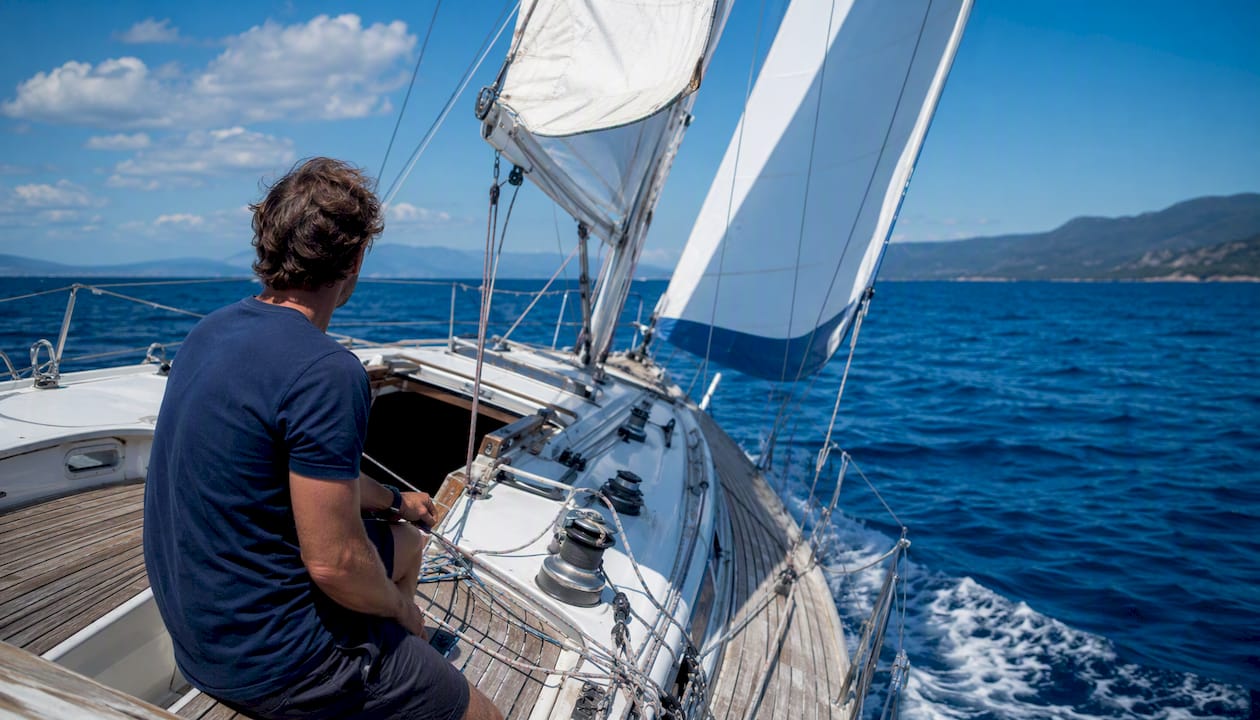
Manevra de virare (also called “coming about”) means turning the bow through the wind to change direction. You use it when sailing upwind. The sequence: skipper calls “ready about,” crew responds “ready,” skipper calls “helm’s a-lee” and turns the wheel, the jib sheets swap sides, and the boat settles on the new tack. Tacking and gybing are the two fundamental maneuvers every beginner encounters; tacking is the safer of the two.
Viraj în zăbrele (also spelled “jibing”) means turning the stern through the wind. Used when sailing downwind. The boom swings across with much more force than in a tack, which is why it’s riskier. When the skipper calls “ready to gybe”:
- Move to the center of the cockpit
- Duck your head below boom height
- Hold on to something solid
- Do not stand on the leeward side
Safety warning: An accidental gybe, where the wind catches the mainsail from the wrong side without warning, can send the boom flying across at speed. If the wind shifts and the mainsail starts to look “floppy” on a downwind run, tell the skipper immediately.
Three essential knots every beginner should learn
You don’t need to be a knot expert. Three knots cover most situations you’ll face as a charter guest or novice crew member.
1. The cleat hitch
Used for: securing a dock line or any line to a cleat.
- Take a full turn around the base of the cleat.
- Cross over the top in a figure-eight pattern, going under each horn.
- Finish with a locking half-hitch by flipping the line under itself on the last pass.
This is the knot you’ll use every time you tie up at a dock. Practice it until it takes under ten seconds.
2. The bowline
(Pronounced “boh-lin”) — Used for: making a fixed loop that won’t slip or jam under load.
- Make a small loop in the line (the “rabbit hole”).
- Pass the working end up through the loop from underneath (the rabbit comes out of the hole).
- Take it around behind the standing part, then back down through the loop. Pull tight.
The bowline is the most useful knot in sailing. It creates a loop you can attach to a ring, a cleat, or a person’s harness in an emergency.
Sfat profesional: The bowline is excellent for dock lines and attaching sheets to sail clews. However, if you’re not fully confident tying it under pressure, don’t use it for any critical lifting task. A poorly tied bowline can slip. When in doubt, ask the skipper to check your knot.
3. The figure-eight
Used for: a stopper knot at the end of a sheet or halyard so it can’t run through a block or cleat.
- Make a loop in the line.
- Pass the working end around the back of the standing part.
- Thread it through the loop from the front. Pull tight.
It’s the simplest knot on the list and one of the most important. Without a stopper knot, a sheet can run all the way through its block and disappear, leaving you with no control of the sail.
Common commands you’ll hear on deck and how to respond
Sailing runs on short, clear commands. When the skipper speaks, they expect a fast response, not a conversation. Here’s your quick call-and-response guide for the commands you’re most likely to hear:
| Command | What It Means | Your Response |
|---|---|---|
| “Ready about?” | Preparing to tack; are you ready? | “Ready!” — then move to center, watch the boom |
| “Helm’s a-lee” | The tack is happening now | Duck, hold on, let the jib sheet go if asked |
| “Ease sheets” | Let the sail out slowly | Release the sheet gradually, don’t let it fly |
| “Trim in” | Pull the sheet in to tighten the sail | Haul in steadily on the winch or by hand |
| “Ready to gybe?” | Preparing to gybe; are you ready? | “Ready!” — move center, duck low |
| “Gybe-oh!” | The gybe is happening now | Stay low, hold on, don’t stand on leeward side |
| “Hands on deck” | Everyone come up from below | Come up quickly and calmly |
| “Man overboard!” | Someone is in the water | Shout it back, point at the person, keep pointing |
A few useful phrases for non-native English speakers on Greek charters:
- “Έτοιμος” (Etimos) — “Ready”
- “Κατάλαβα” (Katalava) — “Understood”
- “Βοήθεια” (Voithia) — “Help”
- “Άνθρωπος στη θάλασσα” (Anthropos sti thalassa) — “Man overboard”
Most skippers on Greek charter boats speak English, but knowing these four phrases can matter in a fast-moving situation.
Safety words and what to do if something goes wrong
Safety vocabulary isn’t just jargon. Knowing these words and the actions behind them is a genuine safety skill, and practicing them in drills before you need them is what makes the difference.
Man overboard (MOB)
The moment someone goes into the water:
- Shout “Man overboard!” loudly and clearly.
- Punct at the person in the water and do not stop pointing. Your job is to keep eyes on them.
- Throw a flotation device (life ring or horseshoe buoy) toward them immediately.
- Assign a dedicated spotter — one person does nothing but point and watch.
- The skipper maneuvers the boat back to recover. Stay out of the way unless asked to help.
MAYDAY vs. pan-pan
MAYDAY is the international distress call for a life-threatening emergency: fire, sinking, or a medical crisis. Broadcast on VHF Channel 16, say “MAYDAY MAYDAY MAYDAY,” your vessel name, your position, the nature of the emergency, and the number of people on board. Repeat until you get a response.
Pan-pan (pronounced “pahn-pahn”) is one step below MAYDAY. Use it for urgent situations that are serious but not immediately life-threatening — a medical concern, a disabled engine in a shipping lane, or a dragging anchor near rocks. Same channel, same format, but you open with “Pan-pan pan-pan pan-pan.”
Heave-to is a technique for stopping the boat in a controlled way during rough conditions. The skipper backs the jib and locks the helm, and the boat sits almost still, giving everyone time to deal with a problem calmly. You don’t need to know how to do it, but knowing the term means you understand what’s happening if the skipper calls it.
Sfat profesional: On your first day aboard, locate the life jackets, the life ring, the flare kit, and the VHF radio before you leave the marina. Ask the skipper to show you where they are. It takes three minutes and you’ll feel much calmer for the rest of the trip.
Emergency contacts in Greece: The Hellenic Coast Guard operates on VHF Channel 16 and can be reached by phone at 112 (the pan-European emergency number) or 108 (the dedicated coast guard line).
How to practice these terms safely on a sailing holiday in Greece
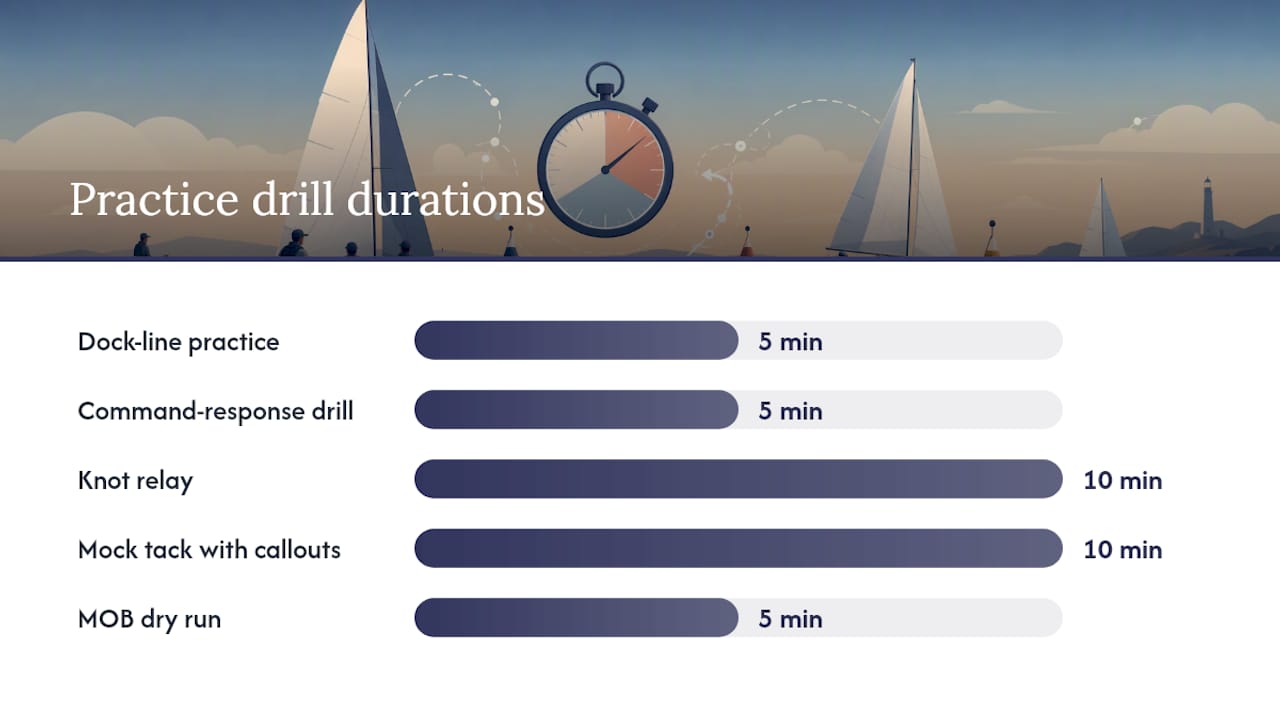
Vocabulary becomes instinct through repetition, and a charter holiday in Greece gives you the perfect setting to practice. Asking for a short orientation and a practice rundown on day one is one of the best things you can do as a charter guest. Here are five short drills you can run with your skipper, most taking under ten minutes:
- Dock-line practice (5 min): Before leaving the marina, practice tying a cleat hitch and a bowline on the dock cleats. Ask the skipper to check each one.
- Command-response drill (5 min): The skipper calls out commands (“ease sheets,” “ready about,” “man overboard”) and each guest responds with the correct action or verbal reply. Run it twice.
- Knot relay (10 min): Each person ties a figure-eight, a cleat hitch, and a bowline in sequence. Time it. Repeat until everyone is under 60 seconds per knot.
- Mock tack with callouts (10 min): The skipper walks through a tack in slow motion, calling each step. Guests practice moving to the correct side and ducking on cue.
- MOB dry run (5 min): Toss a fender (a rubber bumper) overboard and practice the full MOB sequence: shout, point, throw the life ring, assign a spotter. Do this at anchor in calm water.
Mediterranean conditions to expect in Greece: Greek waters, particularly the Aegean, are famous for the meltemi, a strong northerly wind that picks up in July and August, often reaching Force 5–6 by early afternoon. Mornings are usually calm and ideal for beginners to practice maneuvers. The Ionian Sea, on the west side of Greece, tends to be gentler and is a popular choice for first-time charter guests. Sheltered anchorages in the Greek islands offer flat water for knot practice and MOB drills.
Pentru un guided sailing holiday in Greece with built-in orientation time, look for skippered charter options that include a day-one briefing as standard.
Sailing terms in action — real examples from the dock to the open water
Reading a glossary is one thing. Hearing these words in context is what makes them click. Here’s how the vocabulary actually sounds during a typical day on a Greek charter:
At the dock, before departure: The skipper asks you to “take the bow line” and “cleat it off” to the dock. You wrap the dock line around the cleat in a figure-eight and lock it with a half-hitch. When it’s time to leave, they’ll say “let go the stern line” and you release it from the cleat and toss it aboard.
Leaving the marina: As you motor out, the skipper might say “we’ll hoist the main once we clear the headland.” That means raising the mainsail using the halyard. You might be asked to “tail the halyard” — hold the loose end and keep tension on it while someone else cranks the winch.
During a tack: You’re sailing close-hauled toward a rocky headland. The skipper says “ready about?” You reply “ready,” move to the center of the cockpit, and watch the boom. “Helm’s a-lee” — the bow swings through the wind, the jib flaps and then fills on the other side, and you’re on a new tack heading away from the rocks.
At anchor: The skipper calls “we’re on a beam reach, ease sheets a little.” You let the jib sheet out a foot or two and the boat speeds up slightly. Simple adjustment, big effect.
These micro-moments are where sailing vocabulary for beginners stops being abstract and becomes genuinely useful.
Navigation basics — buoys, bearings, and marks
You don’t need to navigate the boat yourself, but understanding a few navigation terms helps you make sense of what the skipper is doing and why.
Buoy — a floating marker anchored to the seabed. Buoys mark channels, hazards, and anchorages. Their color and shape tell you which side to pass on.
Starboard hand mark — a green conical buoy. Keep it on your starboard (right) side when entering a harbor or channel from the sea. Think: green = go right.
Port hand mark — a red can-shaped buoy. Keep it on your port (left) side when entering. Red = keep left on entry.
Bearing — the direction to a landmark or another vessel, measured in degrees from north (0°–360°). If the skipper says “that island is bearing 045,” they mean it’s roughly northeast of your current position.
Waypoint — a GPS coordinate the skipper has programmed as a destination or turning point. Modern chartplotters display these on a digital map.
Chart — a nautical map showing water depth, hazards, ports, and navigation marks. The skipper uses it to plan the route and avoid shallow water.
In Greek waters, the IALA Region A buoyage system applies, which means red marks on your port side and green on your starboard when heading into port. This is the standard across Europe and the Mediterranean.
Weather terms every sailor should understand before heading out
Weather shapes every decision on a sailboat, and a few key terms help you understand the skipper’s calls and stay safe.
Sea state — a description of wave height and character. “Calm” means flat water; “moderate” means waves of roughly 1–2 meters. The skipper checks the sea state forecast before departure, and so should you.
Gust — a sudden, brief increase in wind speed. Gusts can heel the boat sharply and catch you off balance. When you see a dark patch of rippled water approaching on the windward side, that’s often a gust. Hold on.
Prevailing wind — the wind direction that dominates a region over time. In the Aegean, the prevailing summer wind is the meltemi, blowing from the north or northwest. Knowing the prevailing wind helps you understand why the skipper plans routes the way they do.
Squall — a fast-moving storm cell with sudden strong winds and rain. Squalls in the Mediterranean can build quickly in summer afternoons. The skipper watches for dark, anvil-shaped clouds on the horizon.
Wind direction — always described as where the wind is coming from, not where it’s going. A “northerly” blows from the north toward the south.
Force — wind strength measured on the Beaufort scale (0–12). Force 3 is a gentle breeze; Force 5 is a fresh breeze that most beginners find lively. Force 6 and above is when experienced skippers start reefing the sails.
Sail trim and adjustment — the terms that make the boat go faster
Sail trim is the art of adjusting the sails to get the best speed and balance for the current wind angle. You won’t be expected to master it on your first trip, but knowing the vocabulary helps you understand what the skipper is doing.
Sheet trim — the act of adjusting the sheet (the line controlling the sail) to optimize the sail’s angle to the wind. A well-trimmed sail has a smooth curve with no flapping at the leading edge.
Heading up — turning the bow toward the wind. The sails need to be trimmed in (pulled tighter) as you head up, or they’ll start to flap (luff).
Bearing off — turning the bow away from the wind. The sails need to be eased out as you bear off, or the boat slows down and the sails over-power.
Luffing — when the leading edge of a sail flaps because the wind is hitting it at too sharp an angle. If the jib starts to luff, either trim in the sheet or bear off slightly.
Reefing — reducing the size of the mainsail by partially lowering it and securing the excess. Skippers reef when the wind picks up to keep the boat balanced and comfortable. You might hear “let’s put a reef in” when the breeze freshens above Force 4–5.
In irons — when the boat is pointed directly into the wind and has stopped moving, stuck between tacks. The sails flap uselessly and the boat loses steerage. The skipper will back the jib to push the bow off to one side and get moving again.
What skippers actually wish beginners knew before stepping aboard
The single most common mistake new sailors make isn’t getting a term wrong. It’s grabbing a loaded line without thinking. When a sheet or halyard is under tension, it can move with enough force to take your fingers with it. If someone says “hold this line,” keep your palm open and wrap the line around your hand loosely, never loop it around your fingers or wrist.
The second thing: if you’re unsure what a command means, say so immediately. A simple “which line?” or “do you mean this one?” takes two seconds and prevents a real problem. Skippers on charter boats work with beginners every week and genuinely prefer a quick question over a confident wrong action.
If you want to ask for clarification politely mid-maneuver, the phrase “just checking, do you mean the jib sheet?” works perfectly. No skipper will ever be annoyed by that.
Ready to practice these skills on the water in Greece?
Reading about sailing terms is a great start. Practicing them on a gorgeous stretch of Greek water with an experienced skipper beside you is something else entirely. Sailarmada’s skippered private charters are built for exactly this: you get a knowledgeable skipper who handles the navigation while you learn at your own pace, with a proper day-one orientation, real drills, and the freedom to ask every question you have.
If you’re confident enough to handle the helm yourself but want a structured introduction, a private or group sailing option with an orientation session on day one gives you the best of both worlds. The skippered route suits complete beginners and families; the crewed option suits those who want more hands-on time at the helm with guidance close by.
Check available dates and destinations, then book your spot on a Sailarmada charter to put every term in this guide to real, sun-soaked use.
Surse
A few dependable places to deepen your sailing vocabulary before your trip:
- Sailing Terms You Can Use
- Basic sailing, boat and nautical terms
- Sailing 101: Olympic terminology and glossary
- Essential sailing terms