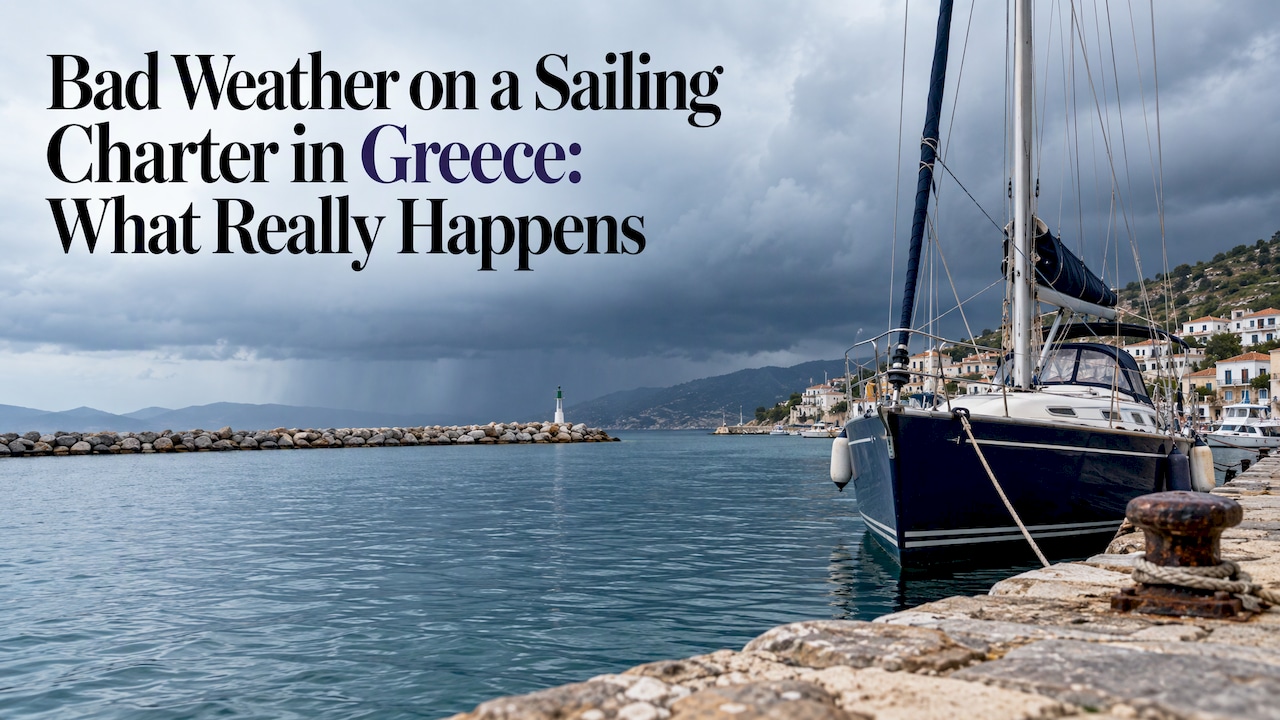
Bad weather on a Greek charter almost never cancels your week. It reshapes it. The skipper decides whether and where to sail, a shorter hop or a more sheltered bay replaces the plan, and a few windy hours usually cost you one island, not the holiday. On our skippered private weeks and group holidays, the route is built around the wind from the first day, with experienced skippers from CAPETAN.club at the helm.
This guide explains what weather actually does to a yacht or catamaran in Greece, who has the final say, what the warnings mean, and what you can do to keep a windy day a good one.
TL;DR
- The Meltemi, a strong northerly wind, is the weather that most often changes Aegean plans in summer. Thunderstorms are more typical of spring and autumn and tend to pass quickly.
- Safety calls belong to the skipper and the port authorities. A coast guard sailing ban can hold even large ferries in port.
- Official warnings come from the Hellenic National Meteorological Service and reach phones through the 112 alert system.
- A good itinerary has built-in alternatives: shorter legs, sheltered anchorages and a flexible order of islands.
- Refunds depend on your charter agreement, so read the weather terms before you pay, and ask the eight questions on our charter weather cancellation page.
Table of Contents
- What bad weather means on a Greek charter
- Who decides whether you sail
- How a skipper reshapes the plan
- Understanding the warnings
- What to do if a storm hits while you are on the trip
- What happens to your booking, refunds and extra costs
- How to give yourself the best odds
- Our perspective
- Ready to plan a week that handles the wind
- FAQ
- Sources
What bad weather means on a Greek charter
Three kinds of weather change a sailing week in Greece: strong seasonal wind, summer or autumn thunderstorms, and the occasional named storm system with gale warnings. They behave very differently, so it helps to know which one you are dealing with.
The Meltemi: strong wind, clear skies
The Meltemi (called Etesian in Greek) is the dry northerly wind of the Aegean. It starts in early June, peaks in July and August and fades by September. It typically blows Force 5 to 7, with gusts above Force 8 now and then, and it can last several days in a row, building short, steep seas between the Cycladic islands, according to a Greek sailing weather guide.
The sky stays blue, which surprises first-timers. A Meltemi day looks perfect from the beach and feels very different out in a channel between Mykonos and Paros. If you want the full picture, including how many strong-wind days to expect, read our piece on sailing the Meltemi in Greece.
Thunderstorms: short, sharp, seasonal
Thunderstorms in Greece show up mostly in spring and autumn. They often form over mainland mountains and drift out to sea, bringing sudden squalls, shifting gusts and lightning. They are usually short-lived and rarely last longer than a couple of hours, per the same weather guide.
That is why the usual answer is patience: stay in a protected harbor or bay, have lunch, watch the sky clear and carry on in the afternoon.
Gale warnings and sailing bans
Sometimes the weather is strong enough that nobody moves. On 31 July 2026, a sailing ban was in force until 19:00 from the ports of Rafina and Lavrio because of winds up to 9 Beaufort in several sea areas, and large ferries could not approach a number of Cycladic ports, including Syros, Tinos, Mykonos, Serifos, Milos, Kea and Kythnos, FYI News reported. In September 2025, the Hellenic National Meteorological Service issued Emergency Gale Warning No. 308, and one Minoan Lines ship skipped its Milos call because the approach was judged dangerous for its 900 passengers.
If a 900-passenger ferry stays out, a charter yacht stays in a safe harbor. That is not a failure of the holiday. It is the system working.
Who decides whether you sail
Three parties shape the decision, in this order of authority.
- The authorities. When the coast guard bans departures from a port, that is binding. No skipper leaves.
- The skipper. Even without a ban, the skipper is responsible for the boat and everyone aboard. If the forecast, the sea state or the crew’s comfort says stay, you stay.
- You and your group. A skipper listens. If half of your crew is nervous about a long open crossing, that goes into the plan as a real factor.
The skipper’s call is the point of having one. A forecast read in the marina at 7 a.m. by someone who knows the local wind patterns, the harbor shelter and the next anchorage is worth more than any app you check from the cockpit.
How a skipper reshapes the plan
A charter week is a sequence of short sailing days, not a fixed timetable. That is what lets weather be absorbed. The usual adjustments look like this:
- A shorter crossing. Instead of a long open-water leg, the boat hops between nearer islands.
- A different order. The skipper swaps the days, taking the exposed leg on the calmest morning and saving the sheltered bay for the windy one.
- A calmer overnight. A harbor with good protection from the north replaces an open anchorage.
- A later start. Mornings are often calmer than afternoons, so departure shifts earlier or later.
- An extra day in one place. Waiting out a blow in a lovely port is not the worst problem to have.
Routes with short legs make all of this easier. Our guide to short-hop sailing routes in Greece shows what easy legs and quiet bays look like in practice, and the skipper-tested Cyclades itinerary gives you day-by-day plans you can picture bending around the wind.
A worked example
Imagine a week in the Cyclades in late July with a strong Meltemi forecast for three days. A fixed plan might demand a long beat north. A flexible one looks different: the first day stays in the lee of a nearby island, the second day goes with the wind rather than against it, and the exposed channel crossing waits for the morning the forecast drops. You still see the islands. You simply see them in a different order, and the sailing is more fun because you are not fighting the sea.
Pick the area that suits your tolerance
The Cyclades are famous and windy. The Dodecanese and other areas can feel different, with more sheltered legs and shorter distances between harbors. Our comparison of Dodecanese vs Cyclades helps if you want to match the sailing area to your group’s appetite for wind. Timing matters too: a shoulder-season week brings milder conditions, though spring and autumn are when thunderstorms are most common.
Understanding the warnings
You do not need to be a meteorologist, but you should know what the alerts mean when your phone buzzes.
The warning colors
In Greece, weather warnings are issued by the Hellenic National Meteorological Service (EMY/HNMS) through the European MeteoAlarm system at three levels: yellow (moderate), orange (severe) and red (extreme). At orange level, the advice is to postpone hikes, boat trips and non-essential travel in the warning area, keep up with the forecast and follow the authorities’ guidance, according to this warnings summary.
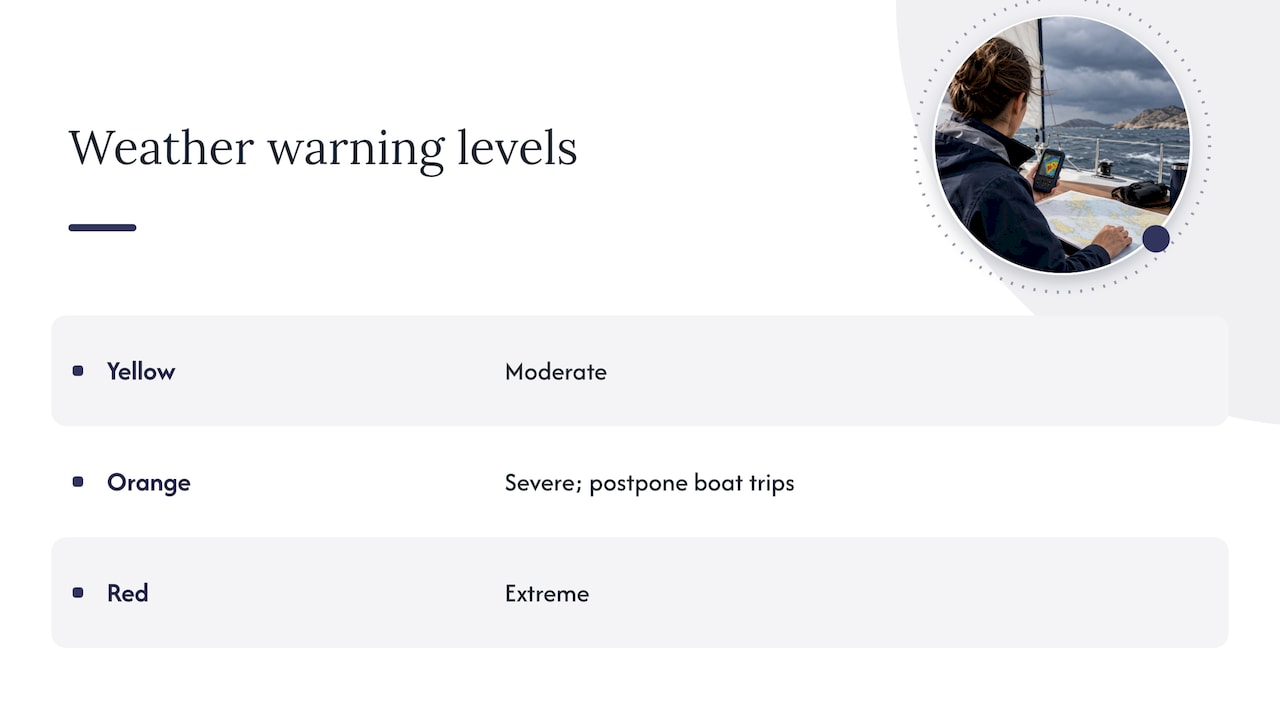
For a charter, an orange warning is the signal to sit tight in port and enjoy the village.
The 112 alert
When a dangerous event is expected, Greek Civil Protection sends a 112 alert that appears on the phone screen with a distinctive alarm sound, and it can also arrive as an SMS from sender 112. Alerts are free, phones sold in Greece since December 2019 receive them automatically, and in an emergency the number to call is 112, per the same source. Tell everyone on board to keep their phones charged and the sound on.
Marine forecasts on the water
HNMS weather and navigation forecasts, a 24-hour forecast and a 12-hour outlook, go out over NAVTEX at 518 kHz from Iraklio, Kerkyra and Limnos. OLYMPIA Radio also broadcasts Weather and Sea bulletins in Greek and English on VHF at 06:00, 10:00, 16:00 and 20:00 UTC, while VHF channel 16 carries gale warnings, as listed here. Your skipper will already be using these. If you are curious, ask to listen in on the morning bulletin. It is a nice way to feel part of the decision.
What to do if a storm hits while you are on the trip
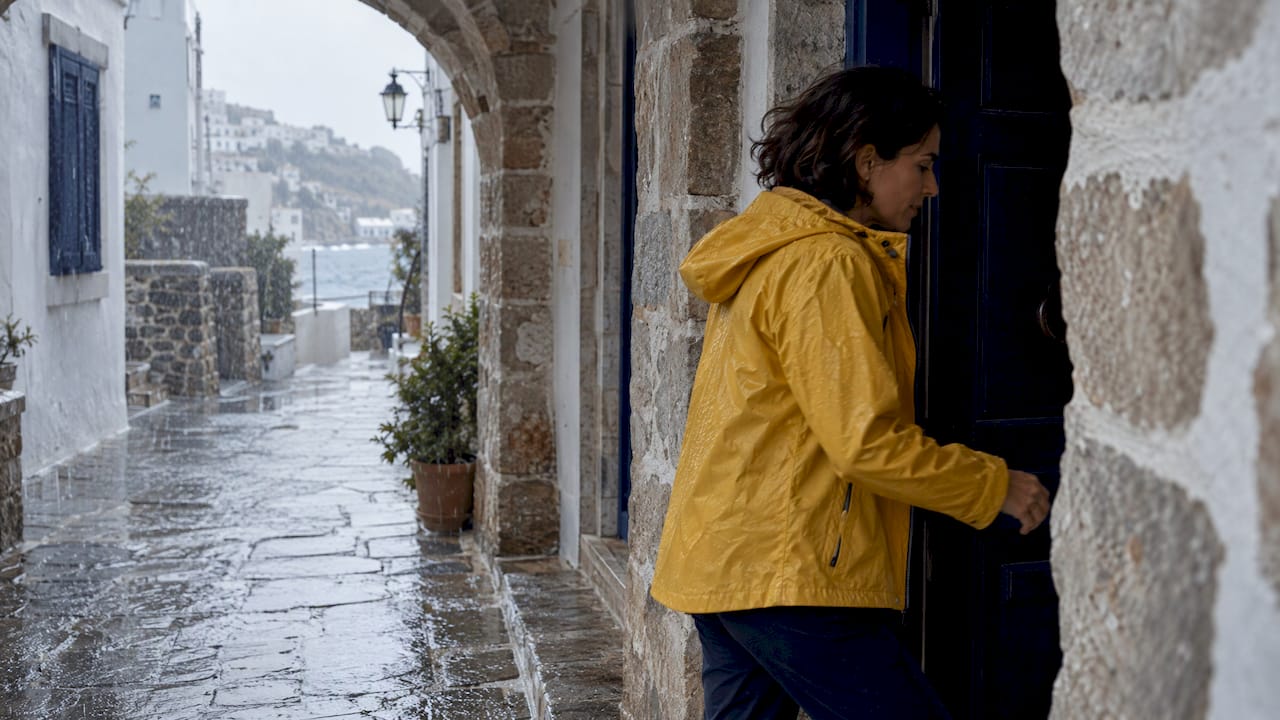
Most of the time you will be in a harbor or bay with plenty of notice. If a thunderstorm catches you ashore, Greece’s Civil Protection guidance for outdoors is practical: seek refuge in a building or car, avoid tall trees in open spaces and stay away from water. If you are isolated on flat ground and your hair stands on end, crouch in the duck position with your head between your knees and get rid of metal objects. The full list is on the Civil Protection storm guidance page.
On the boat itself, the answer is simple: follow your skipper. Life jackets on when asked, loose items stowed, everyone seated and low in the cockpit or below, and no heroic photos on the foredeck. The skipper will brief you before the week starts, and that briefing is worth your full attention.
A short checklist for bad-weather days
- Keep phones charged and 112 alerts switched on.
- Pack a light rain jacket and a warm layer, even in July.
- Bring motion-sickness remedies that suit you, and take them before the sea builds, not after.
- Have a few board games, a book and a plan for a long lunch ashore.
- Agree as a group that a skipper’s “we stay” is the right answer.
What happens to your booking, refunds and extra costs
This is where people worry most, and where clear expectations matter. A weather day is normally treated as part of the sailing week: the route changes and the charter goes on. Whether any money comes back for a lost day depends on the terms of your charter agreement, not on a general rule, so read the weather and cancellation clauses before you pay and keep a copy of what you agreed.
Questions worth settling in writing before booking:
- Who decides on route changes, and on what basis?
- What happens if the boat cannot leave port for a day or more?
- Is any fuel, mooring or marina cost different when plans shift?
- What does the agreement say about cancelling before departure, for example when a named storm is forecast for the week?
- Does your travel insurance cover weather-related disruption, and from what point?
We have gathered the full list in 8 questions every charter booker must ask. It is also smart to book early so you can choose the boat and dates that suit you: see when to book a yacht charter for timing.
For port and mooring rules that matter when you are changing plans on the fly, our overview of sailing regulations in Greece covers the basics a skipper handles.
How to give yourself the best odds
You cannot control the wind, but you can stack the deck.
- Choose the season on purpose. Meltemi lovers want July and August. If you prefer calmer sea, think about June or September, and accept that thunderstorms become more likely in spring and autumn.
- Choose the area to match your group. Short legs and sheltered harbors suit families and first-timers.
- Choose a boat that suits you. Many groups like the stability and space of a catamaran when they want to spend a windy afternoon comfortably in port. Our catamaran vs sailing boat comparison helps you pick.
- Go with a skipper. A skipper who knows the local weather and harbors turns a rough forecast into a plan rather than a problem.
- Stay flexible. The groups who enjoy windy weeks most are the ones who treat the itinerary as a wish list, not a contract.
Our perspective
We have one rule about weather: the sea sets the schedule, and a good holiday is built to bend. That is why our routes are curated by experienced, professionally trained skippers from CAPETAN.club, who plan each week with short legs, sheltered options and a sensible order of islands.
We also think the best answer to a windy forecast is not a bigger fight with the sea but a better week with the people you came with. Private or group, the idea is the same: real sailors beside you at every step, transparent pricing and detailed boat options so you know what you are getting before you go.
A blow-out day in a pretty harbor, a long lunch, a swim off the stern when it eases: that is sailing too.
Sail
Ready to plan a week that handles the wind
If you want a Greek week with a skipper who plans around the weather, start with our Greece private sailing holidays, priced from €560 per week per person. You choose your yacht or catamaran and your dates, and the route is curated by experienced skippers. Prefer company on board? Browse our group sailing holidays, or see how private and group weeks compare.
FAQ
Can bad weather cancel my sailing charter in Greece?
It is rare for a whole week to be lost. More often the route changes, or you spend a day in port when winds are strong or the coast guard restricts departures. Whether any refund applies depends on your charter agreement, so check its weather terms before booking.
Who decides if the boat can sail?
The port authorities can ban departures, and that is binding. Otherwise the skipper decides, because the skipper is responsible for the boat and the crew. A good skipper factors in the forecast, the sea state and how comfortable your group is.
What is the Meltemi and when is it strongest?
The Meltemi is a strong, dry northerly wind in the Aegean. It begins in early June, peaks in July and August and eases by September, according to a Greek sailing weather guide. Our page on sailing the Meltemi explains how to plan around it.
How will I know about a severe weather warning?
Greek Civil Protection sends 112 alerts to phones, with an alarm sound on screen or by SMS, and the Hellenic National Meteorological Service issues yellow, orange and red warnings, as summarized here. Your skipper also follows marine forecasts on VHF and NAVTEX throughout the week.
Sources
- Sailing Weather and Wind Conditions in Greece
- Sailing ban from Rafina and Lavrio, FYI News
- Minoan Lines announcement on the 18 September sailing
- Severe thunderstorm warning in Greece: latest warnings
- Greece sailing weather forecasts
- Storms, Greek Civil Protection guidance