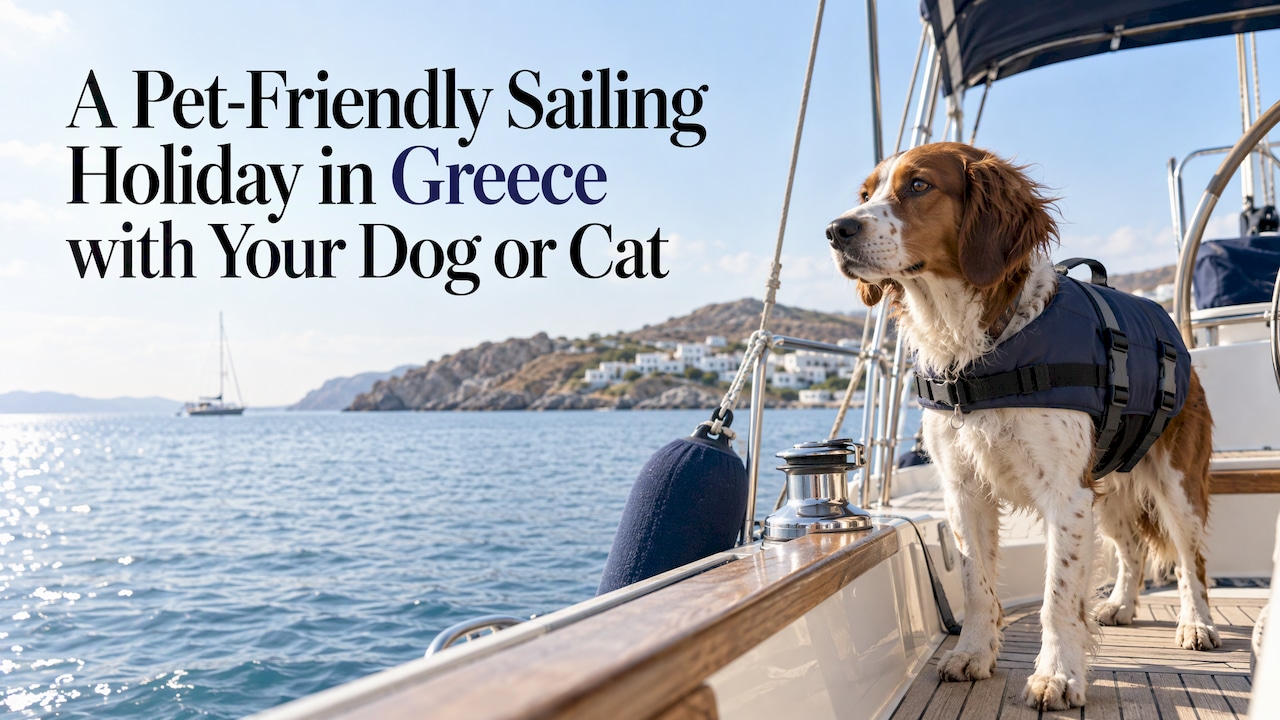
Yes, you can take a dog or cat on a sailing holiday in Greece. It takes three things: a pet that meets Greek entry rules, a yacht whose owner or charter terms accept animals, and a bit of onboard preparation. Get those right and your four-legged crew member gets what you get: swim stops, quiet bays and a new view every morning.
This guide walks you through all of it, from paperwork to life jackets to what to do if your pet gets sick far from home.
TL;DR
- Dogs, cats and ferrets need a microchip, a valid rabies vaccination and the right health document to enter Greece. A yacht arriving from abroad must enter through an authorized border inspection post.
- Pet policies are set yacht by yacht. Confirm in writing before you book, including any cleaning fee or deposit.
- Practice on a docked boat first, then plan a rail net, non-slip bowls, a pet life jacket and a shaded spot.
- Keep a vet plan: know where the nearest island vet is and carry your pet’s records on board.
- Tell us you are traveling with a pet when you start planning your week, so we can help you choose the right boat and route.
Table of Contents
- Can you really sail in Greece with a pet?
- Entry rules: what your pet needs for Greece
- What to confirm before you book a yacht
- Preparing your dog or cat for life on board
- Keeping your pet safe, cool and comfortable at sea
- Moving between islands by ferry with a pet
- If your pet gets sick or hurt
- Choosing the right trip: private or group
- Our view: why a private week suits pet owners
- Plan your pet-friendly week with us
- FAQ
- Sources
Can you really sail in Greece with a pet?
You can, and plenty of crews do. Greece is a natural fit for animals who enjoy water: short hops between islands, lots of anchorages where you can swim, and small harbor towns with waterfront walks.
The honest picture is that it depends on three layers:
- The country. Greece follows EU pet movement rules, which you need to meet before you arrive.
- The boat. A yacht is somebody’s property. Some owners welcome animals, others do not, and the terms are set per boat.
- Your pet. Some dogs love the sea from day one. Others need a few days to find their sea legs. Cats can do well too, especially if they are used to travel and have a safe retreat in a cabin.
A week on a catamaran gives animals more room to roam than a smaller sailing boat, since the wide deck and large cockpit let a dog stretch out. If you are still deciding on the boat type, our guide to catamaran versus sailing boat shows how the two compare for a group or family.
Entry rules: what your pet needs for Greece
Greece applies EU rules. According to the official Visit Greece guidance, dogs, cats and ferrets must be microchipped, hold a valid rabies vaccination and carry a valid animal health certificate. Which document you carry depends on where you travel from:
| Where you travel from | Document |
|---|---|
| An EU country or Northern Ireland | A valid European pet passport |
| A non-EU country | An EU animal health certificate |
Microchip first, then rabies shot
Sequence matters. The US Department of Agriculture explains that for pets traveling from the US, the ISO-compliant microchip (ISO 11784/11785) must be in place before the rabies vaccination, and after a first rabies vaccination the pet must wait at least 21 days, or the manufacturer’s recommended immunity period, before traveling. Pets that do not meet the EU rabies requirements may be refused entry or quarantined at the owner’s expense.
The Greek Foreign Ministry’s page for travelers from Canada says the same about order: a rabies shot given before the microchip is not recognized, and the health certificate must be issued no earlier than two weeks before departure and endorsed by an official veterinarian.
Rules differ a little by country of origin and are updated from time to time, so check your own country’s export page and talk to your vet well ahead of your trip. Start several weeks before departure, not days.
If your yacht arrives by sea from abroad
Most of our guests fly in and step onto a boat that is already in Greece, and that is the simplest route. If you bring a pet by private transport, which includes a yacht, Visit Greece states that you must enter through an authorized border inspection post. The island entry points it lists include Syros, Kalymnos, Kos, Rhodes, Chios, Lesvos, Limnos, Samos, Corfu, Kefalonia, Heraklion and Chania.
For general port and paperwork rules aboard, our Greece sailing regulations guide is a handy companion.
What to confirm before you book a yacht
Because pet policy belongs to the boat, ask these questions in writing before you pay anything:
- Are pets allowed on this exact yacht? Not the fleet, this boat.
- Which animals and sizes? Some owners accept a small dog but not a large one, or dogs but not cats.
- Is there a pet fee or extra cleaning charge? Ask for the amount and whether it is a fee or a refundable deposit.
- Is there a limit on where the pet can go? For instance, many owners prefer animals stay off beds and saloon upholstery.
- Does the boat have a safe deck layout? Low lifelines, gaps and open transoms need netting.
- How many pets can come? One is usually fine, two may need approval.
- Is there shade? A bimini or a covered cockpit is a real comfort for fur-covered passengers in July heat.
Tell your booking contact the breed, weight and age of your pet, and whether you will be on board with a skipper. If you are weighing up who runs the boat, how a catamaran with a captain works explains what a skipper handles, so you can spend your time with your pet.
A yacht that is right for people is not automatically right for animals, and a good match saves everyone stress. We can help you find one: our team are actual sailors, and personalized support is how we approach every booking. Let us know about your dog or cat when you explore private sailing.
Preparing your dog or cat for life on board
Some animals take to the sea straight away. Most do better with a gentle introduction. Bavaria Yachts’ guide to sailing with a dog suggests starting early and taking small steps: a dry run on a docked boat with the engine off, then getting your dog used to engine noise and movement in the harbor, then short trips.
Here is a simple plan that follows that idea:
- Visit the vet. Check vaccinations, ask about seasickness remedies suitable for your pet, and discuss parasite protection for Greek summers.
- Practice wearing the life jacket at home and in a pool or calm shallow water until it is boring.
- Bring familiar things. A favorite blanket, bed and toys make a strange cabin smell like home.
- Teach a spot. Choose a place on deck or in the cockpit where your pet lies down on command.
- Get used to the toilet routine. Dogs often need training to relieve themselves on board, so practice a pad or a turf mat before you leave, and plan frequent shore breaks.
- Introduce noise. Engines, winches and flapping sails can surprise a nervous animal.
A cat needs a secure routine more than anything: a hiding place, a litter tray that stays put and a harness for any outdoor time. Never let a cat roam on deck unsupervised.
Keeping your pet safe, cool and comfortable at sea
Once you are underway, safety and comfort come down to a short list.
Safety gear
- A pet life jacket with a grab handle, fitted properly, worn whenever the boat is moving and when the pet is near the water.
- Rail netting on the lifelines so a puppy or small dog cannot slip through.
- A harness and a short tether for rough weather or when you are maneuvering.
- Non-slip bowls and a mat that will not slide across the deck.
Know what to do if your pet goes overboard: keep eyes on it, call out, and tell your skipper right away so the boat can be maneuvered back. Practice the drill once while still in a calm harbor.
Heat and water
The Greek summer sun is strong and teak decks get hot. Dogs have sensitive paw pads and can overheat quickly. Offer fresh water often, give your pet a shaded spot, walk early in the morning or at sunset, and avoid the hottest hours of the day on hot pavement and sand. Do not let a pet drink sea water.
Swimming
If your dog swims, rinse salt off its coat after the swim and check ears. Use a ramp, a swim ladder with a grip or a lifting handle on the life jacket so your pet can climb back aboard.
Going ashore
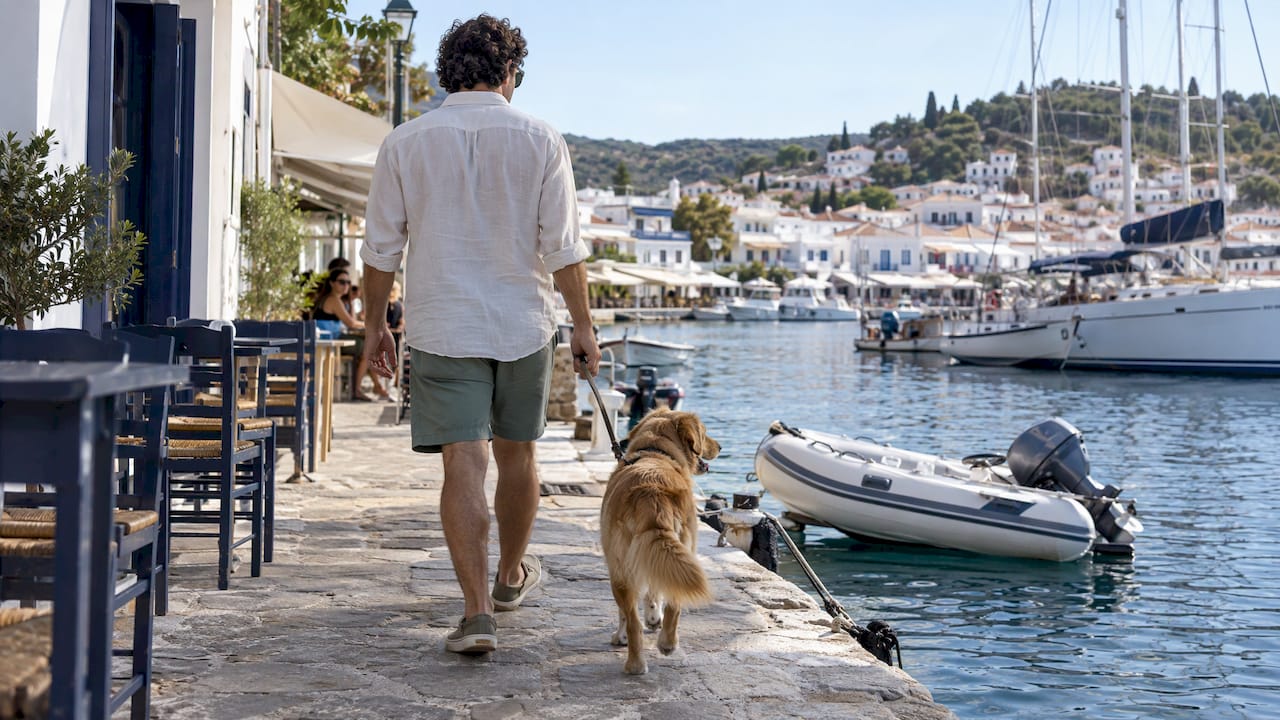
Plan your anchorages with your pet in mind. Harbor towns make easy walks, while remote coves are great for swim stops but may have no shore access for a quick toilet break. Having the dinghy ready makes shore trips smooth, and a good skipper will help you pick stops with a place to walk. Our Saronic Gulf itineraries are a gentle place to start: short distances between ports, so there are frequent chances to step ashore.
Moving between islands by ferry with a pet
Sometimes your trip will include a ferry, perhaps to get to your starting marina or to join a boat on another island. Ferry rules for animals are strict. Anek Lines, for example, says that each passenger may travel with a maximum of five pets, each with its own health booklet, a pet cabin holds at most two animals, and on its high-speed ships pets are only allowed in a small carrier up to 10 kg.
The same company says that pets are not allowed in regular cabins or indoor public areas, and on open decks they must wear a muzzle, be on a leash and be accompanied by their guardian. Other operators have their own rules, so check the one you will use when you book your tickets, and book a pet-allowed cabin early if you need one.
If your pet gets sick or hurt
Nobody wants to think about it, but a plan takes the stress out. Before you leave:
- Ask your own vet for a copy of your pet’s records, vaccination dates and any medication, and keep them on the boat with the pet passport or health certificate.
- Pack a small pet first-aid kit: bandages, tweezers, saline, an electrolyte solution your vet recommends and any regular medication.
- Save the contact details of a vet near each main harbor on your route. Larger islands and marina towns usually have one, but small islands may not, and that is something to check on your route.
- Tell your skipper where the nearest vet is each day. They know the harbors.
If your pet shows signs of heatstroke (heavy panting, drooling, weakness), move it into shade, give small amounts of cool water and call a vet for advice at once. For a serious injury, ask your skipper to head to the nearest port with a vet and call ahead.
Choosing the right trip: private or group
For a sailing holiday with a pet, private charter is usually the easier fit. On a private yacht, you decide the pace, the stops and the swim breaks, and you share the space only with your own crew. The pet policy is simple to settle with one booking party. On a group holiday, other guests share the boat or flotilla and everybody has to be comfortable with animals, which is a conversation to have at the start.
If you are still deciding between the two styles, private or group sailing holidays are compared in a guide on our site. And if Greece is your destination, why Greece suits a private charter explains the privacy and value you get.
Heading on to Italy
Some crews combine a Greek sailing week with a trip along the Italian coast, and you may want a dog-friendly stay on land before or after. A guide to traveling with a dog in Sanremo shows where to sleep, eat and walk with a dog on the Italian Riviera.
Our view: why a private week suits pet owners
We started Sail Armada because we love sailing, and we know that a week on the water feels best when everyone you love is with you, including the four-legged ones.
Here is what we see. Pet owners want freedom: to choose a quiet bay, to stop when the dog needs a walk, to keep the daily rhythm calm. A private charter gives you exactly that. You set the route with a skipper from CAPETAN.club who knows the harbors, and you keep the flexibility of your own boat and your own dates.
We also know that the right yacht matters more than any brochure. Catamarans offer wide decks and a big cockpit, and sailing boats offer a classic feel. We help you choose with transparent pricing, detailed boat options and real sailors on the other end of the line. Tell us who is coming, two legs or four, and we will help you build the week around them.
Sail
Plan your pet-friendly week with us
Our Greece private sailing weeks start from 560 € per week per person, and you decide the pace, the route and the swim stops with an experienced skipper. See the Greece Go Private week for boats, dates and details, and mention your pet when you get in touch so we can help you find a suitable yacht.
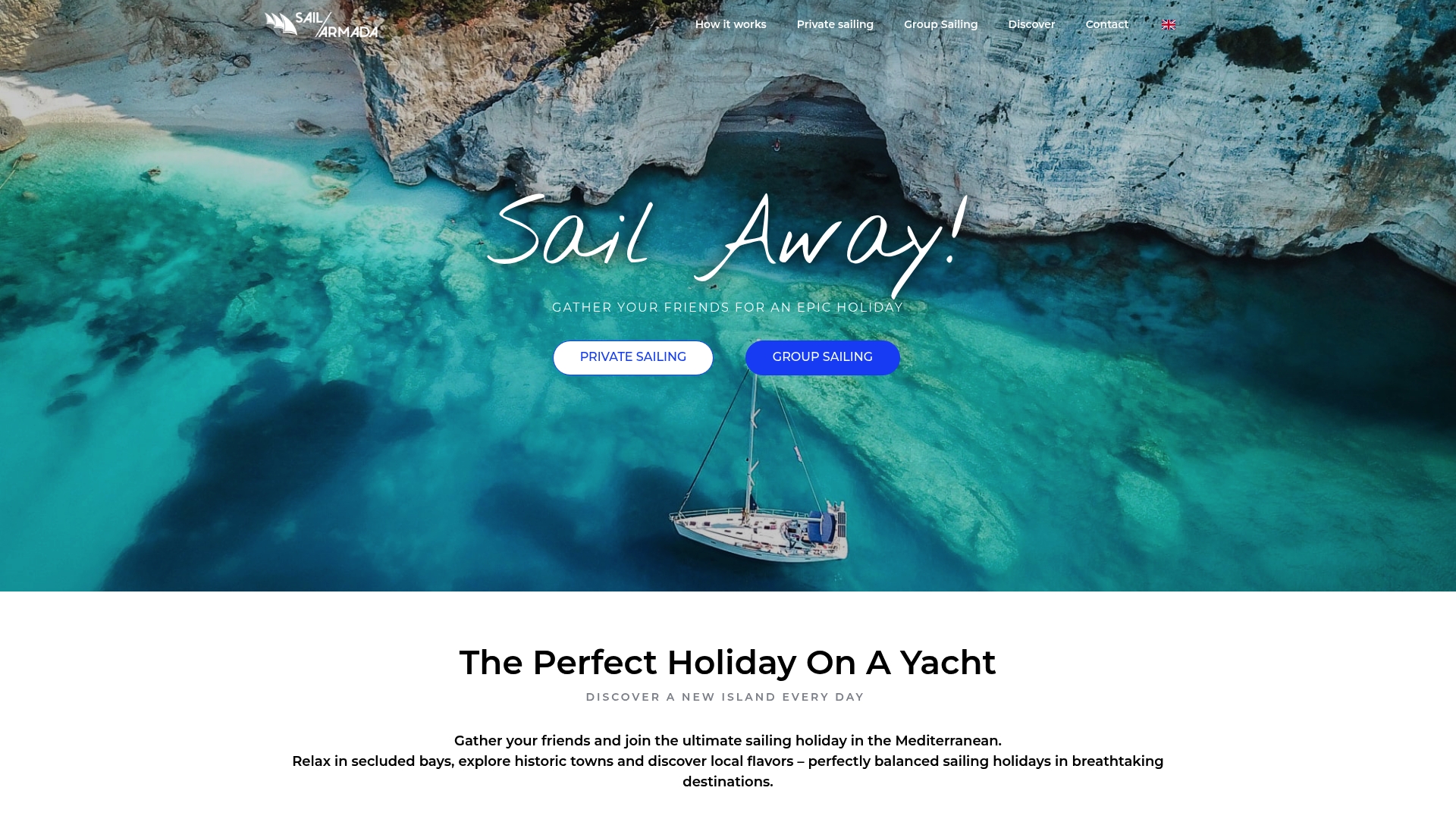
Not sure which week fits? Browse our destinations or head to sailarmada.com to start planning.
FAQ
Can I bring my dog on a yacht charter in Greece?
Often yes, but it depends on the individual yacht and its owner. Confirm in writing before booking, including any fee or deposit, and make sure your dog meets Greek entry rules: microchip, valid rabies vaccination and the right health document.
Can cats go on a sailing holiday?
Cats can, if they are calm travelers and you prepare them. Bring a harness, a secure litter tray and a hiding place, and keep the cat inside or supervised on deck. Check with the yacht owner first, since some accept dogs only.
What documents does my pet need to sail in Greece?
A microchip, a valid rabies vaccination and a valid health document. From within the EU that is a pet passport, and from outside the EU an EU animal health certificate, according to Visit Greece. Ask your vet to check the current requirements for your country of departure.
Should my dog wear a life jacket on a boat?
Yes, wearing one whenever the boat is moving or your dog is near the water is sensible, and pick one with a grab handle. Practice at home first so your dog is comfortable in it.
Sources
- Essentials of Travelling to Greece with your Pet, Visit Greece
- Pet Travel From the United States to Greece, USDA APHIS
- Travelling with pets from Canada to Greece, Greek Ministry of Foreign Affairs
- Registration of companion animals, Anek Lines
- Four Paws on Board: Sailing with Your Dog, Bavaria Yachts