

Securing a charter departure from a Greek marina comes down to three confirmations: a signed whole-charter contract, proof that your operator has filed the e-Charter Permission with the required VAT prepayment, and written marina acceptance of your berth. Expect the VAT portion to be settled roughly two weeks before departure, with marina formalities finalized closer to arrival. Ask your charter operator for all three in writing before you pack a single bag.
TL;DR:
- The VAT prepayment, typically around 70%, must be settled approximately two weeks before departure, with the e-Charter Permission filed before the trip begins.
- Only whole-boat charters are permitted under Greek law, with a minimum duration of eight hours, excluding short or cabin-only rentals.
- Marina entry requires valid seaworthiness certificates, insurance, and a passenger list, which should be pre-submitted and match the actual manifest.
- Most delays occur due to missed or late payments, incomplete paperwork, or lack of written confirmation of permit filing and berth allocation.
- Using a curated operator ensures all legal and logistical steps are handled in advance, reducing the risk of last-minute delays or paperwork issues.
Table of Contents
- What Greek law and marina rules require before you can depart
- Payments and timing: VAT, TEPADACH, and marina fees explained
- How to actually book and arrive without a hitch
- Where charter bookings go wrong and how contracts can protect you
- Getting your group to the marina without the morning scramble
- Why a curated operator makes marina departures easier
- How SailArmada handles the paperwork so you do not have to
- Sources
- FAQ
What Greek law and marina rules require before you can depart
Greece runs chartering through a digital system called e-Charter Permission, which centralizes the registration of the charter agreement and the passenger list. The operator or boat owner files it, not the traveler, but every charterer should know it exists because it is the gatekeeper for legal departure. The e-Charter Permission system replaced a lot of paper shuffling at port offices, and it also tightened the timeline around VAT payment, which we will get to shortly.
Law 4256/2014 sets the legal backbone for touristic yachts in Greece. It bans partial or “cabin-only” chartering outright: you book the whole boat, full stop. It also sets a minimum charter duration of eight hours, so a quick lunchtime cruise technically does not count as a legal charter under this framework.
Marinas add their own layer. The general operating rules published by Alimos Marina require valid seaworthiness certificates, current insurance, a passenger and crew list, and prior permission before a vessel can enter. Berths are allocated, not claimed, and marinas can refuse entry if paperwork is incomplete.
- The whole-charter rule under Law 4256/2014 rules out splitting costs by renting individual cabins.
- Minimum charter duration is eight hours, so same-day short trips fall outside normal charter terms.
- Marinas require seaworthiness certificates, insurance proof, and passenger lists before granting berth access.
A significant portion of VAT owed on the charter fee, commonly about 70%, must typically be prepaid before the trip starts, according to Stephenson Harwood’s analysis of the e-Charter system. That single number explains most last-minute departure headaches.
Payments and timing: VAT, TEPADACH, and marina fees explained
Money is where Greek charter departures tend to stall, so here is the order things actually happen in.
- Your operator calculates the VAT due on the charter fee and typically prepays around 70% of it before the boat leaves the dock, often roughly two weeks ahead of departure according to sector guidance on e-Charter Permission.
- TEPADACH, the environmental fee tied to yacht size, gross tonnage, and length of stay, gets factored in alongside VAT, since a 40-foot catamaran for a week and a 60-footer for two weeks land very differently on the bill.
- The e-Charter Permission gets filed once VAT prepayment is confirmed, generating a permit number that should be shared with you and with the marina.
- Marina fees for transiting vessels are usually prepaid at arrival, while boats staying longer often settle on a monthly prepayment basis under the general mooring-fee practices described by Alimos Marina.
Pro Tip: Ask your operator for a receipted copy of the VAT prepayment and the e-Charter permit number before you finalize travel plans, not after you land in Greece.
If a trip gets canceled after VAT has already been prepaid, tax refunds are not instant. Build a clause into your contract that specifies how and when the operator will pursue and pass along any refund, so you are not left chasing paperwork months later.
How to actually book and arrive without a hitch
Booking a Greek charter departure is less about luck and more about sequence. Here is the order that keeps things moving.
- Confirm the whole-charter contract: exact dates, embarkation and disembarkation marinas, skipper and crew arrangements, and cancellation terms in plain language.
- Get written confirmation that the operator has filed the e-Charter Permission, including the permit number and a VAT prepayment receipt.
- Submit the passenger manifest with full names and ID or passport details exactly as the marina and permission system require.
- Confirm berth allocation with the marina directly or through your operator, and get it in writing rather than a verbal “it should be fine.”
- Arrive with your contract copy, permit number, and IDs on hand for check-in.
Once you are at the marina, a few things should happen in short order.
- The marina checks your passenger list against the one submitted with the e-Charter filing.
- Staff confirm the berth matches what was reserved, which avoids the awkward dance of circling the pontoon looking for a free spot.
- Your skipper runs a safety briefing before you cast off, covering the boat, the route, and house rules on board.
Group organizers juggling multiple families should build in a short buffer here, since manifest mismatches are the single most common reason check-in runs long. If you are coordinating several cabins or boats, planning a group sailing holiday in advance makes this handoff far smoother.
Where charter bookings go wrong and how contracts can protect you
Most delays trace back to the same handful of gaps, and most of them are preventable with a few lines in your contract.
- Late VAT or TEPADACH payment is the top cause of stalled departures, so ask for dated proof of payment and put timing obligations into the contract itself.
- If a charter is canceled after VAT prepayment, refund timelines through Greek tax authorities can stretch out, so include a refund-process clause that spells out who chases the money and when you get it back.
- Marina paperwork gaps, usually a missing or mismatched passenger list, cause holdups at check-in, so insist the operator pre-submits documents and get the marina’s written acceptance before you travel.
Pro Tip: Keep a single folder (digital is fine) with your contract, permit number, VAT receipt, and passenger list. Every delay we have seen traces back to one of these four documents being missing on arrival day.
Getting your group to the marina without the morning scramble
Logistics on departure day matter as much as the legal paperwork. From Athens International Airport, Alimos Marina sits roughly 30 to 40 minutes away by taxi or transfer depending on traffic, and most other Athens-area marinas fall in a similar range.
- Build in a buffer of three to five hours before your scheduled embarkation to cover paperwork, provisioning, and the skipper briefing without rushing.
- Pack soft-sided bags where possible. Hard suitcases eat storage space fast on a sailing boat or catamaran.
- If you are traveling with young children, bring car seats or booster gear separately rather than checked with bulky luggage, since marina porters handle gear differently than cars do.
A little slack in your morning schedule turns boarding day from a scramble into the relaxed start your sailing holiday is supposed to be.
Why a curated operator makes marina departures easier
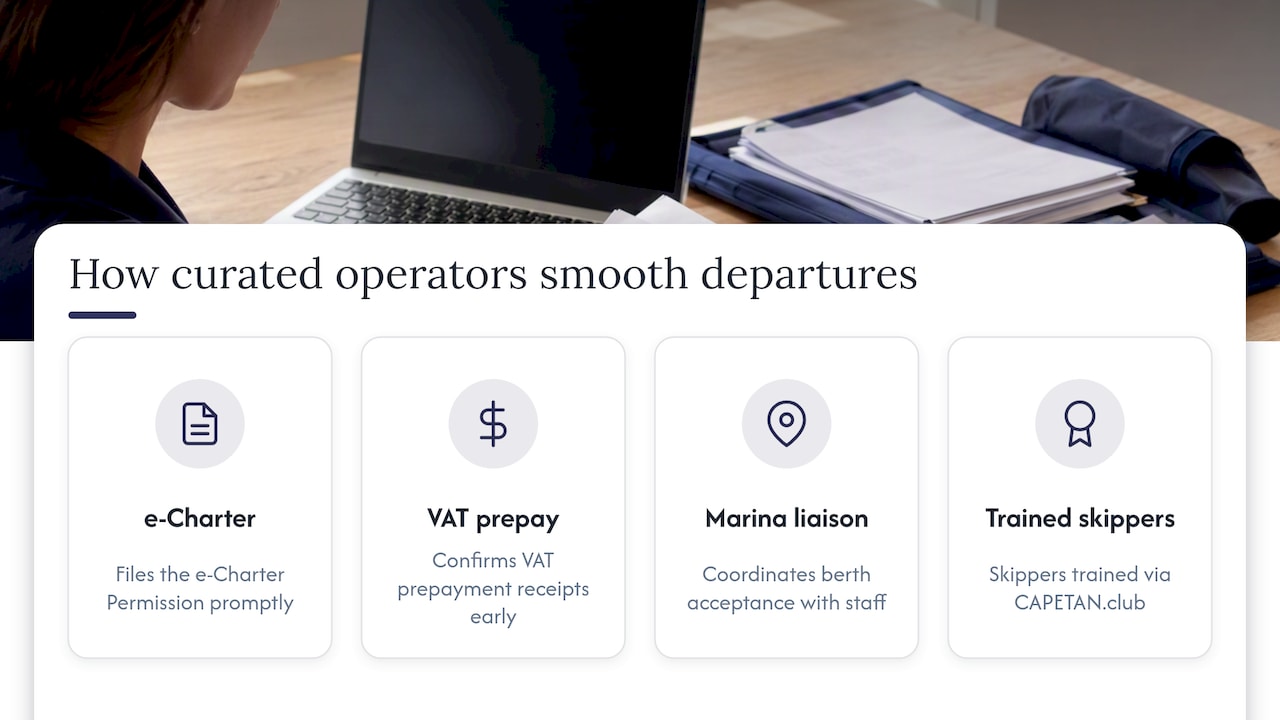
Having watched enough charter mornings unfold, the pattern is clear: the boats that leave on time are the ones whose operator treated paperwork as seriously as the sailing route. SailArmada curates its Greece routes with skippers trained through CAPETAN.club, and that experience extends past steering a catamaran. It covers filing the e-Charter Permission, confirming VAT prepayment receipts, and liaising directly with marina staff on berth acceptance.
One group we coordinated nearly hit a VAT-related delay when a late payment risked pushing their permit filing past the two-week window. Catching it early and prepaying immediately kept their departure on schedule, which is exactly the kind of friction a managed booking is meant to absorb.
— Sail
How SailArmada handles the paperwork so you do not have to
Chasing permit numbers and VAT receipts is not how anyone wants to spend the week before a holiday. Booking through private charter operators means the operator handles the e-Charter Permission filing, confirms VAT prepayment on your behalf, and coordinates directly with the marina on berth acceptance before you even land.
- Private Greece charters typically start from a published price per week per person, with skipper-backed departures and marina logistics arranged.
- Group organizers usually have a single point of contact to assist with permit numbers, VAT receipts, and marina communications.
- Operators generally provide confirmation of berth acceptance and permit documentation before travel, not only after arrival.
Visit the Greece – Go Private page to check dates and get a tailored quote for your group.
Sources
- E-Charter permission: The digitalization of chartering in Greece (Stephenson Harwood)
- LAW 4256/2014 “TOURISTIC YACHTS AND OTHER PROVISIONS”
- General rules of Greek marinas (Alimos Marina documentation)
FAQ
Do I need to file anything myself for a Greek marina departure?
No, the e-Charter Permission is filed by your charter operator or the boat owner, not by passengers. Your job is to confirm in writing that it has been filed and that you have the permit number before departure.
Who pays the VAT on a Greek yacht charter?
The charter operator typically collects and prepays the VAT, often around 70% of the amount due, roughly two weeks before departure. This cost is generally built into your charter price rather than billed separately on arrival.
How far in advance should I book a Greek marina charter?
Booking several weeks ahead gives your operator enough runway to file the e-Charter Permission and settle VAT prepayment without rushing. Last-minute bookings inside the two-week VAT window are the most common source of departure delays.
Can I charter just one cabin instead of the whole boat?
No, Law 4256/2014 prohibits partial chartering in Greece, so the whole vessel must be booked under a single charter agreement. Group organizers often split the total cost among the group instead.
What documents does the marina check on arrival?
Marinas typically check the passenger and crew list, the vessel’s seaworthiness certificate, and valid insurance before confirming your berth. Bringing a printed copy of your charter contract and permit number alongside these speeds up check-in considerably.