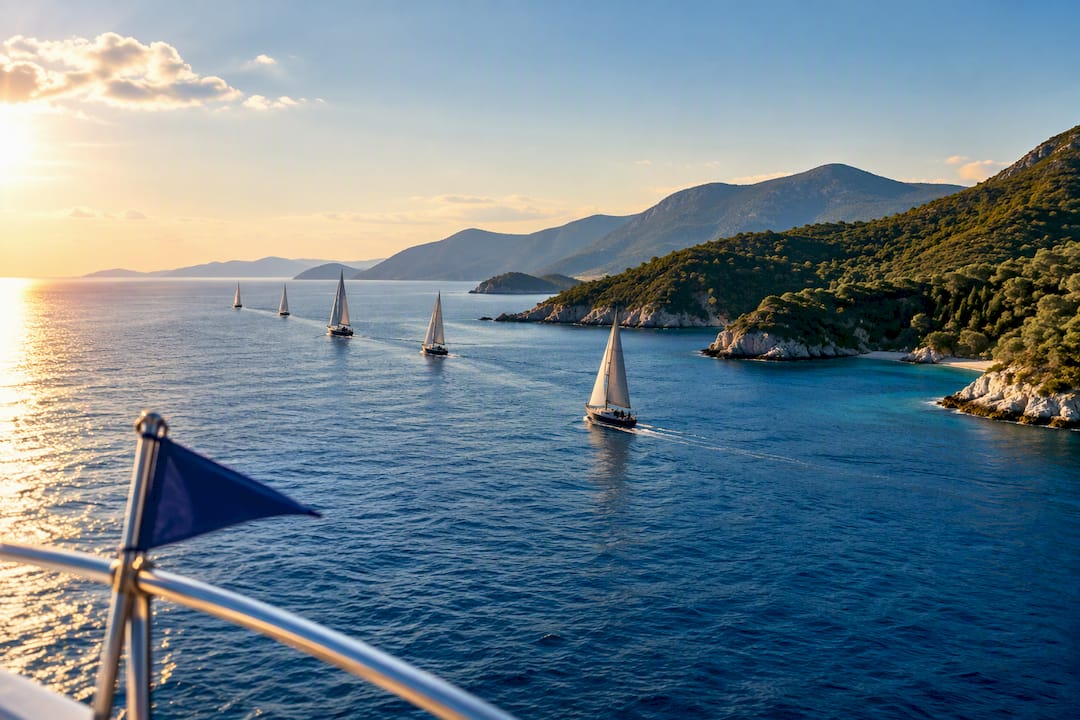
The classic Ionian flotilla route is a 7-day loop out of Lefkada that strings together Meganisi, Ithaca, and Kefalonia, with Paxos and Antipaxos as an optional detour. Short daily legs, sheltered water, and calm mornings make it a genuinely beginner-friendly week, which is why it suits first-time charterers and families as well as seasoned sailors chasing a slower pace. The reliable Maistros wind cycle keeps afternoons breezy but predictable.
TL;DR:
- The classic Ionian 7-day loop covers about 160 nautical miles, with most sailing legs under 25 nautical miles, suitable for beginners.
- Starting from Lefkada, the route includes seven stops with flexible options to extend to Paxos, Antipaxos, or add extra days in Fiskardo.
- Early departure, fuel planning, and practicing stern-to mooring are key to avoiding delays and managing busy marinas like Fiskardo in peak season.
- The region’s predictable Maistros wind makes afternoon breezes reliable, with most legs best completed by late morning to beat crowds and rougher conditions.
- Customized skipper-led trips are available from Sailarmada starting at 560 euros per person, offering real-time route adjustments based on conditions.
Table of Contents
- What Is an Ionian Flotilla Route, and Which Base Do You Start From?
- The Classic 7-Day Lefkada Loop: Day by Day
- Beyond the Classic Loop: Ithaca, South Ionian, and North Ionian Variants
- Weather, Distances, and Timing You Need to Plan Around
- Ports and Anchorages Along the Route: What to Expect at Each Stop
- How Sailarmada Builds a Flotilla Week That Actually Works
- Skipper’s Checklist: Boarding Day and Three Rules for the Week
- Book a Skipper-Led Ionian Week With Sailarmada
- Sources
- FAQ
What Is an Ionian Flotilla Route, and Which Base Do You Start From?
A flotilla route is simply a pre-planned week of short daily sails, usually five to eight boats traveling together with a lead skipper who sets the pace, checks the weather, and picks the anchorages. It’s the sociable middle ground between a fully independent charter and an all-inclusive package tour. You get your own boat and your own cabin, but a professional is running daily briefings and keeping an eye on things if the wind turns or someone needs a hand docking.
The Ionian Sea splits naturally into three cruising grounds, and where you start shapes everything else about your week. The Ionian Islands are traditionally grouped as the Eptanesa, or Seven Islands: Corfu, Paxos, Lefkada, Ithaca, Kefalonia, Zakynthos, and Kythira, though smaller islands like Meganisi and Kalamos fill in the gaps between them.
- Central Ionian (Lefkada, Meganisi, Ithaca, Kefalonia): the most popular cruising ground, tight island spacing, and the default base for most flotilla operators.
- North Ionian (Corfu, Paxos, Antipaxos): wilder coastline, longer open-water stretches, usually run from Corfu.
- South Ionian (Zakynthos, Kefalonia): quieter and less trafficked, better suited to sailors who already have a week of Greek waters under their belt.
Central Ionian routes almost always launch from Lefkada, since it sits at the hub of the island chain with short hops in every direction. North Ionian variants typically start from Corfu, while some south-leaning weeks base out of Kefalonia instead. Whichever base you choose, the rhythm stays the same: a morning briefing on deck, a short passage of two to four hours, and an early afternoon arrival that leaves the rest of the day for swimming, exploring, or simply doing nothing at all.
The Classic 7-Day Lefkada Loop: Day by Day
This is the route most operators default to, and for good reason. It packs in variety without ever asking a beginner crew to handle more than a few hours of sailing in a day. Total distance for the loop, including a Paxos extension, sits close to 160 nautical miles, with most individual legs comfortably under 25.
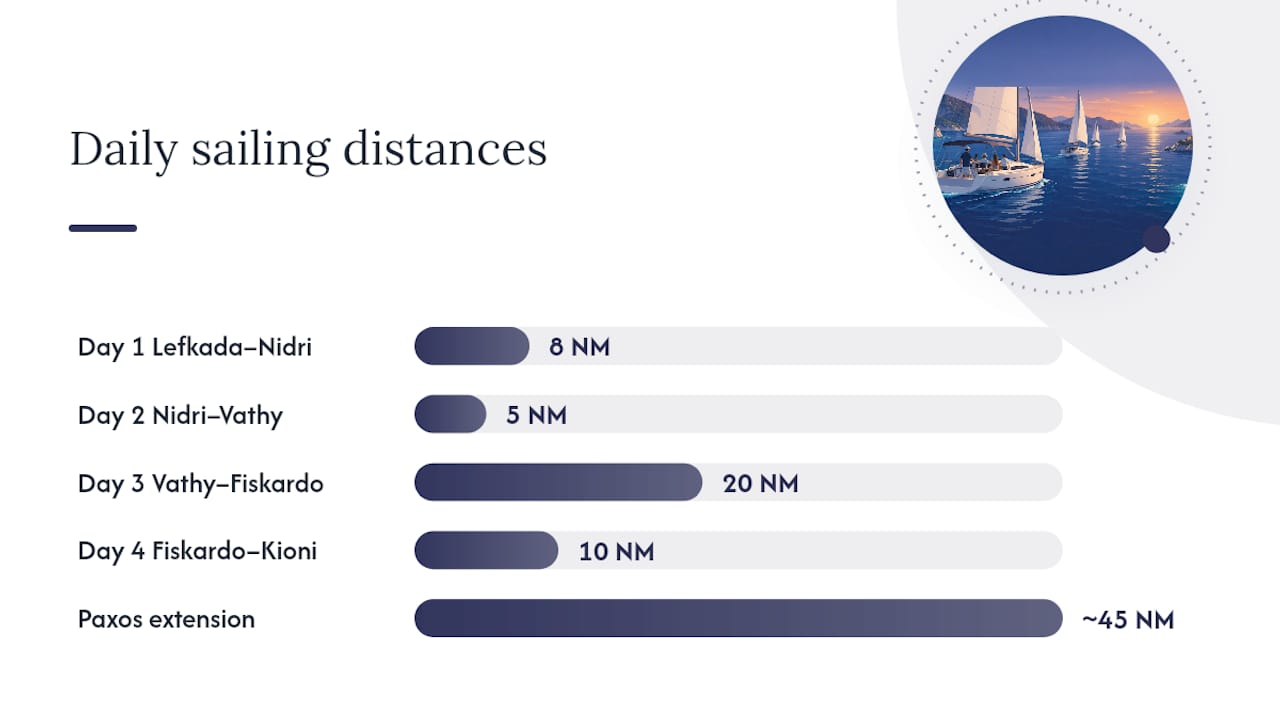
- Day 1: Lefkada Town to Nidri (about 8 NM, 1.5 hours). A gentle shakedown sail through the Lefkada canal before anchoring off Nidri for the night. Check crew roles, fuel level, and provisions before you leave the marina.
- Day 2: Nidri to Vathy, Meganisi (about 5 NM, 1 hour). One of the shortest legs of the week, which makes it the perfect day to practice reversing into a stern-to berth without any pressure.
- Day 3: Vathy to Fiskardo, Kefalonia (about 20 NM, 4 hours). The longest sail so far and the one where the Maistros wind usually fills in properly by late morning. Depart early to beat the harbor crowds.
- Day 4: Fiskardo to Kioni, Ithaca (about 10 NM, 2 hours). A short, scenic hop into one of the prettiest harbors in the Ionian. There’s no fuel dock here, so top up before you leave Fiskardo.
- Day 5: Kioni to Vathy, Ithaca (about 6 NM, 1.5 hours). Another light day. Some flotillas swap this for a run to Sivota instead, depending on the week’s weather pattern.
- Day 6: Vathy to Sivota, Lefkada (about 18 NM, 3.5 hours). A satisfying final passage back toward the mainland side, with a lively harbor and a good last-night taverna scene.
- Day 7: Sivota to Lefkada Marina (about 15 NM, 2.5 hours). A relaxed final morning sail back through the canal to hand the boat over.
If the forecast turns or your crew wants more open water, the classic loop flexes easily. Swap Day 3 for a run out to Paxos and Antipaxos instead, which stretches that leg to roughly 45 nautical miles, the one genuinely long passage most weeks include. Alternatively, cut the Kioni to Vathy hop and spend an extra night in Fiskardo. It’s consistently the most requested extra day on the entire route.
Pro Tip: Fuel up on the morning you leave a harbor, not the night before. Marinas get busy fast once other boats start queuing for the pump, and you don’t want to be the reason the whole flotilla leaves late.
For a version of this loop already mapped into a bookable charter, Sailarmada’s own 7-day Lefkada itinerary follows this same skeleton with adjustments made on the day depending on conditions.
Beyond the Classic Loop: Ithaca, South Ionian, and North Ionian Variants
The Lefkada loop isn’t the only shape an Ionian week can take. Depending on how much open water your crew wants and how much time you have, a few other route families are worth knowing about.
- Ithaca-focused loop: spends two nights around Ithaca’s harbors (Vathy and Kioni) instead of just passing through, ideal for crews who want fewer moving parts and more time swimming off the boat.
- Kefalonia-centric loop: bases out of Kefalonia’s larger marinas and ranges toward Ithaca and Zakynthos, often chosen by sailors who’ve already done the standard Lefkada week and want a fresh set of harbors.
- South Ionian (Zakynthos): quieter anchorages and fewer flotillas sharing the same ports, but it usually asks for one longer open-water passage, so it suits crews with a bit more sea time.
- North Ionian (Paxos, Antipaxos, Corfu): dramatic limestone cliffs and turquoise water around Paxos, launched from Corfu, and generally considered the most scenic but least sheltered of the standard variants.
- Two-week north to south run: links the North and Central Ionian into one continuous passage, a good option if you have the time and want to avoid retracing your steps.
Choosing between them mostly comes down to two questions: how much prior sailing experience is on board, and whether you’d rather maximize beach time or maximize new scenery. A first-time flotilla crew is almost always better served sticking to the Central Ionian loop, where help is never more than a short hop away.
Weather, Distances, and Timing You Need to Plan Around
The single biggest factor shaping an Ionian week is the Maistros, the region’s dependable northwesterly thermal wind. Mornings are typically calm, sometimes glassy, and the breeze builds through late morning into the afternoon, usually settling somewhere between 10 and 18 knots. That predictability is exactly why the Ionian has such a reputation as a forgiving cruising ground compared with the more exposed Aegean.
The daily rhythm that matters most: leave early, arrive early. Skippers who depart by mid-morning routinely finish their passage and are moored before the wind and the crowds both peak in early afternoon.
Most legs in a Central Ionian week run 10 to 25 nautical miles, translating to two to four hours of sailing. The one outlier is a Paxos extension, which can push a single day out to 40 or 45 nautical miles, worth planning fuel and daylight around in advance.
- Provision heavily on Day 1 in Lefkada Town, where supermarkets are larger; smaller islands often have just one or two minimarkets.
- Refuel and top up water whenever you’re at a marina with facilities, not only when the tank runs low.
- Practice stern-to mooring (reversing into a berth and running lines ashore) early in the week, ideally on a quiet day like the Meganisi hop.
- Book ahead for Fiskardo and Lefkada marinas in July and August, when arrivals after 2:00 PM often find berths already full.
- Monitor VHF Channel 16 for hailing and switch to a working channel for marina or lead-boat communication.
- Treat any forecast above 20 knots as a signal to delay departure rather than push through, particularly on open crossings toward Paxos.
Shoulder season sailors in June or September get a real advantage here: regional tourism promotion is actively extending the season, which means quieter harbors and easier berthing outside the July and August rush.
Ports and Anchorages Along the Route: What to Expect at Each Stop
Every stop on an Ionian flotilla week has its own personality, and knowing what to expect before you arrive saves a lot of guesswork with the wheel in your hand.
- Fiskardo (Kefalonia): the most popular harbor on the whole route, with good tavernas and reliable fuel, but it fills up fast in high season, so aim to arrive by early afternoon.
- Kioni (Ithaca): a picture-postcard anchorage with a handful of tavernas right on the quay, though there’s no fuel available here, so plan your tank accordingly.
- Vathy (Ithaca): a proper working harbor with provisions and a relaxed pace, good for a quieter night compared with Fiskardo.
- Nidri (Lefkada): a lively strip with easy provisioning, a solid choice for the first night when everyone’s still finding their sea legs.
- Sivota (Lefkada): a snug, almost landlocked bay that’s popular for a final night before heading back to base.
- Paxos and Antipaxos: postcard-blue water and dramatic cliffs, best treated as a full-day detour rather than an overnight stop unless the forecast is settled.
- The Lefkada canal: narrow with charted depths and a swing bridge that opens on a fixed schedule, so check bridge times before you plan a transit rather than assuming you can pass whenever you like.
The busiest windows across nearly every stop on this list are the last two weeks of July and all of August, when both flotilla traffic and independent charter boats peak at once.
How Sailarmada Builds a Flotilla Week That Actually Works
Curating a good Ionian route isn’t about cramming in as many islands as possible. It’s about balancing three things: a sheltered anchorage for lunch, a swim stop somewhere the water is genuinely clear, and a lively port for dinner where the whole group can compare notes on the day. Sailarmada’s lead skippers build each day’s plan around that balance rather than a fixed script, adjusting the order of stops when the wind or the crowds call for it.
Every morning starts the same way on a well-run flotilla: a short briefing covering the day’s weather, the passage plan, and anything worth flagging about the harbor ahead, whether that’s a tricky approach or a berth that fills up early. If the forecast shifts midweek, the whole plan shifts with it.
That flexibility, paired with the choice between a fully private boat or a group flotilla slot, is what makes a skipper-led week feel less like a fixed tour and more like your own trip with backup on call.
Skipper’s Checklist: Boarding Day and Three Rules for the Week
Arrive at the marina by early afternoon on check-in day. It gives you time to unpack, stock the fridge, and get a full walkthrough of the boat before dinner rather than rushing it in fading light.
A few etiquette notes go a long way: tip harbor staff who help with lines, keep noise down in marinas after 10:00 PM, and always ask before rafting up alongside another boat.
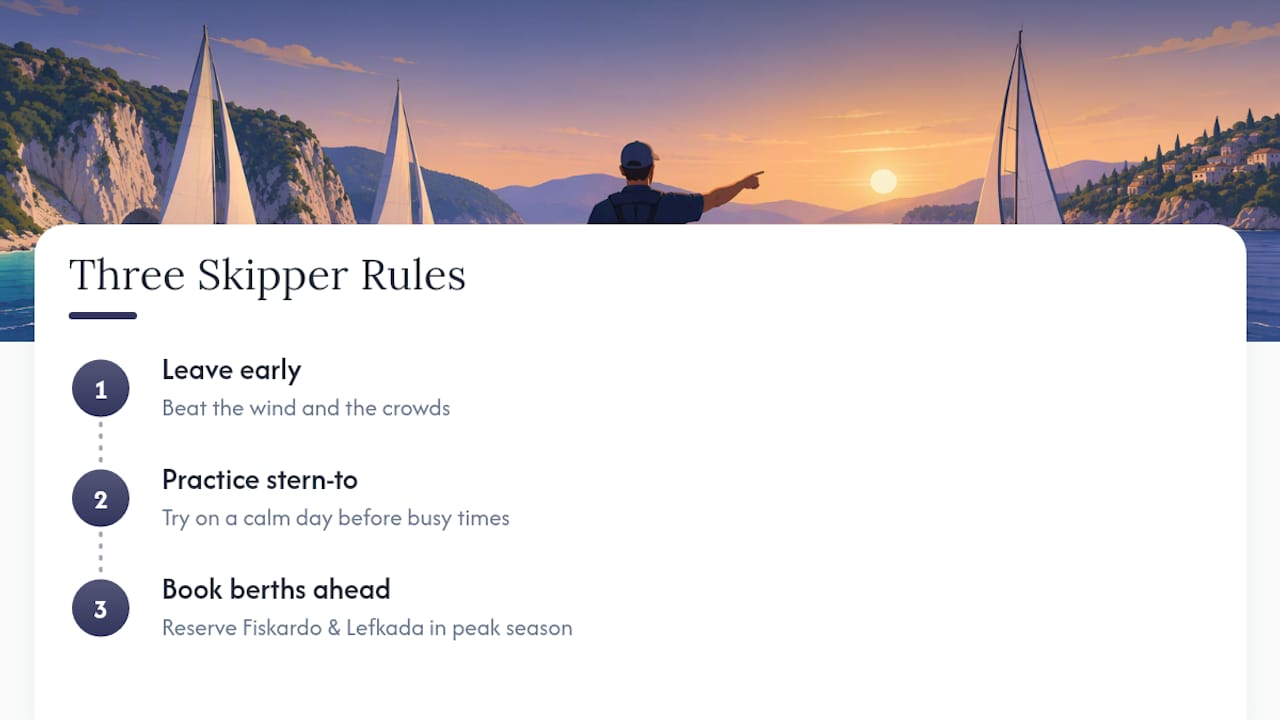
Three rules worth pinning to the chart table: leave early to beat the wind and the crowds, practice your stern-to approach on a calm day before you need it on a busy one, and book ahead for Fiskardo and Lefkada in peak season, since arriving late in August often means no berth at all.
Book a Skipper-Led Ionian Week With Sailarmada
Reading a route on a page is one thing. Having a lead skipper adjust that same route in real time, based on the actual wind and the actual crowd at Fiskardo that week, is what makes the difference between a good sailing holiday and a stressful one. Sailarmada’s Greece programs give you the choice between a fully private boat for your own group or a flotilla slot alongside other crews, with a professional skipper handling the passage planning either way.
The Greece – Go Private package starts from 560 € per week per person and covers exactly the kind of Central Ionian loop this article walks through, with flexible departure dates and a boat sized to your group. Daily briefings, local pilot notes, and support from actual sailors mean you’re never navigating Fiskardo’s crowded pontoons or the Lefkada canal’s bridge schedule on your own. If you’d rather compare yacht sizes and route lengths before deciding, Sailarmada’s Greece destination page breaks down the options by island group. Either way, the next step is simple: pick your dates and send an inquiry, and a real person will map the week around your group’s experience level and how much beach time versus open water you actually want.
Sources
- Ionian Islands | Britannica
- Greece Ionian Islands Sailing Guide: Lefkada, Kefalonia and Ithaca – Nautiful
- Ionian Islands sailing itinerary: 7-day route guide 2026 – Sailing Click
- Ionian sailing itineraries – SailGreeceGuide
- Perifereia Ionion Nison (Region of the Ionian Islands)
FAQ
Where Can I Find Reliable Information on Ionian Flotilla Holidays?
Look for sources that combine pilot-note detail (harbor depths, bridge schedules, fuel availability) with real itinerary breakdowns rather than generic destination marketing. The Region of the Ionian Islands covers official tourism planning, while operators like Sailarmada publish full day-by-day routes such as the 7-day Lefkada loop.
Which Is the Most Beautiful Ionian Island?
There’s no single official answer, since it depends on what you’re after, but Kefalonia and Ithaca consistently top most sailors’ lists for their combination of dramatic coastline and calm, clear anchorages. Paxos and Antipaxos are often singled out for the most striking water color, with limestone cliffs framing turquoise bays that feel noticeably different from the Central Ionian’s greener islands.
How Rough Is the Ionian Sea?
The Ionian is generally calmer and more predictable than the Aegean, with the summer Maistros wind typically settling between 10 and 18 knots and building through the afternoon after calm mornings. That pattern is a major reason it’s considered one of the more forgiving cruising grounds in Greece, though any forecast above 20 knots is a good reason to delay a passage rather than push through it.
Which Are the 7 Ionian Islands?
The traditional Seven Islands, or Eptanesa, are Corfu, Paxos, Lefkada, Ithaca, Kefalonia, Zakynthos, and Kythira. Most flotilla routes only touch a handful of these in a single week, with the Central Ionian loop typically covering Lefkada, Ithaca, and Kefalonia, plus smaller islands like Meganisi that sit just outside the official seven.
What Does an Ionian Flotilla Route Cost?
Pricing depends heavily on the operator, boat type, and season, but Sailarmada’s Greece – Go Private package starts from 560 € per week per person for a private group booking. Current pricing for other yacht sizes and dates is listed directly on the site.